Massachusetts Quitclaim Deed from Husband and Wife to Three Individuals as Joint Tenants
What this document covers
This Quitclaim Deed is a legal document that transfers ownership of property from a husband and wife to three individuals, who hold the title as joint tenants. Unlike warranty deeds, which provide guarantees about the property title, quitclaim deeds simply transfer whatever interest the grantors have without making any guarantees. This form is essential for ensuring a smooth transfer of property ownership while establishing the joint tenancy rights of the new owners.
Form components explained
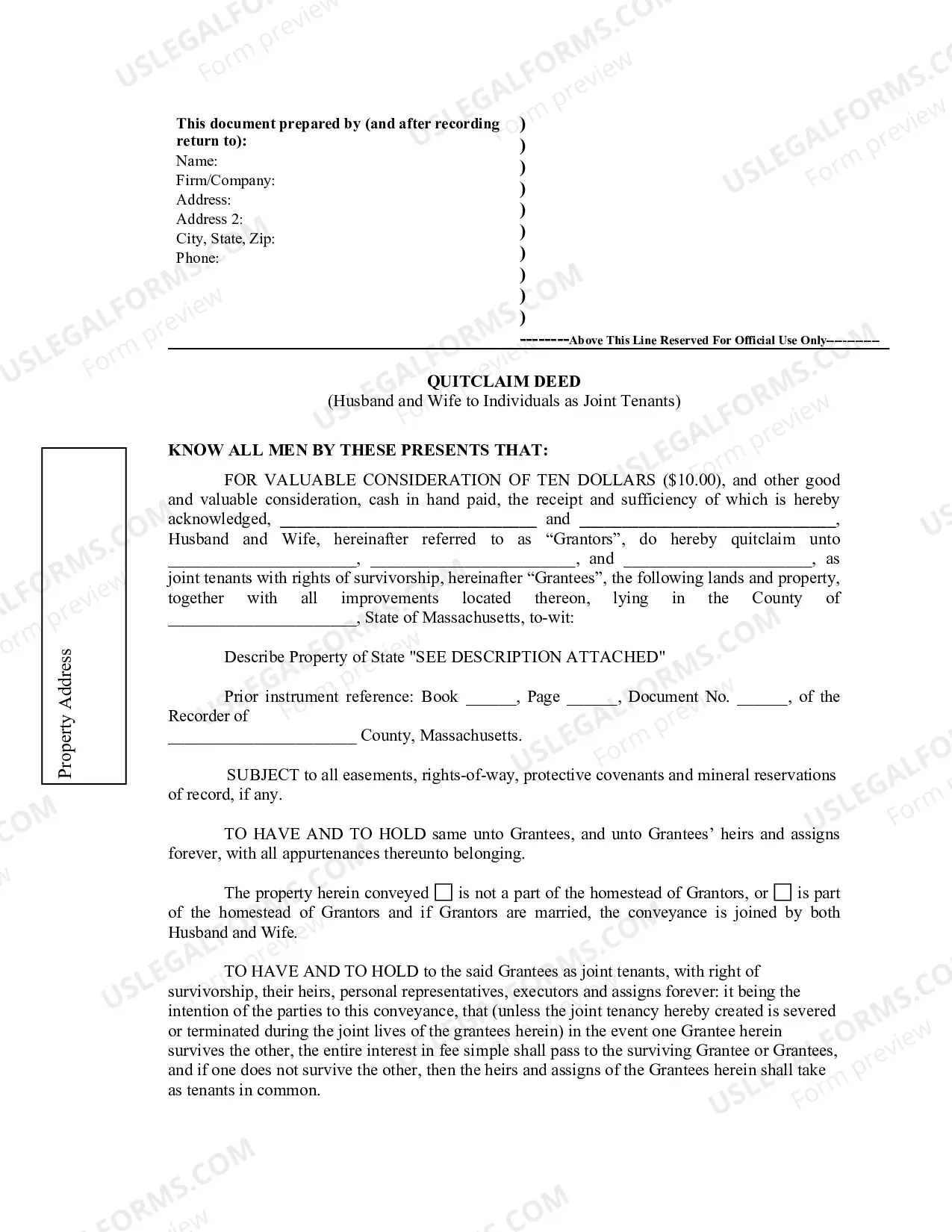
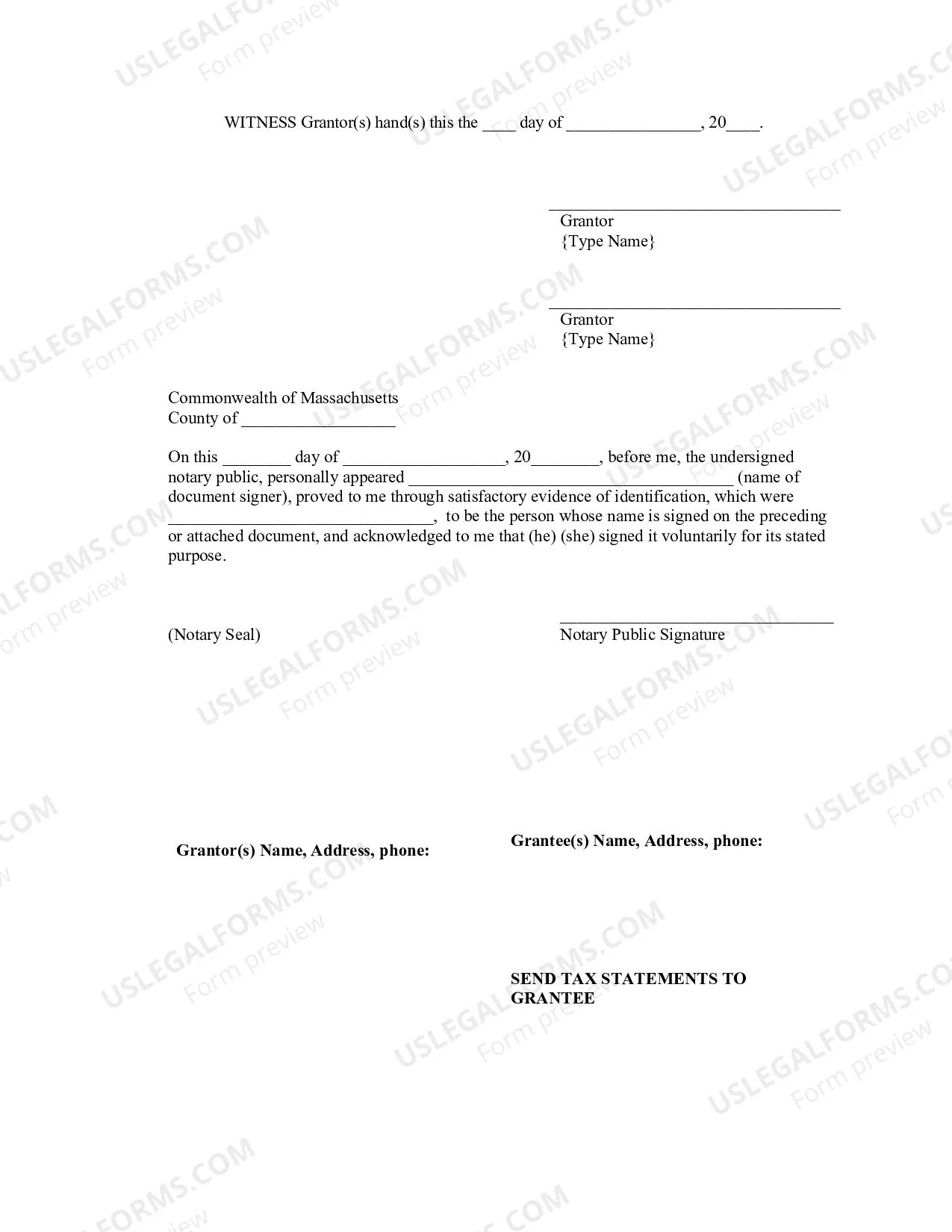
- Identifies the grantors (husband and wife) and the grantees (three individuals).
- Contains a legal description of the property being transferred.
- Establishes joint tenancy with a right of survivorship amongst the grantees.
- Requires notarization for authenticity and legal validation.
- Includes witness signatures from the grantors and a notary public.




Situations where this form applies
This form should be used when a husband and wife wish to transfer their interest in a property to three individuals as joint tenants. Scenarios include family estate planning, changing ownership structures, or when the couple desires to gift or sell property shares while retaining joint tenancy rights for the new owners.
Who should use this form
This form is suitable for:
- Husbands and wives who jointly own property and want to transfer it to others.
- Individuals planning estate transitions for property among family members or friends.
- Real estate agents or legal representatives facilitating property transactions.
Completing this form step by step
- Identify and enter the names of the husband and wife as the grantors.
- List the names of the three individuals who will be the grantees.
- Clearly describe the property in question, using the appropriate legal description.
- Specify the date of the transfer and have both grantors sign the document.
- Arrange for a notary public to witness the signatures and notarize the deed.
Does this form need to be notarized?
Yes, this form must be notarized to be legally valid. This ensures that the identities of the grantors are verified and that the signing is done voluntarily. US Legal Forms offers an integrated online notarization service available 24/7, allowing for secure video calls and legal equivalence without the need for travel.
Get your form ready online
Our built-in tools help you complete, sign, share, and store your documents in one place.
Make edits, fill in missing information, and update formatting in US Legal Forms—just like you would in MS Word.
Download a copy, print it, send it by email, or mail it via USPS—whatever works best for your next step.
Sign and collect signatures with our SignNow integration. Send to multiple recipients, set reminders, and more. Go Premium to unlock E-Sign.
If this form requires notarization, complete it online through a secure video call—no need to meet a notary in person or wait for an appointment.
We protect your documents and personal data by following strict security and privacy standards.

Make edits, fill in missing information, and update formatting in US Legal Forms—just like you would in MS Word.

Download a copy, print it, send it by email, or mail it via USPS—whatever works best for your next step.

Sign and collect signatures with our SignNow integration. Send to multiple recipients, set reminders, and more. Go Premium to unlock E-Sign.

If this form requires notarization, complete it online through a secure video call—no need to meet a notary in person or wait for an appointment.

We protect your documents and personal data by following strict security and privacy standards.
Avoid these common issues
- Failing to provide a complete legal description of the property.
- Not obtaining the necessary notarization of the document.
- Leaving the fields for grantor and grantee names incomplete.
- Not clearly indicating the intention for joint tenancy in the form.
Advantages of online completion
- Easy to complete: The form is designed for electronic fill-out, allowing for clear and legible entries.
- Convenience: Download and complete the form at your own pace instead of dealing with in-person paperwork.
- Reliable: Created by licensed attorneys, ensuring the legal validity of the form.
Summary of main points
- This Quitclaim Deed transfers ownership from a husband and wife to three individuals as joint tenants.
- Ensure that notarization is completed for the document to be legally effective.
- Use this form for family estate planning or changing property ownership structures.
- Complete all relevant fields accurately to prevent any legal issues in the future.
Looking for another form?





Form popularity
FAQ
Recording: Massachusetts quitclaim deeds must be filed with the Registry of Deeds Office. Choose the office in the county where the property is. Filing Fee: Each Registry of Deeds Office charges a filing fee, which must be filed along with the deed.
Joint tenancy is a form of property ownership normally associated with real estate. Each party in a joint tenancy has an equal interest in the propertythe financial obligations as well as any benefits.
To create a joint tenancy, all you need to do is put the right words on the title document, such as a deed to real estate, a car's title slip, or the signature card establishing a bank account.
Adding someone to your house deed requires the filing of a legal form known as a quitclaim deed. When executed and notarized, the quitclaim deed legally overrides the current deed to your home. By filing the quitclaim deed, you can add someone to the title of your home, in effect transferring a share of ownership.
Serve a written notice of the change (a 'notice of severance') on the other owners - a conveyancer can help you do this. Download and fill in form SEV to register a restriction without the other owners' agreement. Prepare any supporting documents you need to include.
Contact an attorney to prepare a quitclaim deed. Choose the way you want to hold the title. Sign the quitclaim deed as directed by your attorney. File the deed with the county's register of deeds so it can be recorded on public record.
The Middlesex South Registry of Deeds is open for customer drop-off only. For the protection of public health and the safety of staff please use electronic recording and Mail whenever possible to file documents.
You can find your property records online at the Secretary of the Commonwealths Massachusetts Land Records website. Access is available to deeds, mortgages, plans, and other land records recorded in the various Registries of Deeds.
Sales history is typically easily available often discoverable on any of the various online home sales search platforms or in person, usually at the office of the recorder of deeds. The recorder's office will likely have both electronic and paper files for you to search.