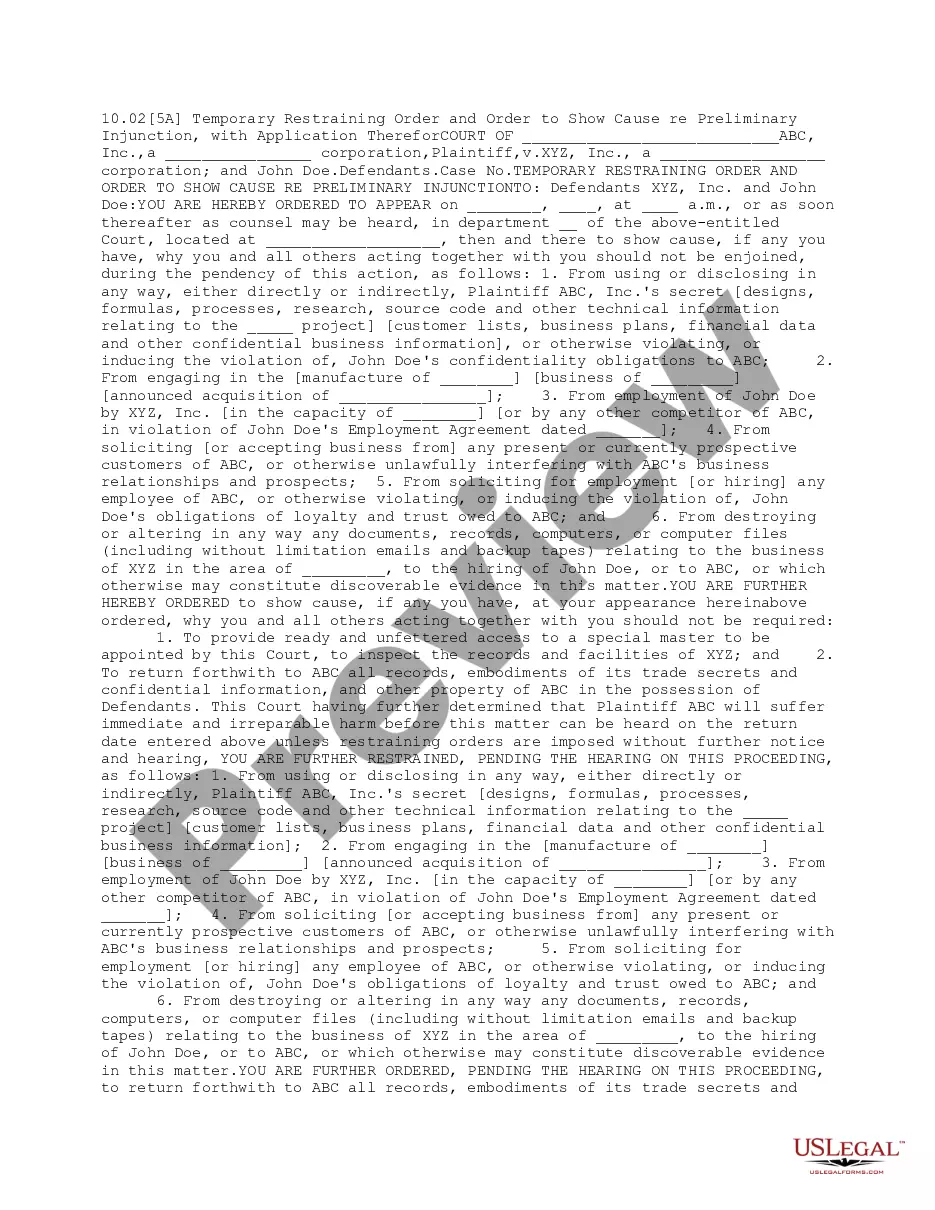
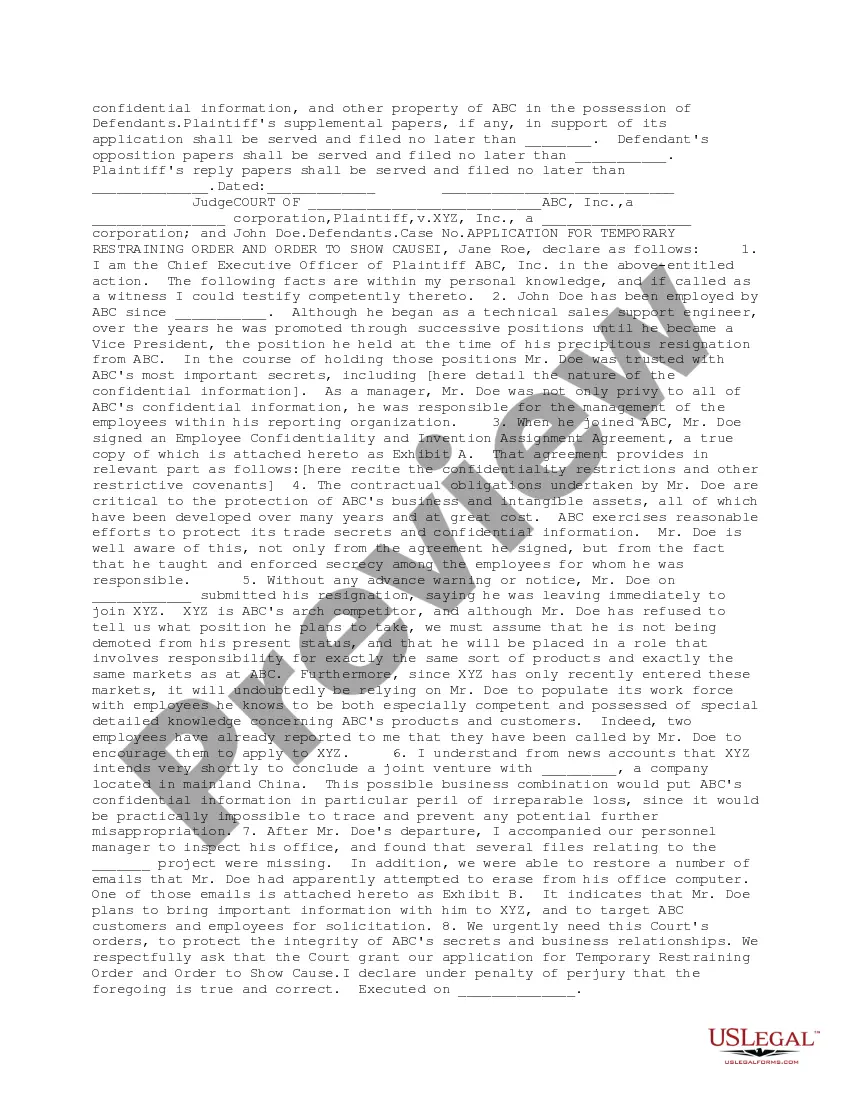
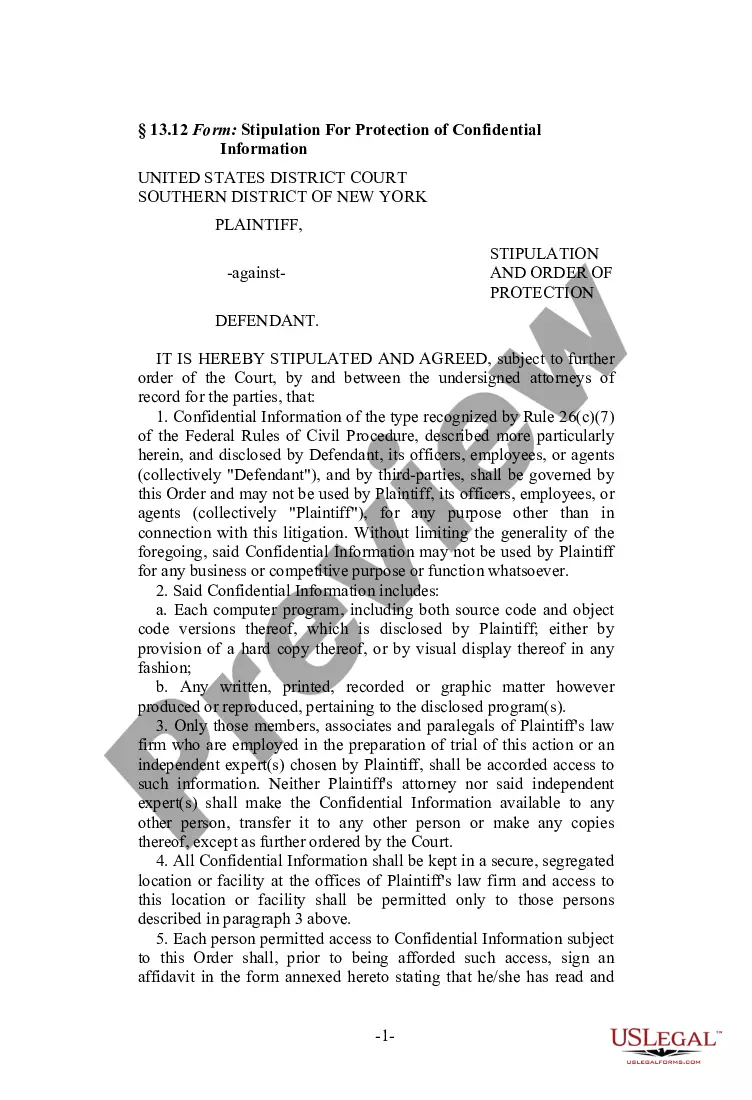
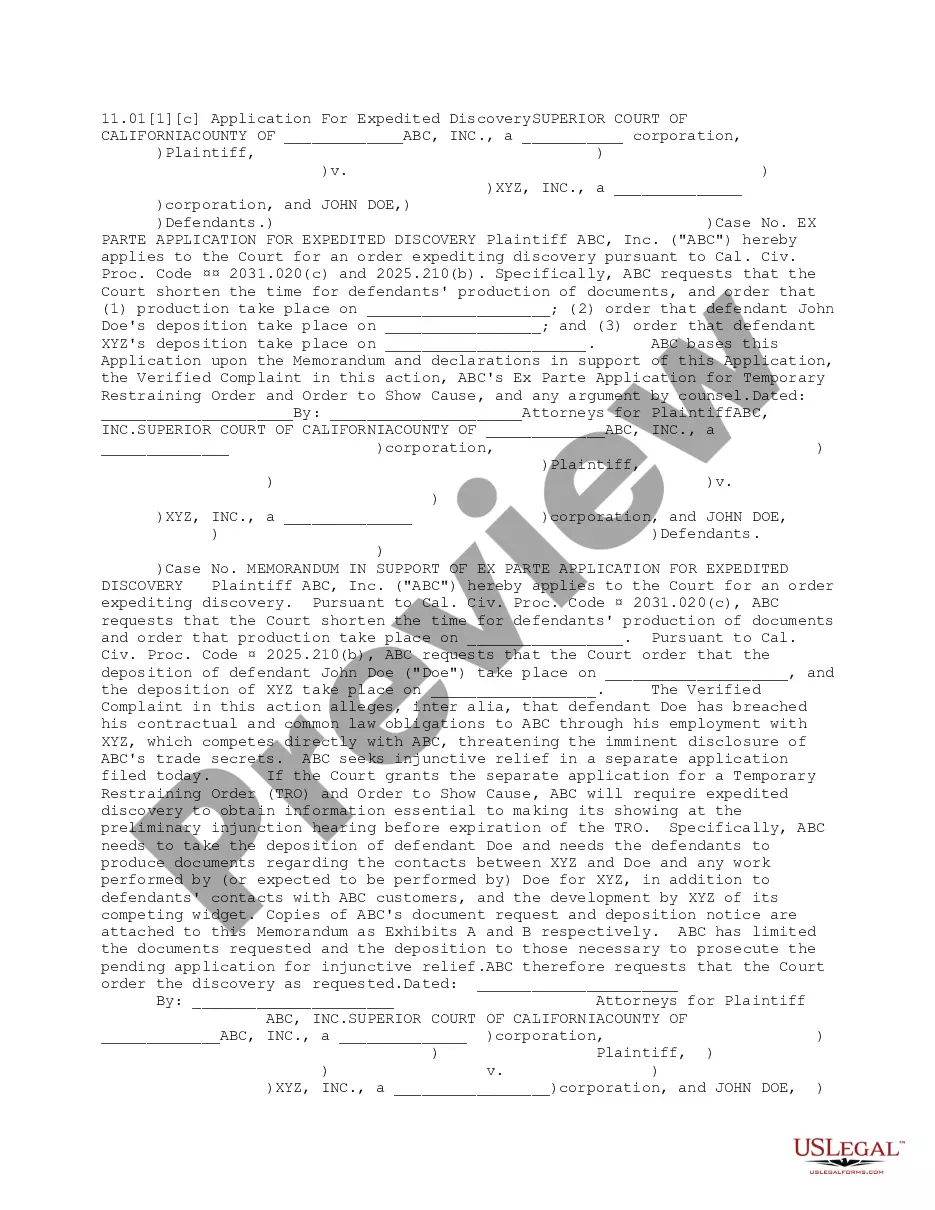
This form is a Temporary Restraining Order and Order to Show Cause regarding a Preliminary Injunction to be used in connection with a trade secrets claim.
Miami-Dade Florida Temporary Restraining Order and Order to Show Cause regarding Preliminary Injunction with Application Therefor
State:
Multi-State
County:
Miami-Dade
Control #:
US-TS10025A
Format:
Word;
PDF;
Rich Text
114 downloads
Description
Free preview

Get your form ready online
Our built-in tools help you complete, sign, share, and store your documents in one place.
Built-in online Word editor
Make edits, fill in missing information, and update formatting in US Legal Forms—just like you would in MS Word.
Export easily
Download a copy, print it, send it by email, or mail it via USPS—whatever works best for your next step.
E-sign your document
Sign and collect signatures with our SignNow integration. Send to multiple recipients, set reminders, and more. Go Premium to unlock E-Sign.
Notarize online 24/7
If this form requires notarization, complete it online through a secure video call—no need to meet a notary in person or wait for an appointment.
Store your document securely
We protect your documents and personal data by following strict security and privacy standards.

Make edits, fill in missing information, and update formatting in US Legal Forms—just like you would in MS Word.

Download a copy, print it, send it by email, or mail it via USPS—whatever works best for your next step.

Sign and collect signatures with our SignNow integration. Send to multiple recipients, set reminders, and more. Go Premium to unlock E-Sign.

If this form requires notarization, complete it online through a secure video call—no need to meet a notary in person or wait for an appointment.

We protect your documents and personal data by following strict security and privacy standards.
Looking for another form?
Form popularity
FAQ
A temporary restraining order, or TRO, is similar to a preliminary injunction in that it is a pre-trial court order that enjoins or mandates another party's conduct. However, it is different in that TROs are more urgent and may be issued without notice to the other party.
A court needs to examine whether the plaintiff is likely to succeed on the merits, whether the plaintiff is likely to suffer irreparable harm without the injunction, whether the balance of equities and hardships is in the plaintiff's favor, and whether an injunction is in the public interest.
For a writ of preliminary injunction to be issued, the applicant must show, by prima facie evidence, an existing right before trial, a material and substantial invasion of this right, and that a writ of preliminary injunction is necessary to prevent irreparable injury.
A preliminary injunction is an injunction that may be granted before or during trial, with the goal of preserving the status quo before final judgment.
Preliminary injunctions generally last until the end of the lawsuit. Permanent Injunctions: At the end of a court case, if the judge agrees that there is an ongoing threat, he or she may issue a permanent injunction prohibiting the threatened action indefinitely.
Finally, a preliminary injunction is merely a provisional remedy, an adjunct to the main case subject to the latter's outcome, the sole objective of which is to preserve the status quo until the trial court hears fully the merits of the case.
Preliminary and permanent injunctions are issued based on evidence that is presented by a plaintiff in a civil case. An example of a preliminary injunction might be when a married couple owns a business and is going through a divorce. Perhaps there is a dispute as to who owns or controls the business and its assets.
Preliminary Injunction Standard. A preliminary injunction is proper where the moving party proves: Likelihood that it will ultimately prevail on the merits; and. That relative interim harm to the parties from issuance of the injunction weights in its favor.
A preliminary injunction usually follows an ex parte application for a restraining order. A complaint must be filed and must (usually) plead injunctive relief. The party seeking the injunction will usually give 24-hour notice of an ex parte application for a temporary restraining order.
A temporary order made by a court at the request of one party that prevents the other party from pursuing a particular course of conduct until the conclusion of a trial on the merits.