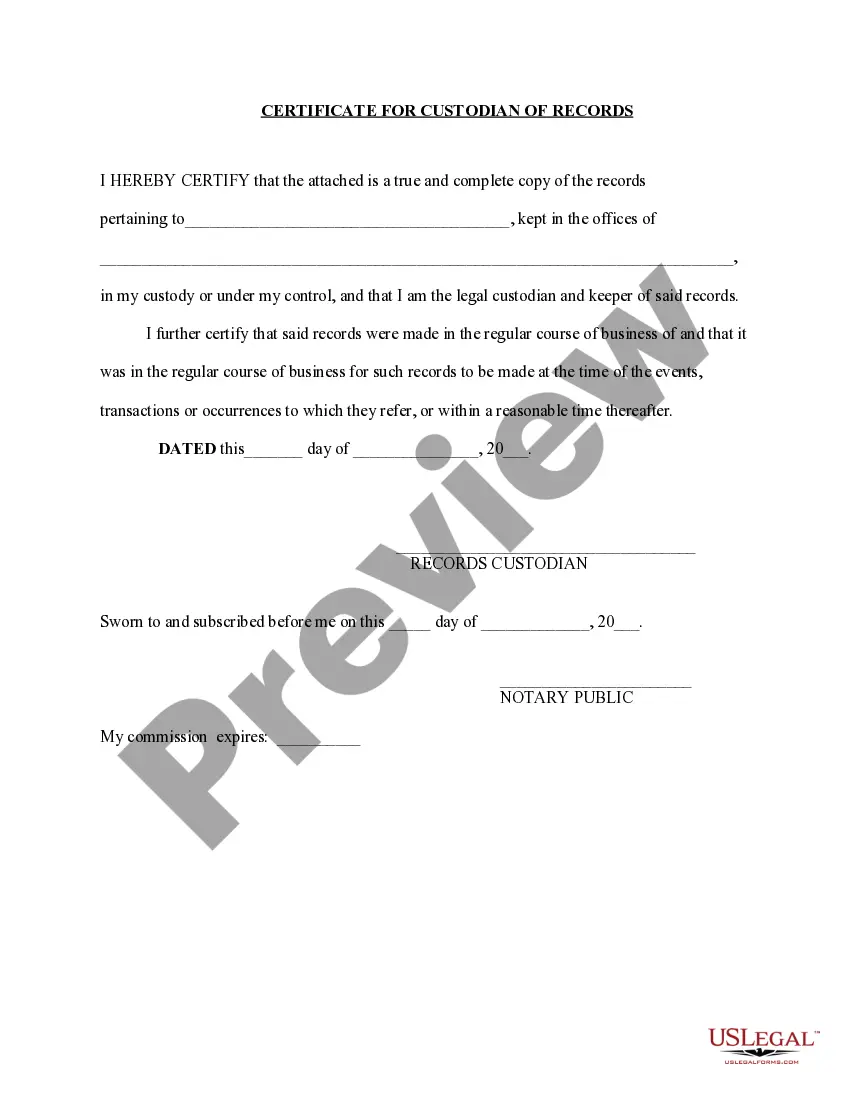
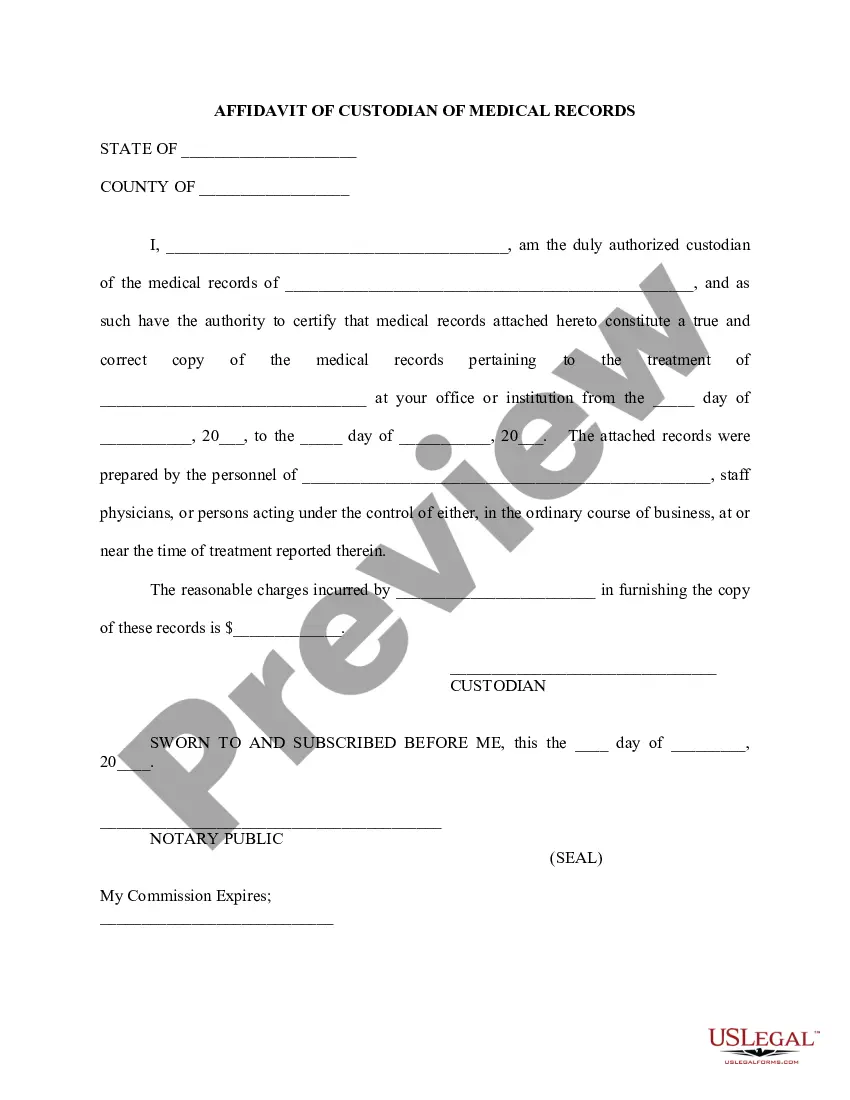
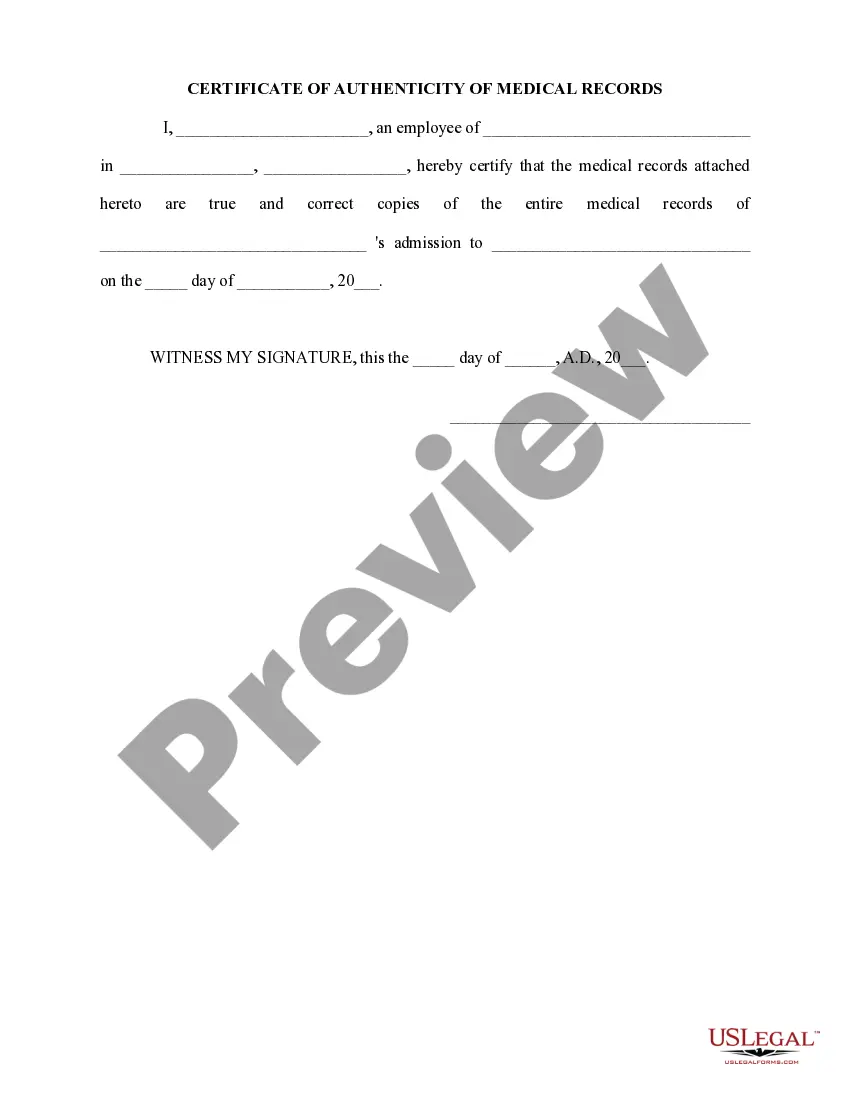
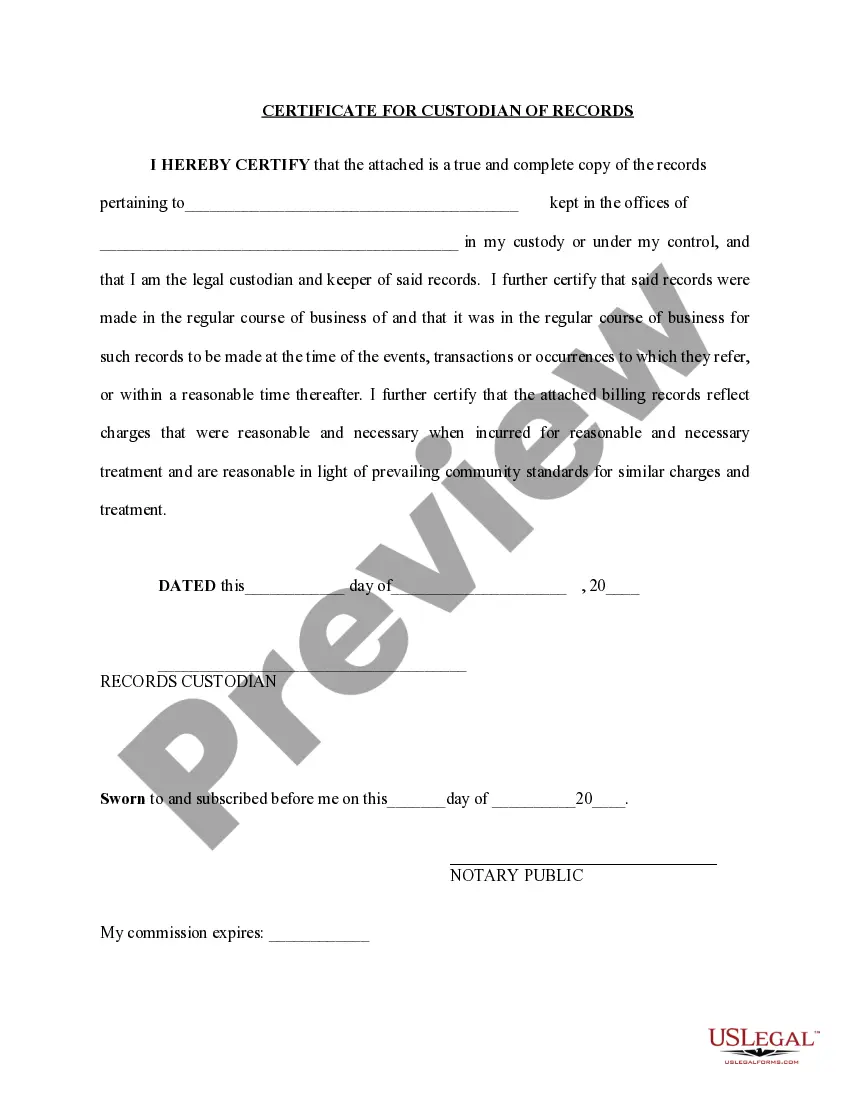
This form is used to certify that records submitted are true and correct and kept in the normal course of business.
Maricopa Arizona Certificate for Custodian of Records
State:
Multi-State
County:
Maricopa
Control #:
US-PI-0241
Format:
Word;
Rich Text
78 downloads
Description
Get your form ready online
Our built-in tools help you complete, sign, share, and store your documents in one place.
Built-in online Word editor
Make edits, fill in missing information, and update formatting in US Legal Forms—just like you would in MS Word.
Export easily
Download a copy, print it, send it by email, or mail it via USPS—whatever works best for your next step.
E-sign your document
Sign and collect signatures with our SignNow integration. Send to multiple recipients, set reminders, and more. Go Premium to unlock E-Sign.
Notarize online 24/7
If this form requires notarization, complete it online through a secure video call—no need to meet a notary in person or wait for an appointment.
Store your document securely
We protect your documents and personal data by following strict security and privacy standards.

Make edits, fill in missing information, and update formatting in US Legal Forms—just like you would in MS Word.

Download a copy, print it, send it by email, or mail it via USPS—whatever works best for your next step.

Sign and collect signatures with our SignNow integration. Send to multiple recipients, set reminders, and more. Go Premium to unlock E-Sign.

If this form requires notarization, complete it online through a secure video call—no need to meet a notary in person or wait for an appointment.

We protect your documents and personal data by following strict security and privacy standards.
Looking for another form?
How to fill out Certificate For Custodian Of Records?
Are you in search of a swift way to create a legally-authoritative Maricopa Certificate for Custodian of Records or perhaps another document to manage your personal or business affairs.
You have two choices: reach out to an expert to compose a legal document for you or draft it completely by yourself.
First and foremost, confirm that the Maricopa Certificate for Custodian of Records is aligned with the regulations of your state or county.
If the document includes a description, be sure to verify its intended purpose.
- The positive aspect is, there's an additional choice - US Legal Forms.
- This service will assist you in obtaining professionally crafted legal documents without incurring exorbitant fees for legal assistance.
- US Legal Forms boasts an extensive library of more than 85,000 state-compliant form templates, including the Maricopa Certificate for Custodian of Records and bundled forms.
- We provide documents suited for various life situations: from divorce forms to real estate document templates.
- With over 25 years in the industry, we've built a flawless reputation among our users.
- Follow these steps to become one of our satisfied customers and acquire the required template effortlessly.
Form popularity
FAQ
The County Recorder maintains public records so the public can access public records and government information as needed for personal and/or business purposes.
More than half of the state's population resides in Maricopa County, which includes the cities of Phoenix, Mesa, Glendale, Scottsdale, Tempe, Chandler, Peoria and the town of Gilbert.
Stephen Richer is the 30th Recorder of Maricopa County. He was elected in November 2020 and took office January 2021. Prior to his election as Recorder, Stephen worked as a lawyer and business person.
The Maricopa County Recorder's Office is capable of receiving and recording documents, plat and survey maps...
The Recorder Does: Record and store land documents for the public record. Assist the public in locating real property parcels on ownership plats. Assist the public in locating records. Sell copies of documents and plats to the public.
COMMON REQUESTS Dog. Licenses. Restaurant. Ratings. Lost/Found. Pet. Immunizations/ Vaccines. STD/HIV. Testing. Elections/ Voting. Permitting. Services. County. Libraries. County. Parks.
Requesting Copies (Copy Request Form) 50 per page for copy requests. The number of pages of a document may be ascertained by calling the Clerk's Office at (602) 452-6700 or by emailing the court at inform@appeals.az.gov. A certification fee of $17.00 is required if the request is for a Certified Copy of the document.
You can file documents with the Clerk of the Superior Court online, by mail or at one of our filing counter locations. Please note: Clerks are committed to assisting you in Superior Court. To ensure fairness, clerks do not give legal advice.
Requesting Copies (Copy Request Form) 50 per page for copy requests. The number of pages of a document may be ascertained by calling the Clerk's Office at (602) 452-6700 or by emailing the court at inform@appeals.az.gov. A certification fee of $17.00 is required if the request is for a Certified Copy of the document.
Court records are maintained in accordance with Rules of the Supreme Court of Arizona, Rule 29: Court Records, subsections (A) and (D). Most records are destroyed once their statutory retention period expires, which can be from one year to 11 years, depending on the case type.