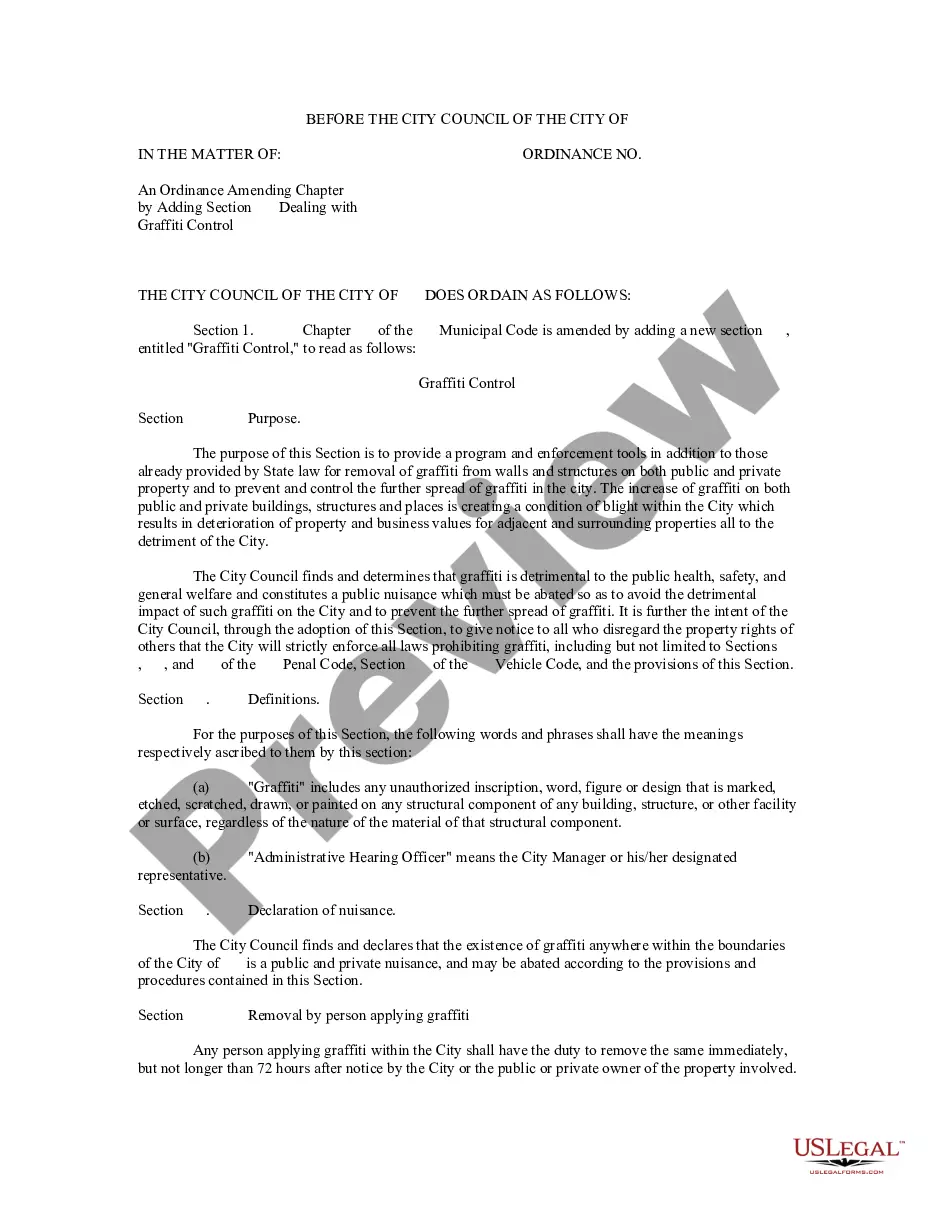
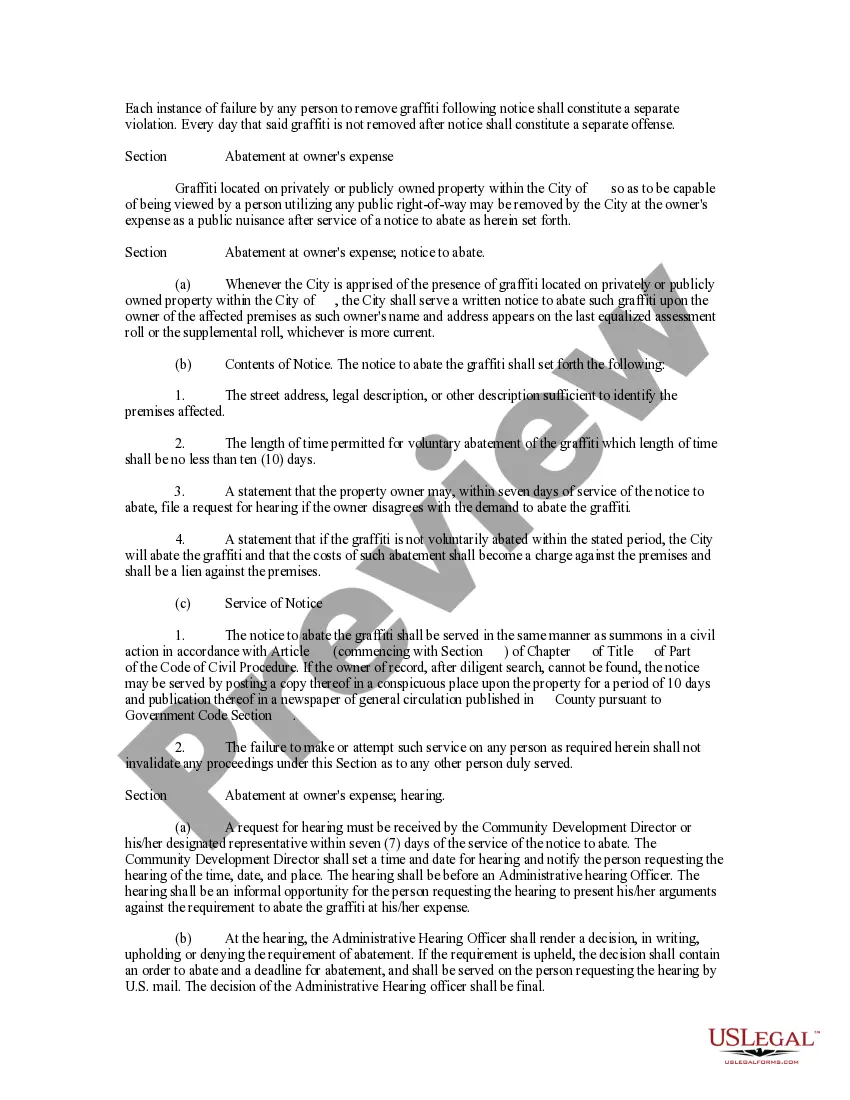
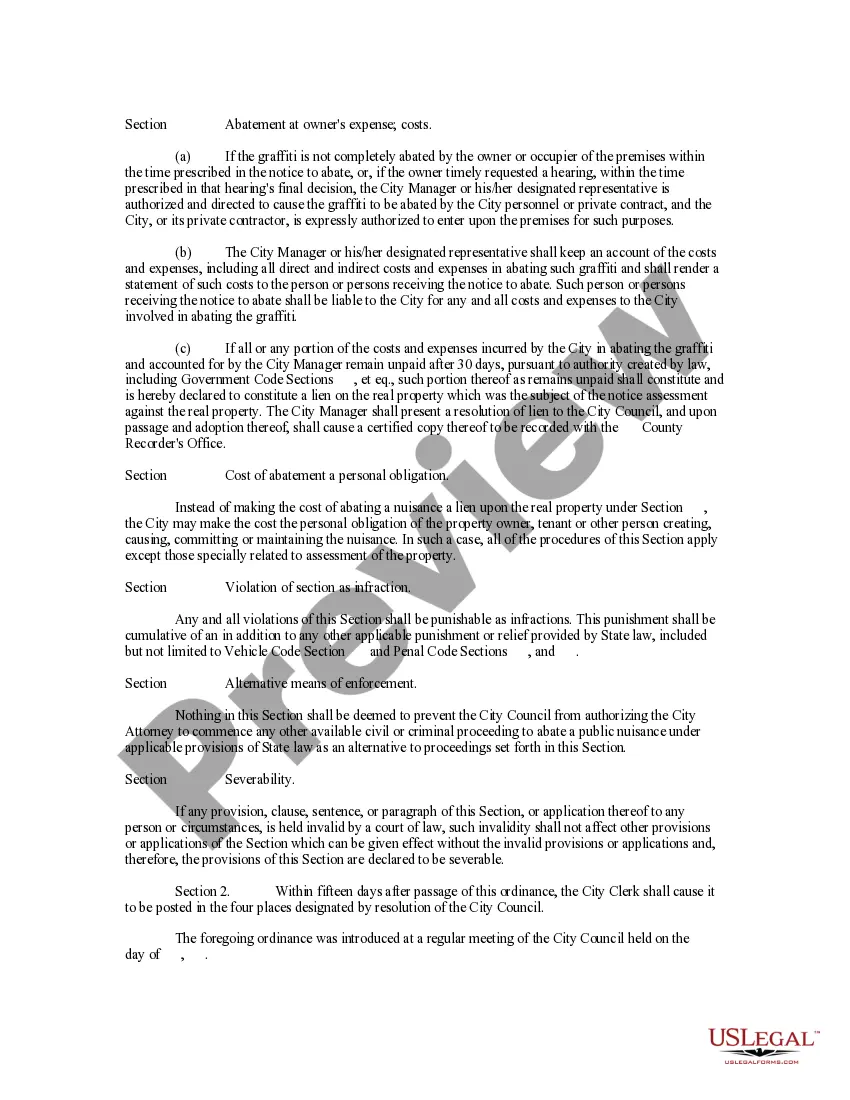
San Antonio Texas Graffiti Control Ordinance
Description
Get your form ready online
Our built-in tools help you complete, sign, share, and store your documents in one place.
Make edits, fill in missing information, and update formatting in US Legal Forms—just like you would in MS Word.
Download a copy, print it, send it by email, or mail it via USPS—whatever works best for your next step.
Sign and collect signatures with our SignNow integration. Send to multiple recipients, set reminders, and more. Go Premium to unlock E-Sign.
If this form requires notarization, complete it online through a secure video call—no need to meet a notary in person or wait for an appointment.
We protect your documents and personal data by following strict security and privacy standards.

Make edits, fill in missing information, and update formatting in US Legal Forms—just like you would in MS Word.

Download a copy, print it, send it by email, or mail it via USPS—whatever works best for your next step.

Sign and collect signatures with our SignNow integration. Send to multiple recipients, set reminders, and more. Go Premium to unlock E-Sign.

If this form requires notarization, complete it online through a secure video call—no need to meet a notary in person or wait for an appointment.

We protect your documents and personal data by following strict security and privacy standards.
Looking for another form?
How to fill out Graffiti Control Ordinance?
A documentation procedure consistently accompanies any legal engagement you undertake.
Starting a business, applying for or accepting a job offer, changing ownership, and many other life situations necessitate you to prepare official documents that vary across the nation.
That is why having everything compiled in a single location is incredibly beneficial.
US Legal Forms is the largest online repository of current federal and state-specific legal documents.
Select the file format and save the San Antonio Graffiti Control Ordinance on your device. Use it as needed: print it or fill it out electronically, sign it, and submit where required. This is the simplest and most reliable method to acquire legal documents. All the samples available in our library are professionally created and verified for compliance with local laws and regulations. Prepare your documentation and manage your legal matters effectively with US Legal Forms!
- Here, you can effortlessly locate and download a document for any individual or business need utilized in your area, featuring the San Antonio Graffiti Control Ordinance.
- Finding samples on the platform is exceptionally simple.
- If you already possess a subscription to our library, Log In to your account, use the search bar to find the sample, and click Download to save it on your device.
- Subsequently, the San Antonio Graffiti Control Ordinance will be accessible for additional use in the My documents section of your profile.
- If you are utilizing US Legal Forms for the first time, adhere to this straightforward guideline to acquire the San Antonio Graffiti Control Ordinance.
- Ensure you are on the correct page with your local form.
- Utilize the Preview mode (if available) and scroll through the template.
- Review the description (if present) to confirm the template meets your needs.
- Search for another document using the search function if the sample does not suit you.
- Click Buy Now once you find the necessary template.
- Select the appropriate subscription plan, then Log In or create an account.
- Choose your preferred payment method (with credit card or PayPal) to proceed.
Form popularity
FAQ
Texas utilizes several building codes, but the primary standard is the International Building Code along with Texas-specific amendments. Each city, including San Antonio, may adopt additional regulations that cater to local needs, such as the San Antonio Texas Graffiti Control Ordinance. To ensure compliance, reviewing both the state and local building codes is crucial. Resources like U.S. Legal Forms can assist you in navigating these requirements effectively.
San Antonio, Texas, uses area codes 210 and 726. These area codes cover various regions and neighborhoods within the city. When reaching out for city services or information, such as details on the San Antonio Texas Graffiti Control Ordinance, knowing the correct area code can help ensure better communication. Always verify the area code for specific local numbers.
San Antonio, Texas operates under the International Building Code and local amendments specific to the city. These codes address construction, safety, and environmental standards. It’s essential to review these guidelines to ensure compliance, especially regarding the San Antonio Texas Graffiti Control Ordinance. Consulting with a local contractor or the city’s planning department can also provide clarity.
To find your local building code, visit your city’s official website or the planning department. These resources often offer downloadable documents or guidance on local regulations. Additionally, your local library may have copies of building codes on hand. Using these resources, you can ensure that you comply with the San Antonio Texas Graffiti Control Ordinance.
Graffiti is considered a criminal offense in Texas, with penalties that can vary based on the severity of the act and the damage caused. Under the San Antonio Texas Graffiti Control Ordinance, fines and community service may be imposed on offenders. Additionally, repeat offenders could face more serious charges that could lead to jail time. It’s important to respect property and to understand the legal implications of graffiti.
If you need to complain about a neighbor in San Antonio, you can submit a complaint to the city's Code Compliance Department. They will investigate issues that may involve code violations, including graffiti that violates the San Antonio Texas Graffiti Control Ordinance. To facilitate the process, gather evidence and document your concern clearly. This will help the city address the matter efficiently.
San Antonio follows the International Building Code, along with local amendments that address specific needs of the city. These codes ensure that all construction projects meet safety standards and zoning requirements. Understanding these codes, including those that relate to the San Antonio Texas Graffiti Control Ordinance, can be crucial for homeowners and builders alike. It's always beneficial to consult with local experts when undertaking a project.
To report code compliance issues in San Antonio, you can contact the city's Code Compliance Department directly. You can either call their office or submit a report online through the city’s official website. By reporting issues, including those related to the San Antonio Texas Graffiti Control Ordinance, you help maintain the community's aesthetic and safety. Your proactive approach can lead to significant positive change.
Yes, graffiti is illegal in Texas under the San Antonio Texas Graffiti Control Ordinance. This law prohibits the intentional defacement of property with paint, markers, or other materials. It is important to understand that property owners can face fines and penalties if they do not remove graffiti in a timely manner. Therefore, it's essential to stay informed about the local regulations regarding graffiti.
It is illegal to graffiti anywhere unless it is done on property with the owner's permission. The San Antonio Texas Graffiti Control Ordinance reinforces this concept, stressing that unauthorized graffiti can lead to significant fines and community cleanup efforts. Individuals interested in expressing their creativity through graffiti should explore opportunities to do so legally, such as designated public art spaces. Understanding local regulations helps foster a respectful relationship between artists and the community.