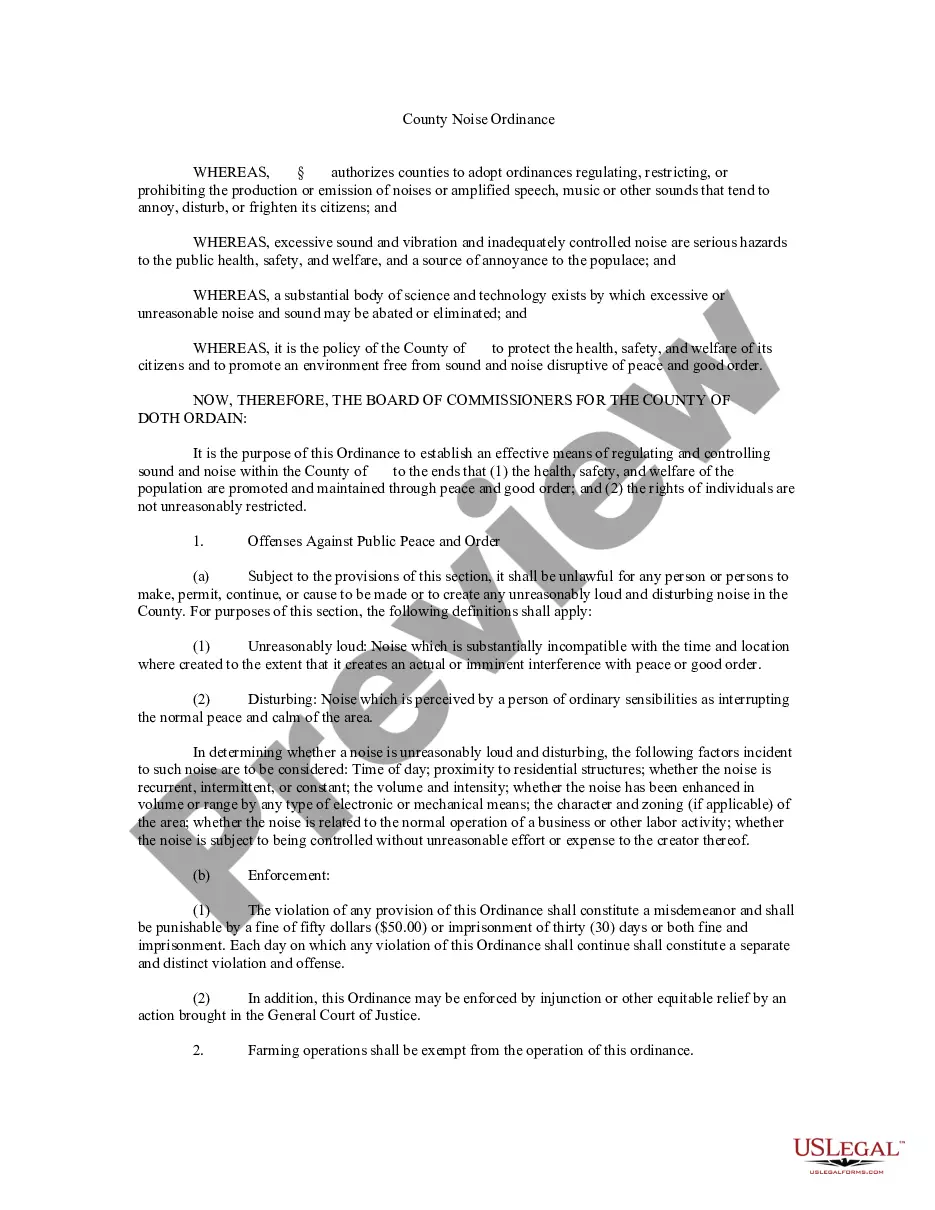
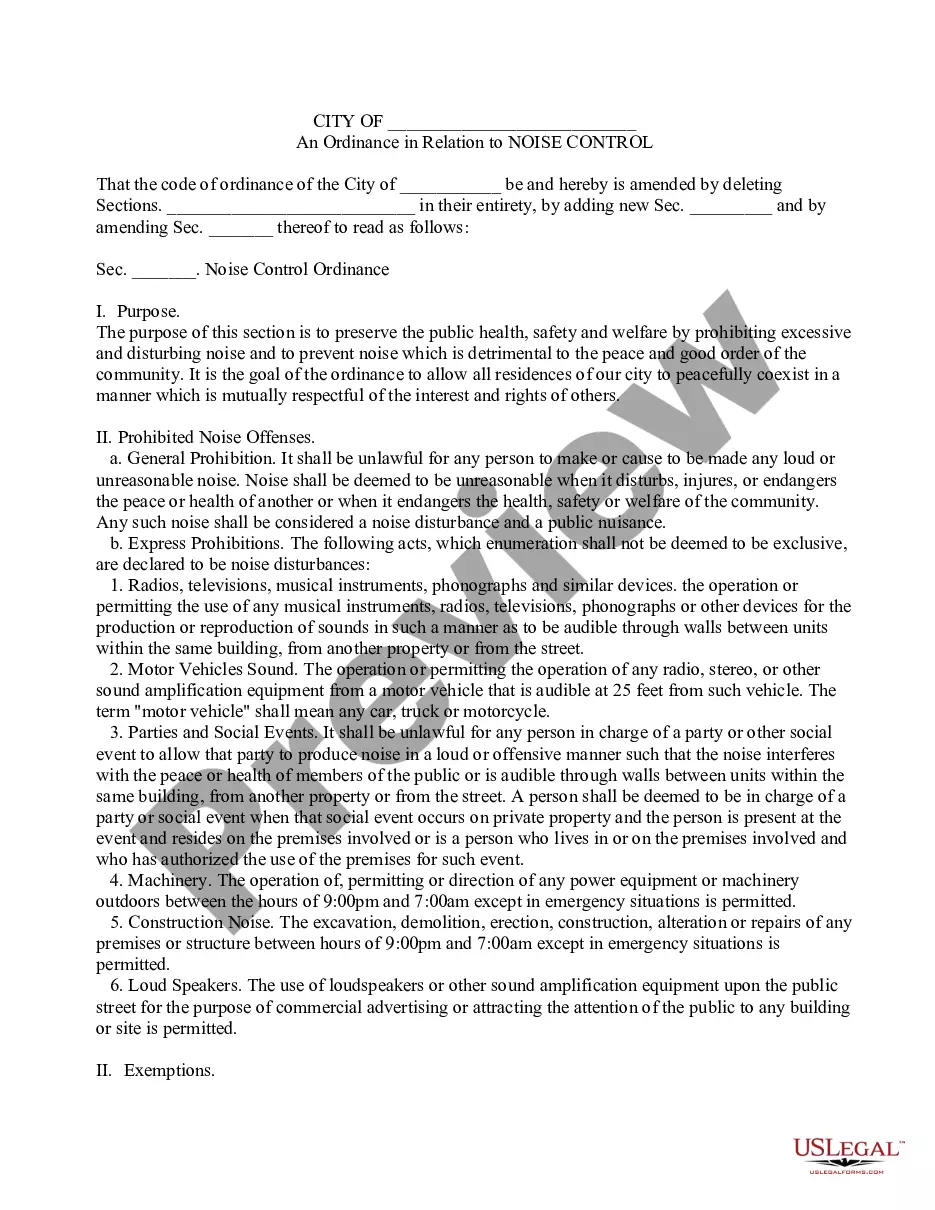
Mecklenburg North Carolina Noise Ordinance
Description

Get your form ready online
Our built-in tools help you complete, sign, share, and store your documents in one place.
Make edits, fill in missing information, and update formatting in US Legal Forms—just like you would in MS Word.
Download a copy, print it, send it by email, or mail it via USPS—whatever works best for your next step.
Sign and collect signatures with our SignNow integration. Send to multiple recipients, set reminders, and more. Go Premium to unlock E-Sign.
If this form requires notarization, complete it online through a secure video call—no need to meet a notary in person or wait for an appointment.
We protect your documents and personal data by following strict security and privacy standards.

Make edits, fill in missing information, and update formatting in US Legal Forms—just like you would in MS Word.

Download a copy, print it, send it by email, or mail it via USPS—whatever works best for your next step.

Sign and collect signatures with our SignNow integration. Send to multiple recipients, set reminders, and more. Go Premium to unlock E-Sign.

If this form requires notarization, complete it online through a secure video call—no need to meet a notary in person or wait for an appointment.

We protect your documents and personal data by following strict security and privacy standards.
Looking for another form?
How to fill out Noise Ordinance?
A document procedure consistently accompanies any legal action you undertake.
Starting a business, applying for or accepting a job offer, transferring ownership, and numerous other life circumstances necessitate that you prepare official documentation that differs across the nation. This is why compiling everything in one location is incredibly beneficial.
US Legal Forms is the largest online repository of current federal and state-specific legal documents.
On this site, you can effortlessly locate and obtain a document for any personal or business purpose used in your jurisdiction, including the Mecklenburg Noise Ordinance.
Select Buy Now when you find the necessary template. Choose the appropriate subscription plan, then sign in or create an account. Select the preferred payment method (using credit card or PayPal) to proceed. Choose the file format and save the Mecklenburg Noise Ordinance onto your device. Utilize it as needed: print it out or complete it electronically, sign it, and submit where required. This is the easiest and most dependable method to acquire legal documentation. All samples offered by our library are expertly drafted and verified for consistency with local statutes and regulations. Prepare your paperwork and manage your legal matters efficiently with US Legal Forms!
- Finding documents on the site is very easy.
- If you already possess a subscription to our service, Log In to your account, search for the form through the search bar, and click Download to store it on your device.
- After that, the Mecklenburg Noise Ordinance will be available for further access in the My documents section of your profile.
- If you are interacting with US Legal Forms for the first time, follow this brief guide to acquire the Mecklenburg Noise Ordinance.
- Ensure you have opened the correct page with your local form.
- Use the Preview mode (if accessible) and browse through the sample.
- Examine the description (if present) to confirm the template matches your needs.
- Look for another document using the search feature if the sample does not suit you.
Form popularity
FAQ
§ 160A-184. A city may by ordinance regulate, restrict, or prohibit the production or emission of noises or amplified speech, music, or other sounds that tend to annoy, disturb, or frighten its citizens.
According to NYC Quiet Hours specified in Local Law 113, neighbors in all five boroughs are bound to quiet hours from 10 pm until 7 am. This also includes having pets making loud noises longer than five minutes at a time.
From 7 p.m. to 10 p.m., a tenant cannot make noise exceeding 50 decibels, and any noise more than 50 decibels is considered a nuisance.) Other cities and counties have similar ordinances for the most part and should be available on line.
Dealing with the problem The first option is to lay a complaint with your local authority by way of a written statement.If the above fails and the offence persists, your lawyer would ask your neighbour to desist and if that too fails, will approach the court for an interdict to stop the noise nuisance.
Legally speaking, noise normally includes vibration. We recommend that noisy DIY be carried out: Monday-Friday 8am-6pm (until 8pm if done after work) Saturdays 8am-1pm.
Councils can investigate complaints of statutory nuisance to tackle noise produced at any time of day or night. They may also issue warning notices in response to complaints about noise above permitted levels from 11pm to 7am. These warning notices can be used by councils for noise that's not a statutory nuisance.
Acceptable noise levels are: 85 dB(C) Sunday through Thursday between 8 a.m. and 9 p.m.; 60 dB(C) Sunday through Thursday between 9 p.m. and 2 a.m. the following day. 85 dB(C) Friday or Saturday between 8 a.m. and 11 p.m.; 60 dB(C) between p.m. and a.m. the following day.
Here's what to do: Reach out to other neighbors who want them gone. Ask them if they've dealt with police issues or lawsuits.Pass around a petition asking them to leave.Take the evidence to your neighbor's landlord or HOA.If this does not work, consider seeing if your area has nuisance neighbor laws.
Reducing Sound with Furniture and Decor Add a rug or two.Invest in a white noise machine and ear plugs.Incorporate more furniture.Invest in some sound-reducing curtains.Utilize a door draft stopper.Speak with your neighbors.Offer suggestions to them.Talk to an on-site manager.
Laws in the U.S. Related to Noise at Night The accepted standard is that people should not be playing loud music (50 decibels or higher) between the hours of 11 p.m. and 7 a.m. Many feel that it is acceptable to push that to midnight or 1 a.m. on weekends and holidays.