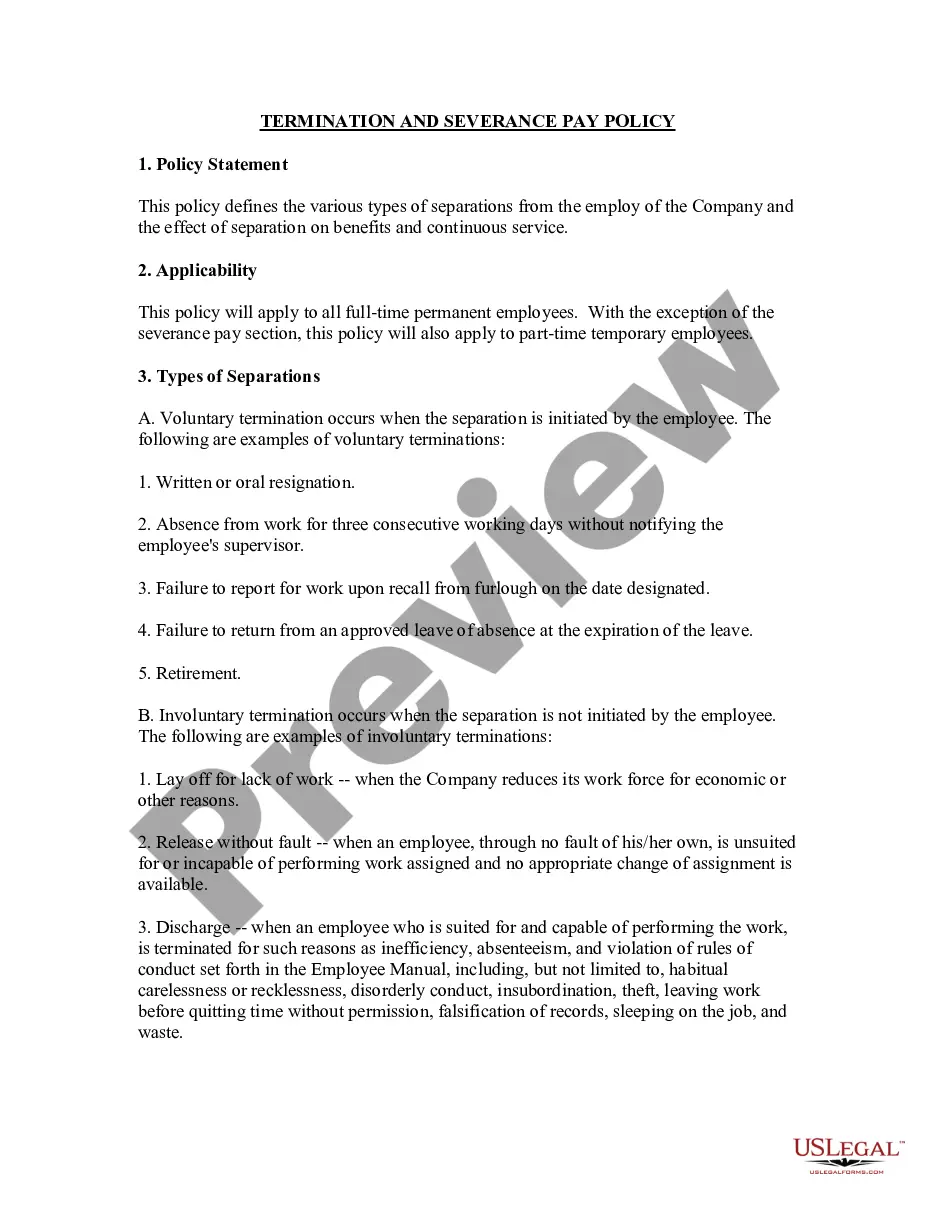
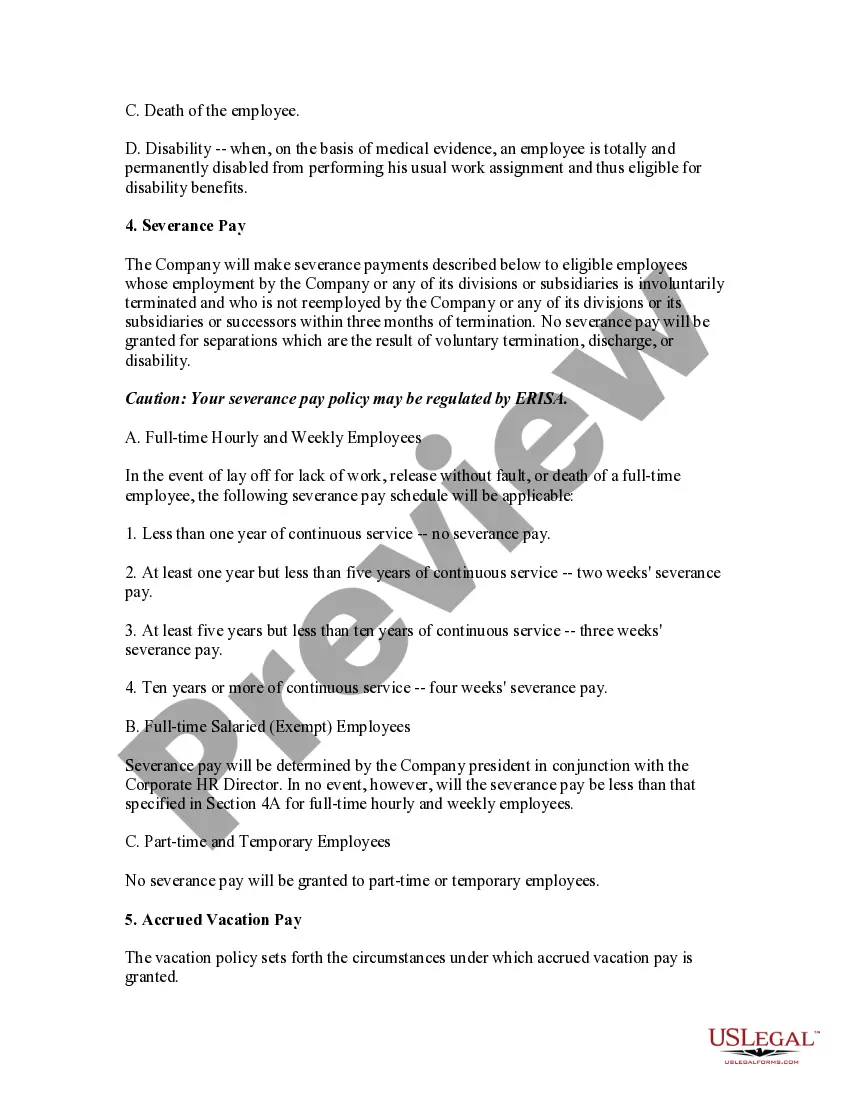
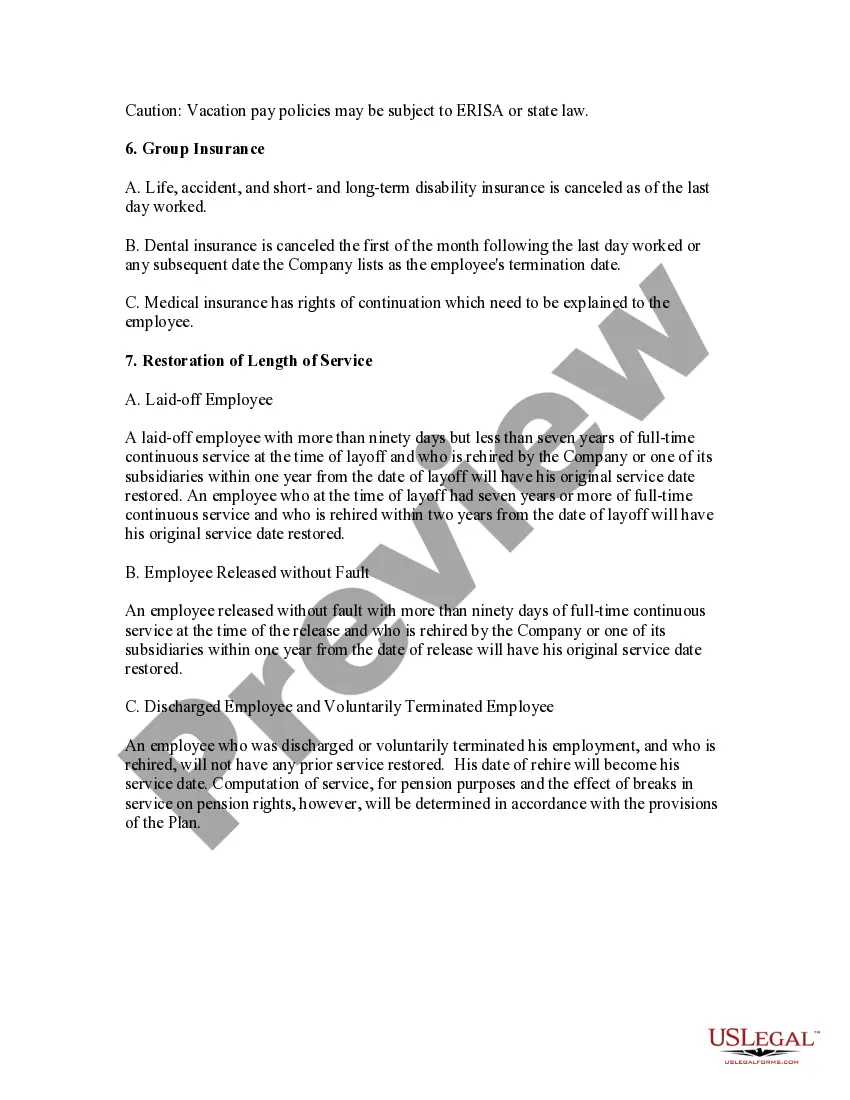
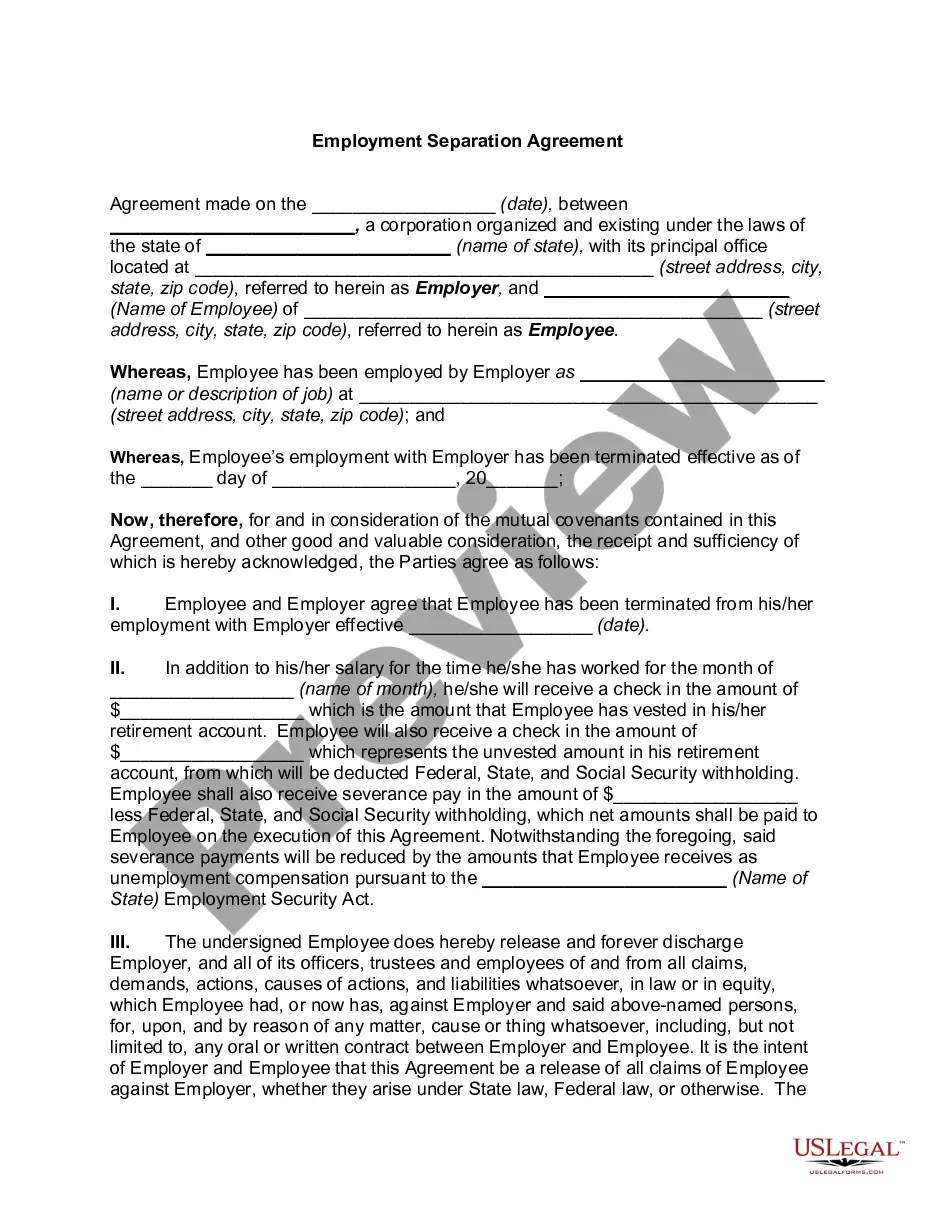
Cuyahoga Ohio Termination and Severance Pay Policy
Description
Get your form ready online
Our built-in tools help you complete, sign, share, and store your documents in one place.
Make edits, fill in missing information, and update formatting in US Legal Forms—just like you would in MS Word.
Download a copy, print it, send it by email, or mail it via USPS—whatever works best for your next step.
Sign and collect signatures with our SignNow integration. Send to multiple recipients, set reminders, and more. Go Premium to unlock E-Sign.
If this form requires notarization, complete it online through a secure video call—no need to meet a notary in person or wait for an appointment.
We protect your documents and personal data by following strict security and privacy standards.

Make edits, fill in missing information, and update formatting in US Legal Forms—just like you would in MS Word.

Download a copy, print it, send it by email, or mail it via USPS—whatever works best for your next step.

Sign and collect signatures with our SignNow integration. Send to multiple recipients, set reminders, and more. Go Premium to unlock E-Sign.

If this form requires notarization, complete it online through a secure video call—no need to meet a notary in person or wait for an appointment.

We protect your documents and personal data by following strict security and privacy standards.
Looking for another form?
How to fill out Termination And Severance Pay Policy?
A document process consistently goes hand in hand with any legal actions you undertake.
Launching a business, applying for or accepting a job proposal, transferring ownership, and numerous other life circumstances necessitate you to prepare official documents that differ from state to state.
That's the reason why gathering everything in one location is extremely beneficial.
US Legal Forms is the largest online repository of current federal and state-specific legal templates. Here, you can effortlessly find and download a document for any personal or business need utilized in your area, including the Cuyahoga Termination and Severance Pay Policy.
This is the simplest and most dependable method to acquire legal documents. All samples available in our library are professionally created and verified for compliance with local laws and regulations. Get your paperwork ready and manage your legal matters effectively with US Legal Forms!
- Finding samples on the platform is incredibly easy.
- If you already possess a subscription to our library, Log In to your account, locate the sample using the search bar, and click Download to save it on your device.
- After that, the Cuyahoga Termination and Severance Pay Policy will be available for further use in the My documents section of your profile.
- If this is your first time using US Legal Forms, follow this quick guide to obtain the Cuyahoga Termination and Severance Pay Policy.
- Ensure you have accessed the correct page with your regional form.
- Utilize the Preview mode (if available) and review the sample.
- Examine the description (if available) to confirm the template meets your requirements.
- Search for an alternative document through the search tab if the sample does not suit you.
Form popularity
FAQ
Notice: An employer does not legally have to give an employee notice of termination. Your personnel file: In Ohio, which is unlike some states, employees do not have a right to view their personnel file.
Step 1: Document the Termination Reason. This is the most crucial step when firing an employee, as missing this step can land you in legal hot water should an employee sue you for wrongful termination. Without documentation, a court will almost always favor the employee.
Under the Fair Labor Standards Act (FLSA), employers in the United States are not required by law to provide written notice of termination to an employee.
It is illegal to be fired for reasons that pertain to protected characteristics like race, gender, pregnancy, disability, religion, or nationality, among others. If you are terminated because of discrimination based on a protected class, it could be considered wrongful termination in Ohio.
Like most states, Ohio is an at-will employment state. This means that an employee can be fired for no reason, or any reason, even if it's a bad reason, so long as the reason is not unlawful. Unless you have signed an employment agreement or belong to a union, you are an at-will employee in Ohio.
Generally, just cause means the employee has failed to meet the employer's reasonable expectations in some way, like failing to show up to work for several days in a row or repeated poor job performance. Once a contract has been entered into, however, the employer has to adhere to its terms.
Ohio is an at-will employment state. This means that most employers may fire (terminate) or discipline an employee for any reason at any time, including a bad reason or no reason at all.
In Ohio, as in most other states, employment is at will. That means that under Ohio law, an employee is generally free to quit his or her job for any reason. Similarly, an employer may generally terminate an employee for any reasonor even for no reasonas long as the reason doesn't violate the law.