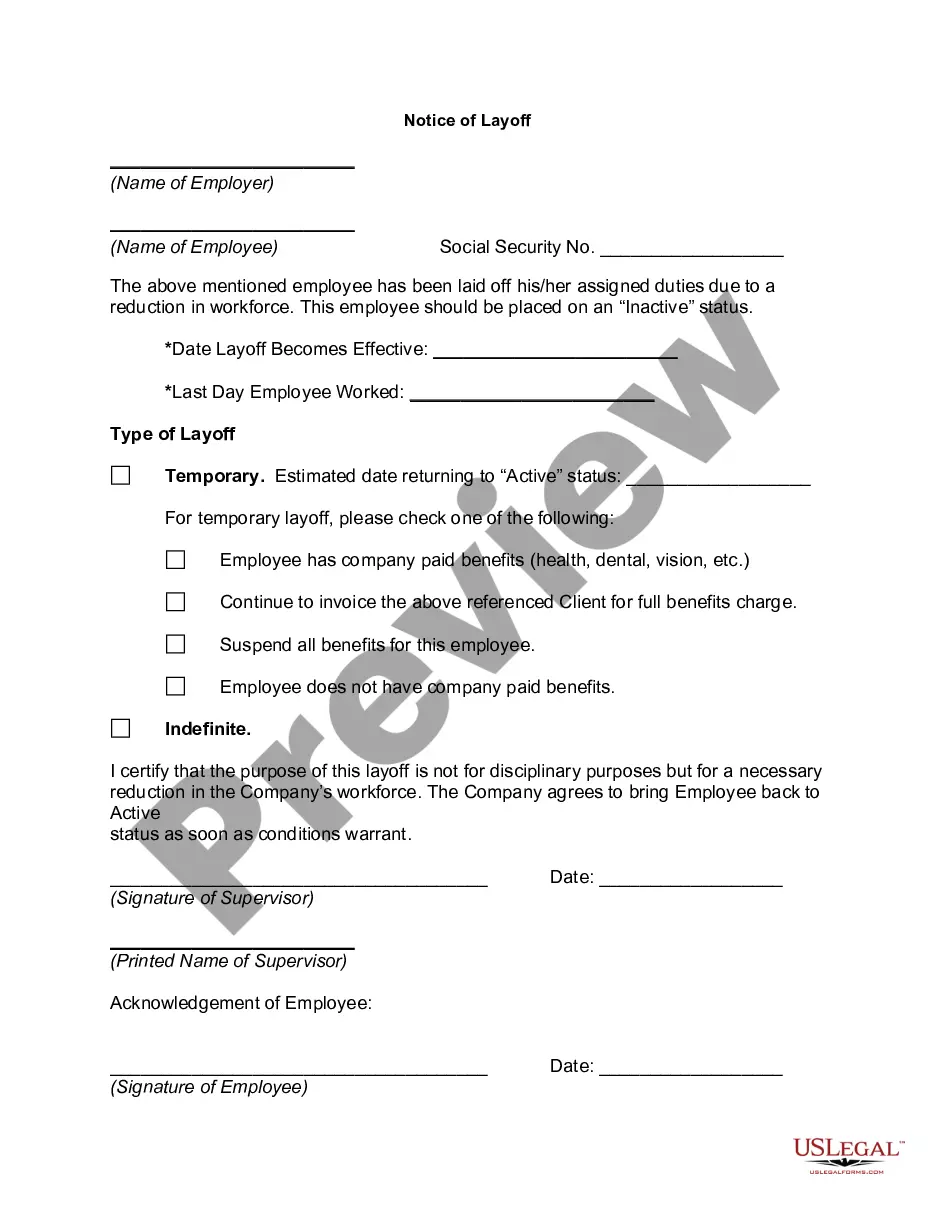
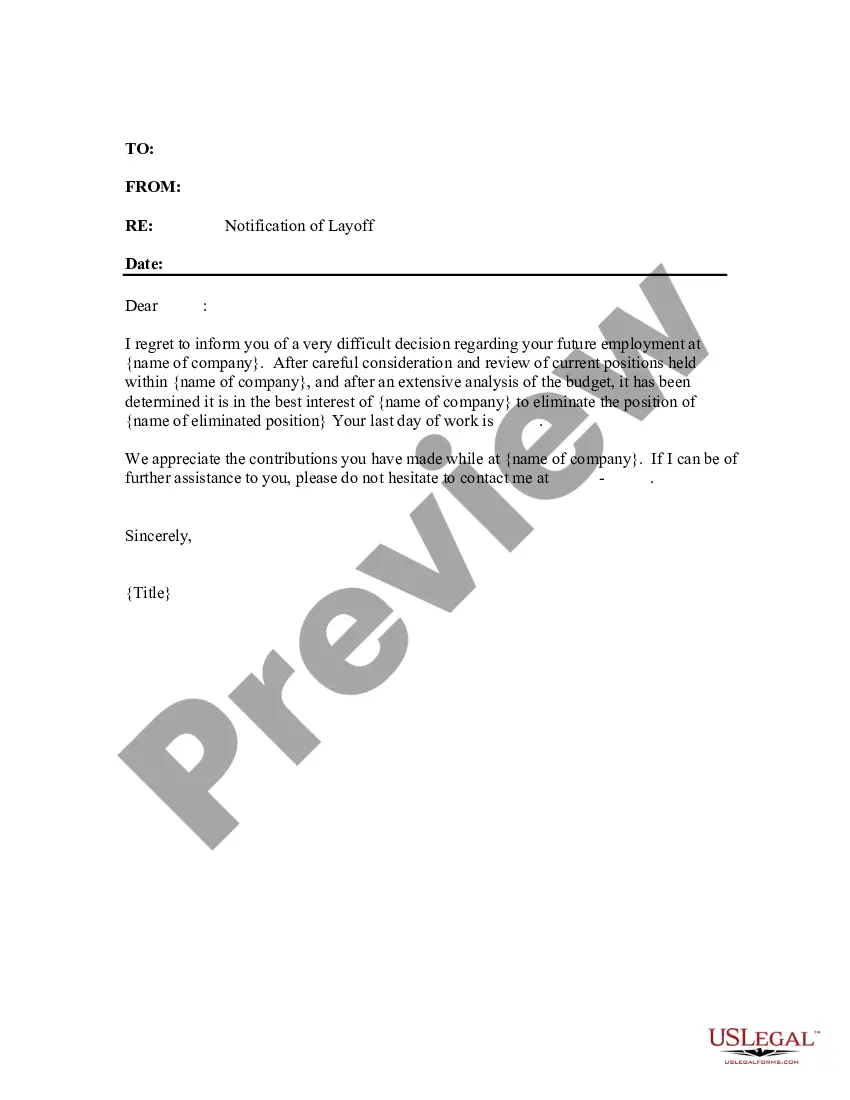
Orange California Notice of Layoff
Description

Get your form ready online
Our built-in tools help you complete, sign, share, and store your documents in one place.
Make edits, fill in missing information, and update formatting in US Legal Forms—just like you would in MS Word.
Download a copy, print it, send it by email, or mail it via USPS—whatever works best for your next step.
Sign and collect signatures with our SignNow integration. Send to multiple recipients, set reminders, and more. Go Premium to unlock E-Sign.
If this form requires notarization, complete it online through a secure video call—no need to meet a notary in person or wait for an appointment.
We protect your documents and personal data by following strict security and privacy standards.

Make edits, fill in missing information, and update formatting in US Legal Forms—just like you would in MS Word.

Download a copy, print it, send it by email, or mail it via USPS—whatever works best for your next step.

Sign and collect signatures with our SignNow integration. Send to multiple recipients, set reminders, and more. Go Premium to unlock E-Sign.

If this form requires notarization, complete it online through a secure video call—no need to meet a notary in person or wait for an appointment.

We protect your documents and personal data by following strict security and privacy standards.
Looking for another form?

How to fill out Notice Of Layoff?
Laws and policies across various sectors differ throughout the nation.
If you're not an attorney, it can be easy to become overwhelmed by numerous regulations when crafting legal documents.
To prevent costly legal help when creating the Orange Notice of Layoff, you require a verified template that is applicable in your county.
Search for another document if there are discrepancies with any of your conditions. Click on the Buy Now button to purchase the template after identifying the suitable one. Select one of the subscription plans and log in or create an account. Choose how you wish to pay for your subscription (via credit card or PayPal). Select the format you wish to save the document in and click Download. Fill out and sign the template manually after printing or complete it all electronically. This is the easiest and most cost-effective method to obtain current templates for any legal matters. Find them all in just a few clicks and keep your documentation organized with US Legal Forms!
- That's where utilizing the US Legal Forms platform comes in handy.
- US Legal Forms is trusted by millions as an online directory featuring over 85,000 state-specific legal documents.
- It's an excellent option for professionals and individuals seeking do-it-yourself templates for various personal and business scenarios.
- All forms can be reused: once you acquire a sample, it remains accessible in your account for future use.
- Therefore, with a valid subscription account, you can easily Log In and re-download the Orange Notice of Layoff from the My documents section.
- For new users, a few additional steps are required to acquire the Orange Notice of Layoff.
- Review the page contents to confirm you have the correct sample.
- Use the Preview feature or read the form description if available.
Form popularity
FAQ
Both a lay-off or short-time must be temporary situations and your employer must give you notice of this before they start. The law on lay-off and short-time does not set out any minimum period of notice you must get. Exceptional circumstances, such as the COVID-19 pandemic, are likely to justify a short notice period.
When an employee is laid off, it typically has nothing to do with the employee's personal performance. Layoffs occur when a company undergoes restructuring or downsizing or goes out of business. In some cases, laid-off employees may be entitled to severance pay or other employee benefits provided by their employer.
They must give you written notice in advance that they want to make a claim. You do not have to pay if they'll return to normal working hours within 4 weeks.
Employees may be prepared to accept a temporary period of lay-off as an alternative to redundancies, for example during the coronavirus (COVID-19) crisis. A redundancy is a dismissal that is necessary because the business has closed down, or the employer needs fewer employees to carry out the work.
To lay off means to terminate the employment of an employee when there is little work to be done. Redundant is superfluous. The employee is too many, no longer needed.
Your employer can ask you to stay at home or take unpaid leave if there's not enough work for you. A lay-off is if you're off work for at least 1 working day. Short-time working is when your hours are cut.
A layoff describes the act of an employer suspending or terminating a worker, either temporarily or permanently, for reasons other than an employee's actual performance. A layoff is not the same thing as an outright firing, which may result from worker inefficiency, malfeasance, or breach of duty.
During a temporary lay-off period, the employee will not report for duty and will not be paid remuneration for this period. It is important to understand that the employee has not been dismissed.
If you are laid-off you should get your full pay unless it is part of your contract that your employer can lay you off without pay or on reduced pay. If it is not part of your employment contract, you may agree to change your contract. For example, a lay-off might be better than being made redundant.