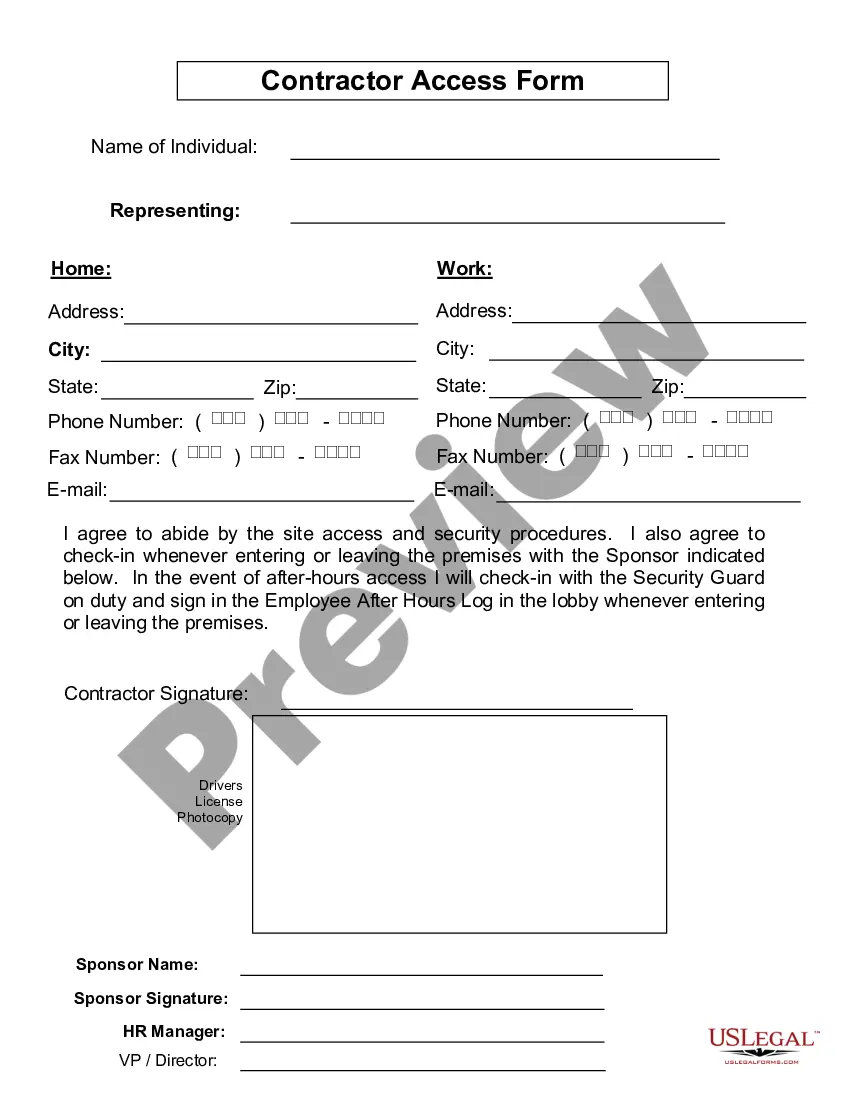
This form is a business type form that is formatted to allow you to complete the form using Adobe Acrobat or Word. The word files have been formatted to allow completion by entry into fields. Some of the forms under this category are rather simple while others are more complex. The formatting is worth the small cost.
Salt Lake Utah Contractor Access Form
Category:
State:
Multi-State
County:
Salt Lake
Control #:
US-132-AZ
Format:
Word;
PDF;
Rich Text
Instant download
Description





How to fill out Contractor Access Form?
A documentation process always accompanies any legal action you undertake.
Establishing a business, applying for or accepting a job offer, transferring real estate, and numerous other life events require you to compile formal paperwork that varies by region.
That’s why consolidating everything in one location is so convenient.
US Legal Forms is the largest online repository of current federal and state-specific legal templates.
This is the most straightforward and reliable method to procure legal documents. All templates available in our library are professionally created and verified for compliance with local laws and guidelines. Organize your documentation and manage your legal matters effectively with US Legal Forms!
- Here, you can effortlessly find and download a document for any personal or commercial purpose relevant to your area, including the Salt Lake Contractor Access Form.
- Finding templates on the platform is very easy.
- If you are already subscribed to our service, Log In to your account, search for the sample using the search bar, and click Download to save it on your device.
- Once downloaded, the Salt Lake Contractor Access Form will be available for further use in the My documents section of your profile.
- If you are using US Legal Forms for the first time, follow this quick guide to acquire the Salt Lake Contractor Access Form.
- Ensure you have accessed the correct page with your localized form.
- Use the Preview option (if available) and examine the sample.
- Review the description (if present) to ensure the template meets your needs.
Form popularity
FAQ
If anything has been built that does not comply with zoning ordinances or building codes, city officials can order that portion of the work to be demolished. In addition, a fine can be levied on the project.
Permits, Inspections & Insurance. Do I have to pull a building permit? Yes. It's required by every municipality in Utah.
Most residential zones also require the shed to be no taller than 12 ft. Accessory Buildings over 200 sq. ft. require a building permit and must also meet all of the setback rules.
The installation of a fence requires a permit from Building Services. ?Fence? means a structure erected to provide privacy or security which defines a private space and may enhance the design of individual sites. A wall or similar barrier is also considered to be a fence. The fee for most residential fences is $34.00.
Utah and Electrical Licenses All electricians performing work in the state of Utah are required to obtain and maintain an electrical license. This process is controlled and carried out by the Utah Department of Commerce, Division of Occupational and Professional Licensing.
In most cases and in most Utah cities, a building permit is not required on any storage shed or accessory building that is 200 square feet or smaller.
A building permit is required for all residential additions and remodels. Start by reviewing and meeting the requirements of the Residential Plan Review Checklist for Additions, Remodels, Basement Finishes and Accessory Structures.
There are exceptions, but most cities/counties require a building permit for any shed larger than 120 square feet, and any building with electrical.
A maximum fence height of six feet (6?) within ten feet (10?) of side yard and rear yard property lines shall be permitted. Fences exceeding six feet (6?) shall be made on a flexible nonopaque material, mesh, or netting.
When to Get a Permit. The permit must be taken out by the person doing the work, the electrical contractor or the homeowner. State law does allow a homeowner of a single family residence to do his or her electrical work.