Clark Nevada Jury Instruction - First Degree Murder - Premeditated Murder - Transferred Intent
Description
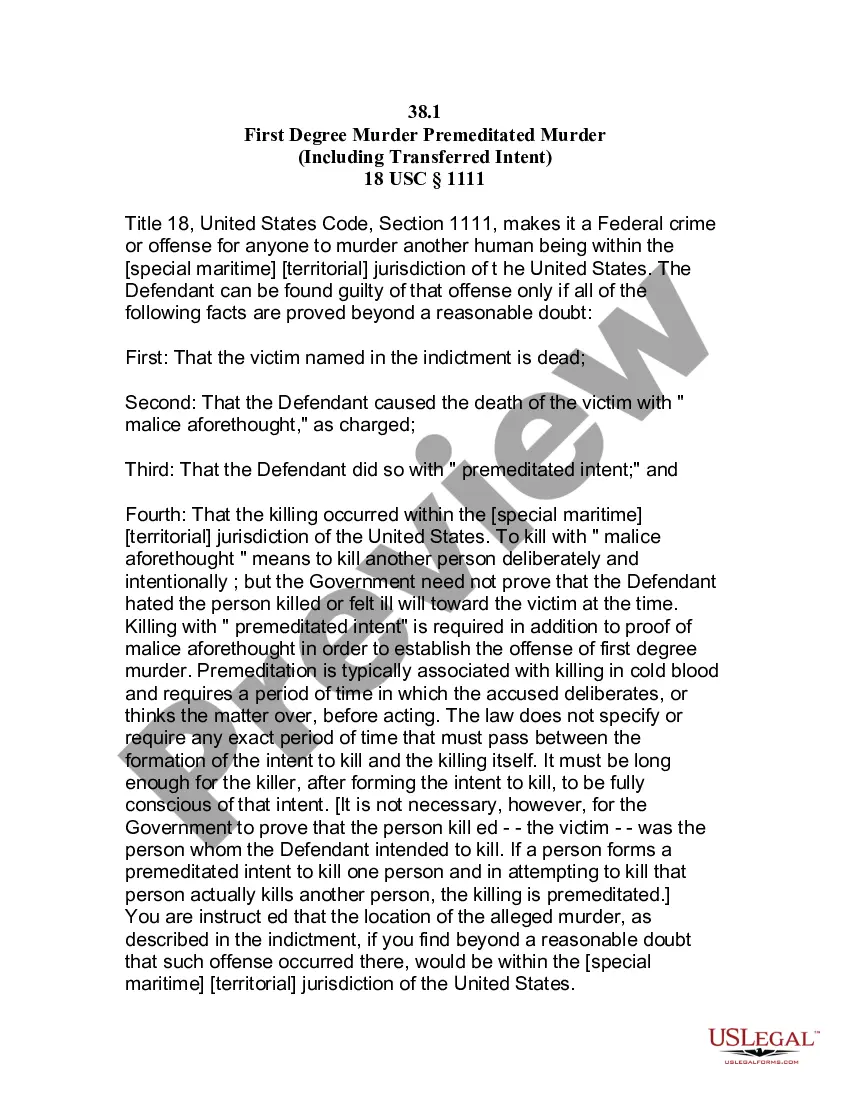
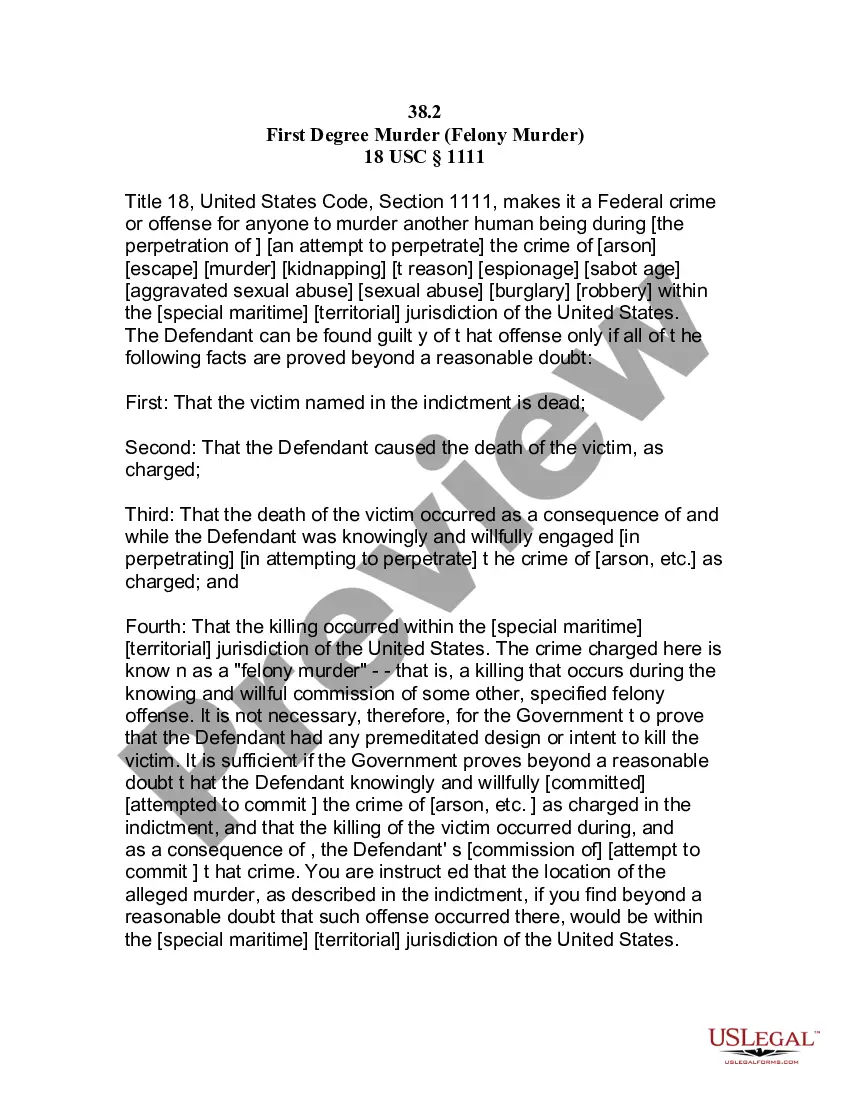
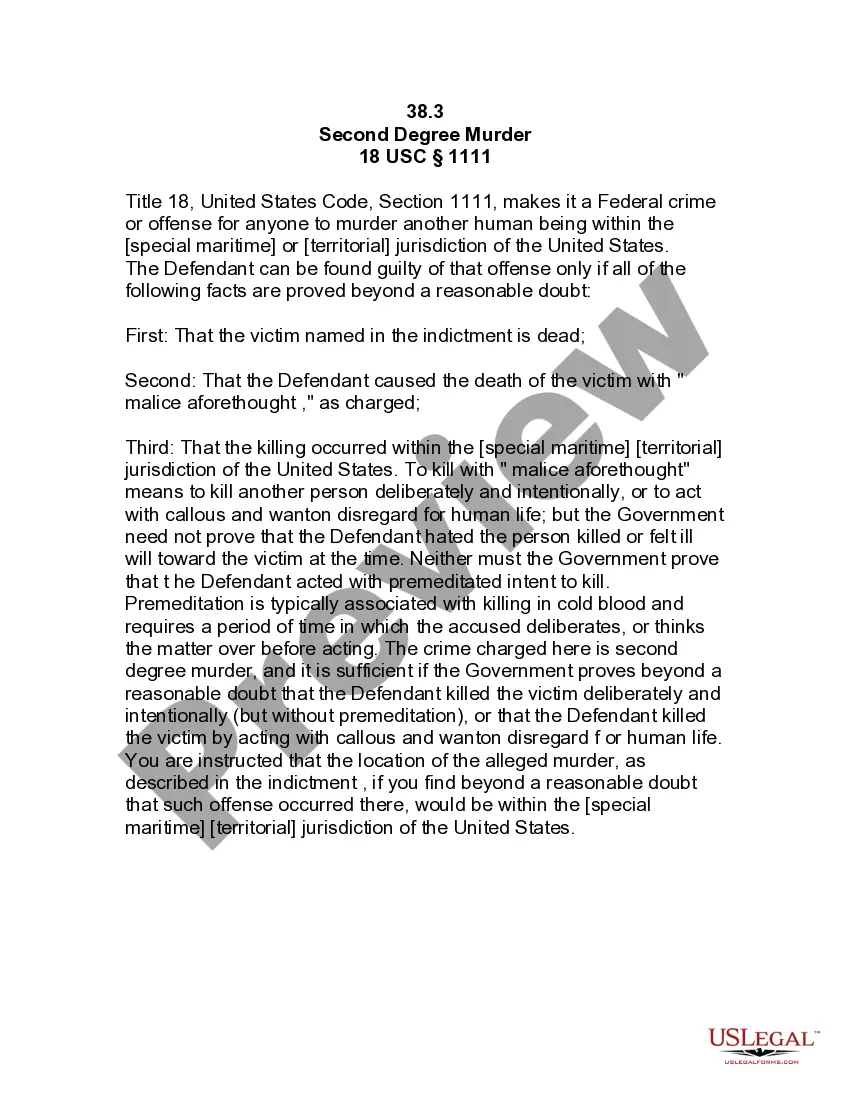
Get your form ready online
Our built-in tools help you complete, sign, share, and store your documents in one place.
Make edits, fill in missing information, and update formatting in US Legal Forms—just like you would in MS Word.
Download a copy, print it, send it by email, or mail it via USPS—whatever works best for your next step.
Sign and collect signatures with our SignNow integration. Send to multiple recipients, set reminders, and more. Go Premium to unlock E-Sign.
If this form requires notarization, complete it online through a secure video call—no need to meet a notary in person or wait for an appointment.
We protect your documents and personal data by following strict security and privacy standards.

Make edits, fill in missing information, and update formatting in US Legal Forms—just like you would in MS Word.

Download a copy, print it, send it by email, or mail it via USPS—whatever works best for your next step.

Sign and collect signatures with our SignNow integration. Send to multiple recipients, set reminders, and more. Go Premium to unlock E-Sign.

If this form requires notarization, complete it online through a secure video call—no need to meet a notary in person or wait for an appointment.

We protect your documents and personal data by following strict security and privacy standards.
Looking for another form?
How to fill out Jury Instruction - First Degree Murder - Premeditated Murder - Transferred Intent?
Legislation and guidelines in every sector differ across the nation.
If you're not an attorney, it's simple to become confused by countless standards regarding the creation of legal documents.
To evade costly legal support when drafting the Clark Jury Instruction - First Degree Murder - Premeditated Murder - Transferred Intent, you require a certified template applicable for your county.
Complete and sign the template by hand after printing it or execute everything electronically. This is the simplest and most cost-effective method to obtain contemporary templates for any legal purposes. Find them all with a few clicks and keep your documentation organized with the US Legal Forms!
- Examine the page content to confirm you have located the right sample.
- Utilize the Preview feature or review the form description if it is provided.
- Search for another document if there are discrepancies with your specifications.
- Press the Buy Now button to acquire the template once you identify the appropriate one.
- Select one of the subscription options and either Log In or create an account.
- Choose your preferred method to pay for your subscription (via credit card or PayPal).
- Pick the format in which you wish to save the file and click Download.
Form popularity
FAQ
In 2005, the United States Supreme Court held that offenders under the age of 18 at the time of the murder was exempt from the death penalty under Roper v. Simmons....New Mexico. OffenseMandatory SentencingSecond Degree MurderMaximum of 15 years in prisonFirst Degree MurderLife (minimum of 30 years)3 more rows
Life Sentences On August 1, 1989, Minnesota changed the mandatory minimum prison term for a life sentence to 30 years. Prior to this change, the mandatory minimum prison term for a life sentence was 17 years.
Murder in the first degree is punished by life imprisonment in Minnesota. The best defense to first-degree murder depends on the facts of the case. Some murder defenses are complete, meaning the person will be found not guilty if believed by the judge or jury.
In fact, Minnesota has enacted what are known as Mandatory Minimum sentences for individuals convicted of first-degree murder. Under the Mandatory Minimum sentencing guideline, a person found guilty of murder in the first degree will receive a life sentence without the possibility of parole.
Since Minnesota does not have the death penalty, the harshest punishment for those convicted of first-degree murder is life in prison. An element of the first-degree murder statute is the intent to kill.
Under the Mandatory Minimum sentencing guideline, a person found guilty of murder in the first degree will receive a life sentence without the possibility of parole. Some crimes that are punishable by a first-degree murder charge include: Rape murder. Murder of a law enforcement officer.
First Degree Murder: Class A Felony, Maximum of life without the possibility of parole and a fine. Aggravated First-Degree Murder: Mandatory life imprisonment with a mandatory minimum of 30 years in prison without the possibility of parole and a fine.
Six types of murder and three types of manslaughter First degree murder highest level of premeditation and indifference to the victim. Second degree murder There was a definite intent to harm but not necessarily kill. Third degree murder The death happened as a result of indifference or neglect.
The transferred intent doctrine is only used for completed crimes, and is not used for attempted crimes.
The three common-law intents ranked in order of culpability are malice aforethought, specific intent, and general intent. Specific intent is the intent to bring about a certain result, do something other than the criminal act, or scienter. General intent is simply the intent to perform the criminal act.