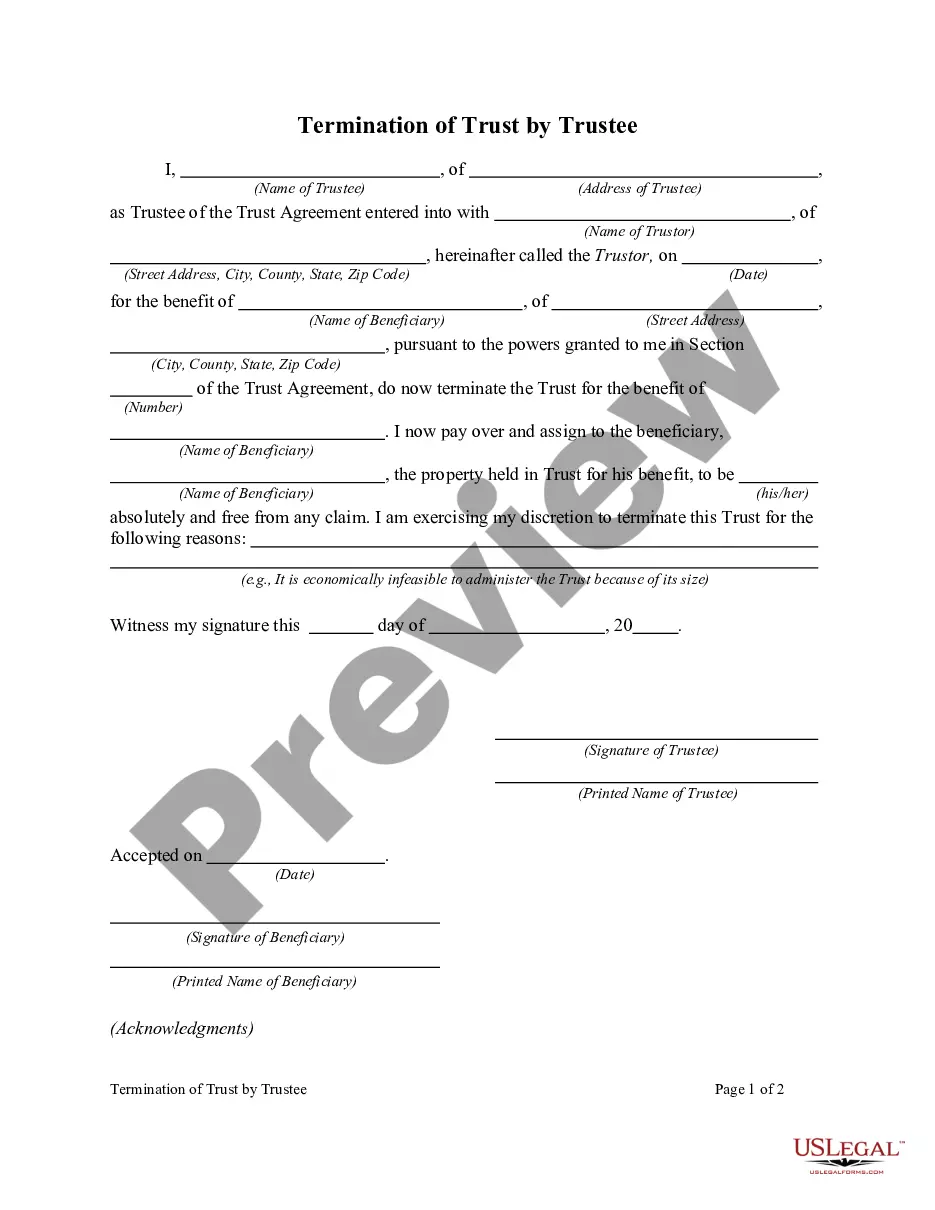
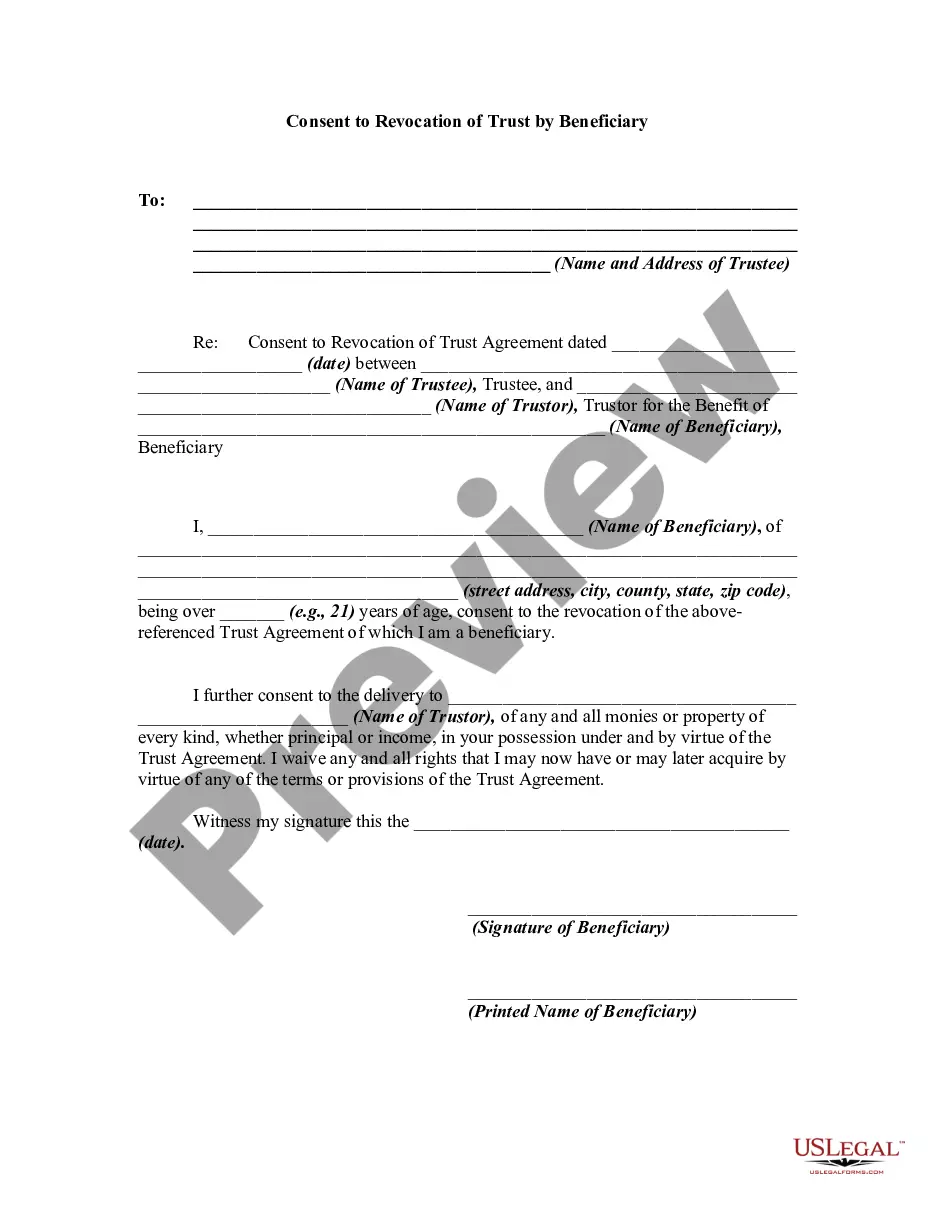
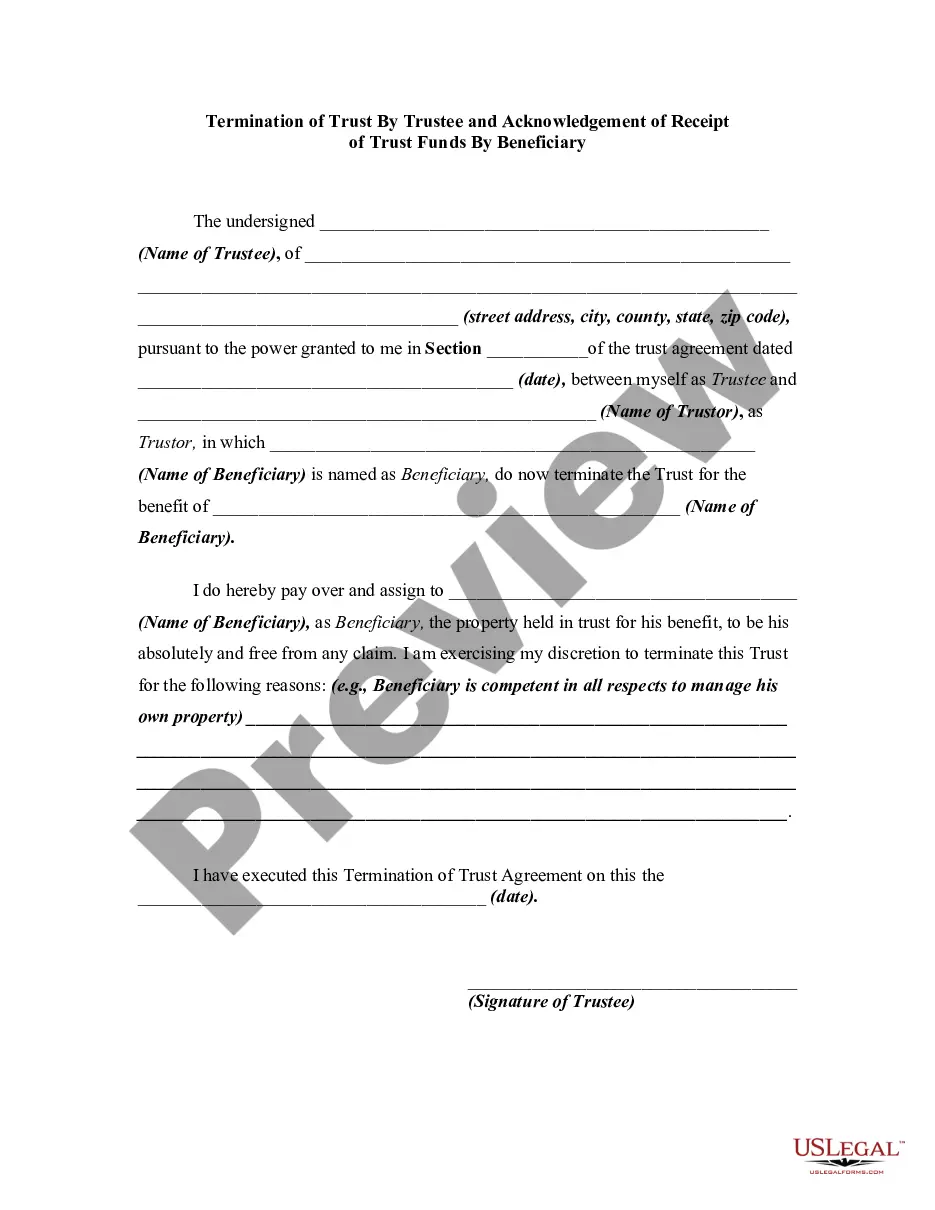
Fairfax Virginia Termination of Trust by Trustee
Description

Get your form ready online
Our built-in tools help you complete, sign, share, and store your documents in one place.
Make edits, fill in missing information, and update formatting in US Legal Forms—just like you would in MS Word.
Download a copy, print it, send it by email, or mail it via USPS—whatever works best for your next step.
Sign and collect signatures with our SignNow integration. Send to multiple recipients, set reminders, and more. Go Premium to unlock E-Sign.
If this form requires notarization, complete it online through a secure video call—no need to meet a notary in person or wait for an appointment.
We protect your documents and personal data by following strict security and privacy standards.

Make edits, fill in missing information, and update formatting in US Legal Forms—just like you would in MS Word.

Download a copy, print it, send it by email, or mail it via USPS—whatever works best for your next step.

Sign and collect signatures with our SignNow integration. Send to multiple recipients, set reminders, and more. Go Premium to unlock E-Sign.

If this form requires notarization, complete it online through a secure video call—no need to meet a notary in person or wait for an appointment.

We protect your documents and personal data by following strict security and privacy standards.
Looking for another form?
How to fill out Termination Of Trust By Trustee?
A paperwork procedure consistently accompanies any legal action you undertake.
Establishing a business, applying for or accepting a job proposal, transferring ownership, and numerous other life circumstances necessitate that you prepare formal documents that vary across the nation.
That’s the reason having everything organized in a single location is highly advantageous.
US Legal Forms is the largest online compilation of current federal and state-specific legal templates.
Utilize it as necessary: print it, or fill it out electronically, sign it, and file it where required. This is the simplest and most reliable method to acquire legal documents. All the samples available in our repository are expertly drafted and confirmed for compliance with local laws and regulations. Prepare your documents and manage your legal affairs effectively with US Legal Forms!
- On this platform, you can easily find and obtain a document for any personal or commercial purpose used in your locality, including the Fairfax Termination of Trust by Trustee.
- Finding forms on the platform is exceedingly simple.
- If you already possess a subscription to our service, Log In to your account, locate the sample using the search function, and click Download to save it on your device.
- After that, the Fairfax Termination of Trust by Trustee will be available for further usage in the My documents section of your profile.
- If you are utilizing US Legal Forms for the first time, follow this straightforward guideline to acquire the Fairfax Termination of Trust by Trustee.
- Confirm you have accessed the correct page with your local form.
- Utilize the Preview mode (if accessible) and scroll through the template.
- Review the description (if present) to ensure the form satisfies your needs.
- Look for another document through the search option in case the sample does not meet your requirements.
- Click Buy Now when you locate the necessary template.
- Choose the appropriate subscription plan and then sign in or register for an account.
- Select the preferred payment option (using a credit card or PayPal) to proceed.
- Choose the file format and download the Fairfax Termination of Trust by Trustee onto your device.
Form popularity
FAQ
When a trust is terminated, the trustee will distribute the trust assets to the beneficiaries according to the trust terms. This process also involves closing any trust accounts and settling any outstanding obligations. The termination effectively concludes the trust's legal existence. Understanding the nuances of the Fairfax Virginia Termination of Trust by Trustee helps ensure a smooth transition and mitigates potential conflicts.
There are a few ways to close your Suntrust account. You can call their customer service number at 1-800-SUNTRUST. Or you can visit a branch in person. If you call them, you will need to answer security questions to prove your identity.
Termination by appointment and advancement In order to do this the trustees will, in most cases, have to exercise their power to appoint and advance. The trust deed will need to be checked, of course, but typically it would require the trustees to execute a deed of appointment and advancement.
Consent by Settlor and All Beneficiaries. Under Virginia Code Section 55-544.11(A), a court shall terminate an irrevocable trust if the settlor and all beneficiaries consent to the modification, even if the termination is inconsistent with a material purpose of the trust. Consent by all Beneficiaries.
As long as there are enough trustees remaining then the trustee can simply retire or else they can appoint someone else in their place before stepping down. If the trustee refuses to step down, then the first port of call is to check the trust document as that often contains express powers to remove trustees.
What Happens When a Trust Ends? Typically, a trust ends with the distribution of property. Usually, the deceased included instructions in the trust instrument regarding how the assets are to be distributed. When there are no instructions, the trustee and the beneficiaries must decide a fair way of splitting the assets.
Petitioning Court for Removal A petition for removal of a trustee can be filed by either a co-trustee or a beneficiary. This process can be further complicated if beneficiaries are also designated as trustees. The petition may also seek financial damages from the trustee.
The Virginia Uniform Trust Code requires that a court terminate or modify an irrevocable trust if upon petition the court finds that the settlor and all beneficiaries consent to the modification or termination2026even if the modification or termination is inconsistent with a material purpose of the trust. Virginia Code
TRUSTEE REQUIREMENTS If the settlor does not name a trustee, a court will appoint one. A trustee: 220e Must have active duties to perform. 220e Cannot be the sole trustee and the sole beneficiary.
A. The settlor, a cotrustee, or a beneficiary, or, in the case of a charitable trust, the Attorney General may petition the court to remove a trustee, or a trustee may be removed by the court on its own initiative.