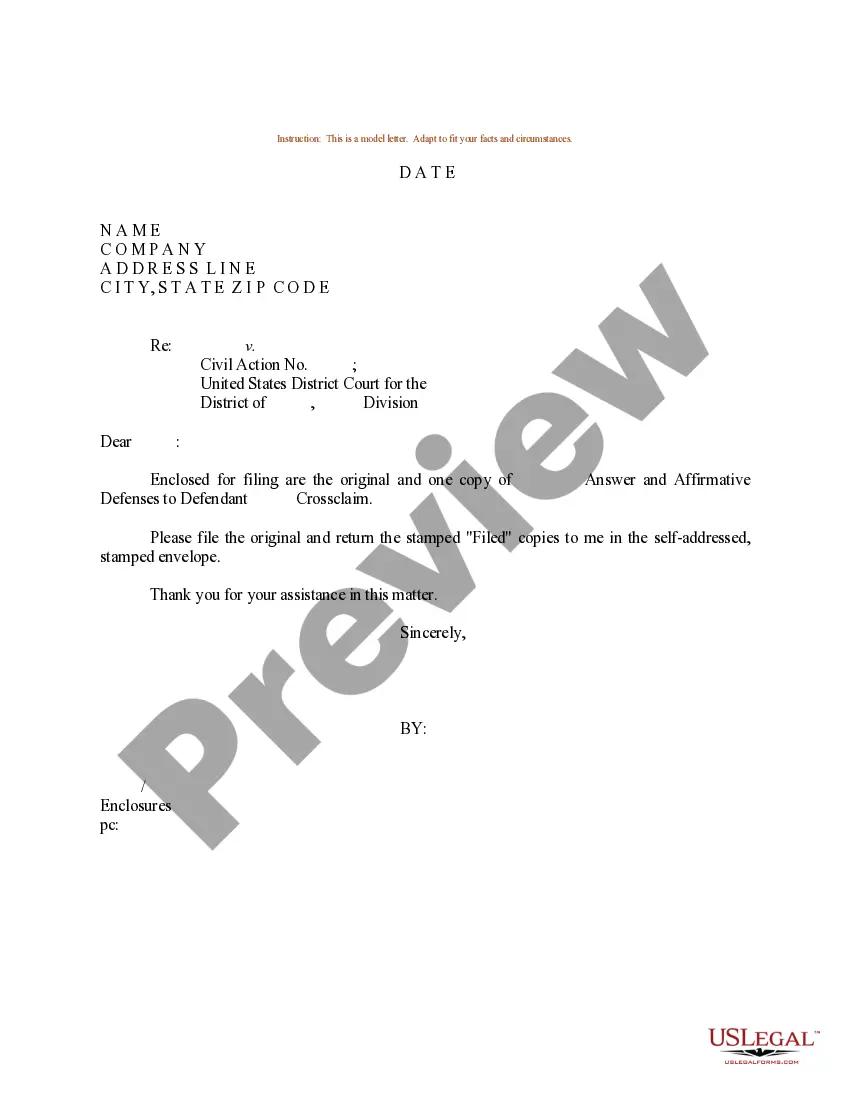
Allegheny Pennsylvania Sample Letter for Answer and Affirmative Defenses to Defendant's Crossclaim
Description
Get your form ready online
Our built-in tools help you complete, sign, share, and store your documents in one place.
Make edits, fill in missing information, and update formatting in US Legal Forms—just like you would in MS Word.
Download a copy, print it, send it by email, or mail it via USPS—whatever works best for your next step.
Sign and collect signatures with our SignNow integration. Send to multiple recipients, set reminders, and more. Go Premium to unlock E-Sign.
If this form requires notarization, complete it online through a secure video call—no need to meet a notary in person or wait for an appointment.
We protect your documents and personal data by following strict security and privacy standards.

Make edits, fill in missing information, and update formatting in US Legal Forms—just like you would in MS Word.

Download a copy, print it, send it by email, or mail it via USPS—whatever works best for your next step.

Sign and collect signatures with our SignNow integration. Send to multiple recipients, set reminders, and more. Go Premium to unlock E-Sign.

If this form requires notarization, complete it online through a secure video call—no need to meet a notary in person or wait for an appointment.

We protect your documents and personal data by following strict security and privacy standards.
Looking for another form?
How to fill out Sample Letter For Answer And Affirmative Defenses To Defendant's Crossclaim?
Preparing documents for business or personal requirements is consistently a significant obligation.
When establishing a contract, a public service application, or a power of attorney, it's crucial to evaluate all federal and state laws of the particular area.
Nonetheless, small counties and even municipalities also have legal stipulations that you need to take into account.
The remarkable feature of the US Legal Forms library is that all the documents you've ever obtained remain accessible - you can retrieve them in your profile within the My documents tab at any time. Join the platform and swiftly acquire verified legal templates for any circumstance with just a few clicks!
- All these aspects make it challenging and time-consuming to produce an Allegheny Sample Letter for Answer and Affirmative Defenses to Defendant's Crossclaim without expert assistance.
- It's simple to prevent wasting money on attorneys drafting your paperwork and generate a legally valid Allegheny Sample Letter for Answer and Affirmative Defenses to Defendant's Crossclaim independently, by utilizing the US Legal Forms online library.
- It is the most comprehensive online collection of state-specific legal documents that are professionally confirmed, ensuring their validity when selecting a sample for your county.
- Previously subscribed users only need to Log In to their accounts to download the required document.
- If you do not yet have a subscription, follow the step-by-step guide below to acquire the Allegheny Sample Letter for Answer and Affirmative Defenses to Defendant's Crossclaim.
- Browse the page you've accessed and verify if it contains the document you need.
- To achieve this, utilize the form description and preview if those options are provided.
Form popularity
FAQ
There is one situation where the burden of proof shifts from the prosecutor to the defendant. This occurs when a defendant raises an affirmative defense. An affirmative defense allows a defendant to be excused from liability even if the prosecutor proves their case.
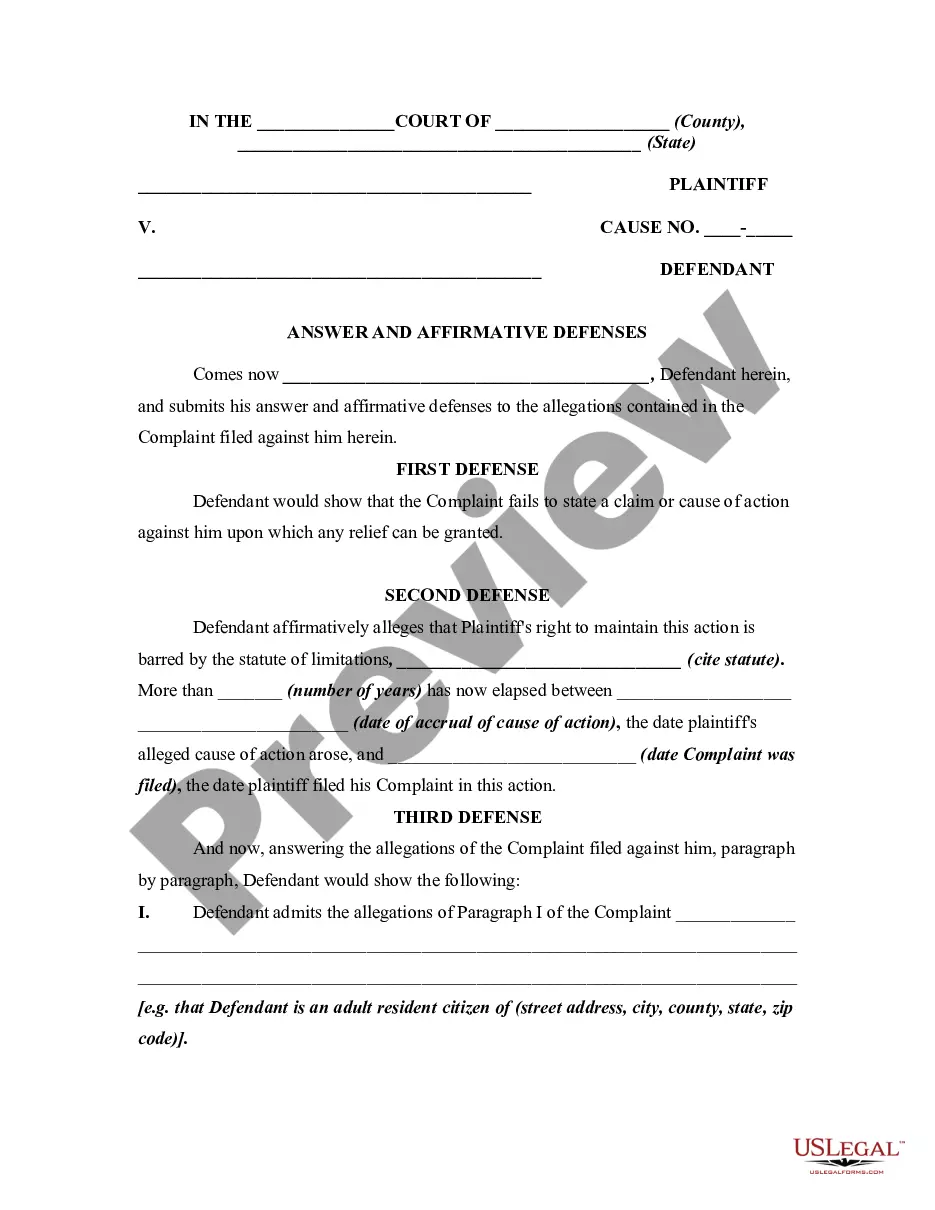
Following the admissions and denials, the answer outlines any affirmative defenses available to the defendant. Affirmative defenses, which are grounded in SUBSTANTIVE LAW, state that an allegation may or may not be true, but that even if it is true, the law provides a legal defense that defeats the plaintiff's claim.
HOW DOES A DEFENDANT RESPOND TO A COMPLAINT? YouTube Start of suggested clip End of suggested clip An. Answer is a written response to the complaint in California Superior Court pursuant toMoreAn. Answer is a written response to the complaint in California Superior Court pursuant to California Code of Civil Procedure Section 430 1.30 be an answer to a complaint.
Overview. Self-defense, entrapment, insanity, necessity, and respondeat superior are some examples of affirmative defenses. Under the Federal Rules of Civil Procedure Rule 56, any party may make a motion for summary judgment on an affirmative defense.
The defendant must offer proof at trial supporting the affirmative defense, meeting the standard of proof set by state law (usually a preponderance of the evidence, which is a lesser standard than the prosecution's).
An affirmative defense says, essentially, even if what you're saying is true, I'm not liable for reason XYZ. Examples of affirmative defenses include bankruptcy, statute of limitations and self-defense.
When drafting an answer, one must: (1) follow the local, state, and federal court rules; (2) research the legal claims in the adversary's complaint; (3) respond to the adversary's factual allegations; and (4) assert affirmative defenses, counterclaims, cross-claims, or third-party claims, if applicable.
Write your answer Only tell the court that you agree, disagree or you do not know if the statement is true. Lawyers usually write "the Defendant admits...," if you agree with the statement. They write "Defendant denies...," if you disagree with the statement.
Overview. Self-defense, entrapment, insanity, necessity, and respondeat superior are some examples of affirmative defenses. Under the Federal Rules of Civil Procedure Rule 56, any party may make a motion for summary judgment on an affirmative defense.
Asserting an Affirmative Defense: An Example Here's an example: In your jurisdiction, the affirmative defense of fraud has five elements, (1) a false representation; (2) about a material fact; (3) made with knowledge of its untruth; (4) with intent to deceive; and (5) defendant relied on the representation.