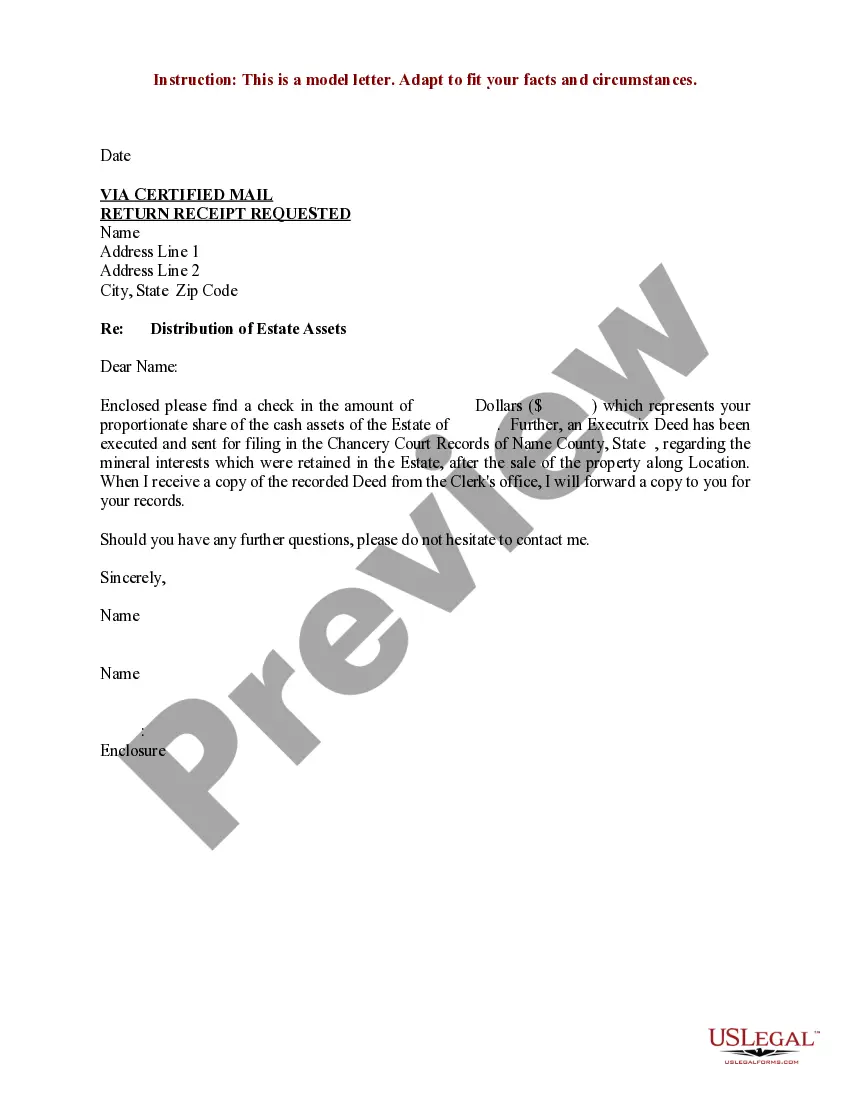
Dallas Texas Sample Letter for Assets and Liabilities of Decedent's Estate
Description
Get your form ready online
Our built-in tools help you complete, sign, share, and store your documents in one place.
Make edits, fill in missing information, and update formatting in US Legal Forms—just like you would in MS Word.
Download a copy, print it, send it by email, or mail it via USPS—whatever works best for your next step.
Sign and collect signatures with our SignNow integration. Send to multiple recipients, set reminders, and more. Go Premium to unlock E-Sign.
If this form requires notarization, complete it online through a secure video call—no need to meet a notary in person or wait for an appointment.
We protect your documents and personal data by following strict security and privacy standards.

Make edits, fill in missing information, and update formatting in US Legal Forms—just like you would in MS Word.

Download a copy, print it, send it by email, or mail it via USPS—whatever works best for your next step.

Sign and collect signatures with our SignNow integration. Send to multiple recipients, set reminders, and more. Go Premium to unlock E-Sign.

If this form requires notarization, complete it online through a secure video call—no need to meet a notary in person or wait for an appointment.

We protect your documents and personal data by following strict security and privacy standards.
Looking for another form?
How to fill out Sample Letter For Assets And Liabilities Of Decedent's Estate?
A paperwork process always accompanies any legal action you undertake.
Launching a business, applying for or accepting a job offer, transferring ownership, and various other life situations necessitate that you prepare official documentation that varies across different regions.
This is why having everything consolidated in one location is extremely beneficial.
US Legal Forms offers the largest online repository of current federal and state-specific legal forms.
Utilize it as needed: print it out or complete it electronically, sign it, and submit it wherever required. This is the easiest and most dependable method to obtain legal documents. All templates offered by our library are expertly crafted and verified for compliance with local laws and regulations. Prepare your documentation and manage your legal matters efficiently with US Legal Forms!
- Here, you can effortlessly find and download a document for any personal or professional purpose utilized in your area, including the Dallas Sample Letter for Assets and Liabilities of Decedent's Estate.
- Finding samples on the platform is remarkably straightforward.
- If you already possess a subscription to our library, Log In to your account, search for the sample using the search bar, and click Download to save it on your device.
- Subsequently, the Dallas Sample Letter for Assets and Liabilities of Decedent's Estate will be accessible for future use in the My documents section of your profile.
- If you are engaging with US Legal Forms for the first time, follow this brief guide to obtain the Dallas Sample Letter for Assets and Liabilities of Decedent's Estate.
- Ensure you have accessed the correct page with your localized form.
- Utilize the Preview mode (if available) and browse through the template.
- Review the description (if any) to verify that the template meets your needs.
- Search for an alternative document using the search tab if the sample does not suit you.
- Click Buy Now once you identify the necessary template.
- Choose an appropriate subscription plan, then either sign in or create an account.
- Select your preferred payment method (via credit card or PayPal) to proceed.
- Choose the file format and download the Dallas Sample Letter for Assets and Liabilities of Decedent's Estate to your device.
Form popularity
FAQ
The general rule in Texas is that the executor has four years from the date of death of the testator (person who drafted the will) to file for probate.
The assets and liabilities that form part of the estate include: Real property (real estate) Stocks and bonds. Life insurance.
The statute of limitations on debt in Texas is four years.
A creditor may file a claim within two years from the date of death of a decedent. After two years, all creditor claims are barred. 1 During such two year period, a personal representative may take action to shorten the time in which a creditor may file a claim against a decedent's estate.
You should wait 10 months before distributing the estate because claimants who want to challenge a Will have six months from the issue of a Grant of Probate to bring a claim under the Inheritance (Provision for Family and Dependants) Act 1975 (the Act).
1. A general notice to creditors must be published within one month of the issuance of letters testamentary. The notice must be in a newspaper of general circulation in the county in which the letters were issued.
The statute of limitations on debt in Texas is four years.
An estate asset is property that was owned by the deceased at the time of death. Examples include bank accounts, investments, retirement savings, real estate, artwork, jewellery, a business, a corporation, household furnishings, vehicles, computers, smartphones, and any debts owed to the deceased.
Order of Payment for Debts of the Estate Following satisfaction of outstanding federal tax obligations, the standard order of priority in Texas for payment of an estate's debts can generally be summarized as follows: Funeral expenses and medical expenses of the decedent's last illnesses, up to $15,000.
"Gross estate" is a term used to describe the total dollar value of an individual's assets at the time of their death. A gross estate value does not consider his figure debts owed and tax liabilities. Once liabilities are deducted from a gross estate value, the remaining sum represents the estate's net value.
