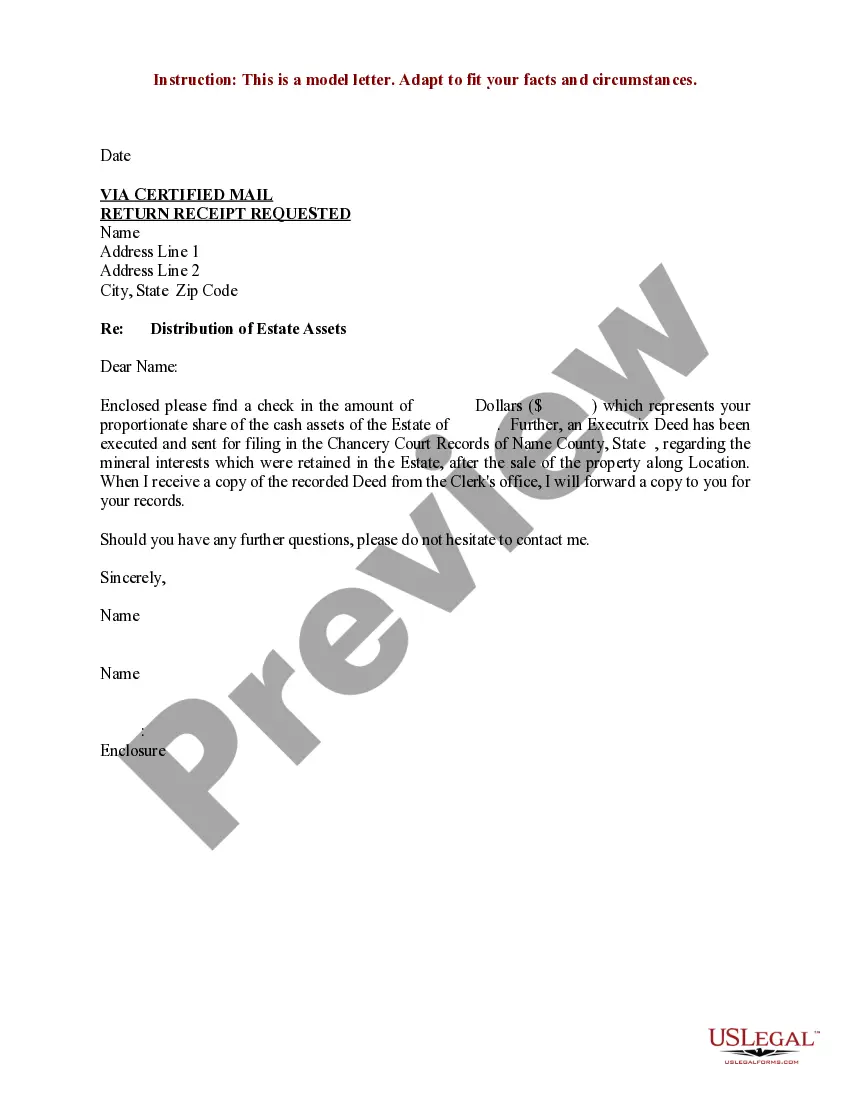
Travis Texas Sample Letter for Distribution of Estate Assets
Description
Get your form ready online
Our built-in tools help you complete, sign, share, and store your documents in one place.
Make edits, fill in missing information, and update formatting in US Legal Forms—just like you would in MS Word.
Download a copy, print it, send it by email, or mail it via USPS—whatever works best for your next step.
Sign and collect signatures with our SignNow integration. Send to multiple recipients, set reminders, and more. Go Premium to unlock E-Sign.
If this form requires notarization, complete it online through a secure video call—no need to meet a notary in person or wait for an appointment.
We protect your documents and personal data by following strict security and privacy standards.

Make edits, fill in missing information, and update formatting in US Legal Forms—just like you would in MS Word.

Download a copy, print it, send it by email, or mail it via USPS—whatever works best for your next step.

Sign and collect signatures with our SignNow integration. Send to multiple recipients, set reminders, and more. Go Premium to unlock E-Sign.

If this form requires notarization, complete it online through a secure video call—no need to meet a notary in person or wait for an appointment.

We protect your documents and personal data by following strict security and privacy standards.
Looking for another form?
How to fill out Sample Letter For Distribution Of Estate Assets?
A paperwork routine always accompanies any legal undertaking you perform.
Establishing a business, applying for or accepting a job offer, transferring ownership, and many other life circumstances require you to prepare formal documentation that differs from one jurisdiction to another. That’s why having everything aggregated in one spot is so beneficial.
US Legal Forms is the largest online repository of current federal and state-specific legal templates.
On this site, you can effortlessly locate and acquire a document for any personal or business need used in your region, including the Travis Sample Letter for Distribution of Estate Assets.
Utilize it as needed: print it or fill it out electronically, sign it, and send it where required. This is the simplest and most dependable method to obtain legal documents. All the samples available in our library are professionally drafted and verified for compliance with local laws and regulations. Prepare your documentation and handle your legal matters effectively with US Legal Forms!
- Finding templates on the site is extremely straightforward.
- If you already hold a subscription to our service, Log In to your account, search for the sample using the search bar, and click Download to save it on your device.
- Subsequently, the Travis Sample Letter for Distribution of Estate Assets will be available for future use in the My documents section of your profile.
- If you are using US Legal Forms for the first time, follow this brief guide to obtain the Travis Sample Letter for Distribution of Estate Assets.
- Ensure you have accessed the correct page with your local form.
- Use the Preview mode (if available) and browse through the sample.
- Review the description (if provided) to confirm the template meets your requirements.
- If the sample doesn’t suit you, search for another document using the search function.
- Click Buy Now when you find the necessary template.
- Choose the appropriate subscription plan, then Log In or create an account.
- Select your preferred payment method (via credit card or PayPal) to proceed.
- Choose the file format and save the Travis Sample Letter for Distribution of Estate Assets on your device.
Form popularity
FAQ
Personal Belongings After Death Without a Will Once someone is named executor, they will be able to divvy up the personal and real property. The court may split property amongst all the beneficiaries as well. If there are no heirs, the entire estate may go directly to the state.
If the beneficiary outlives the person creating the estate plan, but dies before receiving the gift, the gift will go to the probate estate of the deceased beneficiary. It will then go to the appropriate heirs.
If there is no will, then the estate can be distributed by an administrator under Letters of Administration. To make either application, the executor or administrator has to swear an oath or make a statement of truth to the effect that they will administer the estate in accordance with the law.
Generally speaking, the executor of a will cannot take everything simply based on their status as executor. Executors are bound by the terms of the will and must distribute assets as the will directs. This means that executors cannot ignore the asset distribution in the will and take everything for themselves.
Most assets can be distributed by preparing a new deed, changing the account title, or by giving the person a deed of distribution. For example: To transfer a bank account to a beneficiary, you will need to provide the bank with a death certificate and letters of administration.
Disbursements are payments made from the estate to pay debts of the deceased, funeral bills, and all ongoing costs of administering the estate (funeral expenses, storage fees, and attorney's fees). As the executor, it is your responsibility to determine if the estate's assets can cover all outstanding debts and bills.
As an Executor, you should ideally wait 10 months from the date of the Grant of Probate before distributing the estate. The Grant of Probate is the document obtained from the court which gives the legal authority for you to deal with the estate.
According to the UPC, close relatives always come first in the order of inheritance. Generally speaking, the surviving spouse is first in line to inherit, with children and grandchildren next in line. If the surviving spouse has any minor children, they may inherit the whole estate.
If you need to close a bank account of someone who has died, and probate is required to do so, then the bank won't release the money until they have the grant of probate. Once the bank has all the necessary documents, typically, they will release the funds within two weeks.
Most assets can be distributed by preparing a new deed, changing the account title, or by giving the person a deed of distribution. For example: To transfer a bank account to a beneficiary, you will need to provide the bank with a death certificate and letters of administration.