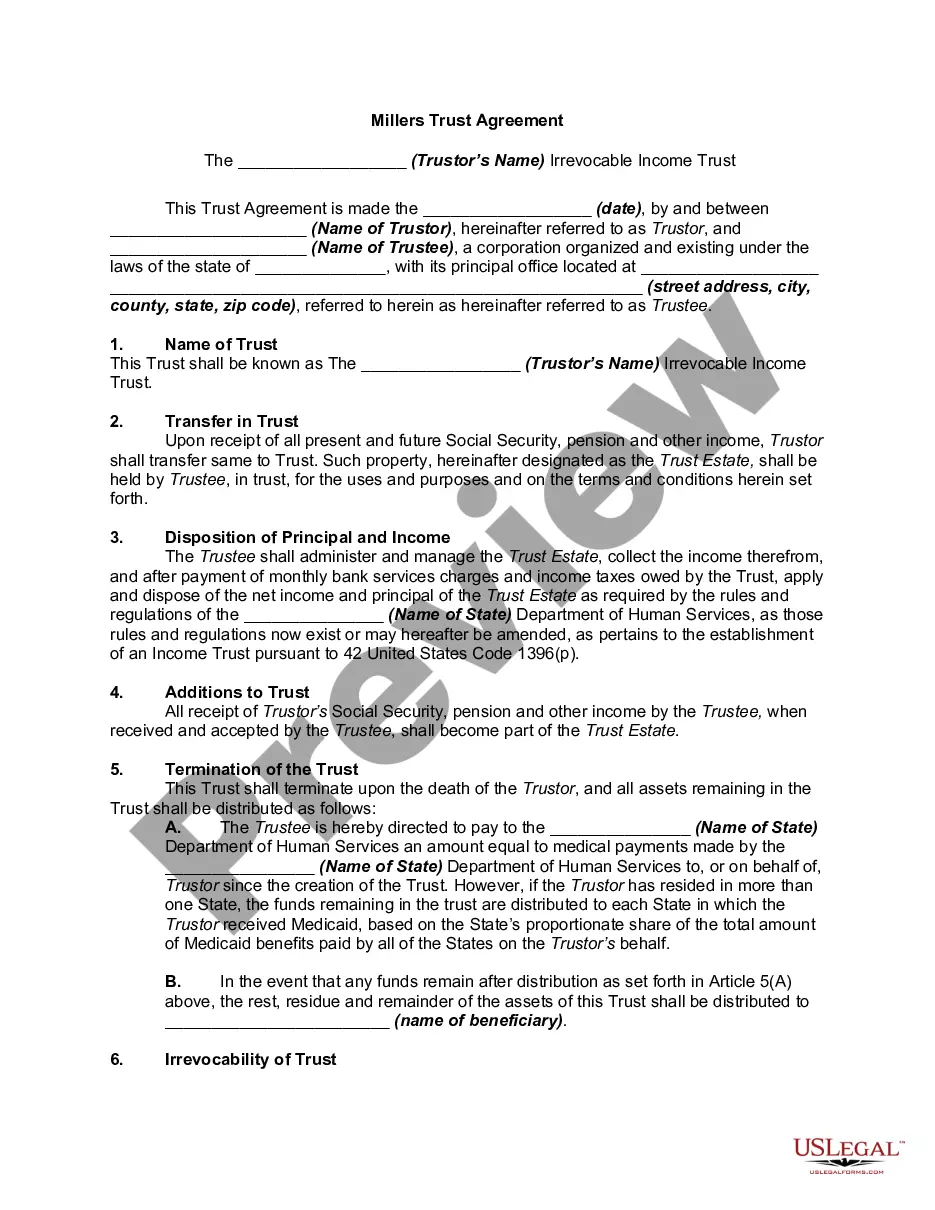
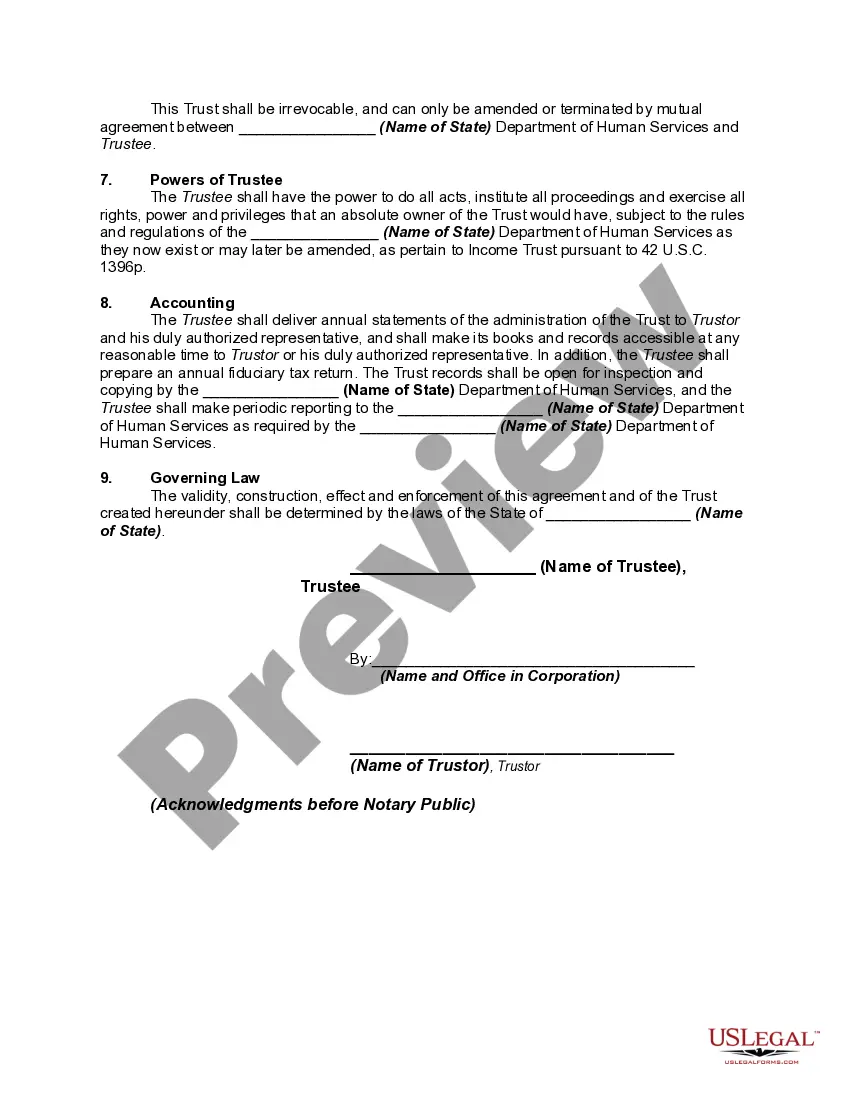
Mecklenburg North Carolina Miller Trust Forms for Medicaid
Description

Get your form ready online
Our built-in tools help you complete, sign, share, and store your documents in one place.
Make edits, fill in missing information, and update formatting in US Legal Forms—just like you would in MS Word.
Download a copy, print it, send it by email, or mail it via USPS—whatever works best for your next step.
Sign and collect signatures with our SignNow integration. Send to multiple recipients, set reminders, and more. Go Premium to unlock E-Sign.
If this form requires notarization, complete it online through a secure video call—no need to meet a notary in person or wait for an appointment.
We protect your documents and personal data by following strict security and privacy standards.

Make edits, fill in missing information, and update formatting in US Legal Forms—just like you would in MS Word.

Download a copy, print it, send it by email, or mail it via USPS—whatever works best for your next step.

Sign and collect signatures with our SignNow integration. Send to multiple recipients, set reminders, and more. Go Premium to unlock E-Sign.

If this form requires notarization, complete it online through a secure video call—no need to meet a notary in person or wait for an appointment.

We protect your documents and personal data by following strict security and privacy standards.
Looking for another form?
How to fill out Miller Trust Forms For Medicaid?
Preparing documents for professional or personal necessities is consistently a significant obligation.
When formulating a contract, a public service application, or a power of attorney, it is crucial to evaluate all federal and state laws of the particular region.
Nonetheless, minor counties and even towns also possess legislative measures that you must take into account.
Enrol in the platform and conveniently access verified legal documents for any purpose with just a few clicks!
- All these factors contribute to the anxiety and duration required to produce Mecklenburg Miller Trust Forms for Medicaid without professional assistance.
- It's feasible to avert spending on attorneys to create your forms and generate a legally valid Mecklenburg Miller Trust Forms for Medicaid independently, utilizing the US Legal Forms online repository.
- It is the largest online compilation of state-specific legal documents that are professionally verified, ensuring their legitimacy when you pick a template for your county.
- Previous subscribers only need to Log In to their accounts to retrieve the necessary document.
- If you haven't subscribed yet, follow the steps outlined below to acquire the Mecklenburg Miller Trust Forms for Medicaid.
- Examine the page you have opened and confirm if it contains the document you need.
- For this, utilize the form description and preview if available.
Form popularity
FAQ
A Miller Trust is specifically designed to qualify an individual for Medicaid benefits by diverting all income into the trust. Income diverted to the trust is not counted as income for purposes of Medicaid eligibility when attempting to qualify for nursing home care. A Miller Trust can only hold the applicant's income.
Miller Trusts can be used to pay for a small monthly allowance, Medicare premiums and medical expenses that are not covered by Medicaid. Unlike other types of trusts, there are very few restrictions on who can establish a Miller Trust to qualify for government benefits.
For 2022, an individual must have a monthly income of $2,523 or less to be eligible for Ohio Medicaid assistance to pay for either nursing home care or home or community-based services. (If both spouses are applying, the monthly income limit is $5,046.)
In 2022, this is $2,523 / month for an individual. A portion, or all of one's income, can be directly deposited into a Miller trust and it is not counted towards Medicaid's income limit. Therefore, this option allows an applicant to become income eligible.
Miller Trusts, also called Qualified Income Trusts, provide a way for Medicaid applicants who have income over Medicaid's limit to become eligible for Medicaid long term care. In short, income over Medicaid's limit, is put into a trust and therefore not counted as income, thus allowing the applicant to become eligible.
Qualified Income Trusts (QIT), also referred to as Miller Trusts, are intended for those who have an income greater than qualifications for Medicaid allow, yet don't have enough income to pay for long term care. With QIT's, an individual's excess income is directly deposited each month into a restricted funds account.
Miller Trusts are basically agreements where one person (called the trustee) agrees to hold and manage money for another person who needs long term care (called the beneficiary), and promises to spend the money only in ways approved by Idaho Dept. of Health & Welfare (primarily paying long term care costs).
The trust account will be used to pay the Medicaid income spend down and any other medical expenses not covered by Medicaid or other insurance. For example, payment of a health insurance premium, such as a Medicare supplemental insurance premium, is allowed.