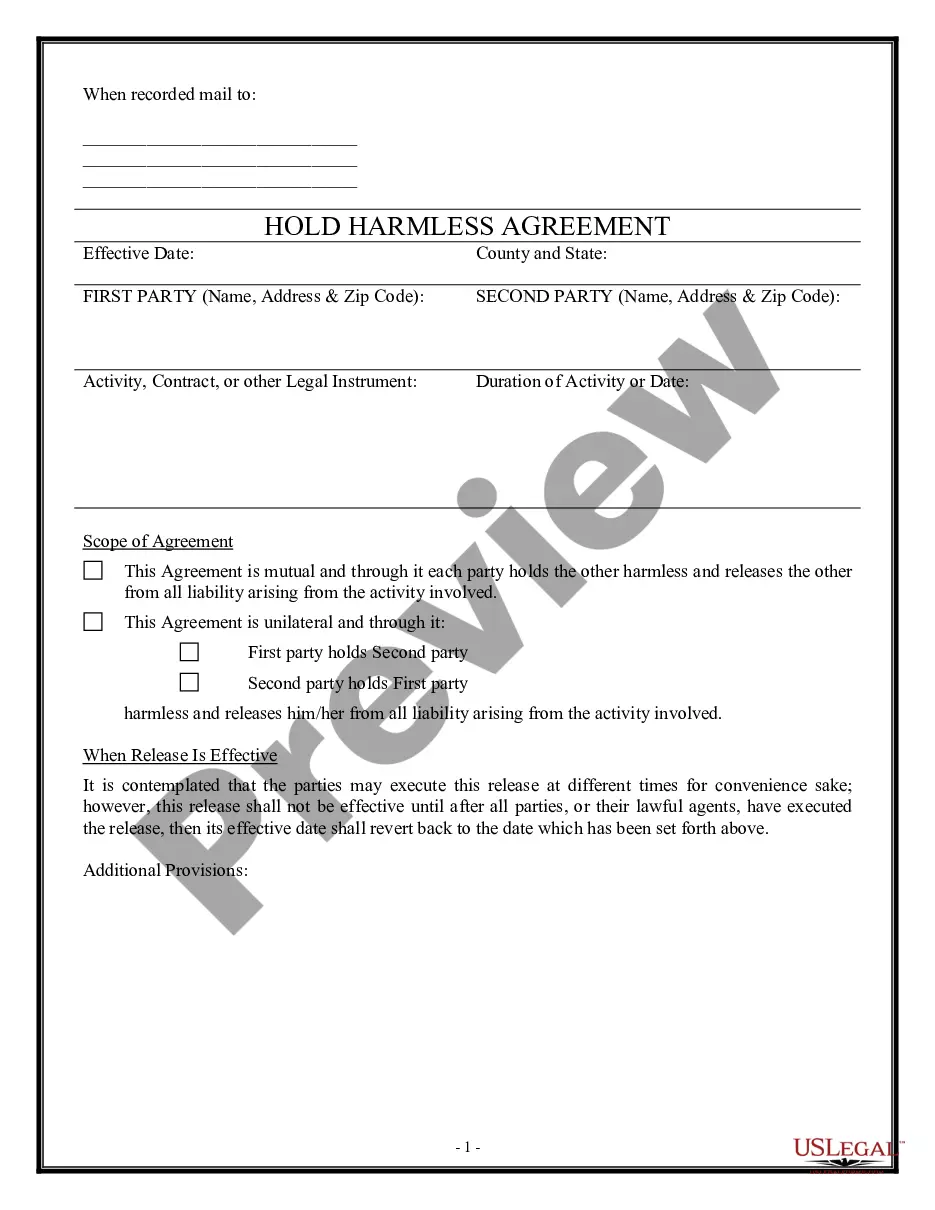
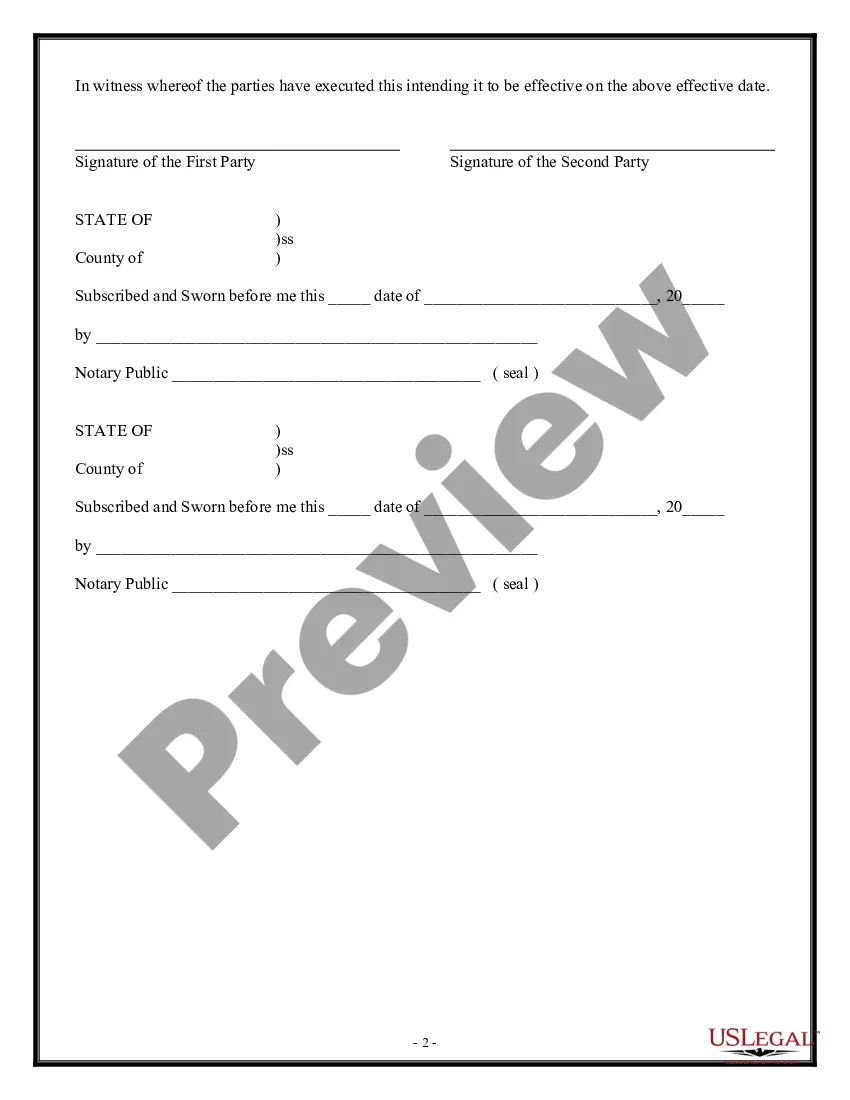
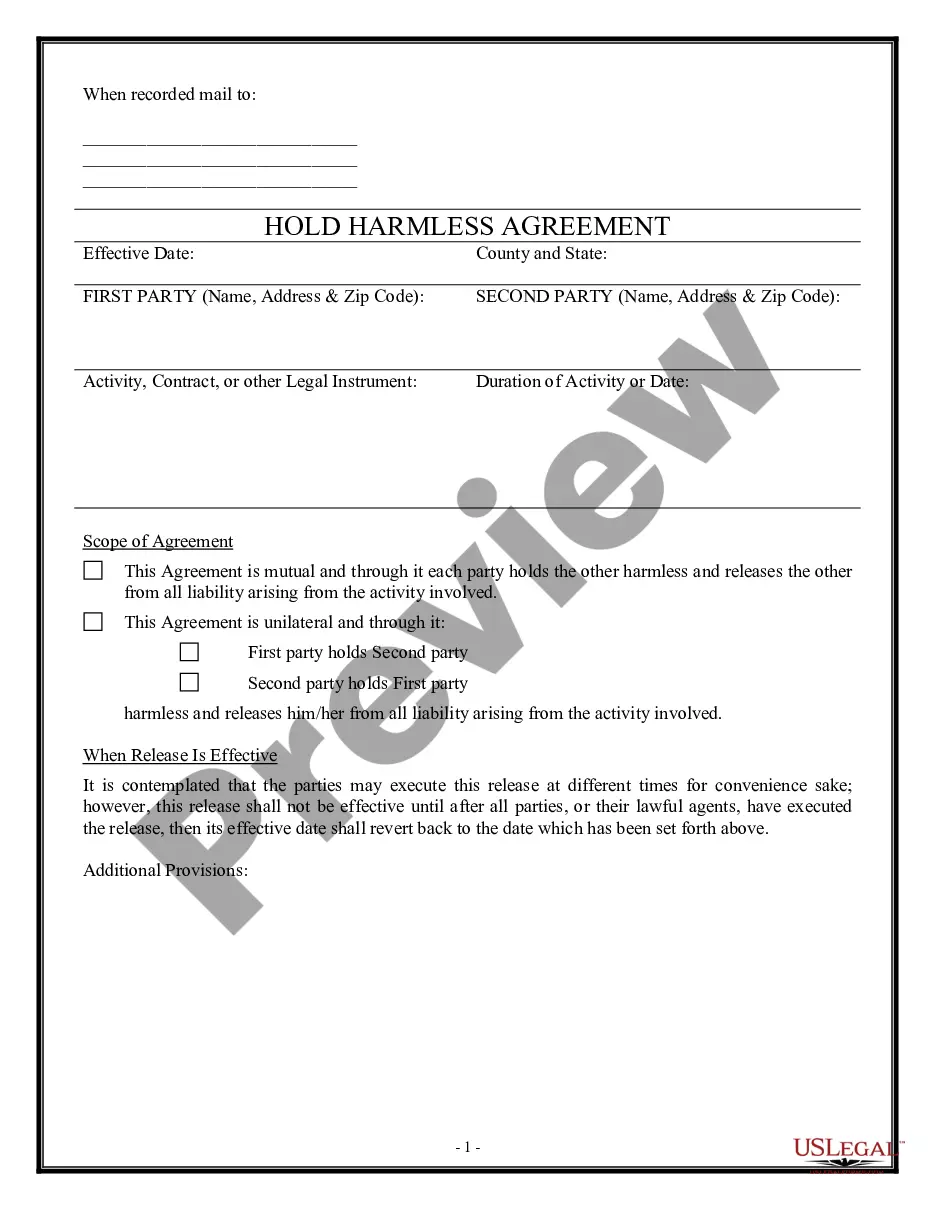
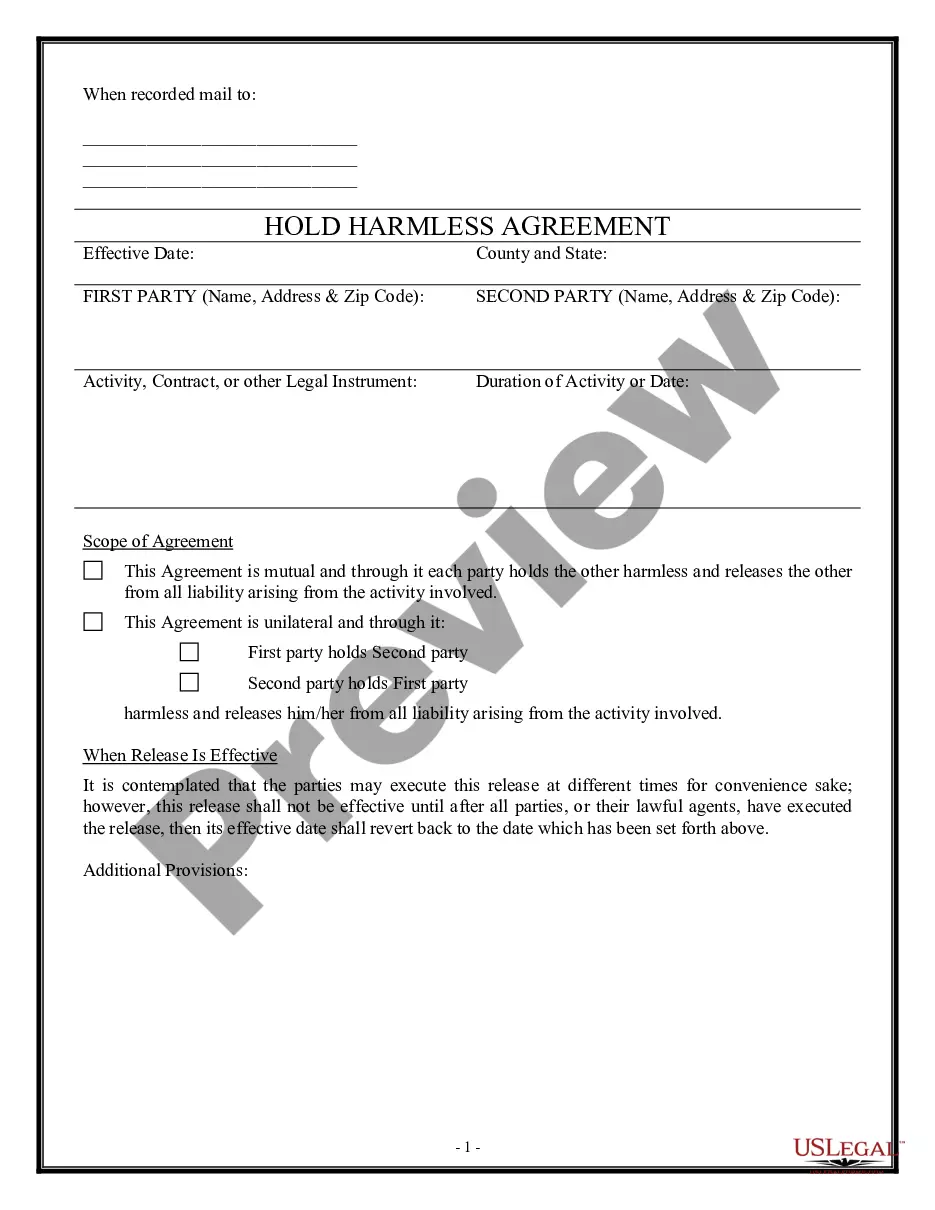
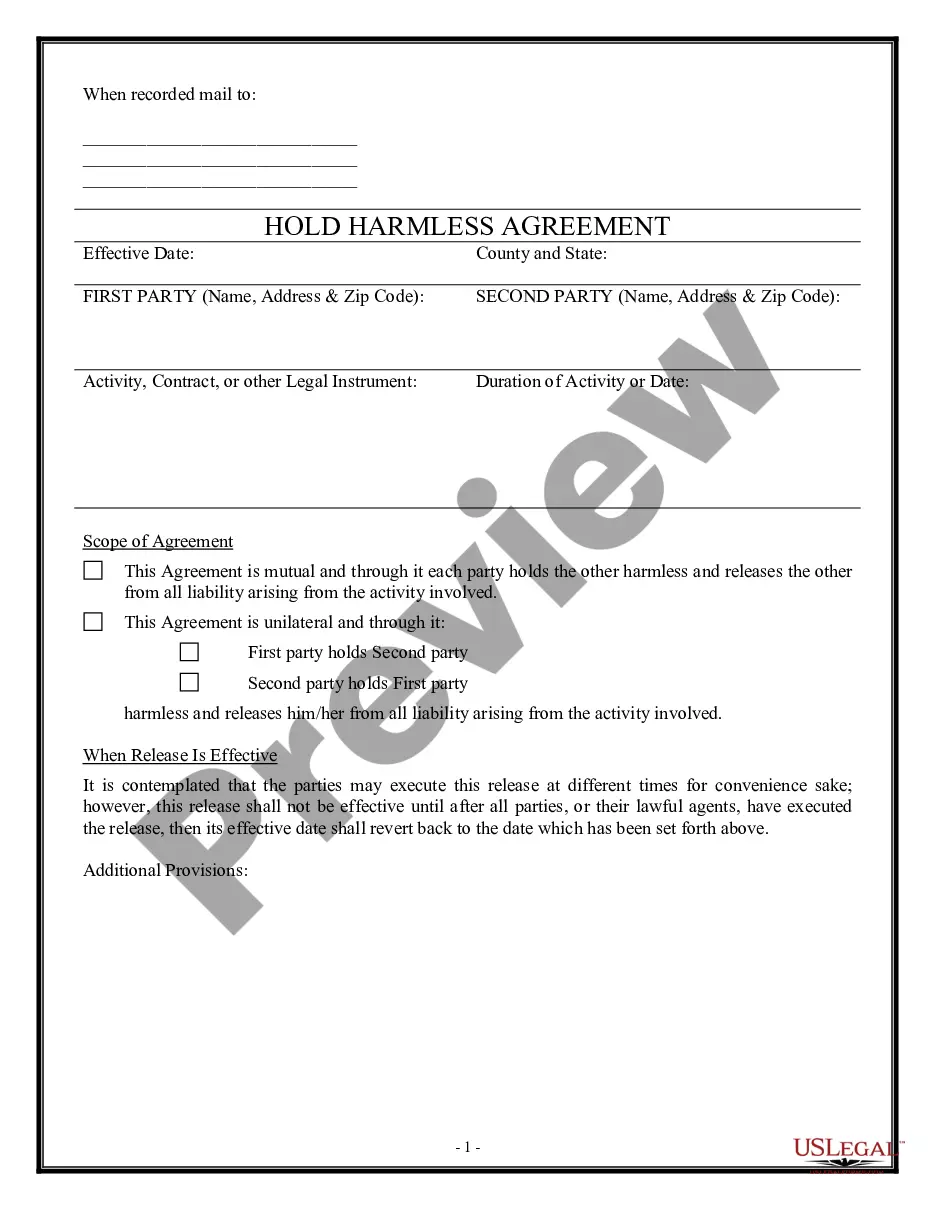
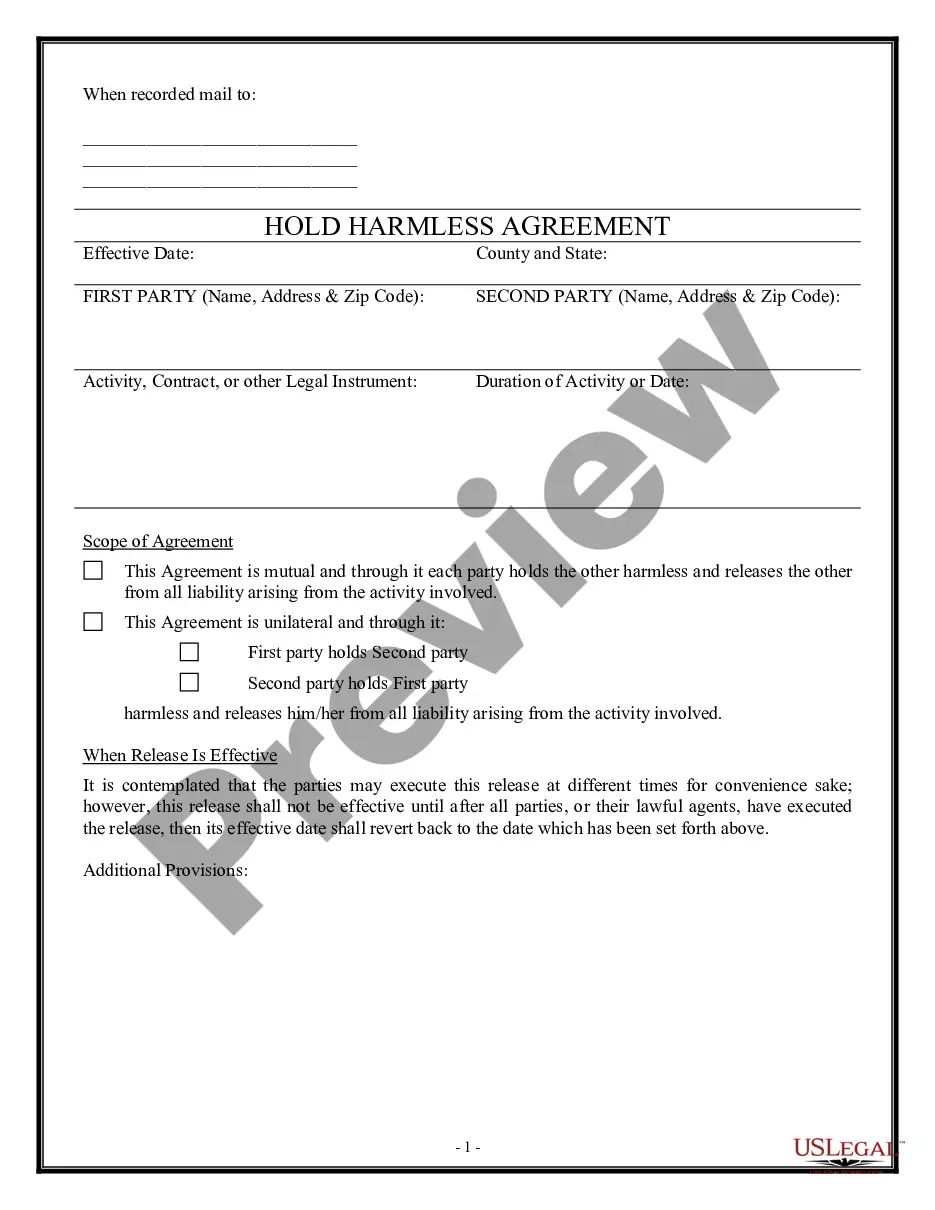
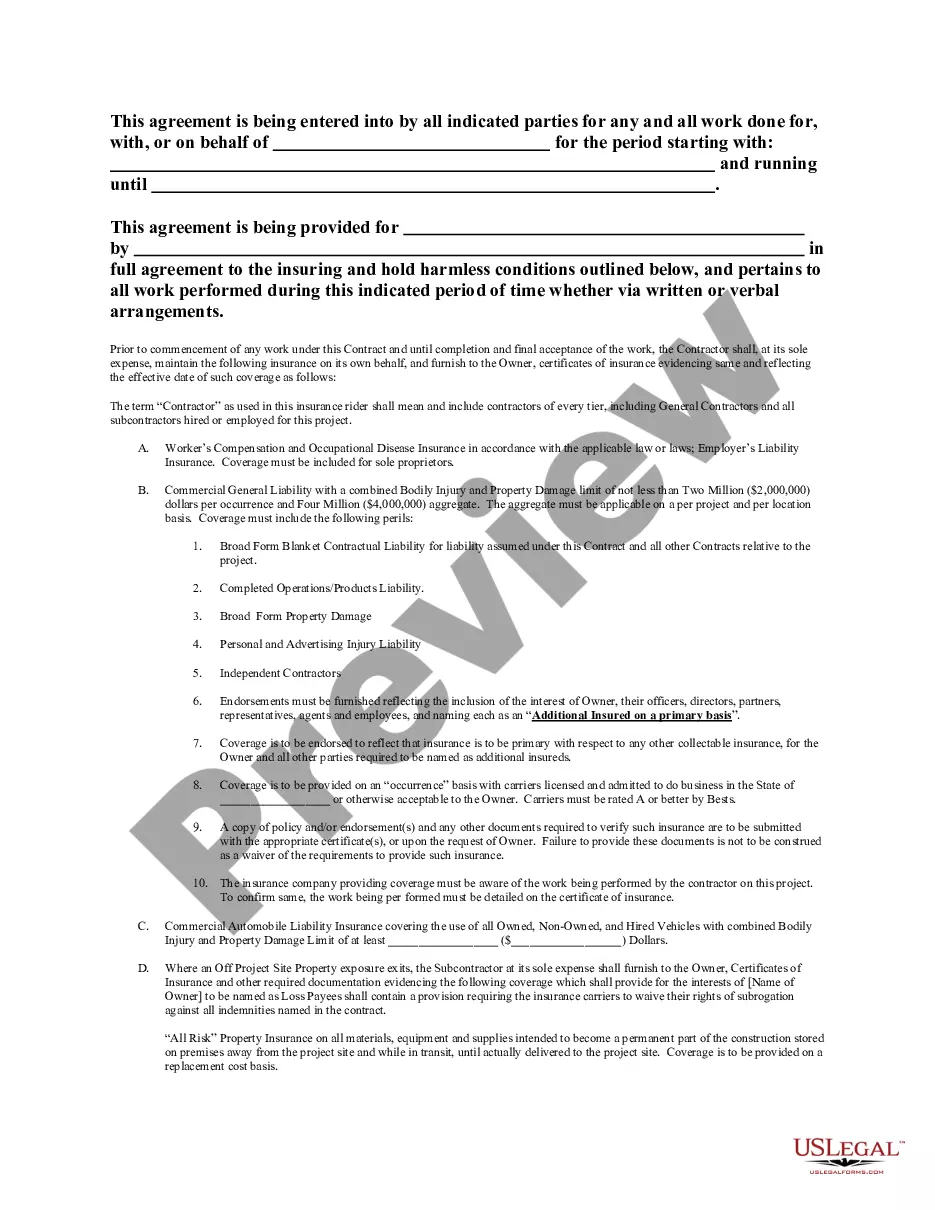
This form is a Hold Harmless Agreement. The form provides that the agreement is mutual and each party holds the other harmless and releases the other from all liability arising from the activity involved.
Newark New Jersey General Hold Harmless Agreement
Category:
State:
Multi-State
City:
Newark
Control #:
US-01708-AZ
Format:
Word;
Rich Text
Instant download
Description
Free preview




Form popularity
FAQ
Filling out a hold harmless agreement involves several straightforward steps. Start by entering the names of the parties involved, followed by a detailed description of the activities covered by the agreement. Next, specify the extent of liability that is being waived, and ensure you include a space for both parties to sign and date the document. To ensure accuracy, consider using a Newark New Jersey General Hold Harmless Agreement template from USLegalForms, which guides you through each necessary detail.
Yes, you can write your own hold harmless agreement, but it is important to ensure that it meets the legal requirements in Newark, New Jersey. When drafting this agreement, be clear and specific about the terms and the parties involved. However, using a standardized template from platforms like USLegalForms can simplify the process and help you avoid costly mistakes.
A hold harmless statement typically includes a clause where one party agrees not to hold the other party liable for any damages or injuries. For instance, in a Newark New Jersey General Hold Harmless Agreement, you might find a statement that indicates the contractor will not hold the property owner responsible for accidents that occur during construction. This type of statement protects both parties and clarifies their responsibilities.
In Newark, New Jersey, a hold harmless agreement does not typically require notarization to be valid. However, while notarization may not be necessary, it can provide an extra layer of legal protection. Always check local laws or consult a legal professional to ensure compliance. For reliable templates and further assistance, consider using US Legal Forms to navigate these requirements.
To complete a Newark New Jersey General Hold Harmless Agreement, start by clearly identifying the parties involved. Next, specify the scope of the agreement, including any activities or risks covered. Ensure that all details are accurate, and both parties sign the document to make it legally binding. If you need assistance, platforms like US Legal Forms provide templates and guidance to streamline the process.
In the context of the Newark New Jersey General Hold Harmless Agreement, there are three main types: broad, intermediate, and limited. A broad agreement protects the indemnified party from all claims, regardless of fault. An intermediate agreement covers claims arising from the indemnified party's negligence, while a limited agreement only covers specific risks outlined in the document. Understanding these types helps you choose the right agreement for your needs.
The primary purpose of a hold harmless agreement is to allocate risk and protect against potential legal claims. In Newark New Jersey general hold harmless agreements, this document serves to limit liability for one party while ensuring that the other party assumes certain risks. It creates a safer environment for activities such as events or contracts by clarifying responsibilities. By using USLegalForms, you can easily draft an agreement that clearly defines these terms to suit your unique situation.
A general hold harmless agreement is a legal document that protects one party from liability for damages or injuries that may occur during a specific activity or event. In the context of Newark New Jersey general hold harmless agreements, this document ensures that participants understand the risks involved and agree not to hold the other party responsible. By outlining the responsibilities and liabilities, it fosters a clear understanding between the parties. Utilizing platforms like USLegalForms can help you create a tailored agreement that meets your specific needs.
A hold harmless letter can be provided by various parties depending on the context. Typically, landlords, contractors, or service providers issue a Newark New Jersey General Hold Harmless Agreement to protect themselves from potential legal claims. This agreement serves as a formal acknowledgment that one party agrees not to hold the other party liable for certain damages or injuries. You can easily find templates and guidance on creating an effective hold harmless letter through platforms like USLegalForms.