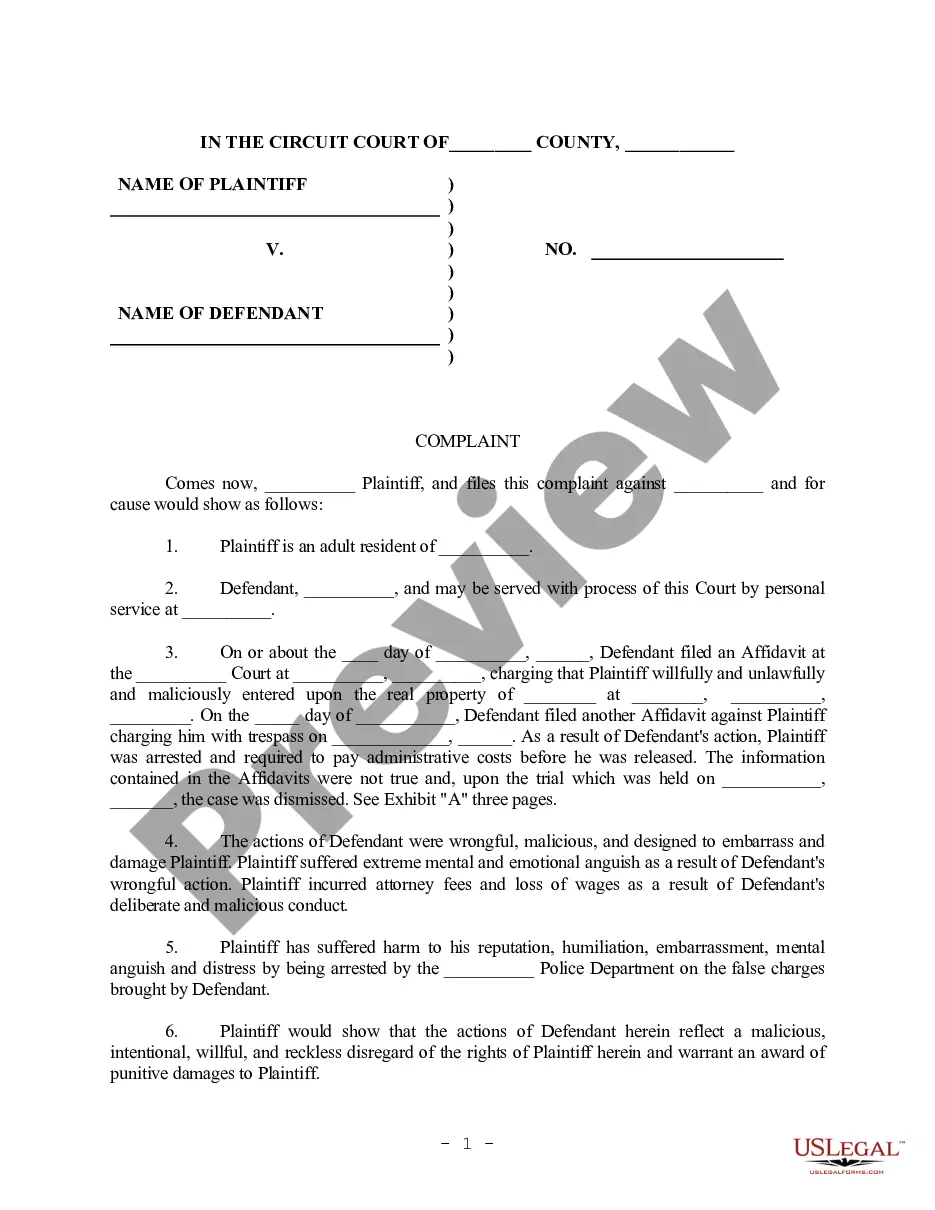
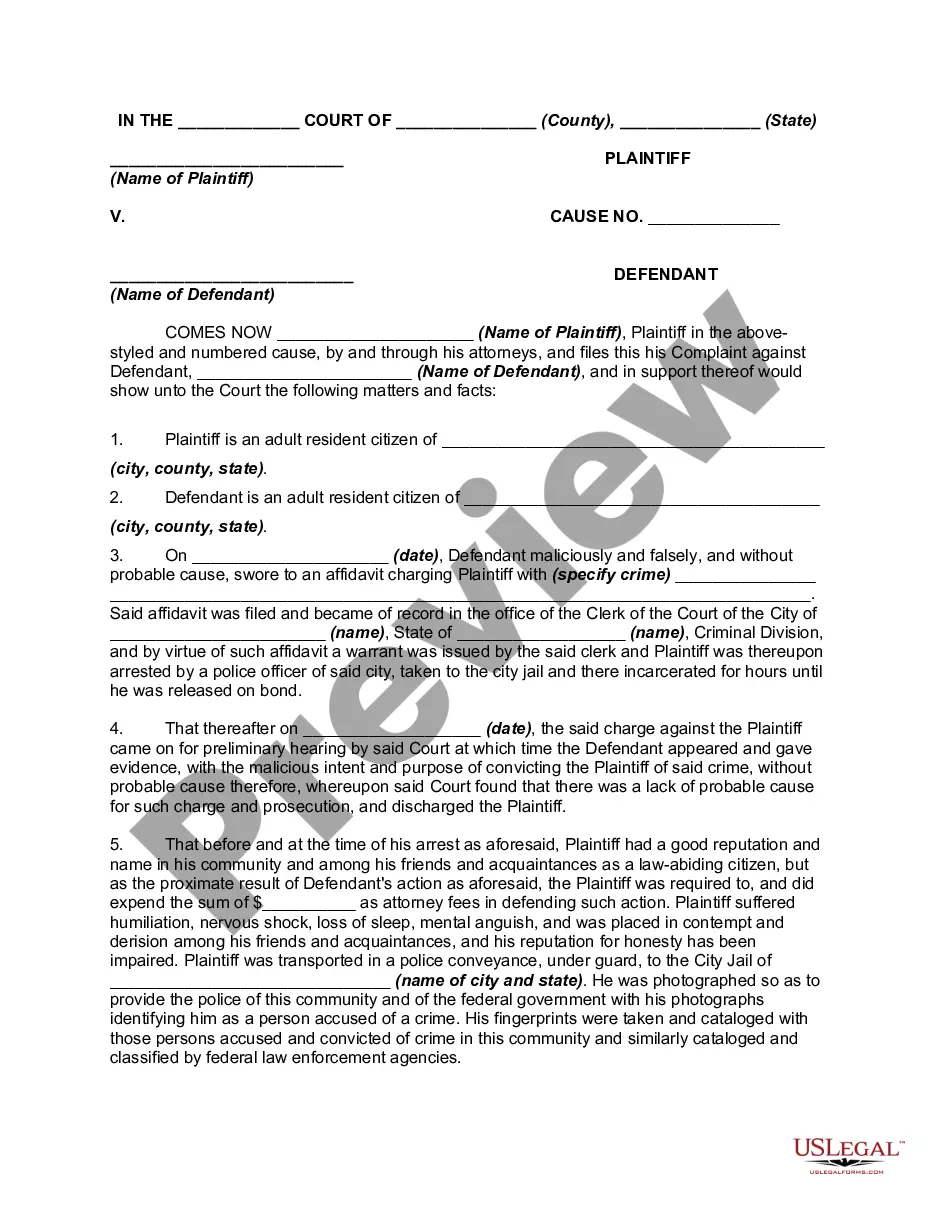
Mecklenburg North Carolina Complaint for Malicious Prosecution, False Imprisonment, Abuse of Process
Description


Get your form ready online
Our built-in tools help you complete, sign, share, and store your documents in one place.
Make edits, fill in missing information, and update formatting in US Legal Forms—just like you would in MS Word.
Download a copy, print it, send it by email, or mail it via USPS—whatever works best for your next step.
Sign and collect signatures with our SignNow integration. Send to multiple recipients, set reminders, and more. Go Premium to unlock E-Sign.
If this form requires notarization, complete it online through a secure video call—no need to meet a notary in person or wait for an appointment.
We protect your documents and personal data by following strict security and privacy standards.

Make edits, fill in missing information, and update formatting in US Legal Forms—just like you would in MS Word.

Download a copy, print it, send it by email, or mail it via USPS—whatever works best for your next step.

Sign and collect signatures with our SignNow integration. Send to multiple recipients, set reminders, and more. Go Premium to unlock E-Sign.

If this form requires notarization, complete it online through a secure video call—no need to meet a notary in person or wait for an appointment.

We protect your documents and personal data by following strict security and privacy standards.
Looking for another form?
How to fill out Complaint For Malicious Prosecution, False Imprisonment, Abuse Of Process?
Are you searching to swiftly compose a legally-binding Mecklenburg Complaint for Malicious Prosecution, False Imprisonment, Abuse of Process, or potentially any other document to manage your personal or business matters? You have two options to consider: reach out to an expert to create a legitimate document for you or generate it entirely by yourself. The positive aspect is that there's an alternative - US Legal Forms. It will assist you in obtaining well-drafted legal documents without incurring exorbitant fees for legal assistance.
US Legal Forms offers an extensive compilation of over 85,000 state-compliant document templates, including Mecklenburg Complaint for Malicious Prosecution, False Imprisonment, Abuse of Process and form bundles. We provide papers for a variety of life situations: from divorce documentation to real estate records. We've been operational for over 25 years and have established a solid reputation among our clients. Here's how you can join them and acquire the necessary template without unnecessary complications.
- First and foremost, verify if the Mecklenburg Complaint for Malicious Prosecution, False Imprisonment, Abuse of Process conforms with your state's or county's regulations.
- If the form contains a description, ensure to check its intended purpose.
- Initiate the searching process once more if the document is not what you were hoping for by using the search box in the header.
- Select the subscription that aligns with your requirements and proceed to payment.
- Choose the format you wish to receive your form in and download it.
- Print it out, complete it, and sign on the designated line.
Form popularity
FAQ
In New York, the criteria for Abuse of Process are: regularly issued legal process, civil or criminal, compelling performance or forbearance of some act, and. the person activating the process was moved by an ulterior purpose to do harm, without economic or social excuse or justification, and.
To win a suit for malicious prosecution, the plaintiff must prove four elements: (1) that the original case was terminated in favor of the plaintiff, (2) that the defendant played an active role in the original case, (3) that the defendant did not have probable cause or reasonable grounds to support the original case,
Naming the wrong person in a lawsuit by accident would not constitute malice. Winning the Frivolous Lawsuit: The plaintiff in the malicious prosecution case must show that he or she won the prior lawsuit at least as to any claims filed under the new lawsuit (favorable termination).
1. In false imprisonment, though intention is an essential element, yet it need not be necessarily malicious. In malicious prosecution, the presence of malice or ill motive has to be proved for a successful action. 2.
The primary difference between the two legal actions is that malicious prosecution concerns the malicious or wrongful commencement of an action, while, on the other hand, abuse of process concerns the improper use of the legal process after process has already been issued and a suit has commenced.
Abuse of process refers to the improper use of a civil or criminal legal procedure for an unintended, malicious, or perverse reason. It is the malicious and deliberate misuse of regularly issued civil or criminal court process that is not justified by the underlying legal action.
Rule 3.4 enables the court to strike out the whole or part of a statement of case which discloses no reasonable grounds for bringing or defending a claim (rule 3.4(2)(a)), or which is an abuse of the process of the court or otherwise likely to obstruct the just disposal of the proceedings (rule 3.4(2)(b)) Rule 24.2
The plaintiff must prove that: (1) the prosecution was initiated by the defendant; (2) it was terminated in the plaintiff's favour; (3) there was an absence of reasonable and probable cause to commence the prosecution; and (4) the defendant's conduct in setting the criminal process in motion was fueled by malice.
1. Abuse of process has been defined as "something so unfair and wrong that the court should not allow a prosecutor to proceed with what is in all other respect a regular proceeding" 1. 2. Both the Crown Courts and magistrates' courts have discretion to protect the process of the court from abuse.
Malicious prosecution occurs when one party has knowingly and with malicious intent initiated baseless litigation against another party. This includes both criminal charges and civil claims, for which the cause of action is essentially the same.