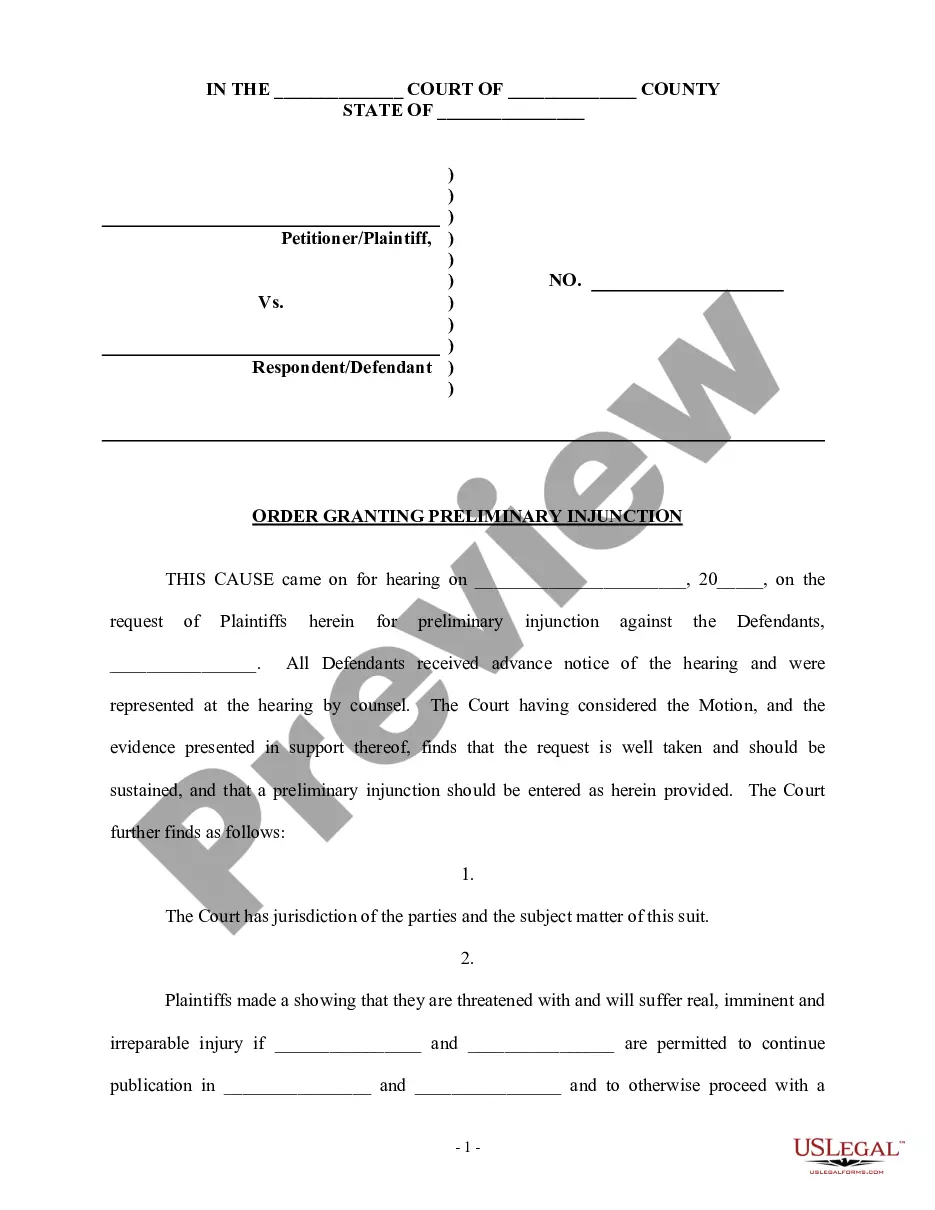
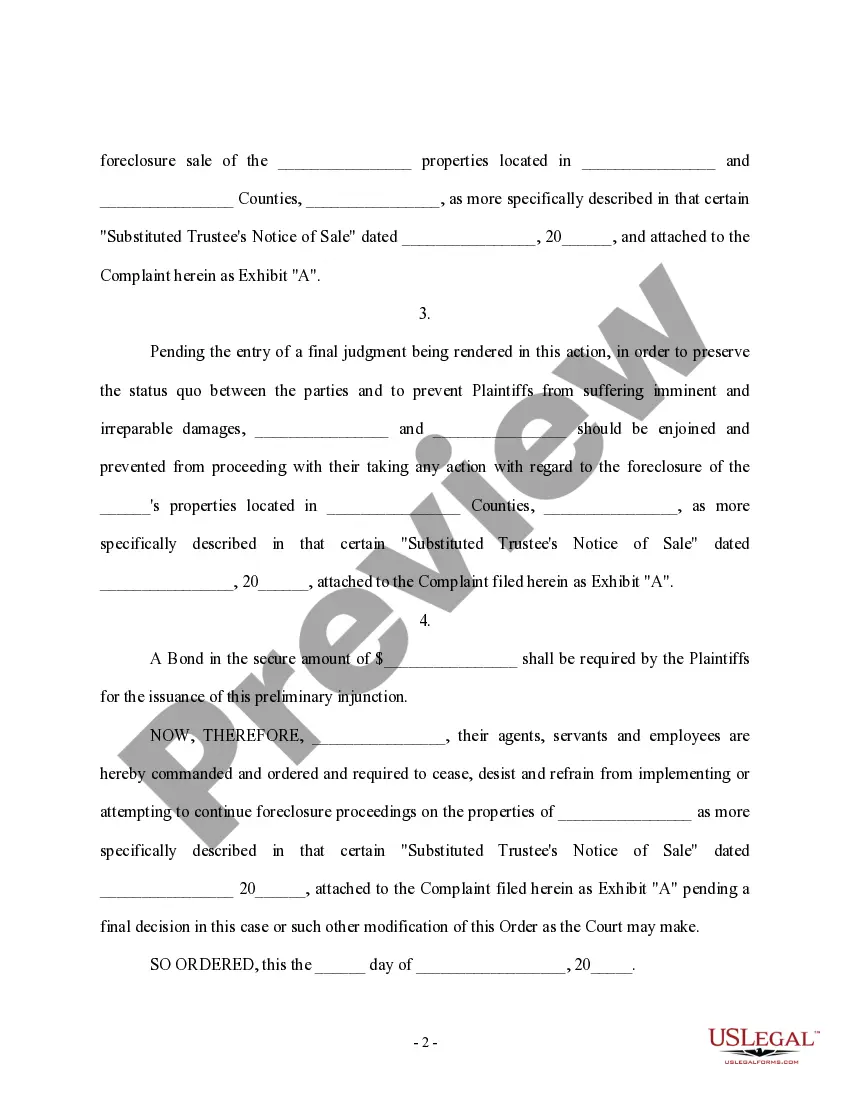
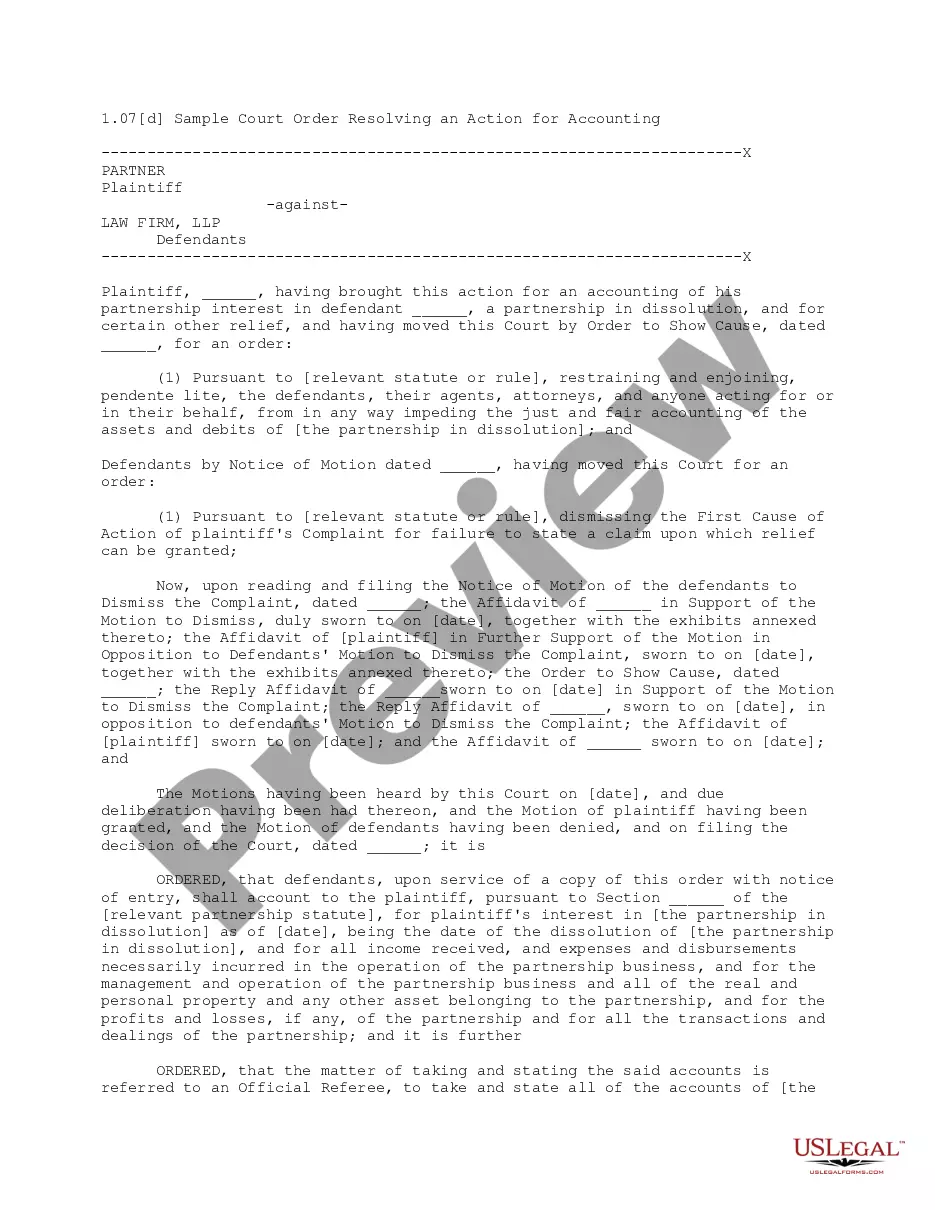
This is an Order Granting a Preliminary Injunction against defendants. The order provides that the court having considered the motion and the evidence submitted in support of the motion, finds that the request is well taken and should be sustained.
Harris Texas Order Granting Preliminary Injunction
Category:
State:
Multi-State
County:
Harris
Control #:
US-01009
Format:
Word;
Rich Text
Instant download
Description
Free preview




How to fill out Order Granting Preliminary Injunction?
Drafting documents, such as the Harris Order Granting Preliminary Injunction, to manage your legal matters is a demanding and lengthy undertaking.
Numerous circumstances necessitate the assistance of a lawyer, which also renders this task not particularly economical.
However, you can take control of your legal issues and manage them independently. US Legal Forms is here to help.
Here’s what you should do before acquiring the Harris Order Granting Preliminary Injunction: Ensure that your template aligns with your state/county since the laws regarding the creation of legal documents may vary from state to state.
- Our platform offers over 85,000 legal forms designed for different scenarios and life events.
- We ensure that each form adheres to the laws of each state, so you don't have to be concerned about possible legal complications related to compliance.
- If you already know our offerings and have a subscription with US, you understand how straightforward it is to obtain the Harris Order Granting Preliminary Injunction template.
- Simply sign in to your account, download the template, and modify it to suit your needs.
- Did you misplace your document? Fear not. You can retrieve it in the My documents section of your account - on either desktop or mobile.
- The registration process for new users is quite simple!
Form popularity
FAQ
Preliminary injunctions generally last until the end of the lawsuit. Permanent Injunctions: At the end of a court case, if the judge agrees that there is an ongoing threat, he or she may issue a permanent injunction prohibiting the threatened action indefinitely.
Preliminary and permanent injunctions are issued based on evidence that is presented by a plaintiff in a civil case. An example of a preliminary injunction might be when a married couple owns a business and is going through a divorce. Perhaps there is a dispute as to who owns or controls the business and its assets.
The party asking for an injunctive relief must prove three things: 1) that there is a cause of action against the defendant; 2) that the party seeking the injunction has a right to the property in question; and 3) that the objects in question are in danger of ?probable, imminent, and irreparable injury.? In the Strube
The first is 'with notice' to the respondent and the second is 'without notice'. If the application is made 'with notice', the respondent is told when the hearing will be and the court will listen to the arguments of both parties. The court will then either grant or refuse the injunction.
Grounds of Temporary Injunction: Property in dispute is in danger of being WASTED, DAMAGED or ALIENATED by any party to the suit, or WRONGFULLY SOLD IN EXECUTION OF DECREE. Where defendant: THREATENS or INTENDS TO REMOVE or DISPOSE OF HIS PROPERTY with a view to defraud creditors.
The party asking for an injunctive relief must prove three things: 1) that there is a cause of action against the defendant; 2) that the party seeking the injunction has a right to the property in question; and 3) that the objects in question are in danger of ?probable, imminent, and irreparable injury.? In the Strube
A temporary restraining order, or TRO, is similar to a preliminary injunction in that it is a pre-trial court order that enjoins or mandates another party's conduct. However, it is different in that TROs are more urgent and may be issued without notice to the other party.
To obtain a preliminary injunction, a plaintiff must establish that (1) he is likely to succeed on the merits, (2) he is likely to suffer irreparable harm in the absence of preliminary relief, (3) the balance of equities tips in his favor, and (4) an injunction is in the public interest.? Winter v.
In determining whether to grant or deny a preliminary injunctive relief, the courts generally look to several of the factors including: (1) the plaintiff's likelihood of prevailing on the merits;(2) a showing of irreparable injury to plaintiff if relief is not granted; (3) the threatened injury to the movant is
An application for an interim injunction must usually be supported by evidence. This will usually be in the form of a witness statement or affidavit including all material facts of which the Court should be made aware, and attaching relevant documents.