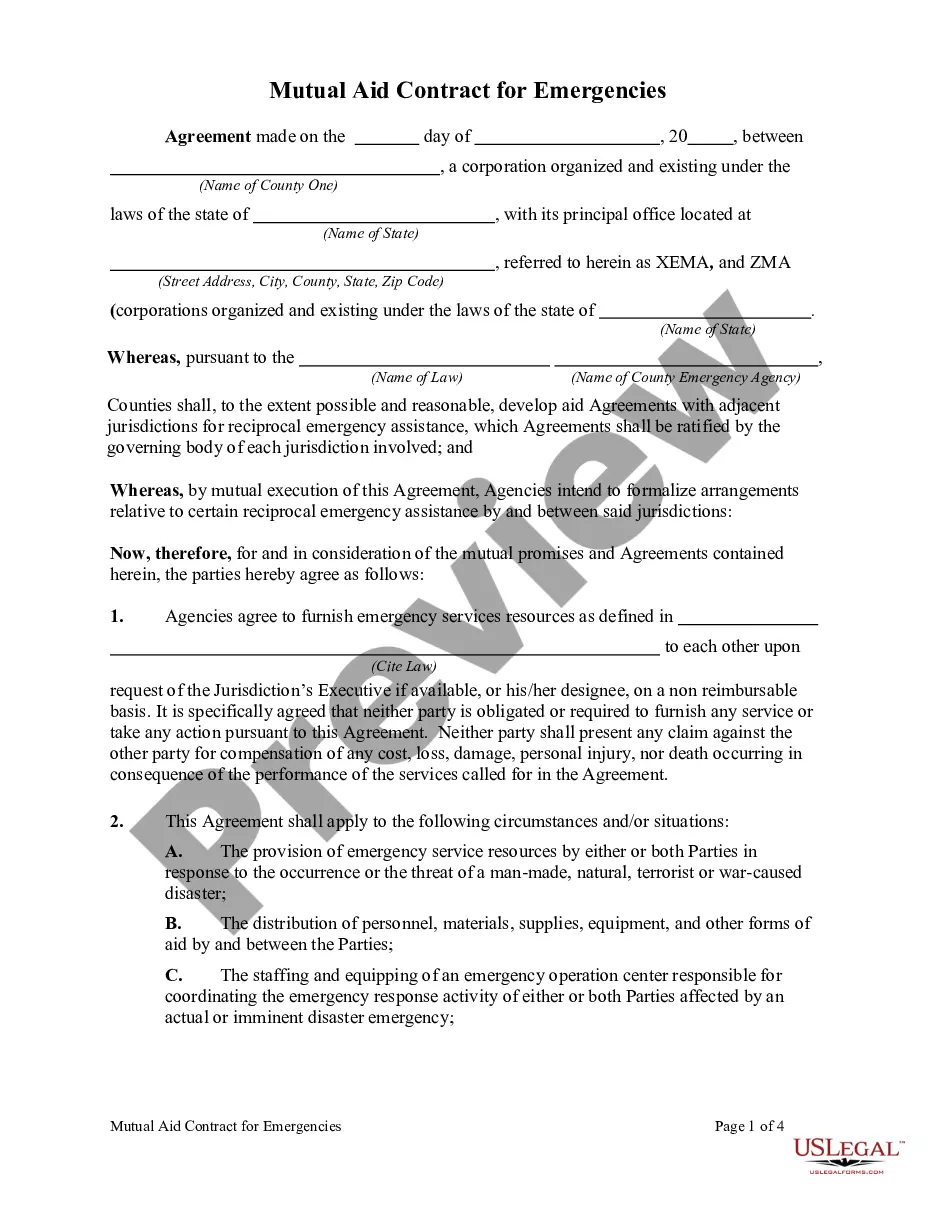
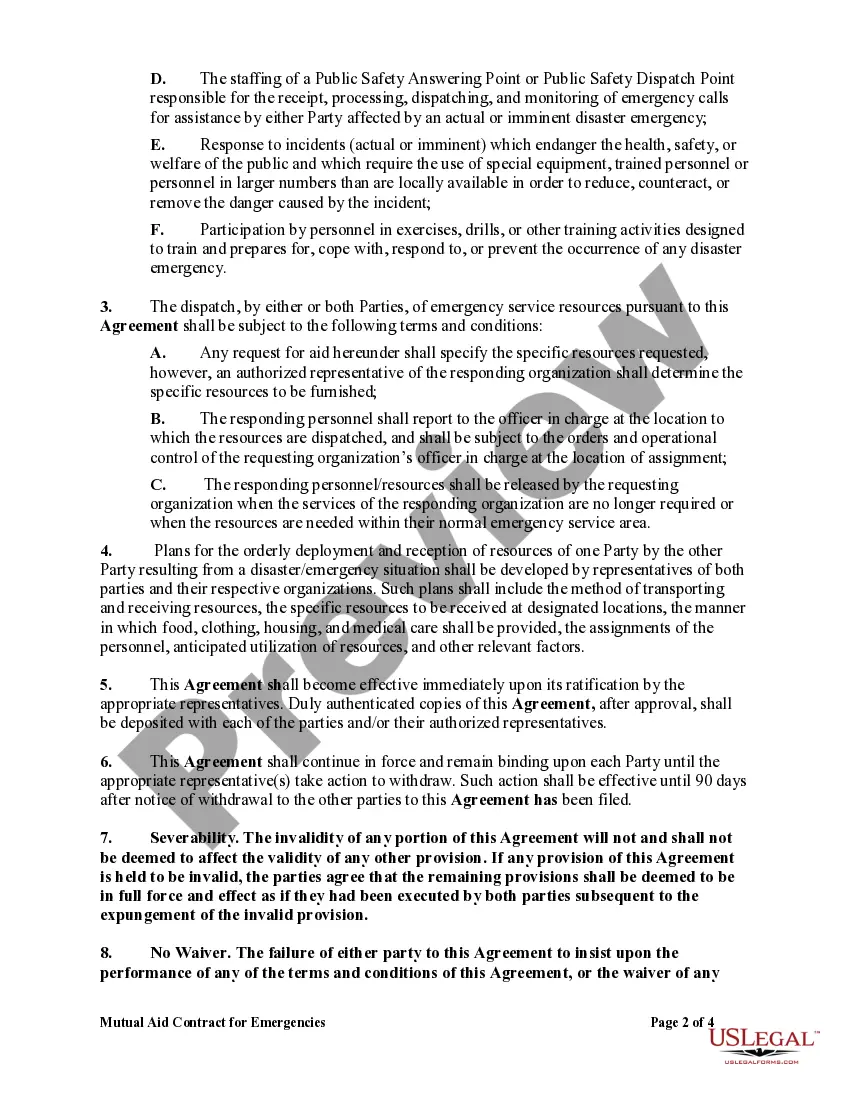
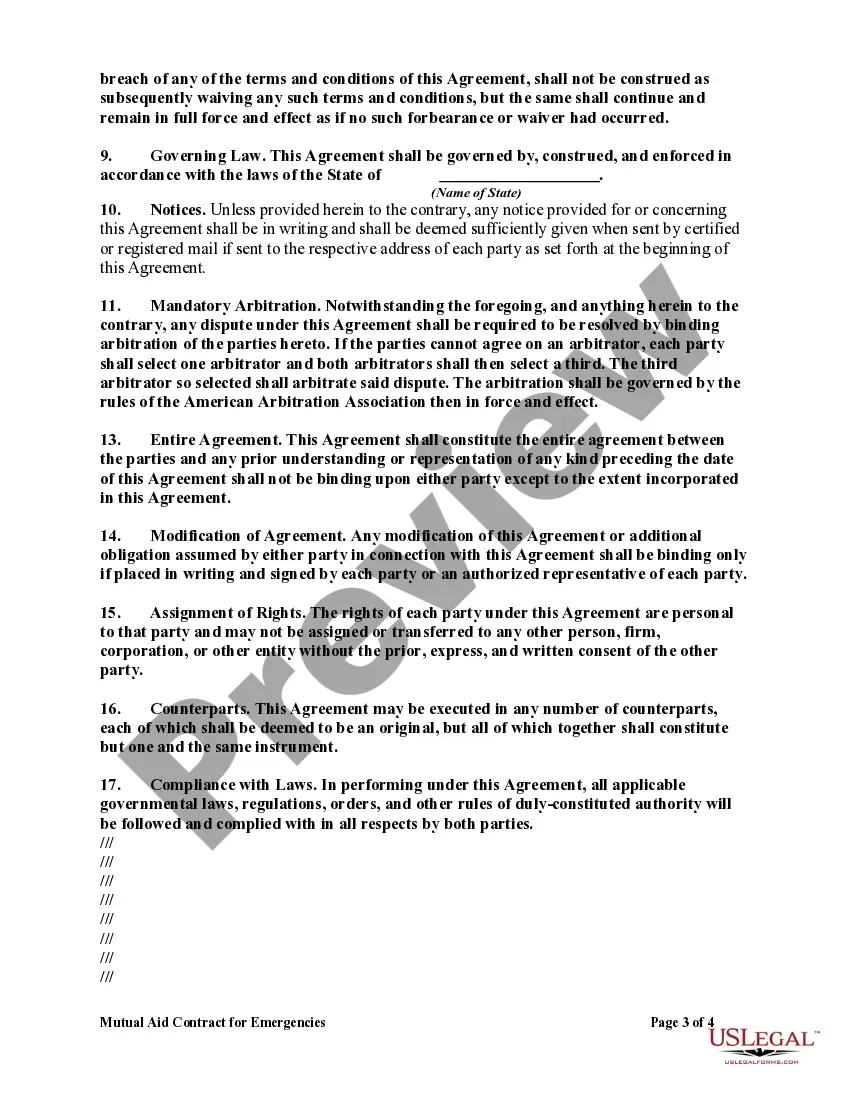
Fulton Georgia Mutual Aid Contract for Emergencies
Description




How to fill out Mutual Aid Contract For Emergencies?
Creating documents, such as the Fulton Mutual Aid Contract for Emergencies, to handle your legal matters is a challenging and time-intensive endeavor.
Many scenarios necessitate an attorney's involvement, which also renders this job costly.
However, you can take charge of your legal concerns and manage them yourself.
The onboarding process for new users is equally simple! Here’s what you need to do prior to acquiring the Fulton Mutual Aid Contract for Emergencies: Ensure that your form is tailored to your state/county as the laws for generating legal documents can differ from one state to another. Find out more details about the form by previewing it or reading a brief overview. If the Fulton Mutual Aid Contract for Emergencies isn’t what you are seeking, use the header to locate an alternative form. Log In or create an account to start using our website and obtain the form. Everything look satisfactory on your end? Click the Buy now button and choose the subscription option. Choose the payment method and enter your payment details. Your form is ready. You can proceed to download it. It’s a straightforward task to find and acquire the required template with US Legal Forms. Thousands of businesses and individuals are already benefiting from our vast collection. Sign up now if you wish to explore what additional benefits you can access with US Legal Forms!
- US Legal Forms is here to assist.
- Our platform offers over 85,000 legal templates designed for diverse situations and life events.
- We ensure every document complies with the laws of each state, so you need not worry about potential legal compliance issues.
- If you're already familiar with our offerings and have a subscription with US, you understand how simple it is to obtain the Fulton Mutual Aid Contract for Emergencies form.
- Just Log In to your account, download the form, and customize it according to your requirements.
- Have you misplaced your document? No problem. You can retrieve it from the My documents folder in your account - accessible on both desktop and mobile.
Form popularity
FAQ
Mutual aid agreements establish the legal basis for two or more entities to share resources. Mutual aid agreements may authorize mutual aid between two or more neighboring communities, among all jurisdictions within a state, between states, between Federal agencies, and/or internationally.
NIMS Components Preparedness. Resource management. Communications and information management.
EMAC, state law in all 50 states, the District of Columbia, US Virgin Islands, Puerto Rico, Guam and the Northern Mariana Islands, is implemented on behalf of the Governors by the emergency management agencies.
In emergency services, mutual aid is an agreement among emergency responders to lend assistance across jurisdictional boundaries. This may occur due to an emergency response that exceeds local resources, such as a disaster or a multiple-alarm fire. Mutual aid may be ad hoc, requested only when such an emergency occurs.
EMAC works as follows: When a disaster occurs, the governor of the affected state or territory declares a state of emergency. The impacted state assesses its resource needs and identifies shortfalls for which assistance will be requested, and authorized representatives from the affected state then activate EMAC.
The mutual aid system is designed to facilitate the rendering of aid to agencies/jurisdictions stricken by an emergency whenever its respective resources are overwhelmed or inadequate. The CEOC/OAEOC coordinates mutual aid requests for agencies/jurisdictions.
Qualification, certification, and credentialing are the essential steps to help ensure that personnel deploying under mutual aid agreements can perform their assigned roles.
EMAC works as follows: When a disaster occurs, the governor of the affected state or territory declares a state of emergency. The impacted state assesses its resource needs and identifies shortfalls for which assistance will be requested, and authorized representatives from the affected state then activate EMAC.
According to FEMA, mutual aid agreements and assistance agreements are agreements between agencies, organizations, and jurisdictions that provide a mechanism to quickly obtain emergency assistance in the form of personnel, equipment, materials, and other associated services.
According to FEMA, mutual aid agreements and assistance agreements are agreements between agencies, organizations, and jurisdictions that provide a mechanism to quickly obtain emergency assistance in the form of personnel, equipment, materials, and other associated services.