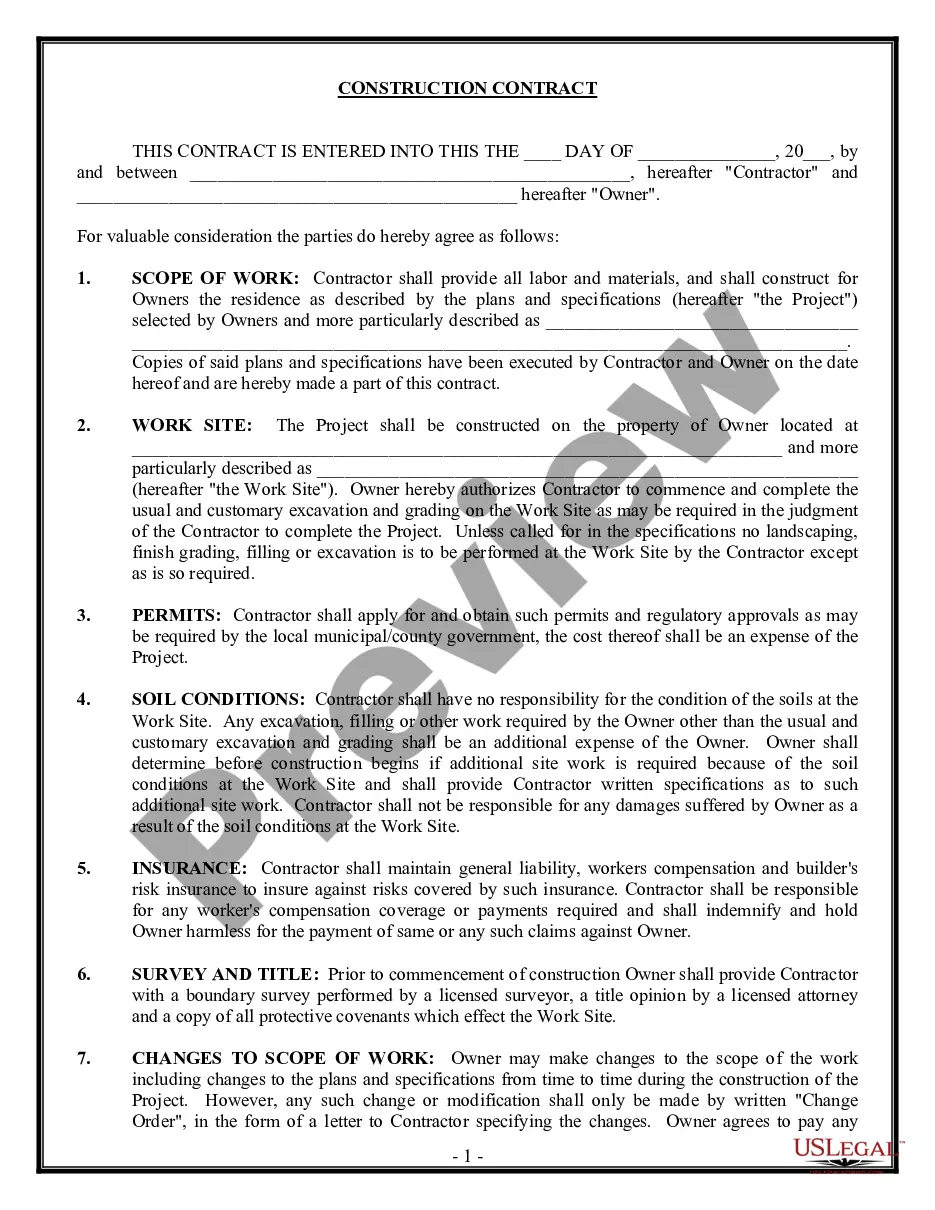
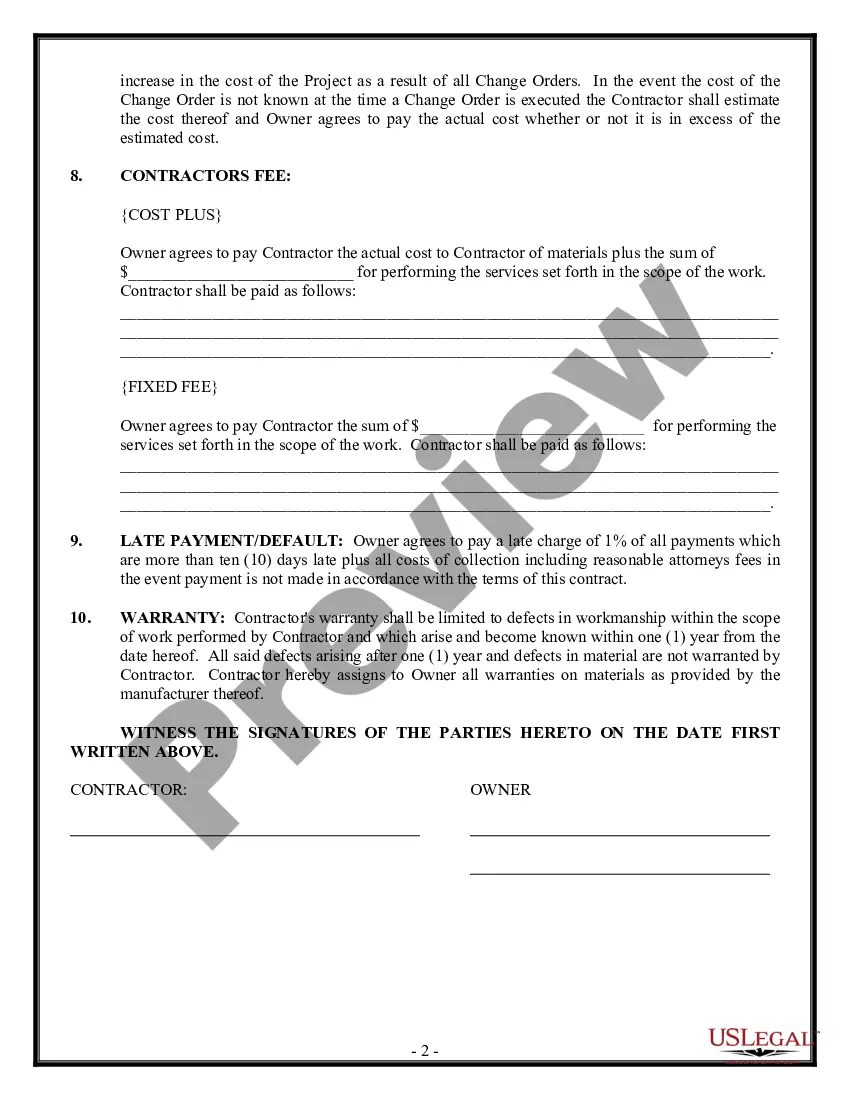
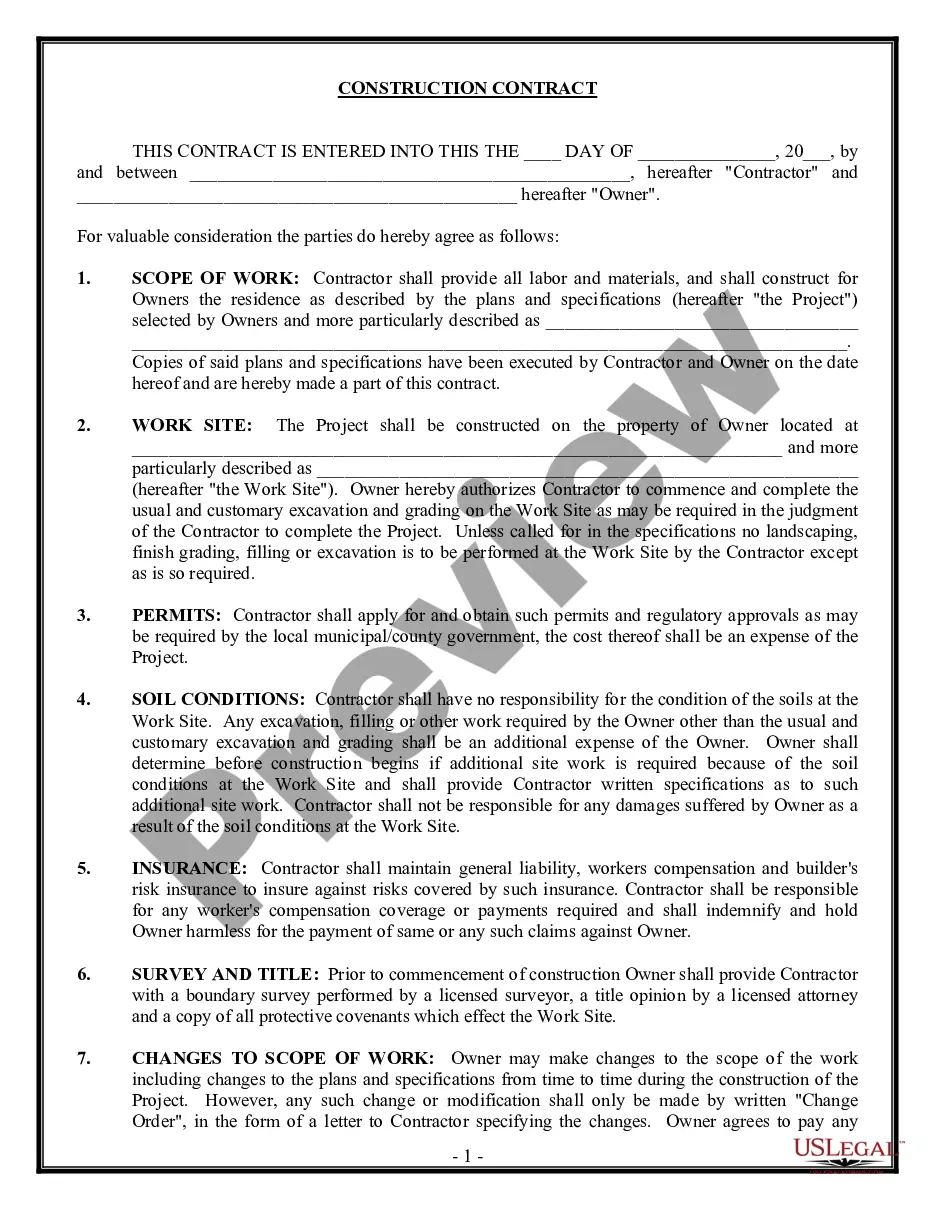
Mecklenburg North Carolina Construction Contract for Residential Construction
Description

Get your form ready online
Our built-in tools help you complete, sign, share, and store your documents in one place.
Make edits, fill in missing information, and update formatting in US Legal Forms—just like you would in MS Word.
Download a copy, print it, send it by email, or mail it via USPS—whatever works best for your next step.
Sign and collect signatures with our SignNow integration. Send to multiple recipients, set reminders, and more. Go Premium to unlock E-Sign.
If this form requires notarization, complete it online through a secure video call—no need to meet a notary in person or wait for an appointment.
We protect your documents and personal data by following strict security and privacy standards.

Make edits, fill in missing information, and update formatting in US Legal Forms—just like you would in MS Word.

Download a copy, print it, send it by email, or mail it via USPS—whatever works best for your next step.

Sign and collect signatures with our SignNow integration. Send to multiple recipients, set reminders, and more. Go Premium to unlock E-Sign.

If this form requires notarization, complete it online through a secure video call—no need to meet a notary in person or wait for an appointment.

We protect your documents and personal data by following strict security and privacy standards.
Looking for another form?
How to fill out Construction Contract For Residential Construction?
Drafting paperwork for business or personal requirements is consistently a significant obligation.
When developing an agreement, public service inquiry, or a power of attorney, it's vital to take into account all federal and local regulations of the specific area.
However, smaller counties and even towns also possess legislative regulations that you must be mindful of.
To find the one that meets your needs, use the search tab at the top of the page. Ensure the template meets legal requirements and click Buy Now. Select the subscription plan, then Log In or create an account with US Legal Forms. Use your credit card or PayPal account to pay for your subscription. Download the selected document in your desired format, print it, or fill it out electronically. The remarkable aspect of the US Legal Forms library is that all the documentation you've ever purchased remains accessible - you can retrieve it in your profile under the My documents tab at any time. Join the platform and effortlessly obtain confirmed legal forms for any circumstance with just a few clicks!
- These elements render it challenging and lengthy to produce a Mecklenburg Construction Contract for Residential Construction without professional assistance.
- It is feasible to prevent squandering funds on lawyers preparing your documentation and create a legally binding Mecklenburg Construction Contract for Residential Construction independently, using the US Legal Forms online library.
- This is the largest online repository of state-specific legal documents that are expertly verified, ensuring their legitimacy when selecting a template for your county.
- Former subscribed users only need to Log In to their accounts to secure the necessary form.
- In case you do not hold a subscription, adhere to the step-by-step instructions provided below to acquire the Mecklenburg Construction Contract for Residential Construction.
- Review the opened page and confirm if it includes the sample you need.
- For this purpose, utilize the form description and preview if these features are available.
Form popularity
FAQ
North Carolina law allows an individual to serve as the general contractor if the land is in your name and the home is to be solely occupied by you and your family for 12 months after completion, without a license and/or experience.
Generally no, however a zoning permit will be required. As long as the patio is level with the grade around it, then a building permit would not be required.
Building Permit Fee: Square Footage up to 1500 sq. ft.: $240 Basic Fee. Square Footage over 1500 sq. ft.: Multiply by $0.20 + $240.00 (Basic Fee) North Carolina Licensed General Contractors add $10.00 Homeowner Recovery Fund.
Generally, a building permit is required for ANY construction, installation, repair, replacement or alteration costing more than $15,000.
Current Law: North Carolina law currently requires any building construction or alteration project costing $30,000 or more to be superintended (supervised and managed) by a general contractor licensed in this state.
Failing to obtain a permit when required may result in substantial fines or being ordered to remove the offending project or incur costs to certify compliance with the applicable codes; it depends. What may surprise licensees is how many seemingly minor improvements/repairs may require a permit.
If you want to be a General Contractor in North Carolina, it is important to get a General Contractor's License. According to NC § 87-1(a), you must be a licensed General Contractor to undertake construction on any project that has a total value of $30,000 or more.
For any accessory building, such as a shed, with any dimension exceeding 12 feet, The North Carolina State Building Code requires that a permit be issued, though a 12'x12' shed doesn't normally need a permit. Each county or local municipality manages this process differently and with varying fee structures.
According to the North Carolina Residential Building Code, permits are required for accessory structures (sheds) with any dimension that exceeds 12'. These are the responsibility of the homeowner and can be obtained through your local city or county zoning and/or building inspections department.
You need a building permit for all construction that involves the construction, reconstruction, alteration, repair, movement to another site, removal, or demolition of any building or structure. All electrical, plumbing and mechanical work needs a separate permit for each trade.