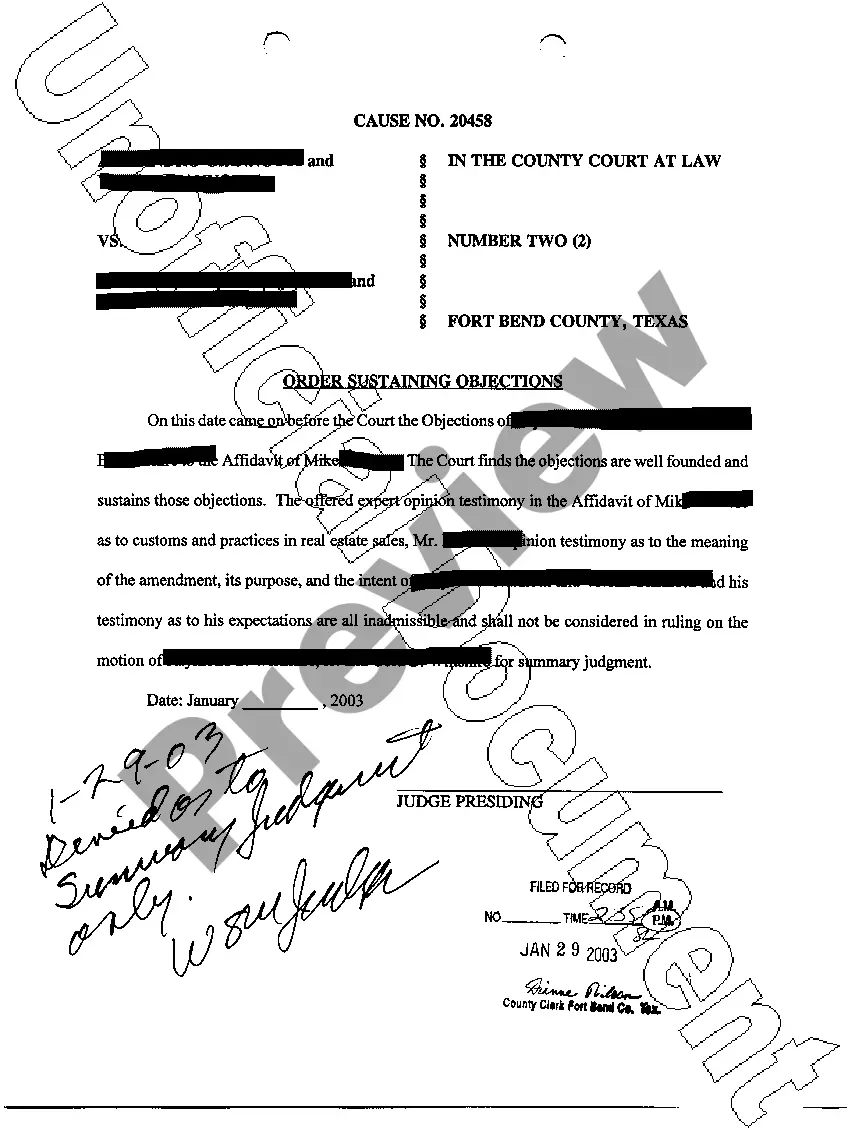
Dallas Texas Order Sustaining Objections
Description


How to fill out Texas Order Sustaining Objections?
If you have previously used our service, Log In to your account and retrieve the Dallas Texas Order Sustaining Objections onto your device by clicking the Download button. Ensure your subscription is active. If not, renew it as per your payment arrangement.
If this is your inaugural encounter with our service, follow these straightforward steps to obtain your document.
You hold ongoing access to every document you have acquired: you can locate it in your profile under the My documents section whenever you wish to reuse it. Utilize the US Legal Forms service to efficiently find and save any template for your personal or business requirements!
- Confirm you’ve found the relevant document. Review the details and utilize the Preview feature, if available, to determine if it suits your requirements. If it’s not suitable, use the Search tab above to locate the correct one.
- Purchase the template. Click the Buy Now button and select either a monthly or yearly subscription option.
- Establish an account and process your payment. Enter your credit card information or opt for PayPal to finalize the transaction.
- Retrieve your Dallas Texas Order Sustaining Objections. Choose the file format for your document and store it on your device.
- Complete your document. Print it or utilize professional online editors to fill it out and electronically sign it.
Form popularity
FAQ
In Texas, the evidence code addressing the lack of foundation issue is found in the Texas Rules of Evidence, primarily Rule 104. This rule covers preliminary questions about the admissibility of evidence, including its foundation. Familiarity with these rules is key when navigating Dallas Texas Order Sustaining Objections, ensuring that you properly address any potential issues in court.
An example of a lack of foundation objection occurs when a witness attempts to introduce a document without first explaining its origin or context. For instance, if a party tries to admit a report without showing how the author prepared it, others may object. Such objections are crucial in cases involving Dallas Texas Order Sustaining Objections, as they maintain the integrity of the evidence presented.
A lack of foundation objection in Texas refers to a legal challenge against the admissibility of evidence due to insufficient preliminary evidence. Essentially, this objection states that the party presenting the evidence has not adequately demonstrated its reliability. Understanding this objection is essential when dealing with Dallas Texas Order Sustaining Objections, as it can significantly affect trial proceedings.
The foundation objection rule is a legal principle that requires a party to establish a proper basis for the admission of evidence. In the context of Dallas Texas Order Sustaining Objections, this means showing that evidence is relevant and reliable. Without a solid foundation, the court may not allow the evidence to be presented, potentially impacting the outcome of a case.
There is generally no strict limit on the number of objections that a party can make, as long as they are relevant and timely. However, excessive or frivolous objections may be frowned upon by the court. Understanding how to make valid objections is crucial, especially in cases addressing the Dallas Texas Order Sustaining Objections.
The key types of objections in court are relevance, hearsay, leading, and asked and answered. These objections ensure that only appropriate and fair evidence is considered by the judge or jury. If you face a Dallas Texas Order Sustaining Objections, knowing these types can equip you to better engage in the legal process.
The four main objections typically encountered in court include relevance, hearsay, privilege, and lack of foundation. Each objection targets a different aspect of how evidence is presented or allowed. Understanding these objections can be beneficial, particularly in matters involving Dallas Texas Order Sustaining Objections.
When an objection is sustained, the judge agrees with the objection and prohibits the introduction of specific evidence or further questioning. This ruling helps maintain fairness and order in the court proceedings. If you are navigating a Dallas Texas Order Sustaining Objections, realizing the implications of sustained objections is essential for your case.
Objections in court responses refer to the formal challenges made by attorneys regarding the admissibility of evidence or the appropriateness of questions posed. These objections are crucial for protecting a party's rights during a trial. If you seek support on matters like Dallas Texas Order Sustaining Objections, resources are available to guide you through the process.
The four common types of objections in court include relevance, hearsay, leading, and argumentative. Each type serves to challenge the admissibility of evidence based on specific legal standards. For anyone facing a Dallas Texas Order Sustaining Objections, understanding these categories can help clarify the grounds for raising an objection.