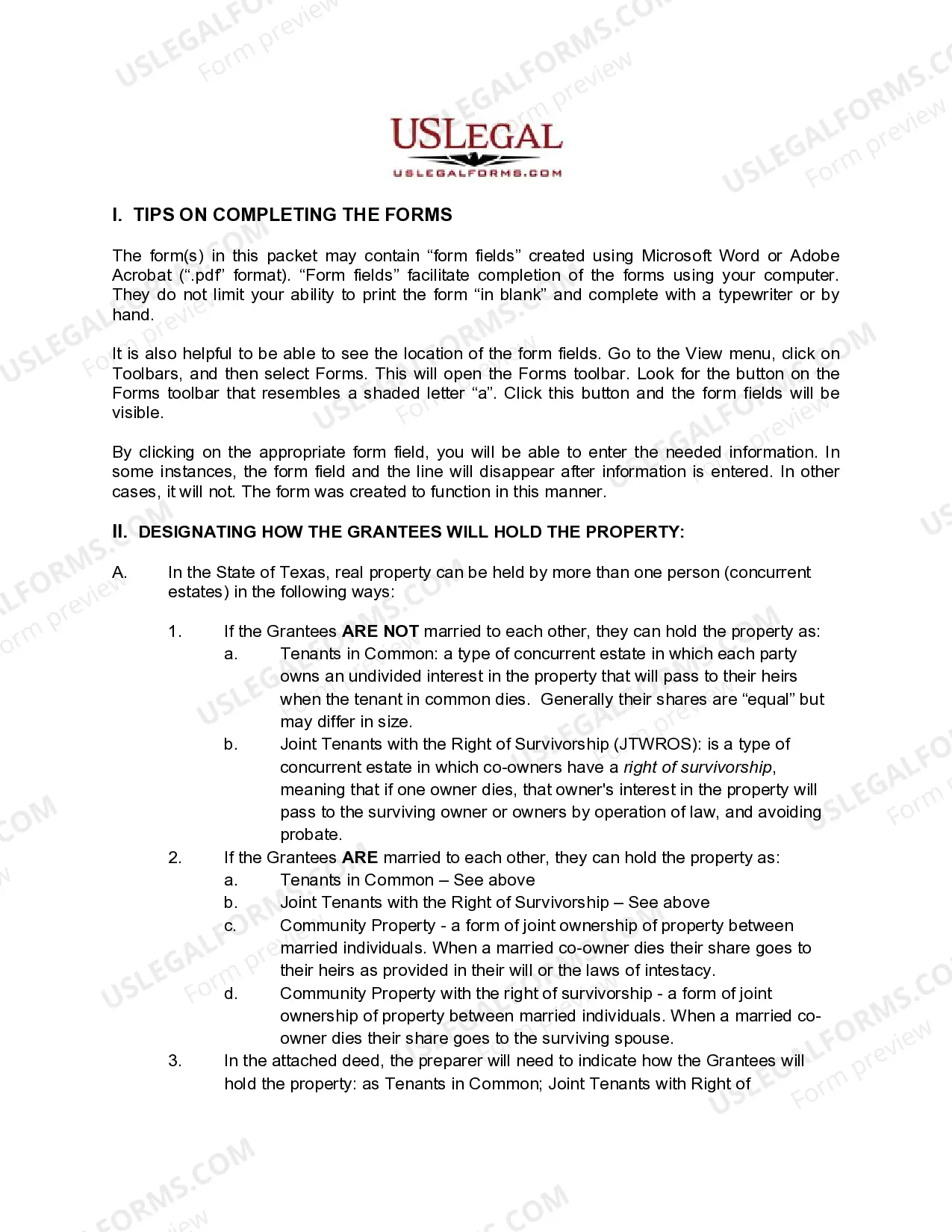
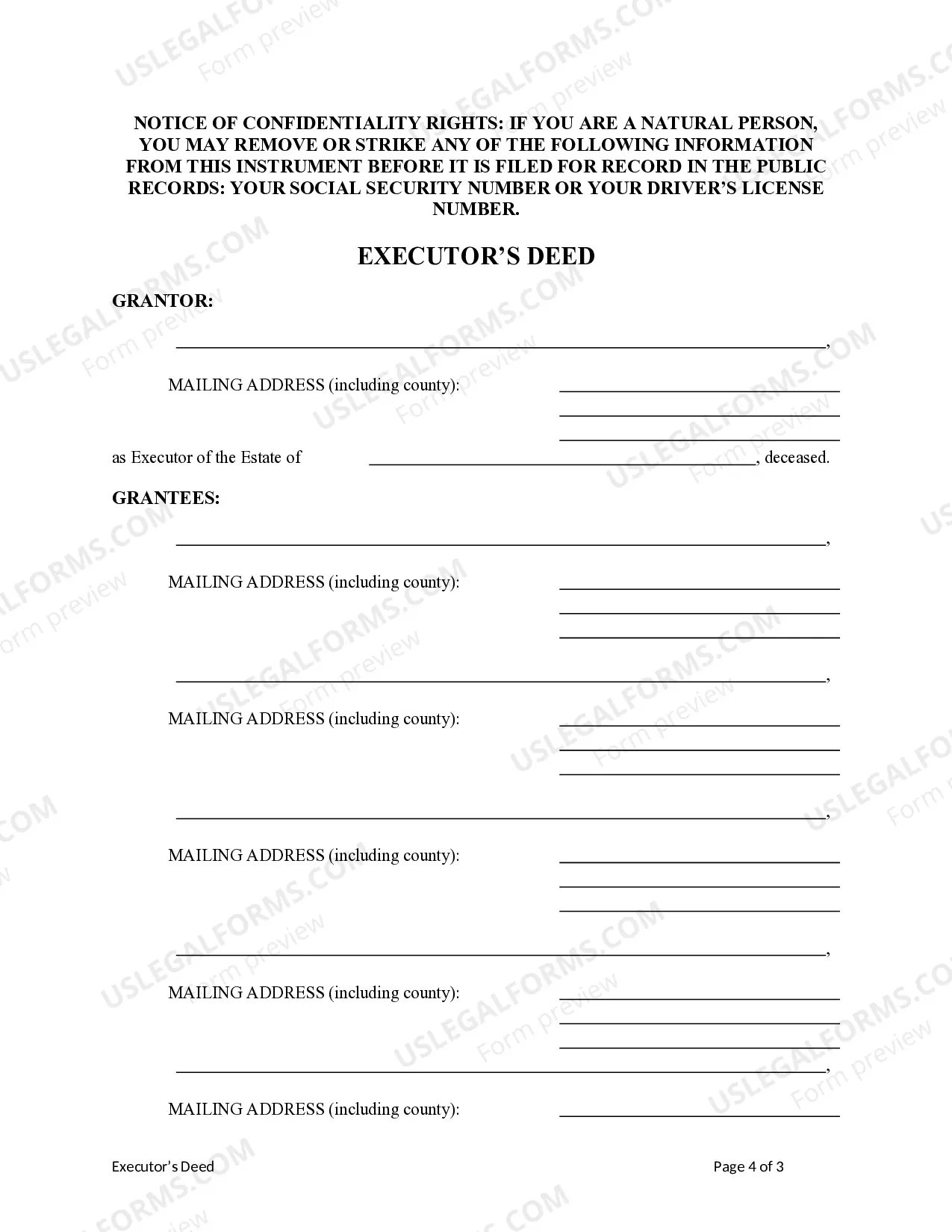
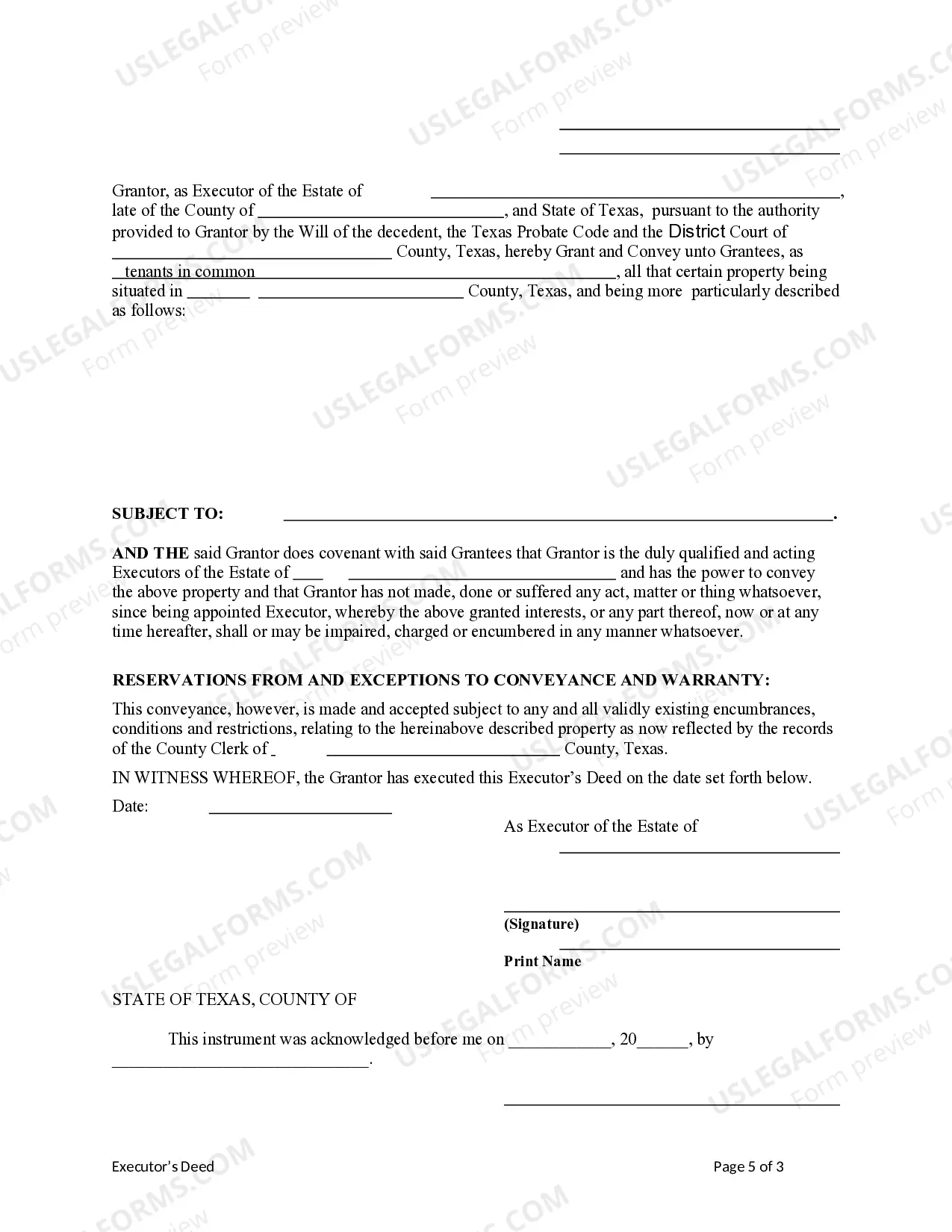
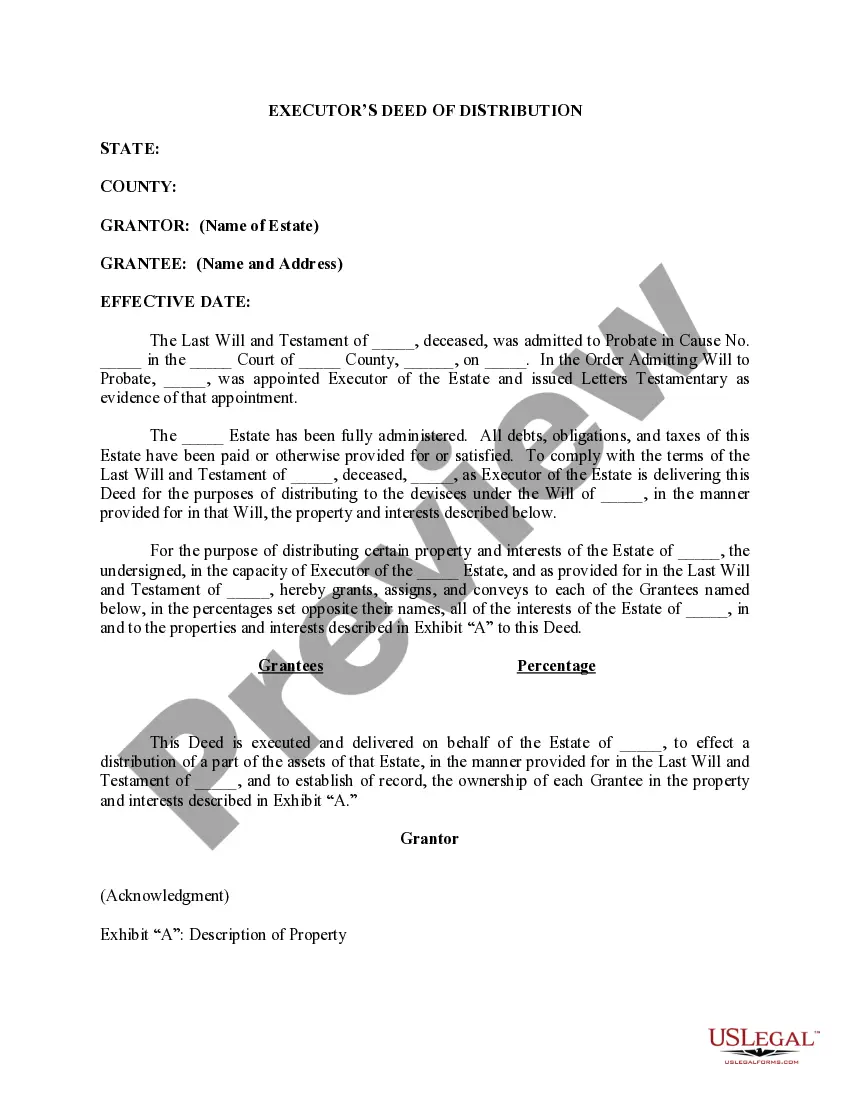
This form is an Executor's Deed where the Grantor is the executor of an estate and the Grantees are the beneficiaries or heirs of the estate. Grantor conveys the described property to the Grantees. This deed complies with all state statutory laws.
Tarrant Texas Executor's Deed - Estate to Five Beneficiaries
State:
Texas
Category:
County:
Tarrant
Control #:
TX-096-78
Format:
Word;
Rich Text
60 downloads
Description
Free preview


Get your form ready online
Our built-in tools help you complete, sign, share, and store your documents in one place.
Built-in online Word editor
Make edits, fill in missing information, and update formatting in US Legal Forms—just like you would in MS Word.
Export easily
Download a copy, print it, send it by email, or mail it via USPS—whatever works best for your next step.
E-sign your document
Sign and collect signatures with our SignNow integration. Send to multiple recipients, set reminders, and more. Go Premium to unlock E-Sign.
Notarize online 24/7
If this form requires notarization, complete it online through a secure video call—no need to meet a notary in person or wait for an appointment.
Store your document securely
We protect your documents and personal data by following strict security and privacy standards.

Make edits, fill in missing information, and update formatting in US Legal Forms—just like you would in MS Word.

Download a copy, print it, send it by email, or mail it via USPS—whatever works best for your next step.

Sign and collect signatures with our SignNow integration. Send to multiple recipients, set reminders, and more. Go Premium to unlock E-Sign.

If this form requires notarization, complete it online through a secure video call—no need to meet a notary in person or wait for an appointment.

We protect your documents and personal data by following strict security and privacy standards.
Looking for another form?

How to fill out Texas Executor's Deed - Estate To Five Beneficiaries?
Irrespective of social or occupational position, completing legal documents is a regrettable requirement in contemporary society.
Frequently, it’s nearly impossible for an individual lacking legal training to develop this type of paperwork from scratch, primarily due to the intricate terminology and legal subtleties they entail.
This is where US Legal Forms proves to be useful.
Ensure the template you select is appropriate for your region, as the laws of one state do not apply to another.
Preview the document and read a brief overview (if available) of situations where the file can be applicable.
- Our platform provides an extensive assortment of over 85,000 ready-to-use state-specific documents that cater to nearly any legal circumstance.
- US Legal Forms also acts as an excellent resource for associates or legal advisers who seek to enhance their efficiency by utilizing our DIY forms.
- Whether you need the Tarrant Texas Executor's Deed - Estate to Five Beneficiaries or any other document that will be legitimate in your region, with US Legal Forms, everything is readily accessible.
- Here’s how you can obtain the Tarrant Texas Executor's Deed - Estate to Five Beneficiaries in moments using our reliable service.
- If you're already a member, you can simply Log In to your account to retrieve the necessary form.
- However, if you are new to our site, please follow these instructions before downloading the Tarrant Texas Executor's Deed - Estate to Five Beneficiaries.
Form popularity
FAQ
?When more than one person is appointed to act as 'co-executors', decision-making as between the executors will be governed by the will. If the will is silent on the issue, then unanimous consent is required. Therefore, wills frequently set out a 'majority rule' standard for decision making.
Can Beneficiaries Demand to See Deceased Bank Statements? No, generally, beneficiaries cannot demand to see the decedent's bank statements unless they are also a personal representative of the estate. However, it is within the executor's discretion to share bank statements with beneficiaries upon request.
Once the assets of the estate have been distributed, the personal representative must issue a final accounting with the court, which must also be sent to each beneficiary.
The executor can sell property without getting all of the beneficiaries to approve. However, notice will be sent to all the beneficiaries so that they know of the sale but they don't have to approve of the sale.
Your will can name two or more co-executors. You can provide that your co-executors must act together or that each may act independently of the others. If you designate three or more co-executors, you can allow action to be taken by a majority vote.
If the will names multiple executors, but only one person wishes to take out a grant of probate, it is wise for at least one of the others to sign a power reserved letter, just in case the appointed executor cannot complete the administration of the estate.
Up to four executors can act at a time, but they all have to act jointly. So it might not be practical to appoint that many people. It's a good idea, though, to choose two executors in case one of them dies before you do or 'renounce probate' if they do not want the job.
Under Texas law, you can be removed as the executor of an estate for flagrant misconduct, mismanagement, or theft of the estate's assets. If enough evidence exists to believe you have stolen money or property under your control, you can be removed.
(a) An executor, administrator, or temporary administrator a court finds to have taken care of and managed an estate in compliance with the standards of this title is entitled to receive a five percent commission on all amounts that the executor or administrator actually receives or pays out in cash in the
The executor will notify all creditors about the person's death and validate any claims before paying them to ensure that they are legitimate debts. Other duties include: Filing tax returns for the decedent and the estate and paying any taxes due. Notifying the Social Security Administration regarding benefits payments.