Charlotte North Carolina UCC1 Financing Statement Addendum
Description
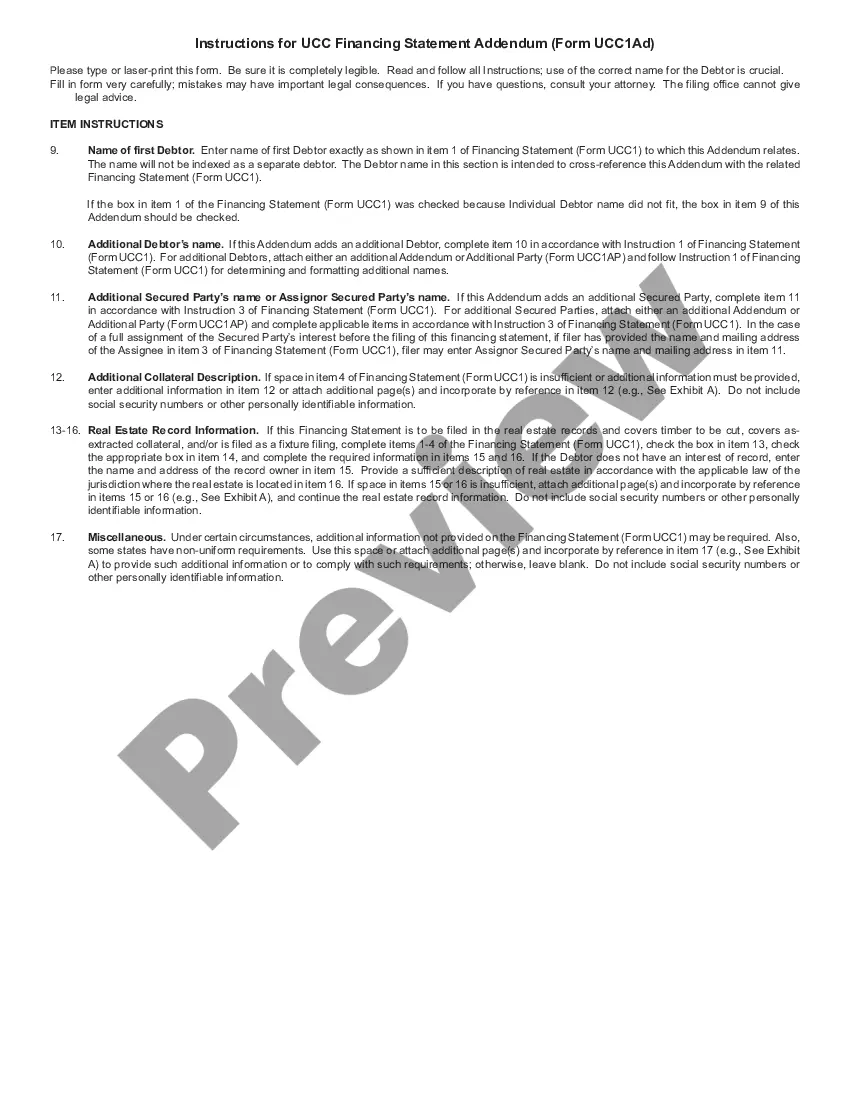
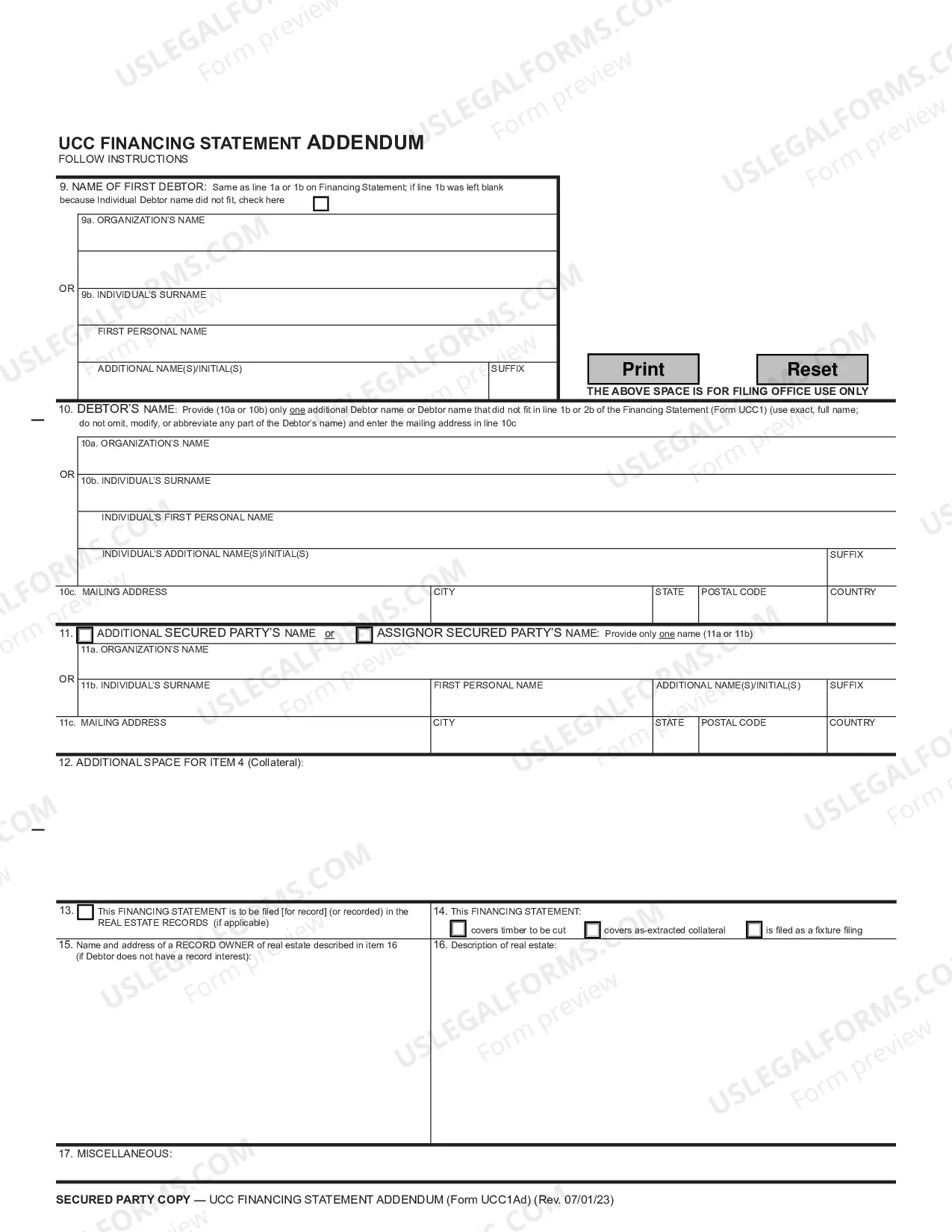
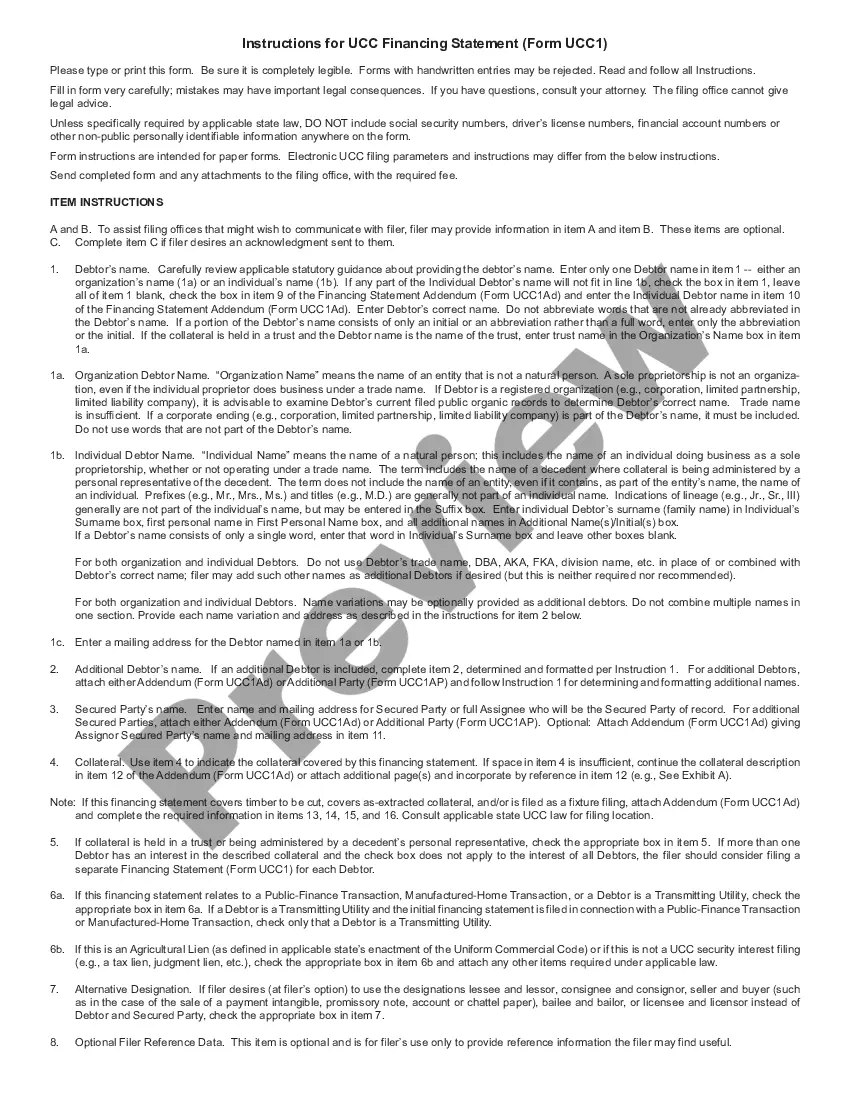
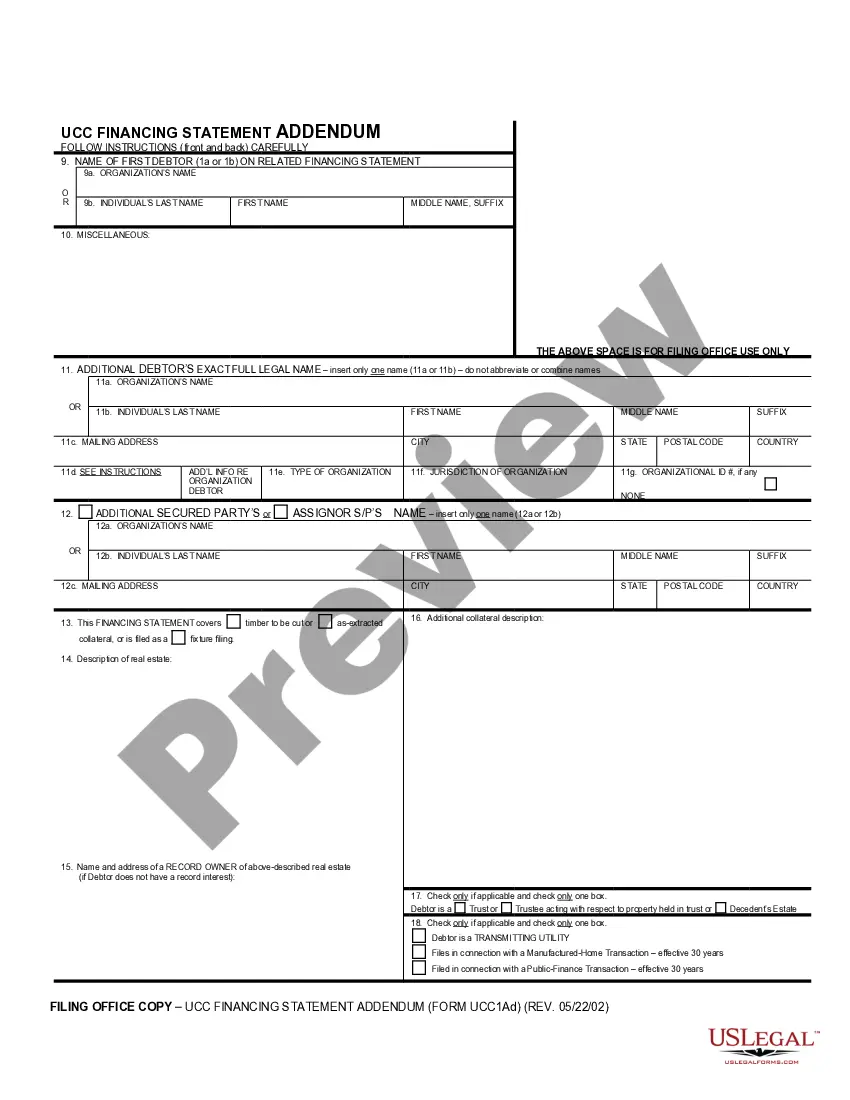
Get your form ready online
Our built-in tools help you complete, sign, share, and store your documents in one place.
Make edits, fill in missing information, and update formatting in US Legal Forms—just like you would in MS Word.
Download a copy, print it, send it by email, or mail it via USPS—whatever works best for your next step.
Sign and collect signatures with our SignNow integration. Send to multiple recipients, set reminders, and more. Go Premium to unlock E-Sign.
If this form requires notarization, complete it online through a secure video call—no need to meet a notary in person or wait for an appointment.
We protect your documents and personal data by following strict security and privacy standards.

Make edits, fill in missing information, and update formatting in US Legal Forms—just like you would in MS Word.

Download a copy, print it, send it by email, or mail it via USPS—whatever works best for your next step.

Sign and collect signatures with our SignNow integration. Send to multiple recipients, set reminders, and more. Go Premium to unlock E-Sign.

If this form requires notarization, complete it online through a secure video call—no need to meet a notary in person or wait for an appointment.

We protect your documents and personal data by following strict security and privacy standards.
Looking for another form?
How to fill out North Carolina UCC1 Financing Statement Addendum?
Regardless of an individual's social or professional rank, filling out law-related paperwork is an unfortunate requirement in the contemporary professional landscape.
Frequently, it’s nearly impossible for someone lacking legal expertise to develop such documents from the beginning, primarily due to the intricate language and legal details involved.
This is where US Legal Forms can be a lifesaver.
Confirm that the form you found is applicable in your locale since the regulations of one state or county may not apply to another.
Review the document and check a brief overview (if available) of cases for which the document can be utilized.
- Our platform provides an extensive library of over 85,000 ready-to-use, state-specific documents suitable for almost any legal scenario.
- US Legal Forms also serves as a valuable resource for associates or legal advisors looking to save time with our DIY templates.
- Whether you need the Charlotte North Carolina UCC1 Financing Statement Addendum or any other suitable document for your state or county, US Legal Forms has everything at your disposal.
- Here’s how you can quickly obtain the Charlotte North Carolina UCC1 Financing Statement Addendum using our reliable platform.
- If you are already a member, you can go ahead and Log In to your account to retrieve the required form.
- However, if you are new to our library, make sure to follow these steps before obtaining the Charlotte North Carolina UCC1 Financing Statement Addendum.
Form popularity
FAQ
It provides a method of giving notice of a security interest in personal property to interested third parties. The code provides for the recording of security agreements in which a loan of money is secured by collateral, thereby giving the lender rights to the property.
Every U.S. state and the District of Columbia have adopted at least part of the UCC (though it has not been adopted as federal law). Each jurisdiction, however, may make its own modifications (Louisiana has never adopted Article 2), and may organize its version of the UCC differently.
In all cases, you should file a UCC-1 with the secretary of state's office in the state where the debtor is incorporated or organized (if a business), or lives (if an individual).
Although the UCC-1 Financing Statement does not require signatures, any attachment such as the legal description or special terms and conditions may require the signature of the Debtor.
North Carolina's enactment of the UCC is codified in Chapter 25 of the North Carolina General Statutes (unofficial). North Carolina has adopted the following articles of the UCC: Article 1: General Provisions: UCC Article 1 deals with definitions and also the rules of interpretation of the provisions.
-- Except as otherwise provided in subsections (e), (f), and (g) of this section, an initial financing statement filed in connection with a public-finance transaction or manufactured-home transaction is effective for a period of 30 years after the date of filing if it indicates that it is filed in connection with a
All other UCC's will be filed in the Office of the NC Dept of the Secretary of State, Uniform Commercial Code Section, PO Box 29622, Raleigh, NC 27626-0622.
Form UCC3 is used to amend (make changes to) a UCC1 filing. The required information is: An acknowledgement name and address. (Recommended for return copy of the filing.)
A UCC is a security agreement on personal property that is recorded to protect the lender's or secured party's investment. In a security agreement, a loan is secured by personal property as collateral, thereby giving the lender rights in the property.
How to complete a UCC1 (Step by Step) Filer Information. Name and phone number of contact at filer. Email contact at filer.Debtor Information. Organization or individual's name. Mailing address. Secured Party Information. Organization or individual's name. Mailing address. Collateral Information. Description of collateral.