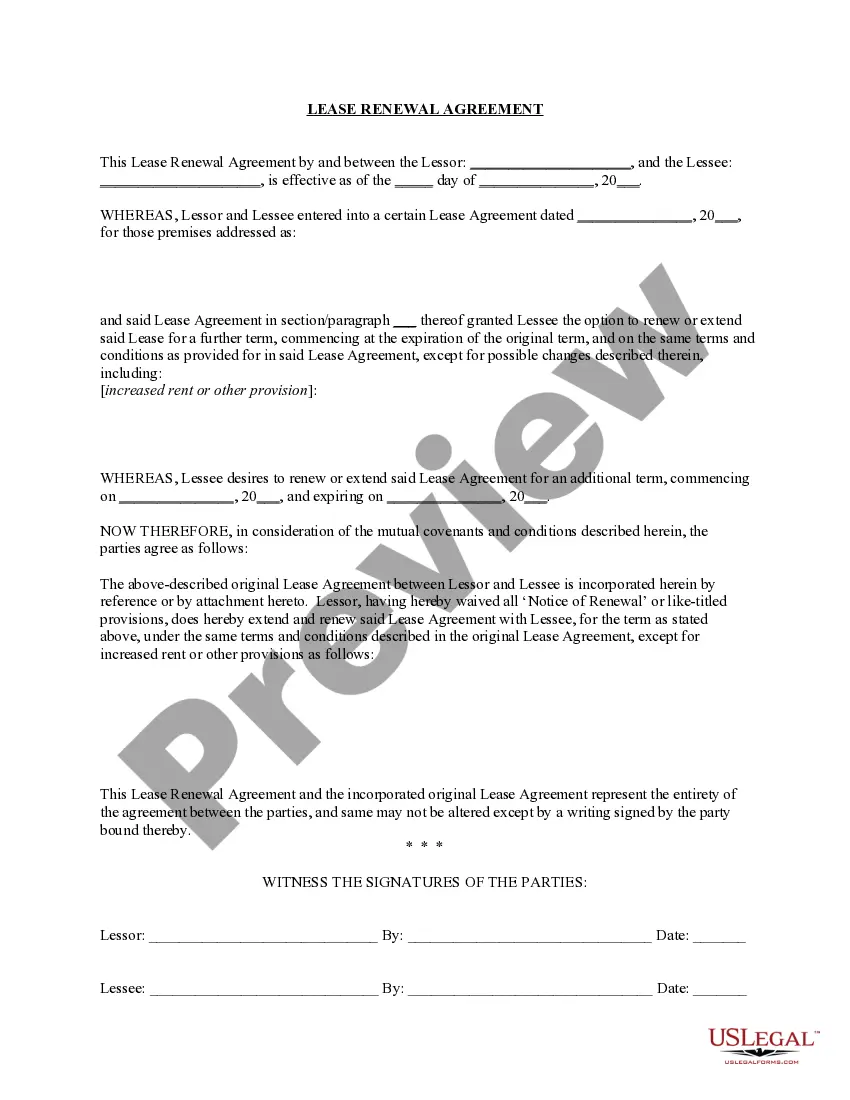
Chicago Illinois Residential Lease Renewal Agreement
Description
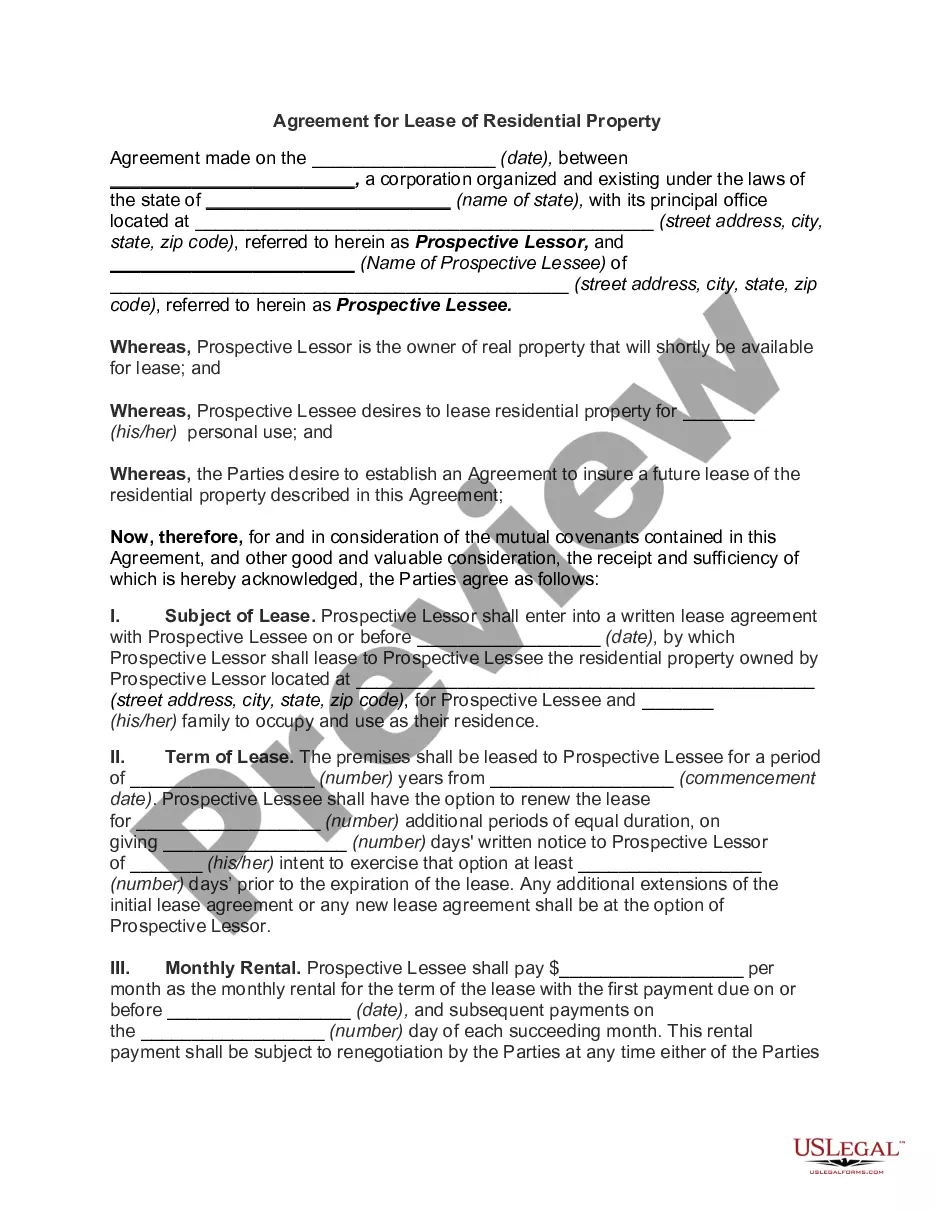
Get your form ready online
Our built-in tools help you complete, sign, share, and store your documents in one place.
Make edits, fill in missing information, and update formatting in US Legal Forms—just like you would in MS Word.
Download a copy, print it, send it by email, or mail it via USPS—whatever works best for your next step.
Sign and collect signatures with our SignNow integration. Send to multiple recipients, set reminders, and more. Go Premium to unlock E-Sign.
If this form requires notarization, complete it online through a secure video call—no need to meet a notary in person or wait for an appointment.
We protect your documents and personal data by following strict security and privacy standards.

Make edits, fill in missing information, and update formatting in US Legal Forms—just like you would in MS Word.

Download a copy, print it, send it by email, or mail it via USPS—whatever works best for your next step.

Sign and collect signatures with our SignNow integration. Send to multiple recipients, set reminders, and more. Go Premium to unlock E-Sign.

If this form requires notarization, complete it online through a secure video call—no need to meet a notary in person or wait for an appointment.

We protect your documents and personal data by following strict security and privacy standards.
Looking for another form?
How to fill out Illinois Residential Lease Renewal Agreement?
Regardless of social or occupational position, completing legal documents is a regrettable requirement in the contemporary professional landscape.
Frequently, it’s nearly impossible for an individual lacking legal training to generate such documents from the ground up, primarily due to the intricate language and legal details they involve.
This is where US Legal Forms can be beneficial.
Ensure that the template you select is appropriate for your area since the regulations of one state or region may not apply to another.
Review the document and read a brief summary (if available) of situations for which the form can be utilized.
- Our service offers an extensive collection of over 85,000 ready-to-use state-specific documents suitable for nearly any legal circumstance.
- US Legal Forms also proves to be a valuable resource for associates or legal advisors seeking to enhance their time management by using our DIY forms.
- Whether you need the Chicago Illinois Residential Lease Renewal Agreement or any other document applicable in your region, with US Legal Forms, everything is accessible.
- Here’s how you can swiftly obtain the Chicago Illinois Residential Lease Renewal Agreement using our reliable service.
- If you are already a customer, you can proceed to Log In to your account to retrieve the required document.
- However, if you are new to our collection, make sure to follow these steps before acquiring the Chicago Illinois Residential Lease Renewal Agreement.
Form popularity
FAQ
You had a contract for the term of the lease and there's no obligation to continue past the stated date. There's also no obligation for you to stay if you want to move at the end of the lease. But if your landlord doesn't renew, you'll have to move. If you're a reliable renter, most landlords want to renew the lease.
It's important to note the Chicago Landlord Tenant Ordinance requires landlords to give tenants 30 days' written notice if they do not intend to renew their lease. Failure to do so enables a tenant to stay in the property for 60 days after the lease ends under the same terms and conditions as the previous lease.
Your landlord must notify you in writing that he/she intends to terminate the lease. If you are renting month-to-month, you are entitled to a 30-day written notice. Leases running year-to-year require a 60-day written notice. YOUR LANDLORD DOES NOT HAVE TO GIVE YOU ANY REASON FOR TERMINATING THE LEASE.
If Your Landlord Moves to Terminate Your Lease Under the ordinance, landlords must provide: 60 days of notice to terminate your lease if you have lived in your apartment for more than six months but less than three years.
Notice to terminate must be given at least four months before the end of the term. In all other lease agreements for a period of less than one year, a party must give thirty days' written notice. Any notice given should call for ter- mination on the last day of that rental period.
Under the ordinance, landlords must provide: 60 days of notice to terminate your lease if you have lived in your apartment for more than six months but less than three years. 120 days of notice to terminate your lease if you have lived in your apartment for more than 3 years.
Once your lease expired, it did not automatically renew. If you have not already, you should provide your landlord with a written 30 days notice of your intention to move out. Once the 30 days have expired, you are free to move out.
In Chicago, a landlord cannot ask the tenant to renew more than 90 days before the lease ends. Also, if the tenancy is less than 6 months, the landlord must let the tenant know 30 days before the lease ends if the landlord doesn't want to renew the lease.
For tenancies 6 months-3 years, must give 60 days notice or tenant can stay for 60 days. For tenancies over 3 years, must give 120 days notice or tenant can stay for 120 days.)
Landlords must give tenants 30 days written notice if the lease will not be renewed. If the landlord fails to do this, the tenant can stay in the property for 60 days after the lease ends under the same terms and conditions of the previous lease.