This form is an official California Judicial Council form which complies with all applicable state codes and statutes. USLF updates all state forms as is required by state statutes and law.
Downey California Dementia Attachment to Capacity Declaration - Conservatorship
State:
California
City:
Downey
Control #:
CA-GC-335A
Format:
PDF
Instant download
This website is not affiliated with any governmental entity
Public form
Description




How to fill out California Dementia Attachment To Capacity Declaration - Conservatorship?
If you’ve previously taken advantage of our service, Log In to your account and retrieve the Downey California Dementia Attachment to Capacity Declaration - Conservatorship on your device by clicking the Download button. Ensure your subscription is active. If it’s not, renew it according to your payment strategy.
If this is your inaugural engagement with our service, follow these straightforward steps to acquire your document.
You have continuous access to every document you have purchased: you can find it in your profile under the My documents section whenever you wish to use it again. Utilize the US Legal Forms service to swiftly find and secure any template for your personal or professional requirements!
- Confirm you’ve found the correct document. Browse through the description and use the Preview option, if available, to see if it fulfills your requirements. If it doesn’t fit your needs, use the Search tab above to find the suitable one.
- Procure the template. Click the Buy Now button and choose a monthly or yearly subscription plan.
- Establish an account and process your payment. Utilize your credit card information or the PayPal option to finalize the transaction.
- Acquire your Downey California Dementia Attachment to Capacity Declaration - Conservatorship. Choose the file format for your document and save it to your device.
- Complete your form. Print it or utilize professional online editors to fill it out and sign it digitally.
Form popularity
FAQ
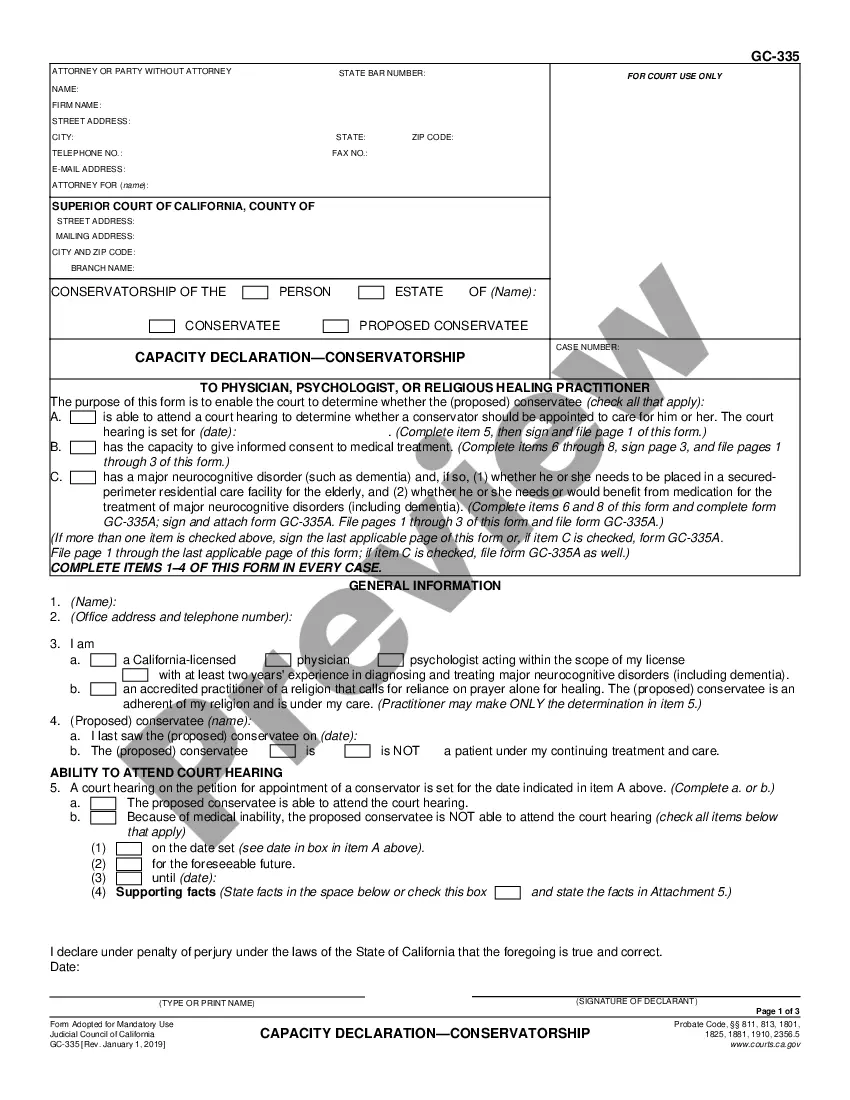
Filing for conservatorship in California involves several important steps. First, you must prepare necessary documents, including the Downey California Dementia Attachment to Capacity Declaration - Conservatorship, which demonstrates the individual's mental state. Next, you'll file these documents with the court, ensuring you follow the specific guidelines for your situation. Lastly, after the court reviews your filing, you will attend a hearing where a judge will decide whether to grant the conservatorship.
To get a conservator appointed in California, you must start by filing a petition with the court. This petition should include the Downey California Dementia Attachment to Capacity Declaration - Conservatorship, which helps establish the individual's mental condition. After filing, the court will schedule a hearing, allowing interested parties to provide their input. If the court finds sufficient evidence, it will appoint a conservator to manage the affairs of the individual in question.
The four components of capacity evaluation involve understanding the individual's ability to understand information, appreciate the situation, reason about choices, and communicate a decision. These elements are critical in forming a complete picture of one's capabilities, especially under the guidelines of the Downey California Dementia Attachment to Capacity Declaration - Conservatorship. A well-rounded evaluation covers each component to determine the need for conservatorship accurately.
A capacity assessment typically includes questions about the individual's understanding of their situation, their ability to communicate preferences, and their grasp of the consequences of their choices. In the context of the Downey California Dementia Attachment to Capacity Declaration - Conservatorship, the assessment aims to gather thorough insights into the individual’s cognitive functioning. This helps determine the appropriate course of action regarding conservatorship.
To obtain conservatorship for dementia patients in California, you must demonstrate that the individual cannot make sound decisions regarding their health or finances. This process often requires a capacity evaluation and may involve using the Downey California Dementia Attachment to Capacity Declaration - Conservatorship for support. It is advisable to consult an attorney specialized in conservatorships to navigate legal complexities efficiently.
Starting the conservatorship process in California involves filing a petition in court, along with necessary documentation, including a capacity declaration. You will need to specify the type of conservatorship you seek, which may include the Downey California Dementia Attachment to Capacity Declaration - Conservatorship for individuals suffering from dementia. Consulting with a legal expert can streamline the process and help ensure you meet all legal requirements.
A capacity declaration can be completed by qualified professionals, including psychologists, psychiatrists, or licensed clinical social workers. These experts will evaluate the individual in accordance with the standards set forth in the Downey California Dementia Attachment to Capacity Declaration - Conservatorship. It's important to choose someone experienced with dementia assessments, as they provide credible documentation for legal proceedings.
A full capacity evaluation is a comprehensive assessment of an individual's cognitive functioning and decision-making capabilities. In relation to the Downey California Dementia Attachment to Capacity Declaration - Conservatorship, this evaluation typically involves interviews, tests, and observations. The goal is to create a thorough report that outlines the individual's abilities and limitations concerning their care and financial decisions.
Capacity refers to a person's mental ability to make informed decisions, while guardianship provides legal authority to another person to make decisions on behalf of someone who lacks that capacity. In the context of Downey California Dementia Attachment to Capacity Declaration - Conservatorship, understanding this distinction is crucial. Capacity is assessed before a conservatorship is granted, as it determines whether guardianship is necessary.
A capacity evaluation for conservatorship assesses an individual's ability to make decisions regarding their personal and financial affairs. This evaluation is essential in the context of Downey California Dementia Attachment to Capacity Declaration - Conservatorship, as it determines if an individual qualifies for a conservator due to their dementia. Trained professionals, such as psychologists, typically conduct these evaluations to provide an accurate understanding of the individual's cognitive abilities.