Louisiana Military Advance Medical Directive
Understanding this form
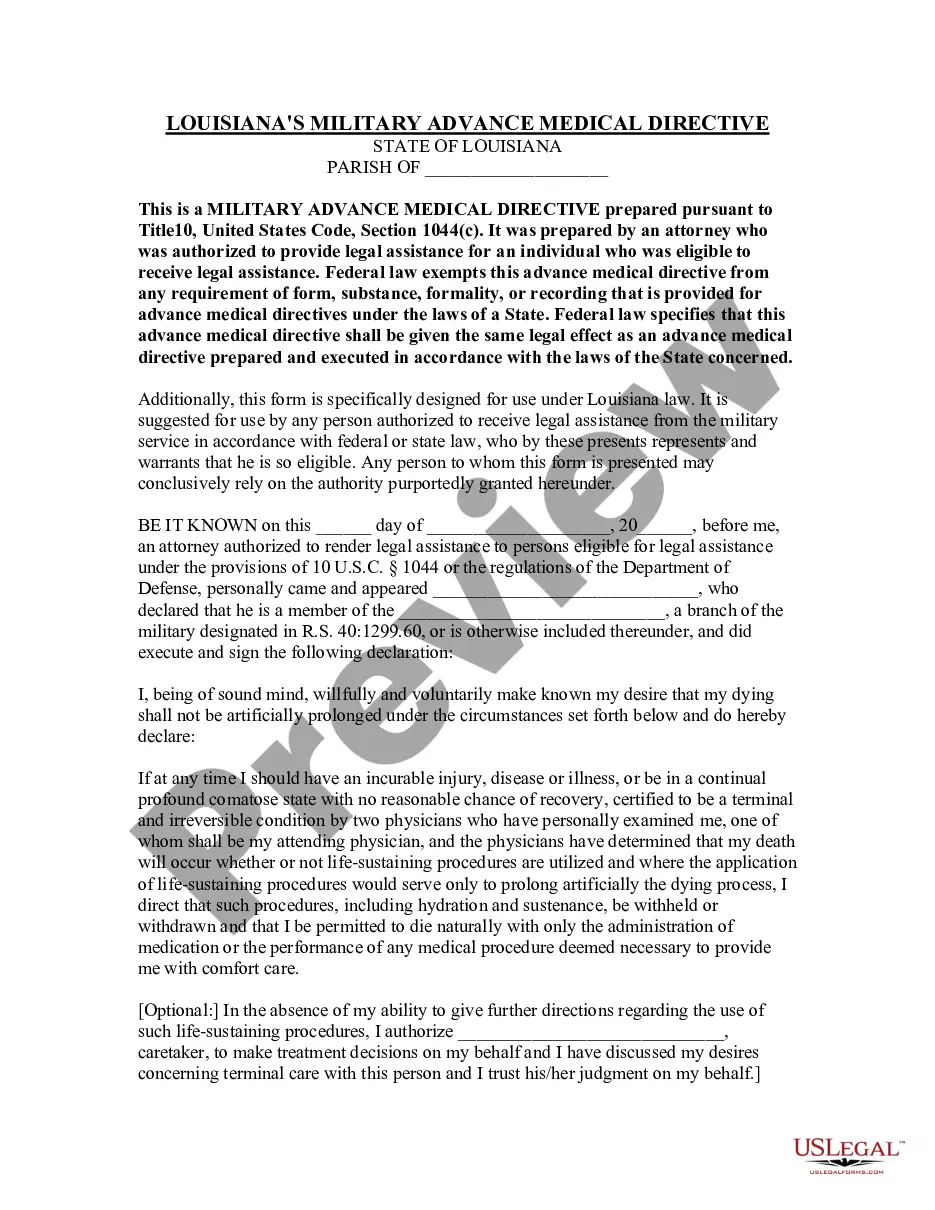
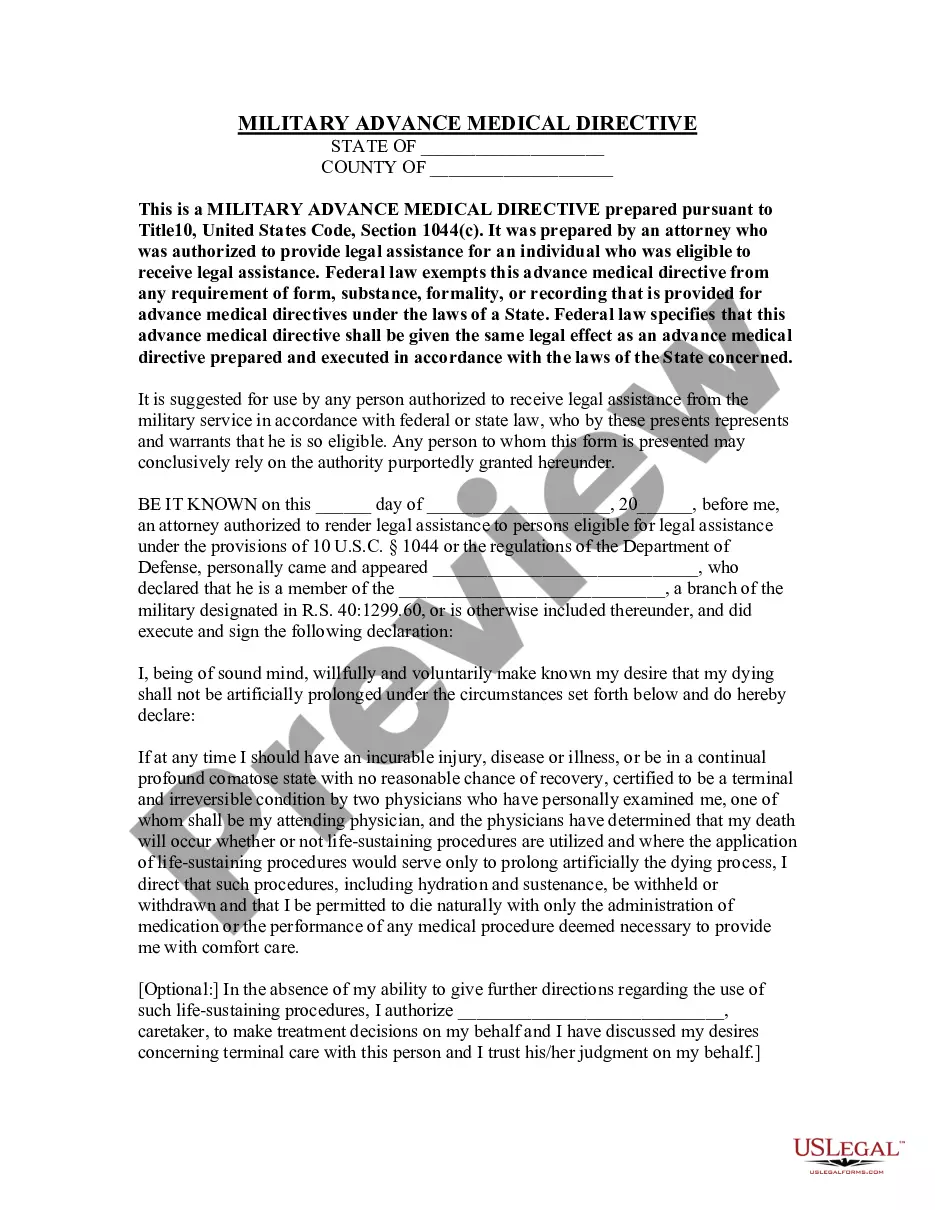
The Louisiana Military Advance Medical Directive is a legally binding document that allows military members to specify their healthcare preferences in case of a terminal condition. This directive ensures that life-sustaining procedures are not used to artificially prolong the dying process if two physicians certify that death is imminent. Unlike standard advance medical directives, this form is tailored specifically for service members under Louisiana law and is exempt from certain state requirements concerning format and recording.
Key parts of this document
- Declaration of intent not to prolong life artificially under specified medical conditions.
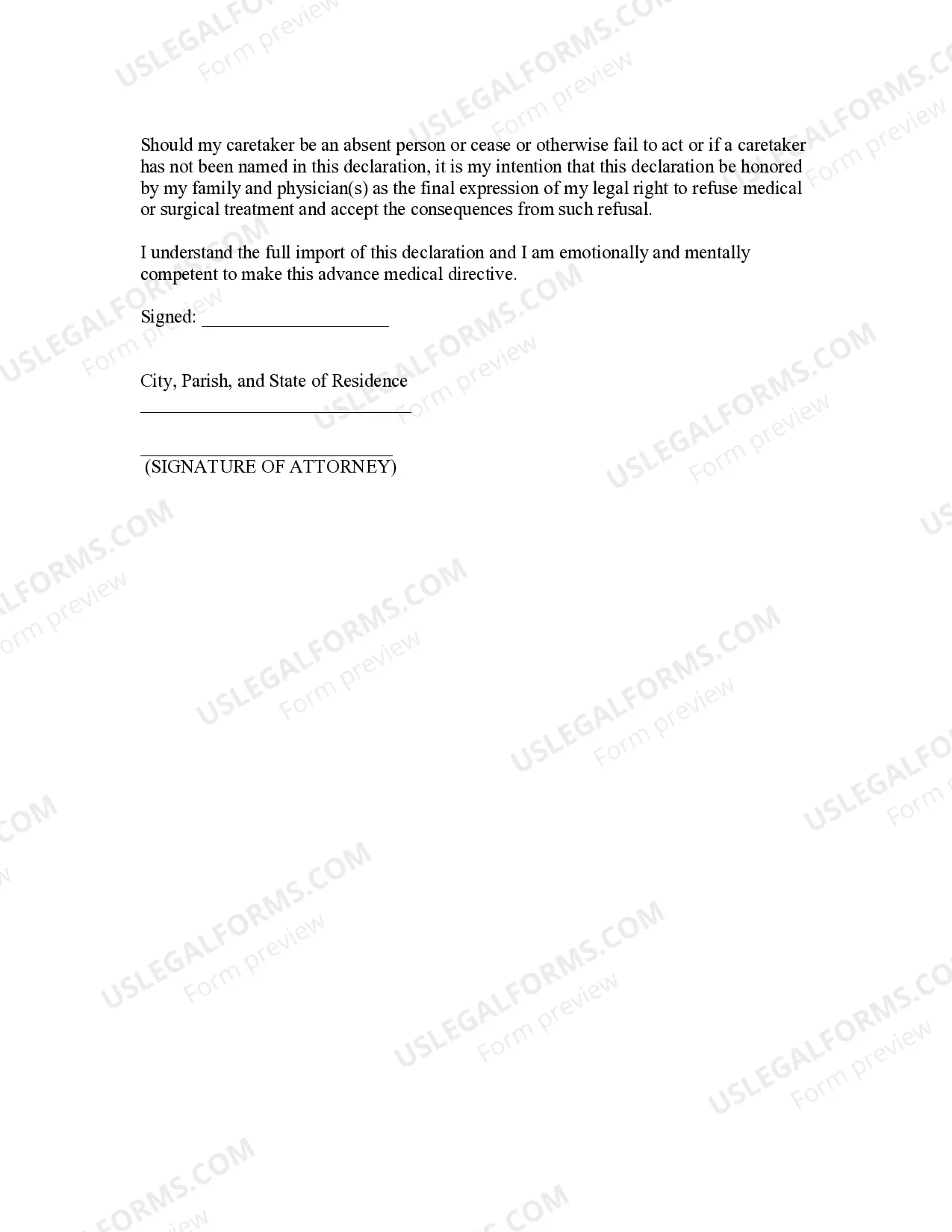
- Authority granted to a designated caretaker to make treatment decisions if the person is unable to do so.
- Certification requirement by two physicians regarding the terminal condition.
- Signature of an attorney authorized to provide legal assistance to military personnel.


When this form is needed
This form is essential when a military member wants to ensure that their healthcare wishes are respected in the event of a catastrophic medical situation. It is particularly applicable for those diagnosed with terminal illnesses or who face irreversible conditions, and is recommended for service members who want to communicate their wishes regarding life-sustaining treatments clearly.
Who needs this form
- Active-duty military personnel.
- National Guard and reserves who are eligible for legal assistance.
- Any service member who desires to outline their end-of-life care preferences.
- Individuals seeking to ensure their healthcare decisions are respected by medical staff and family members.
Steps to complete this form
- Identify the date of execution and the parish where the directive is being made.
- Provide personal details, such as name and branch of military service.
- Clearly state your wishes regarding the withholding of life-sustaining procedures.
- Select and designate a caretaker to make decisions on your behalf if needed.
- Ensure the document is signed by yourself and an authorized attorney.
Notarization guidance
This document requires notarization to meet legal standards. US Legal Forms provides secure online notarization powered by Notarize, allowing you to complete the process through a verified video call, available 24/7.
Get your form ready online
Our built-in tools help you complete, sign, share, and store your documents in one place.
Make edits, fill in missing information, and update formatting in US Legal Forms—just like you would in MS Word.
Download a copy, print it, send it by email, or mail it via USPS—whatever works best for your next step.
Sign and collect signatures with our SignNow integration. Send to multiple recipients, set reminders, and more. Go Premium to unlock E-Sign.
If this form requires notarization, complete it online through a secure video call—no need to meet a notary in person or wait for an appointment.
We protect your documents and personal data by following strict security and privacy standards.

Make edits, fill in missing information, and update formatting in US Legal Forms—just like you would in MS Word.

Download a copy, print it, send it by email, or mail it via USPS—whatever works best for your next step.

Sign and collect signatures with our SignNow integration. Send to multiple recipients, set reminders, and more. Go Premium to unlock E-Sign.

If this form requires notarization, complete it online through a secure video call—no need to meet a notary in person or wait for an appointment.

We protect your documents and personal data by following strict security and privacy standards.
Common mistakes to avoid
- Failing to have the form signed by an authorized attorney.
- Not specifying a caretaker or failing to discuss wishes with them beforehand.
- Overlooking the requirement of certification by two physicians for terminal conditions.
- Neglecting to update the document if personal circumstances change.
Why use this form online
- Convenience of accessing and completing the form from anywhere, ensuring timely preparation.
- Editable templates allow users to tailor the directive to their specific needs.
- Reliable legal language has been drafted by licensed attorneys to ensure enforceability.
- Quick download ensures you have a copy readily available for healthcare providers and family members.
Legal use & context
- This directive is recognized under federal law, providing it with the same legal effect as state-compliant directives.
- Military personnel are encouraged to use this form to avoid ambiguity in end-of-life medical decisions.
- It safeguards individual rights to refuse treatment based on personal healthcare preferences.
Key takeaways
- The Louisiana Military Advance Medical Directive is crucial for military members wishing to express specific healthcare preferences.
- It requires careful completion, including physician certification and the selection of a caretaker.
- This directive is designed to ensure that the wishes of military personnel are honored during medical emergencies.
Looking for another form?


Form popularity
FAQ
As long as you can still make your own decisions, your advance directive won't be used. You can change or cancel it at any time. Your health care agent will only make choices for you if you can't or don't want to decide for yourself.
You can get the forms in a doctor's office, hospital, law office, state or local office for the aging, senior center, nursing home, or online. When you write your advance directive, think about the kinds of treatments that you do or don't want to receive if you get seriously hurt or ill.
The name and contact information of your healthcare agent/proxy. Answers to specific questions about your preferences for care if you become unable to speak for yourself. Names and signatures of individuals who witness your signing your advance directive, if required.
A breathing machine, CPR, and artificial nutrition and hydration are examples of life-sustaining treatments. Living willAn advance directive that tells what medical treatment a person does or doesn't want if he/she is not able to make his/her wishes known.
The living will. Durable power of attorney for health care/Medical power of attorney. POLST (Physician Orders for Life-Sustaining Treatment) Do not resuscitate (DNR) orders. Organ and tissue donation.
An advance directive is a set of instructions someone prepares in advance of ill health that determines his healthcare wishes. A living will is one type of advance directive that becomes effective when a person is terminally ill.
Advance directives are not required. If you do not have one and are unable to make decisions for yourself then your health care providers will consult with the following people in the order listed: 1. Your legal guardian 2.
Talk to your agent. Talk to the person or persons you want to make decisions for you so they: Write your personal directive. You have 2 options: Sign it. You and a witness have to sign the personal directive to make it a legal document. Give out copies.