Louisiana Agreed Cancellation of Lease
What is this form?
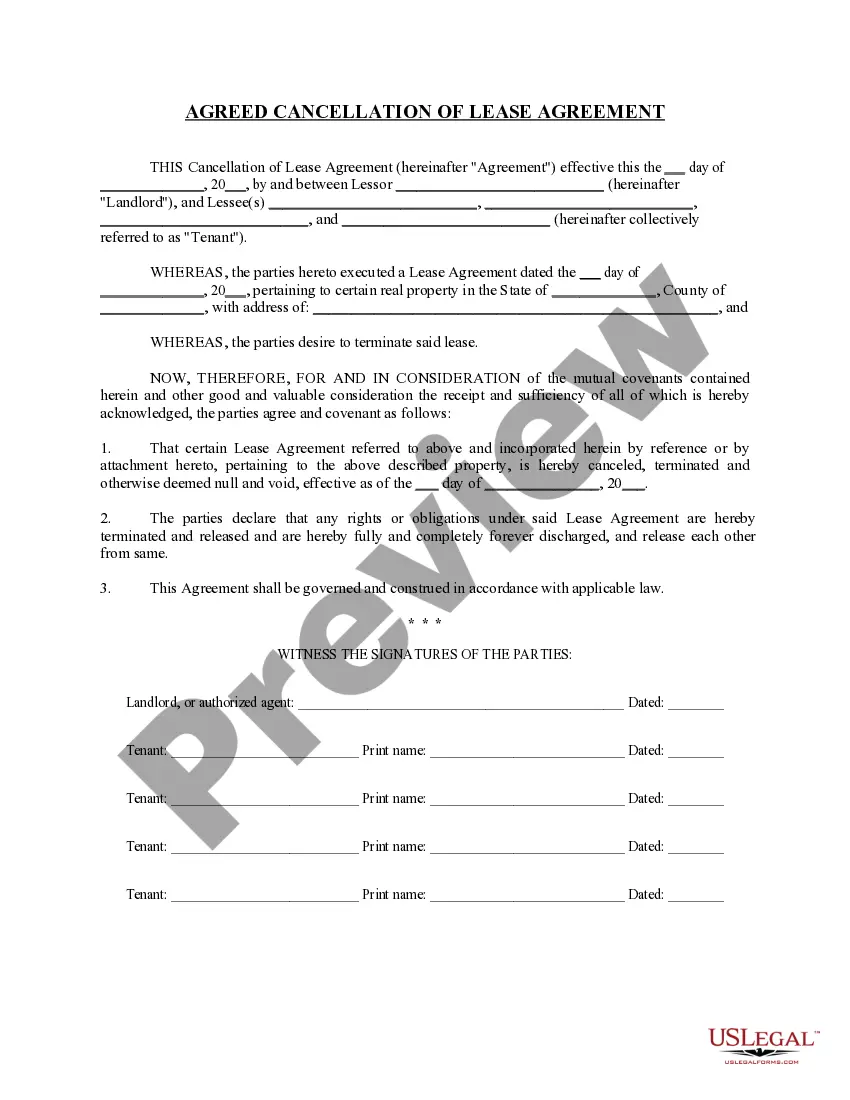
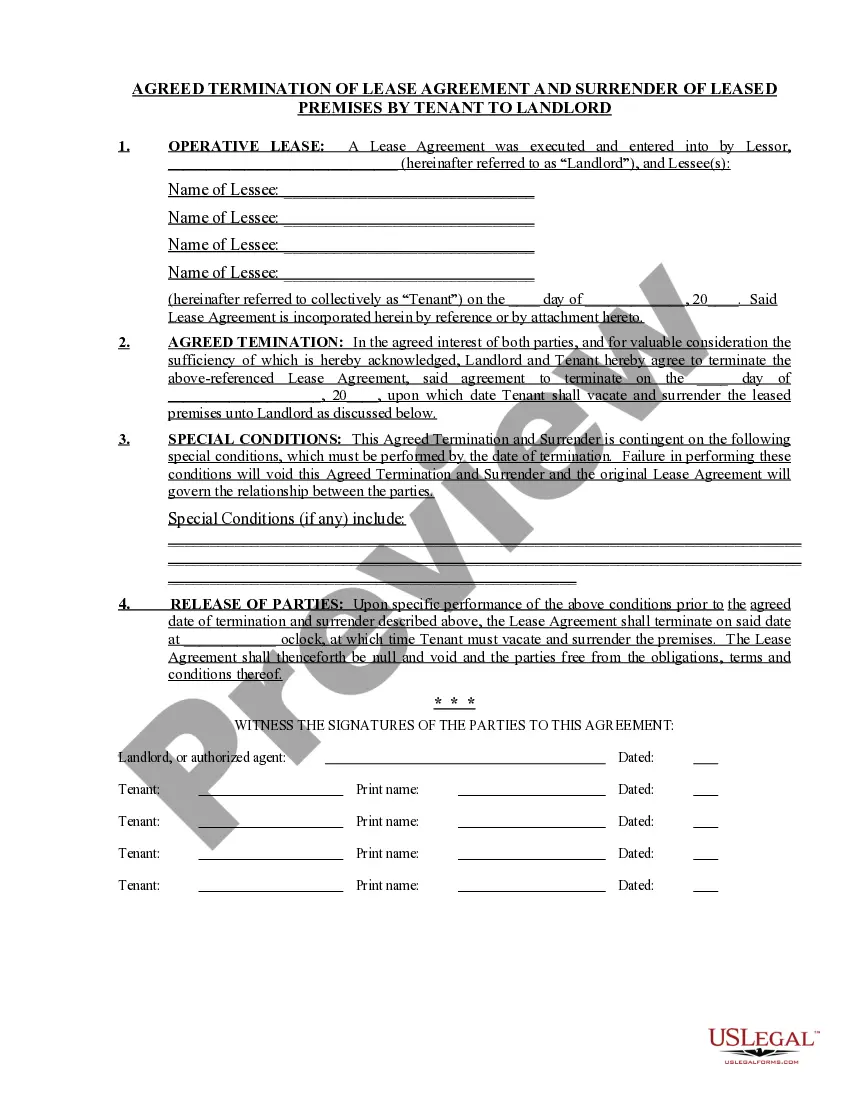
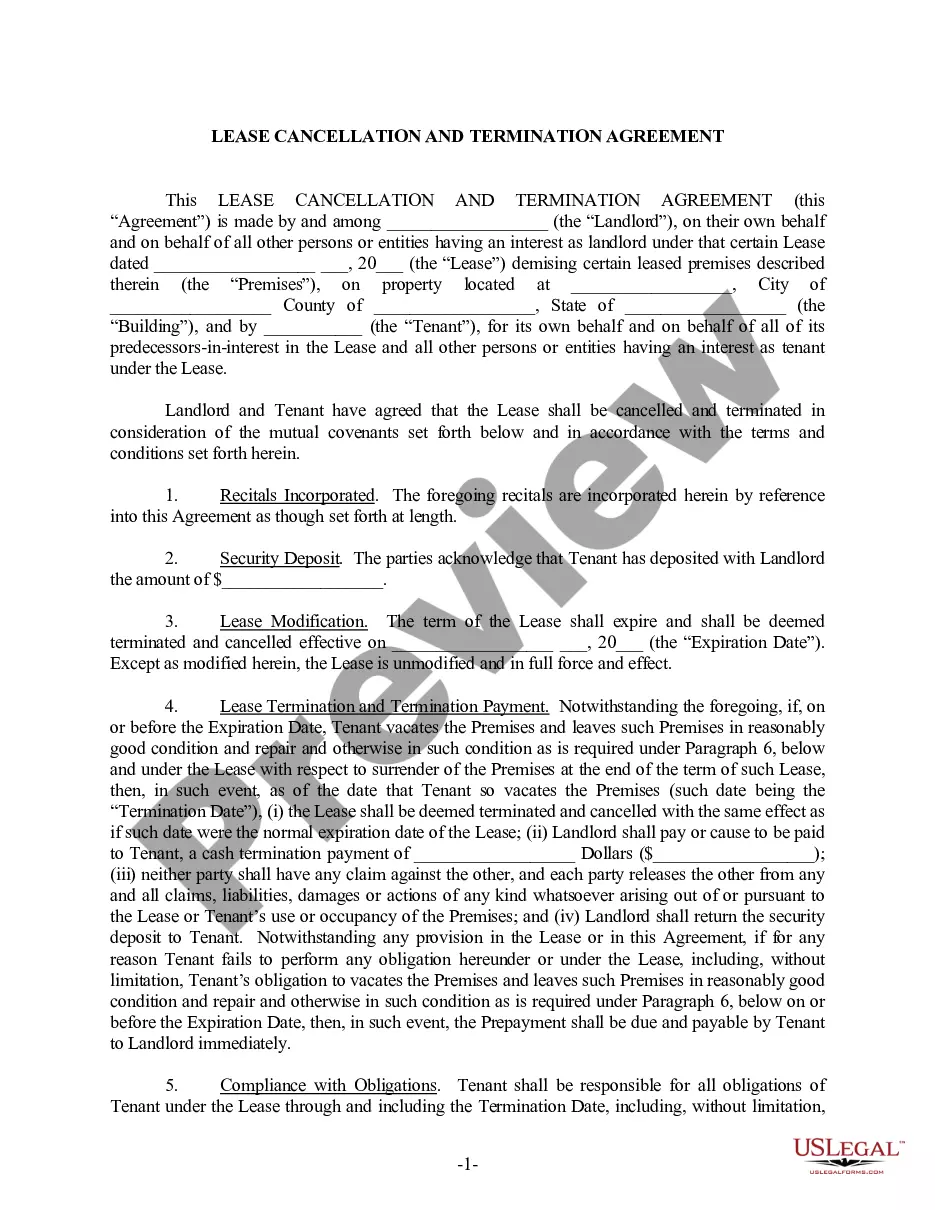
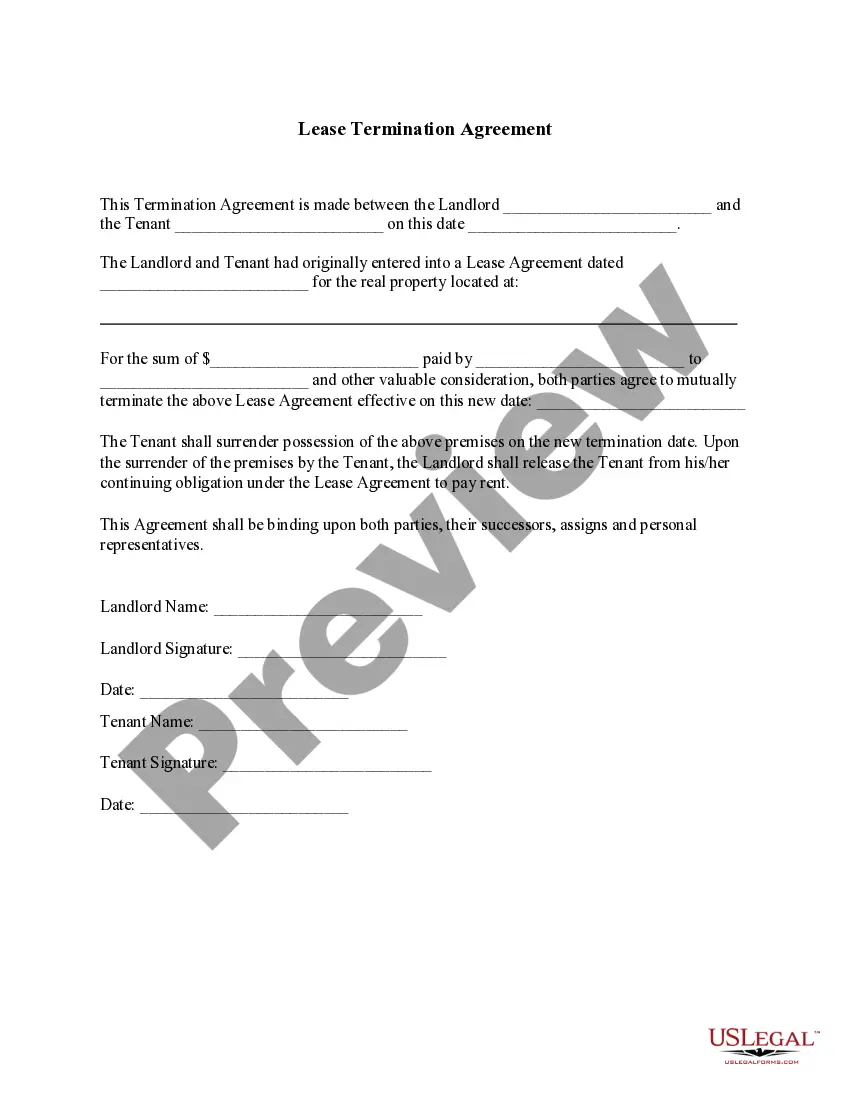
The Agreed Cancellation of Lease is a legal document that provides a smooth and mutual agreement between a landlord and tenant to cancel a lease without any penalties or obligations. This form is ideal for situations where both parties agree to terminate their lease, differentiating it from other lease termination forms that may involve specific conditions or requirements.
Form components explained
- Parties involved: Identification of the landlord (Lessor) and tenant (Lessee).
- Lease details: Reference to the original lease agreement being canceled.
- Effective date: The specific date the cancellation takes effect.
- Mutual release: A declaration that all rights and obligations under the original lease are terminated.
- Signatures: Signatures of both the landlord and tenant(s) to finalize the agreement.
When to use this document
This form should be used when both the landlord and tenant agree to terminate their lease without dispute. Scenarios requiring this form include the end of a rental arrangement, mutual decision to part ways before the lease ends, or situations where tenants are unable to fulfill their lease obligations, but both parties wish to end the agreement amicably.
Who can use this document
- Landlords looking to terminate a lease agreement amicably.
- Tenants seeking to officially cancel their lease without penalties.
- Property managers facilitating lease terminations on behalf of landlords.
How to complete this form
- Identify the parties: Fill in the names of the landlord and tenants.
- Specify the lease details: Enter the date of the original lease agreement and the property address.
- Enter the effective cancellation date: Clearly state when the lease will be considered terminated.
- Mutual release: Acknowledge that all obligations under the lease are canceled.
- Gather signatures: Ensure that all parties sign and date the document to make it legally binding.
Does this form need to be notarized?
Notarization is generally not required for this form. However, certain states or situations might demand it. You can complete notarization online through US Legal Forms, powered by Notarize, using a verified video call available anytime.
Get your form ready online
Our built-in tools help you complete, sign, share, and store your documents in one place.
Make edits, fill in missing information, and update formatting in US Legal Forms—just like you would in MS Word.
Download a copy, print it, send it by email, or mail it via USPS—whatever works best for your next step.
Sign and collect signatures with our SignNow integration. Send to multiple recipients, set reminders, and more. Go Premium to unlock E-Sign.
If this form requires notarization, complete it online through a secure video call—no need to meet a notary in person or wait for an appointment.
We protect your documents and personal data by following strict security and privacy standards.

Make edits, fill in missing information, and update formatting in US Legal Forms—just like you would in MS Word.

Download a copy, print it, send it by email, or mail it via USPS—whatever works best for your next step.

Sign and collect signatures with our SignNow integration. Send to multiple recipients, set reminders, and more. Go Premium to unlock E-Sign.

If this form requires notarization, complete it online through a secure video call—no need to meet a notary in person or wait for an appointment.

We protect your documents and personal data by following strict security and privacy standards.
Avoid these common issues
- Failing to include the effective date of cancellation.
- Not securing all required signatures from tenants.
- Leaving out details of the original lease agreement.
Why complete this form online
- Convenience: Download and complete the form at your own pace.
- Editability: Customize the form easily to fit your specific situation.
- Reliability: Trusted templates drafted by licensed attorneys ensure compliance with legal standards.
Looking for another form?
Form popularity
FAQ
In some circumstances, a tenant can break a fixed-term agreement early without penalty. A tenant can give 14 days' written notice to end an agreement early without penalty if: they have accepted an offer of social housing (e.g. from DCJ Housing)
When you sign an auto lease, you may notice a sign in the finance manager's office stating, "There is no cooling off period." Unlike a mortgage or other loan, a car lease contract is final, and there is no three-day right to rescind your contract. You cannot turn in your keys and change your mind.
While some jurisdictions may have provisions that allow consumers to change their minds with no consequences, generally there is no cooling-off period for leasing real property. Once the landlord and tenant sign a lease and a copy is delivered to the both parties, it becomes a valid contract.
If you have a month-to-month lease, you can usually cancel the lease by giving your landlord 10 days written notice before the end of the rental month. Check your lease though, because many leases require 30 days' notice.
A landlord can't force you to move out before the lease ends, unless you fail to pay the rent or violate another significant term, such as repeatedly throwing large and noisy parties. In these cases, landlords in California must follow specific procedures to end the tenancy.
Give the landlord/agent a written termination notice and vacate move out and return the keys according to your notice, and/or. apply to the NSW Civil & Administrative Tribunal (NCAT) for a termination order.
Negotiate with your landlord for an early termination of your lease. Any lease can be legally terminated before its end date if both parties agree. Also, if rents have risen in the area since you signed your lease, the landlord may be motivated to terminate the lease in order to charge a higher rent.
Breaking the lease might result in the loss of a security deposit. As explained previously, your roommate's misconduct can also be imputed to you, meaning that moving out before the lease expires, causing damage to the unit or not paying rent can cause you to lose your security deposit.
Unless such a condition is explicitly stated in the lease or there is a rare jurisdictional law that requires a cooling period, your lease is binding the second you sign your name. The landlord has the right to decide whether to mutually agree to terminate the lease or to hold you to the terms.