Louisiana Last Will and Testament, Spouse and Children
What this document covers
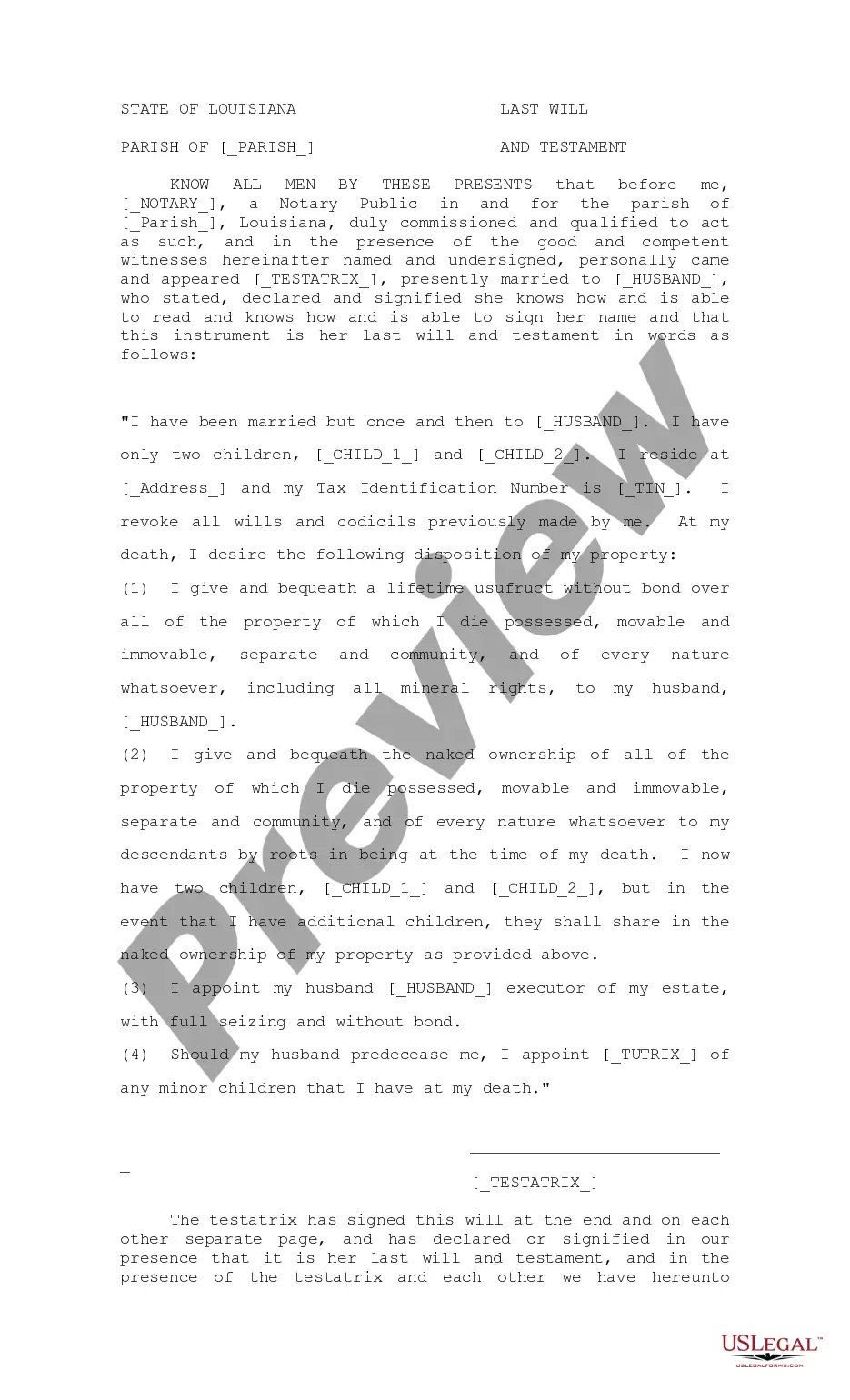
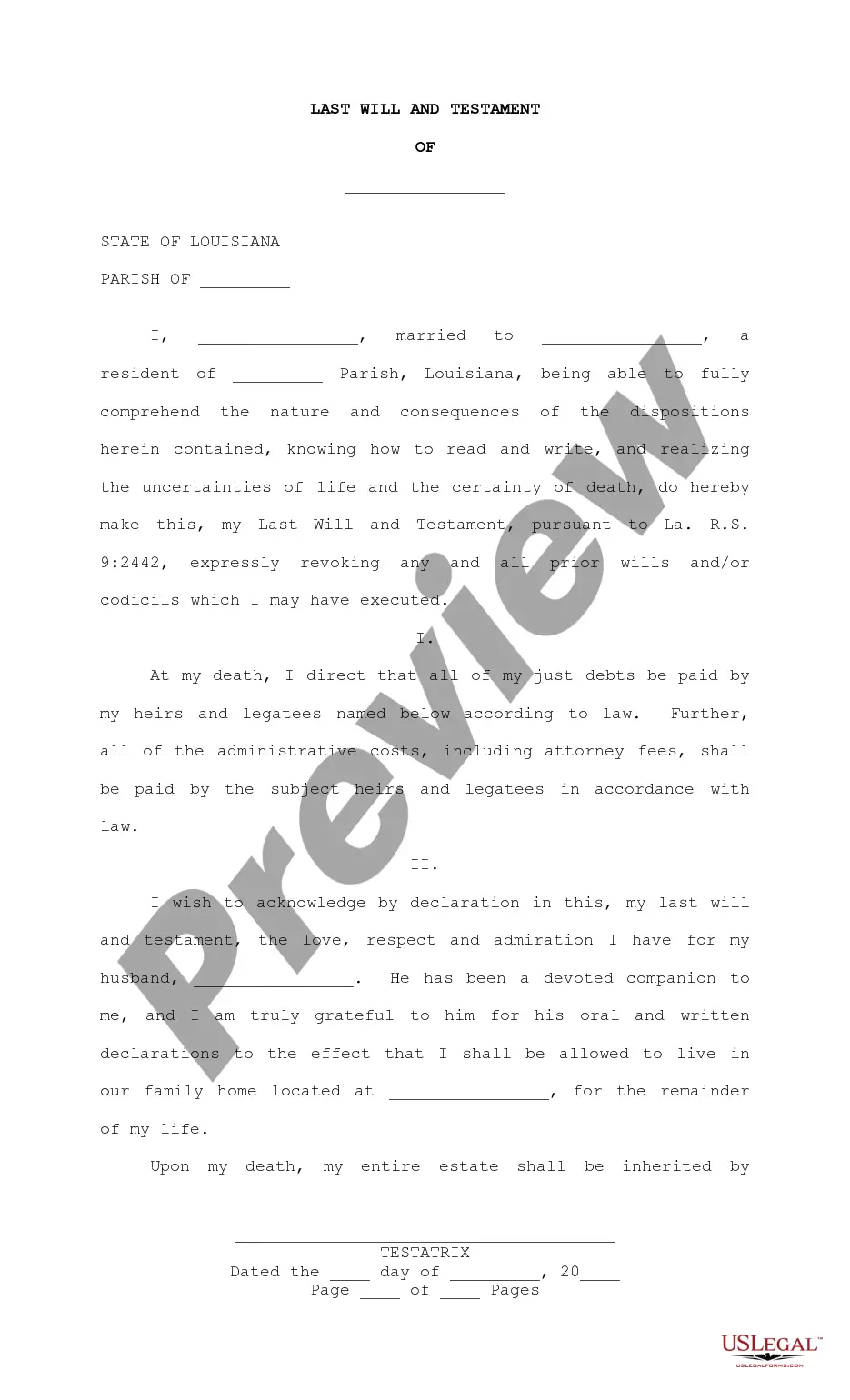
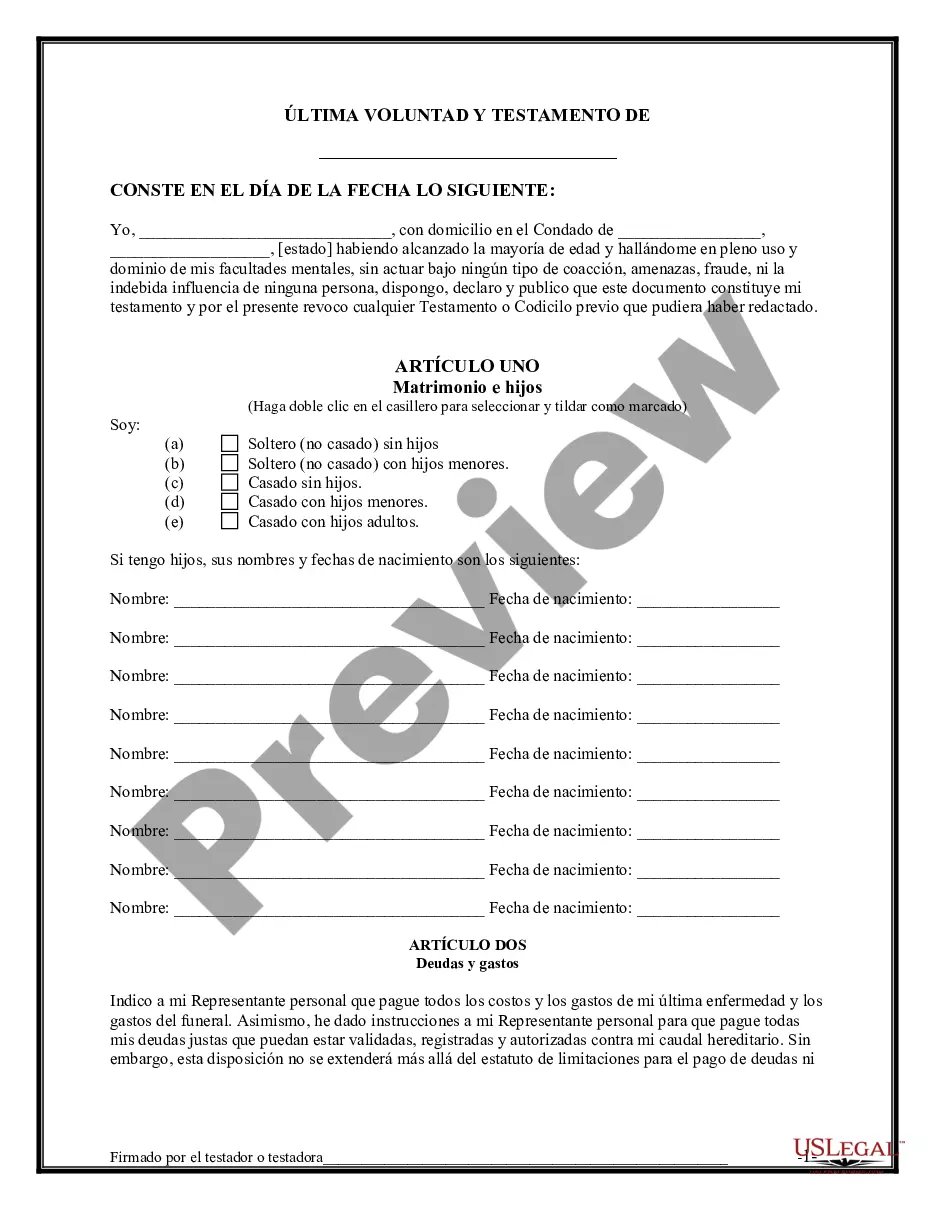
The Last Will and Testament, Spouse and Children, is a legally binding document that allows a married individual to outline the distribution of their estate after death. This specific will form includes provisions for a spouse and children, distinguishing it from other types of wills by ensuring that the surviving spouse has a lifetime usufruct over the estate while the children inherit the naked ownership. It is drafted according to Louisiana statutory requirements, making it valid in the state.
Key parts of this document
- Identification of the testatrix (the person making the will) and her marital status.
- Designation of the husband as the recipient of a lifetime usufruct over the estate.
- Bequest of the naked ownership of the estate to the children.
- Appointment of the husband as the executor of the estate.
- Specification of a tutrix for any minor children in case the husband passes away before the testatrix.



Common use cases
This will form is ideal for individuals who are married and have children. It is particularly useful in scenarios where a person wants to ensure that their spouse can manage the estate during their lifetime while also securing the inheritance for their children. Use this form to specify details about asset distribution and to simplify the probate process by clearly outlining your wishes.
Intended users of this form
- Married individuals with children.
- Those who want to provide for a surviving spouse while protecting children's inheritance.
- Individuals looking for a straightforward will that complies with Louisiana state law.
- Anyone wishing to appoint an executor and potentially a tutrix for minor children.
Completing this form step by step
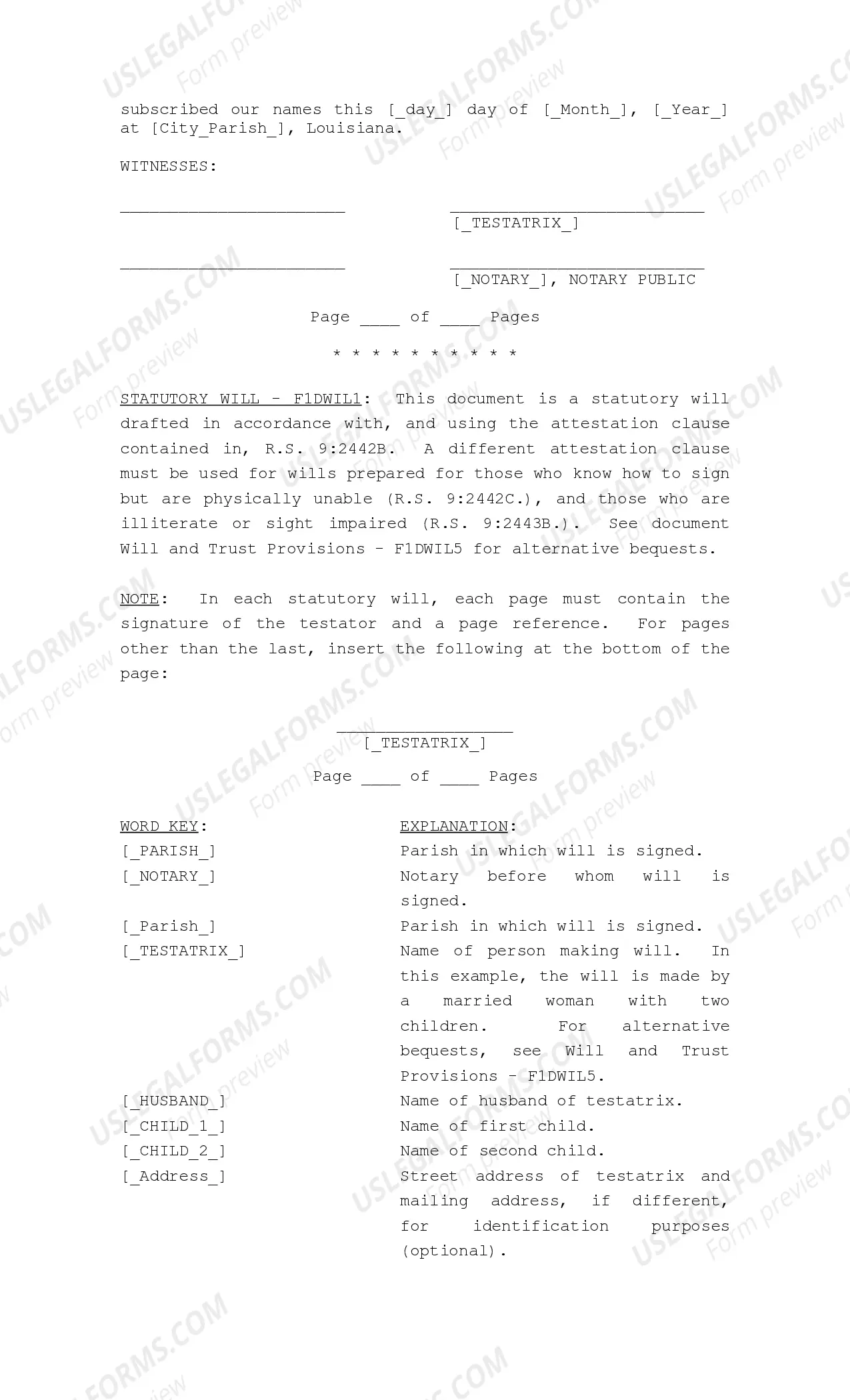
- Begin by entering the names of the testatrix and her husband.
- Specify the names of the children who will inherit the estate.
- Indicate the address and Tax Identification Number of the testatrix for identification.
- Fill in the dates when the will is being signed and the city/parish of execution.
- Have the testatrix and witnesses sign the document at the end and on each page as required by Louisiana law.
Is notarization required?
To make this form legally binding, it must be notarized. Our online notarization service, powered by Notarize, lets you verify and sign documents remotely through an encrypted video session.
Get your form ready online
Our built-in tools help you complete, sign, share, and store your documents in one place.
Make edits, fill in missing information, and update formatting in US Legal Forms—just like you would in MS Word.
Download a copy, print it, send it by email, or mail it via USPS—whatever works best for your next step.
Sign and collect signatures with our SignNow integration. Send to multiple recipients, set reminders, and more. Go Premium to unlock E-Sign.
If this form requires notarization, complete it online through a secure video call—no need to meet a notary in person or wait for an appointment.
We protect your documents and personal data by following strict security and privacy standards.

Make edits, fill in missing information, and update formatting in US Legal Forms—just like you would in MS Word.

Download a copy, print it, send it by email, or mail it via USPS—whatever works best for your next step.

Sign and collect signatures with our SignNow integration. Send to multiple recipients, set reminders, and more. Go Premium to unlock E-Sign.

If this form requires notarization, complete it online through a secure video call—no need to meet a notary in person or wait for an appointment.

We protect your documents and personal data by following strict security and privacy standards.
Common mistakes to avoid
- Failing to have the will signed by the required witnesses, which can invalidate the document.
- Not including all necessary information about beneficiaries and the executor.
- Neglecting to revoke any previous wills, leading to confusion about the testatrix's intent.
- Omitting the correct date and city/parish where the will is signed.
Why use this form online
- Instant access to a legally compliant and professionally drafted will.
- Ability to fill in information at your convenience, ensuring accuracy.
- Reduced costs compared to hiring an attorney for a simple will.
- Easy-to-follow instructions guide you through each step of the completion process.
Summary of main points
- The Last Will and Testament is essential for married individuals wishing to secure their family's future.
- This form ensures a spouse receives a lifetime interest in the estate, while children inherit ownership.
- Proper execution, including notarization and witness signatures, is critical for legality.
- Using this form online provides a convenient and cost-effective solution for estate planning.
Looking for another form?
Form popularity
FAQ
In order to satisfy legal requirements in Louisiana, a will must be signed by two (2) witnesses who have attested the testator's signature. In addition, a will must be notarized by a state-authorized individual and registered with the Secretary of State's Office.
A notarized will does not need to be probated.When a person dies leaving behind a will that is not notarized, the law requires that its validity be ascertained by a notary or by a court. Similarly, any non-notarized modification made to a will must be probated, whether the will is notarized or not.
Form a Last Will in Louisiana Signature: In the presence of a notary and two competent witnesses, the testator must declare or signify to the witnesses that the document is his Louisiana Last Will and Testament and must sign his name at the end of the document and on each other separate page.
LOUISIANA'S LIVING WILL.A living will can be executed by a person and simply witnessed by two people who will not inherit anything from the person when they decease. It does NOT need to be notarized.
Although a last will and testament is not legally required, without a will, state laws (called laws of intestacy) will determine the distribution of the deceased's assets.In Louisiana, a Petition for Probate of Testament must be filed with the court to request the recognition of the will as valid.
Create the initial document. Start by titling the document Last Will and Testament" and including your full legal name and address. Designate an executor. Appoint a guardian. Name the beneficiaries. Designate the assets. Ask witnesses to sign your will. Store your will in a safe place.
The general requirements for a valid Will are usually as follows: (a) the document must be written (meaning typed or printed), (b) signed by the person making the Will (usually called the testator or testatrix, and (c) signed by two witnesses who were present to witness the execution of the document by the maker