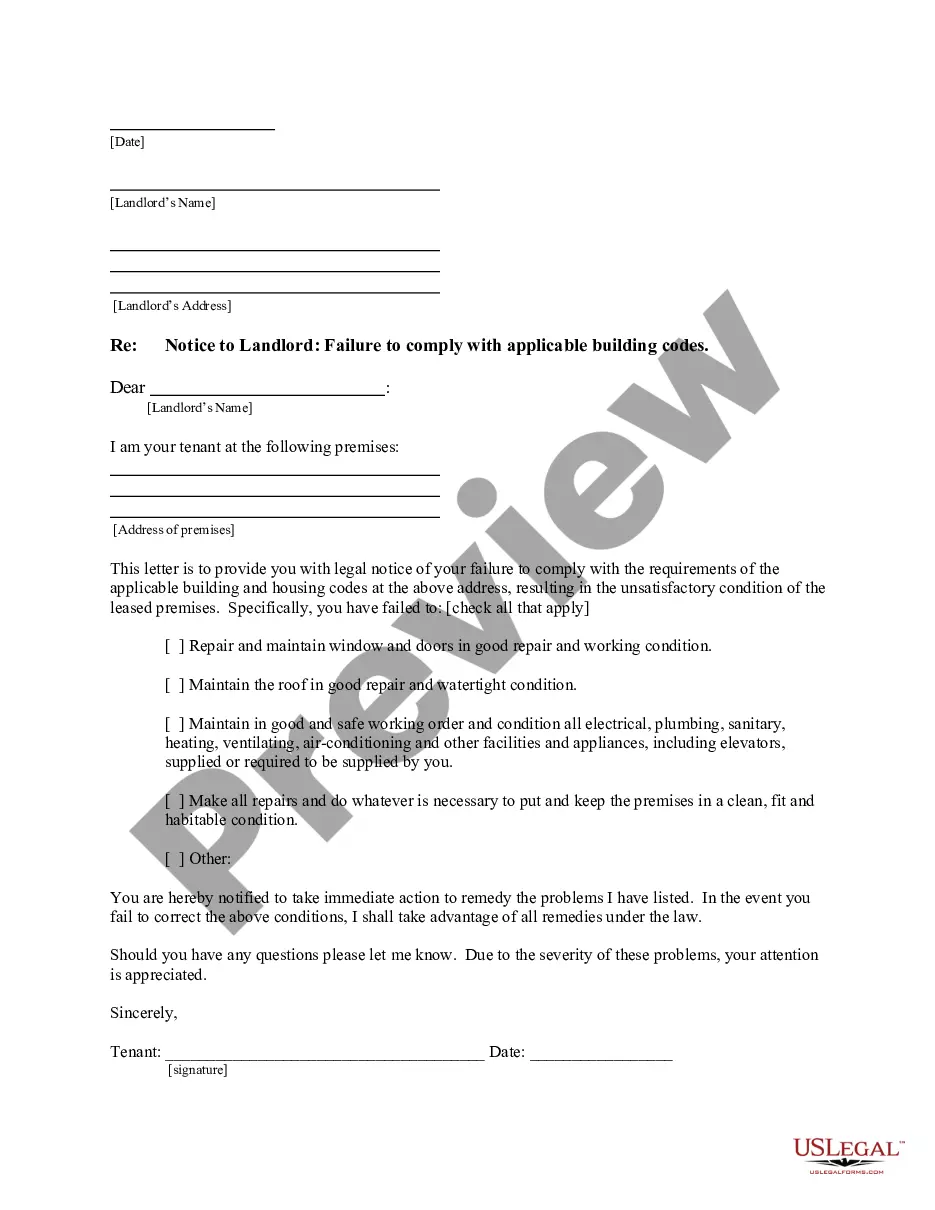
Kentucky Essential Legal Life Documents for New Parents
Overview of this form package
The Kentucky Essential Legal Life Documents for New Parents form package provides crucial legal documents tailored specifically for parents welcoming a new child. This package is designed to help new parents address important legal considerations, ensuring protection for their family and assets. Unlike other generic packages, these documents cater to Kentucky state laws and include essential forms needed for proper planning.
Documents contained in this package
- General Durable Power of Attorney for Property and Finances or Financial Effective Immediately
- General Power of Attorney for Care and Custody of Child or Children
- Statutory Health Care Directive / Living Will
- Financial Statement Form - Husband and Wife Joint
- Parental Permission and Medical Consent Form
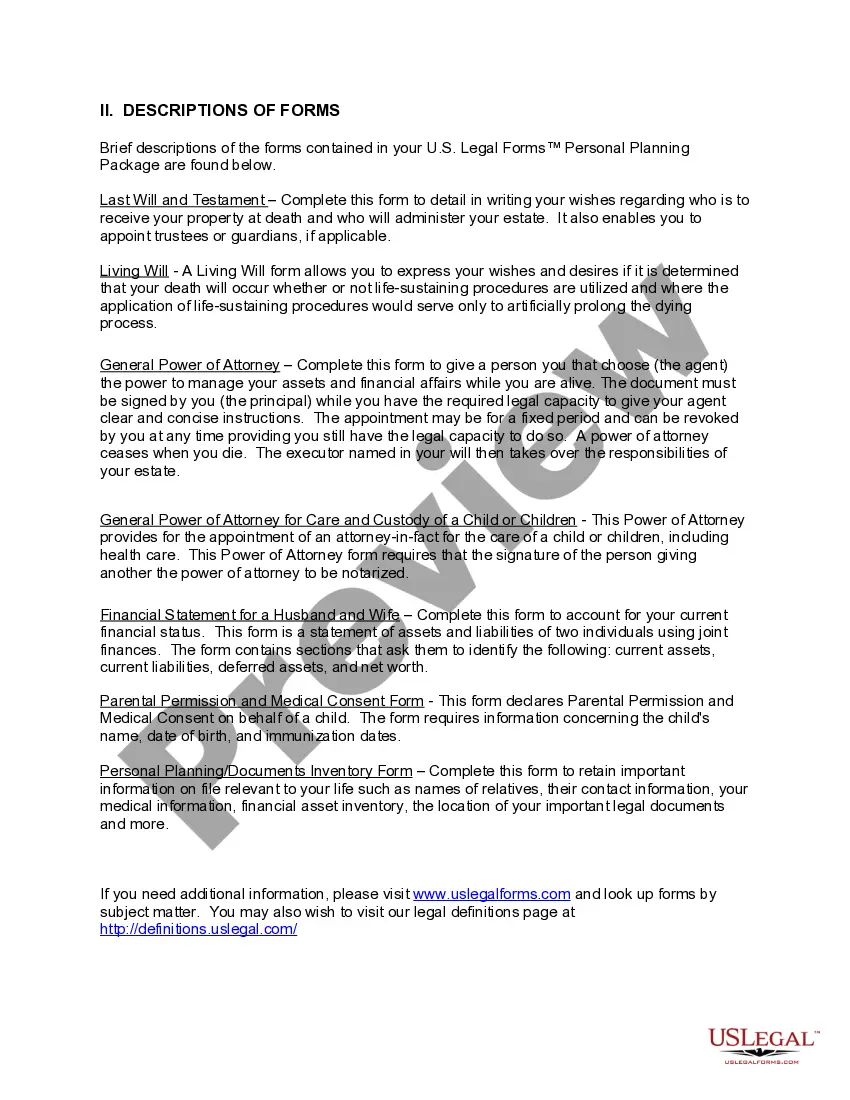
- Personal Planning Information and Document Inventory Worksheets - A Legal Life Document







When this form package is needed
This form package is ideal for new parents in Kentucky who are starting a family and need to establish their legal rights and responsibilities. Use this package when:
- You want to ensure your child's wellbeing is provided for in your Will.
- You need to specify your medical preferences in case of incapacitation.
- You require someone to handle your financial transactions if you are unable to do so.
- You wish to grant someone the authority to take care of your child.
- You want to outline medical consent for your child's treatments.
Who needs this form package
- New parents or expecting parents in Kentucky.
- Anyone who wants to formalize their wishes concerning guardianship and custody of their children.
- Parents looking to protect their financial interests and medical preferences.
- Individuals who want to prepare essential life documents in compliance with Kentucky law.
Steps to complete these forms
- Review all included forms to understand each document's purpose.
- Fill in your personal information, including relevant dates and signatures.
- Ensure you provide accurate details regarding your financial status and other necessary specifics.
- Consult with a legal professional if you have questions about how to complete specific sections.
- Store completed documents securely and inform trusted individuals of their location.
Notarization guidance for this package
Yes, forms in this package must be notarized to be legally valid. Specific documents, like the General Power of Attorney for Care and Custody of a Child or Children, require notarization. This ensures that the documents are properly executed according to Kentucky law. US Legal Forms also offers integrated online notarization services, providing secure video calls with notary professionals available 24/7.
Get your form ready online
Our built-in tools help you complete, sign, share, and store your documents in one place.
Make edits, fill in missing information, and update formatting in US Legal Forms—just like you would in MS Word.
Download a copy, print it, send it by email, or mail it via USPS—whatever works best for your next step.
Sign and collect signatures with our SignNow integration. Send to multiple recipients, set reminders, and more. Go Premium to unlock E-Sign.
If this form requires notarization, complete it online through a secure video call—no need to meet a notary in person or wait for an appointment.
We protect your documents and personal data by following strict security and privacy standards.

Make edits, fill in missing information, and update formatting in US Legal Forms—just like you would in MS Word.

Download a copy, print it, send it by email, or mail it via USPS—whatever works best for your next step.

Sign and collect signatures with our SignNow integration. Send to multiple recipients, set reminders, and more. Go Premium to unlock E-Sign.

If this form requires notarization, complete it online through a secure video call—no need to meet a notary in person or wait for an appointment.

We protect your documents and personal data by following strict security and privacy standards.
Mistakes to watch out for
- Failing to properly sign and date the forms as required.
- Overlooking the necessity for notarization where applicable.
- Using outdated or incorrect personal information.
- Not providing sufficient details in the General Power of Attorney documents.
- Neglecting to inform relevant parties about the location of these documents.
Benefits of completing this package online
- Convenient access and download options from the comfort of your home.
- Edit and customize forms easily to fit your specific needs.
- Reliable documents created by licensed attorneys tailored for Kentucky residents.
- Cost-effectiveâsave time and money compared to hiring legal services.
What to keep in mind
- This package provides essential legal documents tailored for new parents in Kentucky.
- It includes a Will, Living Will, Powers of Attorney, financial statements, and consent forms.
- Using this package ensures compliance with Kentucky law and protects your family's future.
- Important to complete and store documents correctly and notify trusted individuals of their location.
Looking for another form?

Form popularity
FAQ
I don't like the father. Do I have to establish paternity? You don't have to file for paternity unless you want a child support order. If you wait for over four (4) years from the child's birth to file a paternity action, you might not be able to get back child support for those four years.
If a child is born between two unmarried people, then the father does not have any rights to custody or visitation, until paternity is established. Paternity can be established by signing a Voluntary Acknowledgment of Paternity (VAP) or by genetic testing.
If a man seeking to establish paternity does not attend the paternity test, the man is in contempt of the court order that required him to do so. The man may be held in contempt of court. In addition, if the man does not appear, the court may grant a default judgment against him.
There is no age that a judge will give the power to a minor to decide where they live. The older the child is, the court will give a greater deference to the child's desires. Neither the receipt by this attorney nor a reply from this attorney constitutes the initiation of an attorney-client relationship.
The person wishing to be appointed the child's guardian files a Petition and an Application with the district court in the county where the child lives, and the court, after a hearing at which the child's best interests are considered, appoints a guardian.
Kentucky is not a state that favors mothers over fathers. In fact, Kentucky is the first state to give both a fair shot. According to WFPL, the bill that offers parents a fair shot is a bill that states divorced parents receive joint custody as a default.
Establishing Paternity in Kentucky Under Kentucky state law, when a child's parents are married, the biological and legal father is assumed to be the child's mother's husband. However, when the parents are unmarried, determining paternity includes some additional steps.