Kentucky Revocation of Premarital or Prenuptial Agreement
Overview of this form
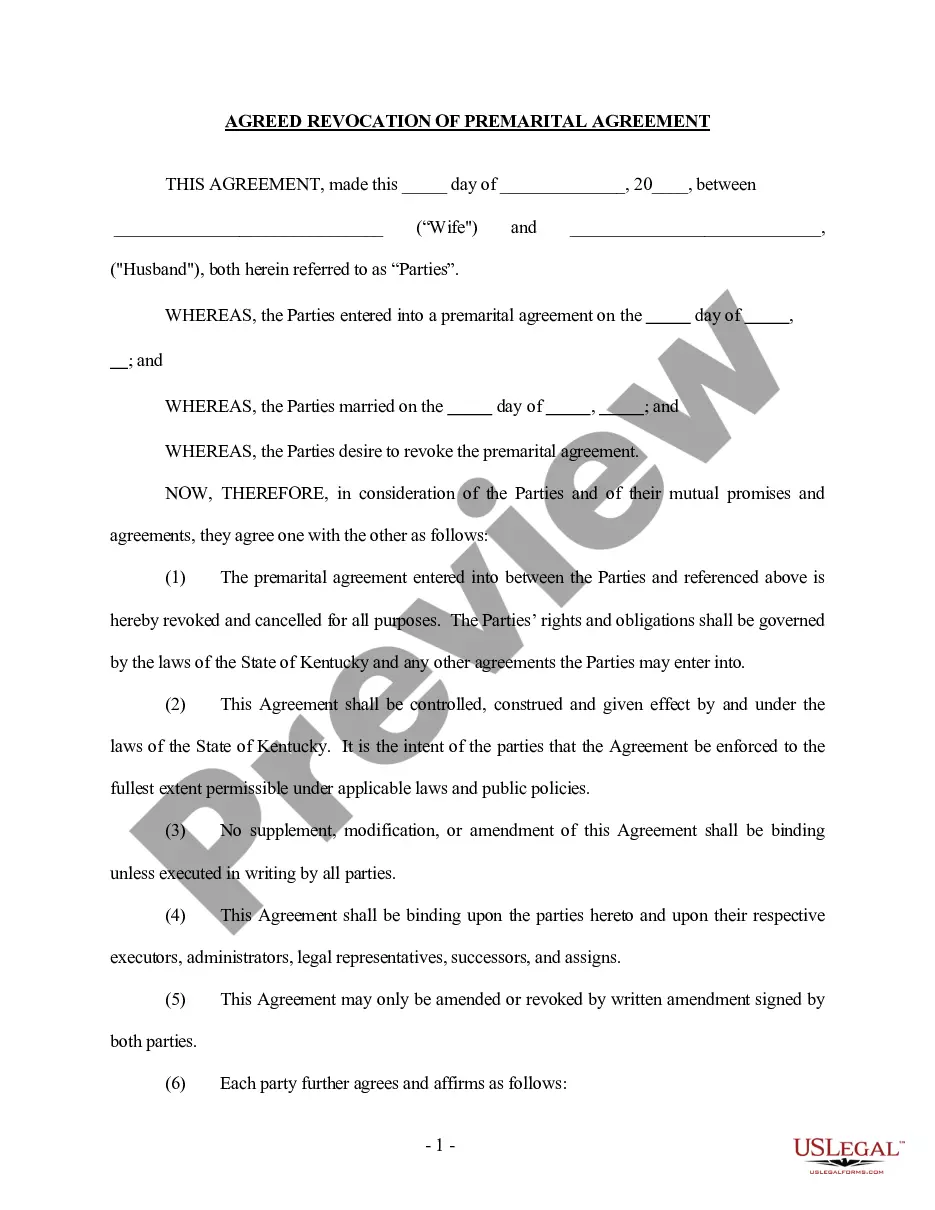
The Revocation of Premarital or Prenuptial Agreement is a legal document used by spouses to officially cancel an existing premarital agreement. This form differs from similar forms by specifically focusing on the revocation process, ensuring that the rights and obligations of the parties are governed by applicable state laws and that it is binding on their respective representatives and successors.
Key components of this form
- Date of agreement execution.
- Names and identification of the parties involved (husband and wife).
- Statement of revocation of the original premarital agreement.
- Governing laws of the State of Kentucky.
- Terms on modifications and amendments of the agreement.
- Binding effect on successors and assigns.
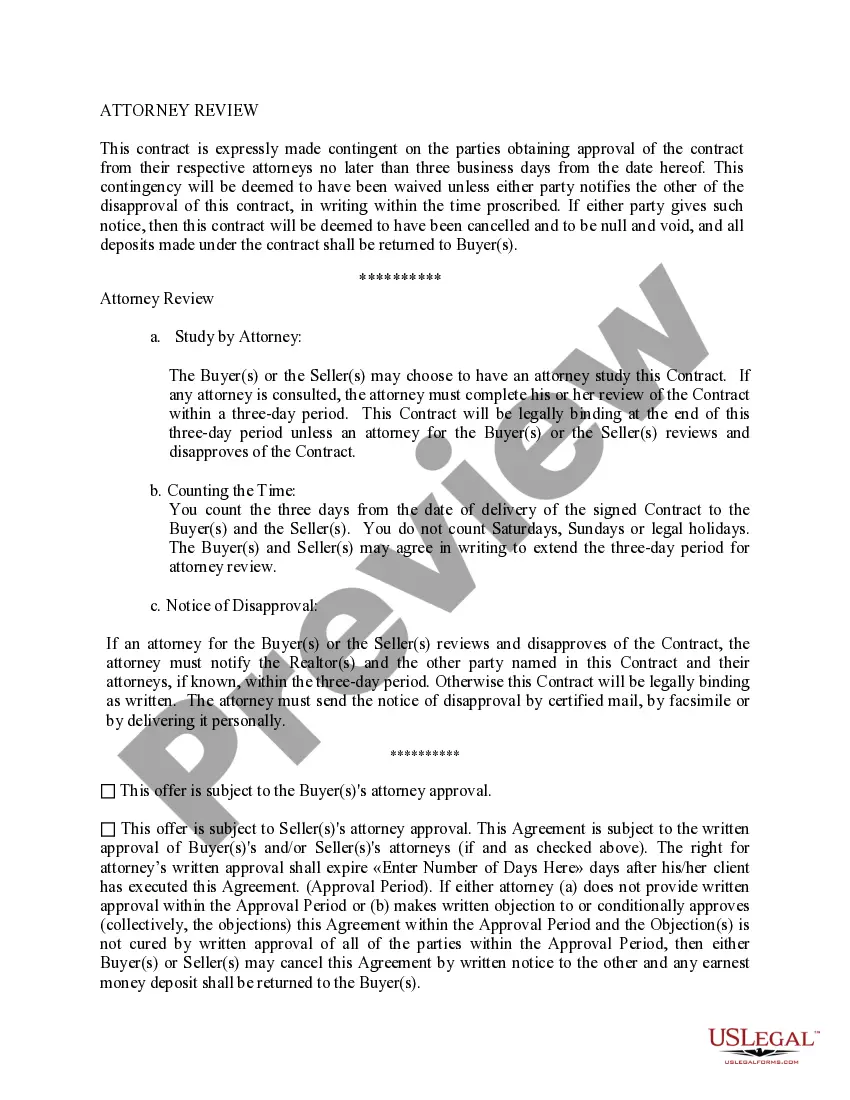
Common use cases
This form is necessary when a married couple decides to revoke an existing premarital or prenuptial agreement. Situations may arise such as changes in marital circumstances, the birth of children, or the couple's desire to approach financial matters differently. Revoking the agreement formalizes the intention to discard previous legal obligations defined in the original document.
Intended users of this form
- Married couples in Kentucky who wish to revoke their premarital agreement.
- Parties wishing to ensure that their legal rights are clearly stated and governed by current state laws.
- Individuals looking to modify their financial and legal obligations following marriage.
How to prepare this document
- Identify the parties by filling in the names of the wife and husband.
- Enter the date on which the agreement is being executed.
- Clearly state the original premarital agreement being revoked.
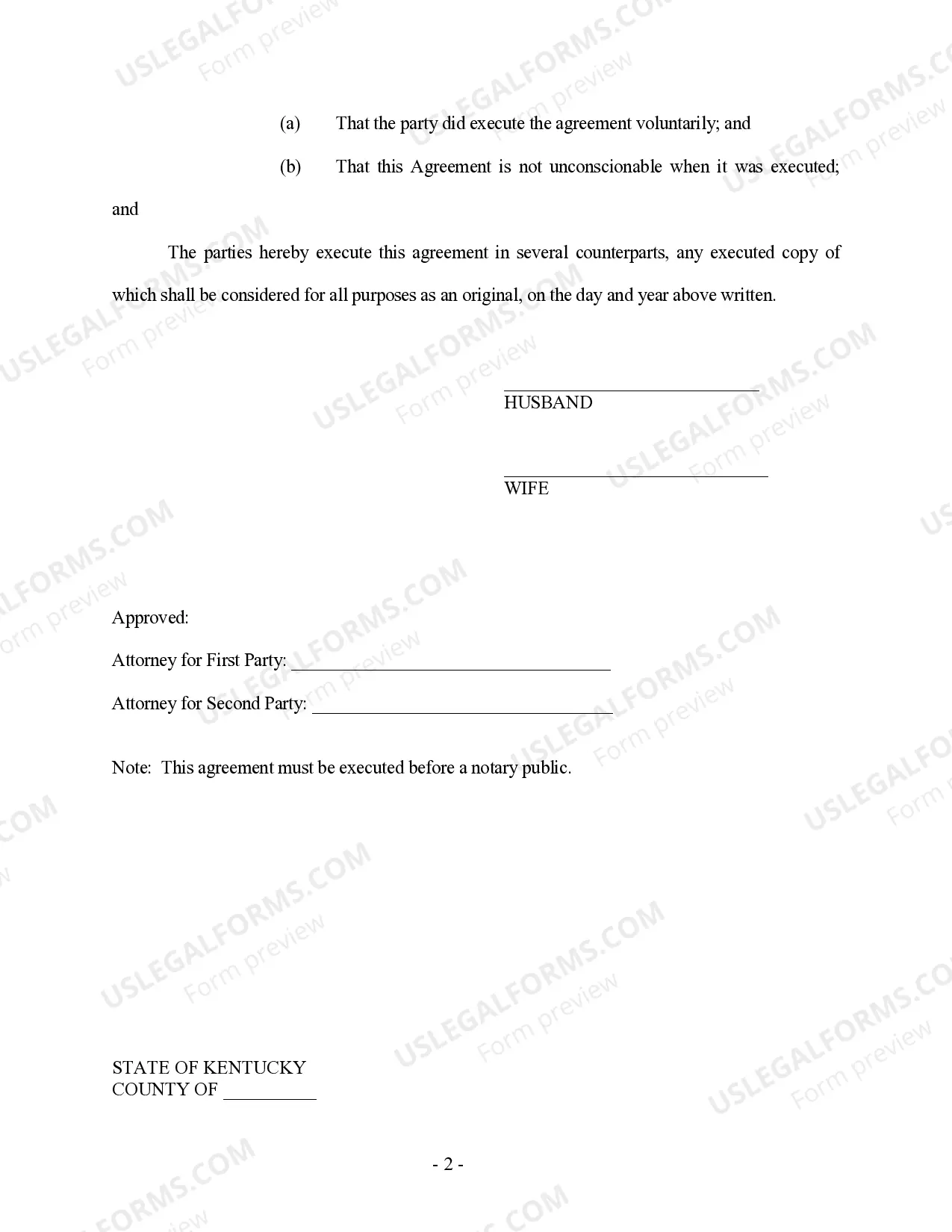
- Sign and date the form, ensuring both parties complete the necessary signatures.
- Retain a copy for your records and consider obtaining legal advice for further implications.
Does this document require notarization?
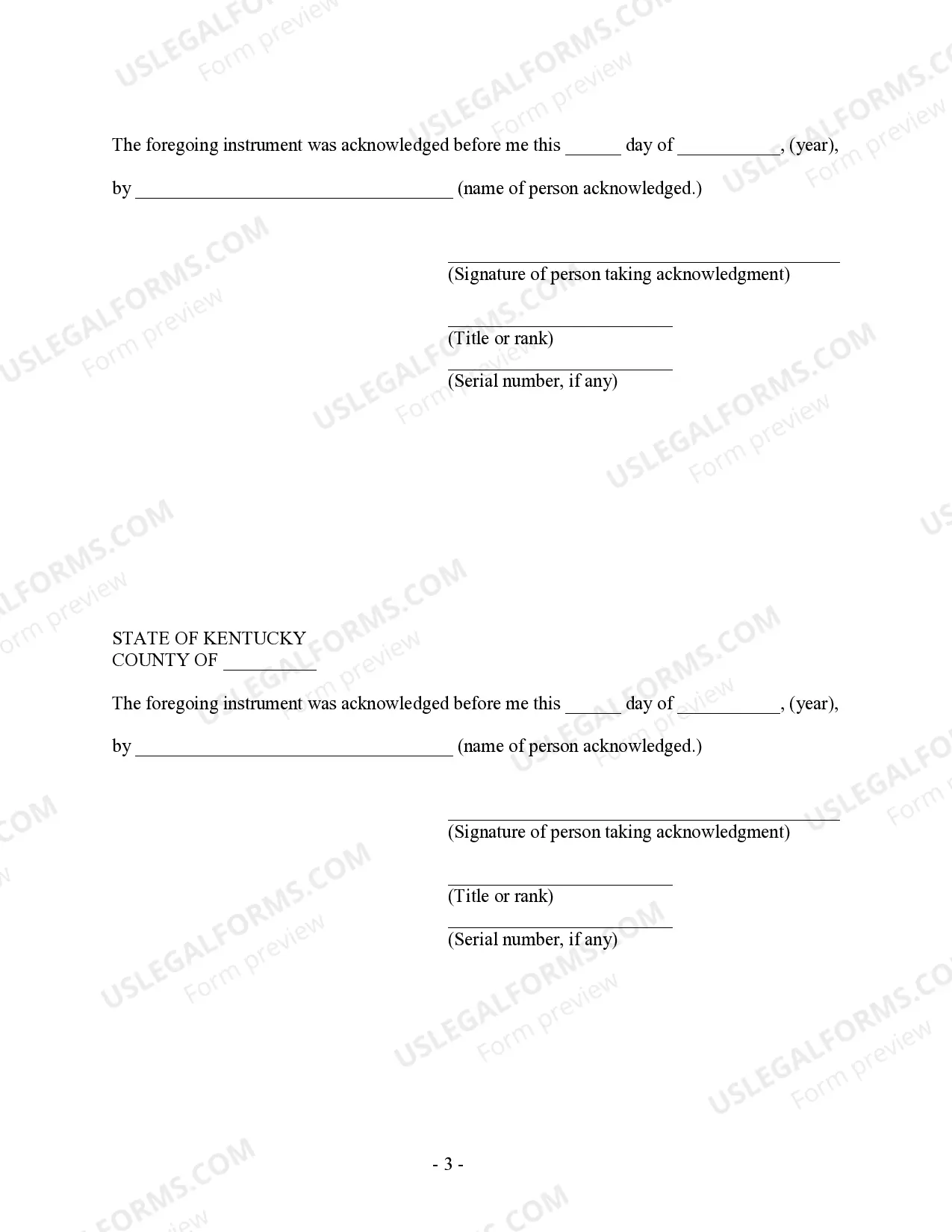
This form does not typically require notarization unless specified by local law. However, seeking notarization can add an extra layer of validation for the revocation.
Get your form ready online
Our built-in tools help you complete, sign, share, and store your documents in one place.
Make edits, fill in missing information, and update formatting in US Legal Forms—just like you would in MS Word.
Download a copy, print it, send it by email, or mail it via USPS—whatever works best for your next step.
Sign and collect signatures with our SignNow integration. Send to multiple recipients, set reminders, and more. Go Premium to unlock E-Sign.
If this form requires notarization, complete it online through a secure video call—no need to meet a notary in person or wait for an appointment.
We protect your documents and personal data by following strict security and privacy standards.

Make edits, fill in missing information, and update formatting in US Legal Forms—just like you would in MS Word.

Download a copy, print it, send it by email, or mail it via USPS—whatever works best for your next step.

Sign and collect signatures with our SignNow integration. Send to multiple recipients, set reminders, and more. Go Premium to unlock E-Sign.

If this form requires notarization, complete it online through a secure video call—no need to meet a notary in person or wait for an appointment.

We protect your documents and personal data by following strict security and privacy standards.
Typical mistakes to avoid
- Failing to date the revocation, which can lead to disputes about its validity.
- Not having both parties sign the document, making it ineffective.
- Assuming that verbal agreements or informal discussions suffice for revocation.
Why complete this form online
- Quick access to downloadable forms, enabling immediate use.
- Editability allows for custom inputs tailored to your situation.
- Reliable templates drafted by licensed attorneys to ensure legal compliance.
Legal use & context
- This form effectively nullifies previous premarital agreements and their associated legal obligations.
- Once executed, it ensures that the parties are free from the stipulations of their former agreement.
- It is important to understand that revoking an agreement does not automatically guarantee the establishment of new terms unless explicitly stated.
What to keep in mind
- The Revocation of Premarital or Prenuptial Agreement is essential for couples who want to legally cancel their previous agreements.
- It is vital to ensure that both parties sign and date the document.
- This form must adhere to Kentucky law to be enforceable.
Looking for another form?








Form popularity
FAQ
No, you cannot get a prenup if you are already married.You can still sign a postnuptial agreement (or postnup), which achieves the same goals as a prenup in most cases. Prenups are a common step before marriage. Texas community property rules are the reason why prenups are common in Texas.
The agreement was signed under fraud or duress; The agreement is unconscionable; The circumstances of the parties have changed, making the agreement unenforceable at this time.
Prenuptial agreements help couples determine what will happen to the parties' assets in the event of a divorce or a spouse's death. The law states that couples cannot revoke prenuptial agreements unless both parties agree to it.
The three most common grounds for nullifying a prenup are unconscionability, failure to disclose, or duress and coercion. Unconscionability may be present if the agreement is patently unfair to one party.
A prenup can also be overturned if one or both parties change their mind after initially signing the agreement. They may decide at that time to sign a new agreement suspending the prenup.
Prenuptial agreements do not expire, unless they have a specific clause in them stating the agreement expires after a certain length of marriage (very uncommon).
The three most common grounds for nullifying a prenup are unconscionability, failure to disclose, or duress and coercion.Duress and coercion can also invalidate a prenup. If the prenup was signed the day before your wedding, it may appear that the parties didn't have much time to fully review the agreement.
#1) One spouse signed the prenup under duress. #2) The prenup is too one-sided. #3) The prenup is full of unenforceable clauses. #4) One or both parties committed fraud. #5) One or both parties did not have a lawyer at the time of signing.
Prenuptial agreements are generally one-sided, but are dressed up to pretend that there is consideration for the contract on both sides.