Kansas Notice of Dishonored Check - Civil - Keywords: bad check, bounced check
Overview of this form
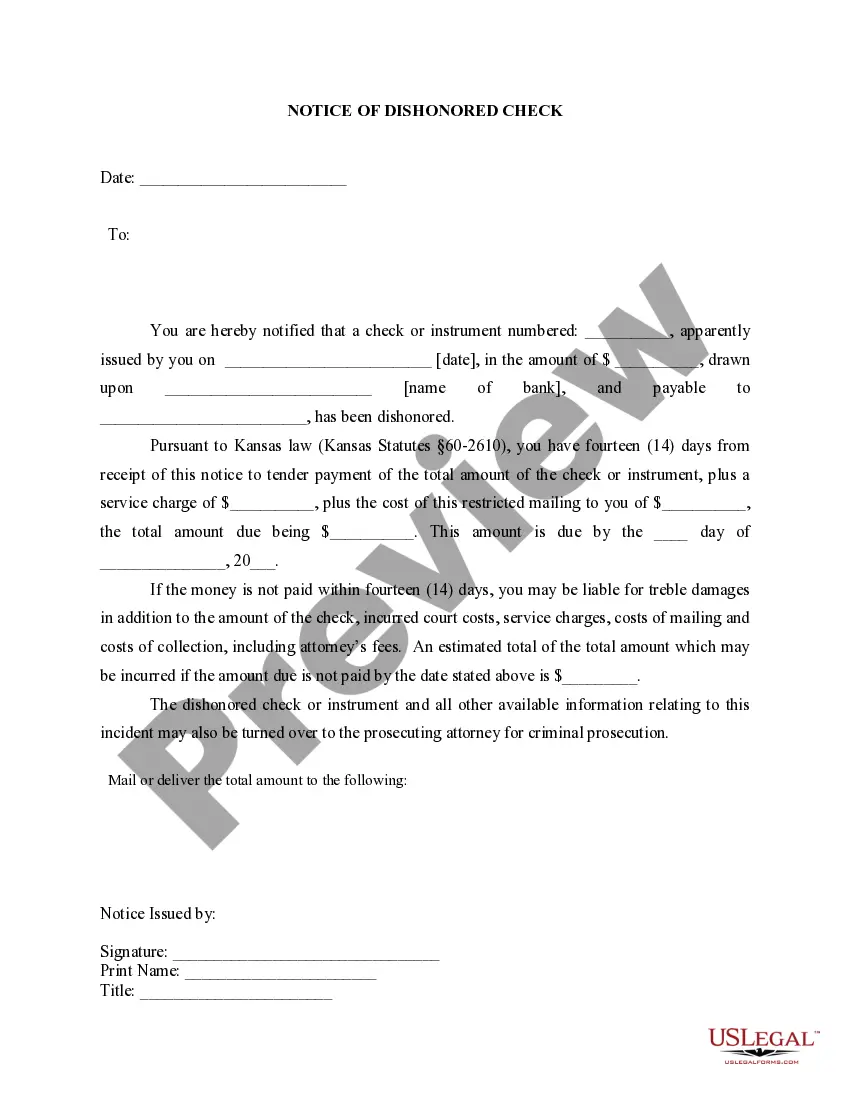
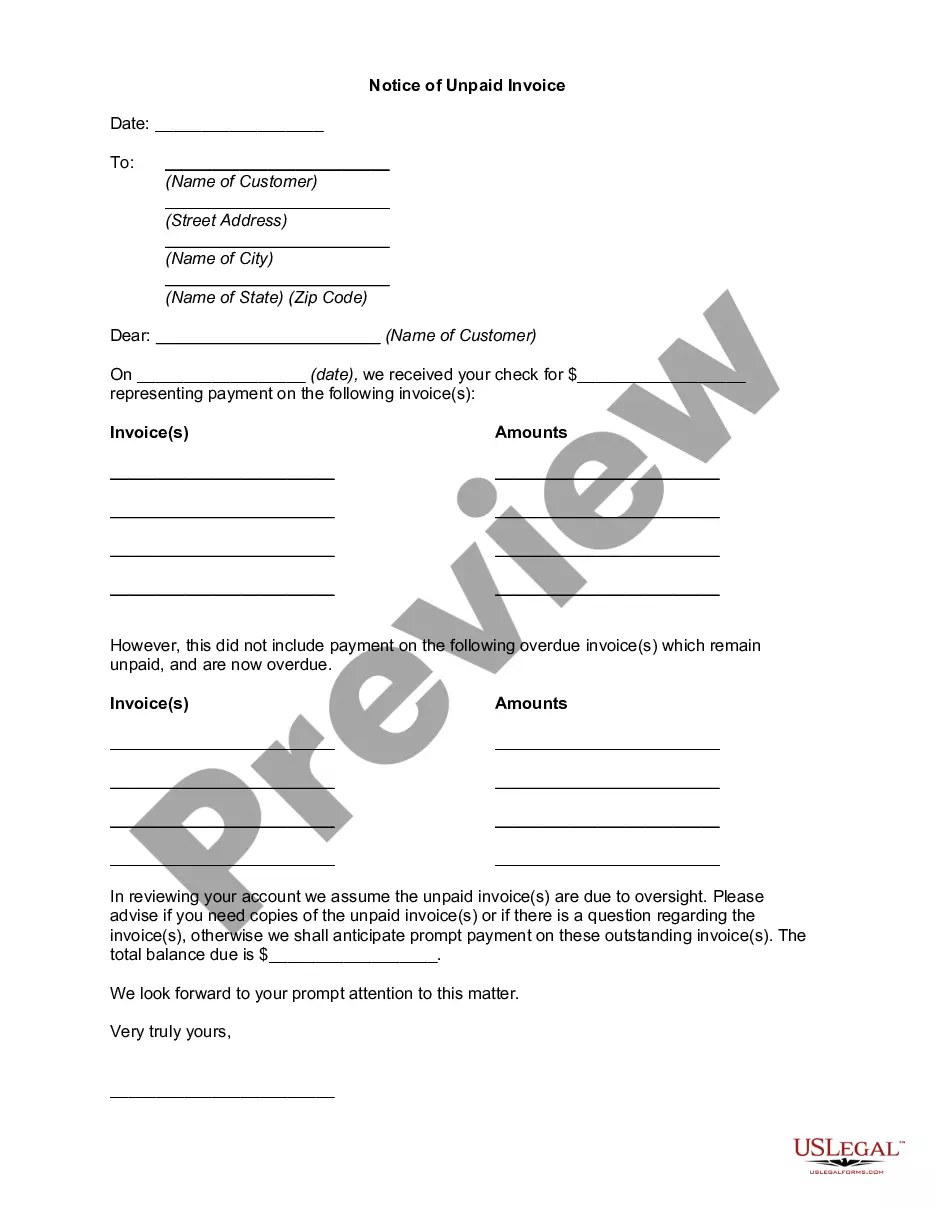
The Notice of Dishonored Check - Civil is a formal notification that a check has not been honored by the bank, commonly referred to as a bounced check or bad check. This document serves to inform the debtor of their obligation to remedy the situation by paying the amount due. It provides important legal information regarding potential penalties if the debt remains unpaid, making it essential for anyone dealing with a bounced check.
Form components explained
- Identification of the debtor and check details.
- Amount due, including the check amount and any service charges.
- Deadline for payment, typically fourteen days from receipt of the notice.
- Consequences for non-payment, including potential treble damages.
- Optional legal actions that may follow the notice.

When to use this form
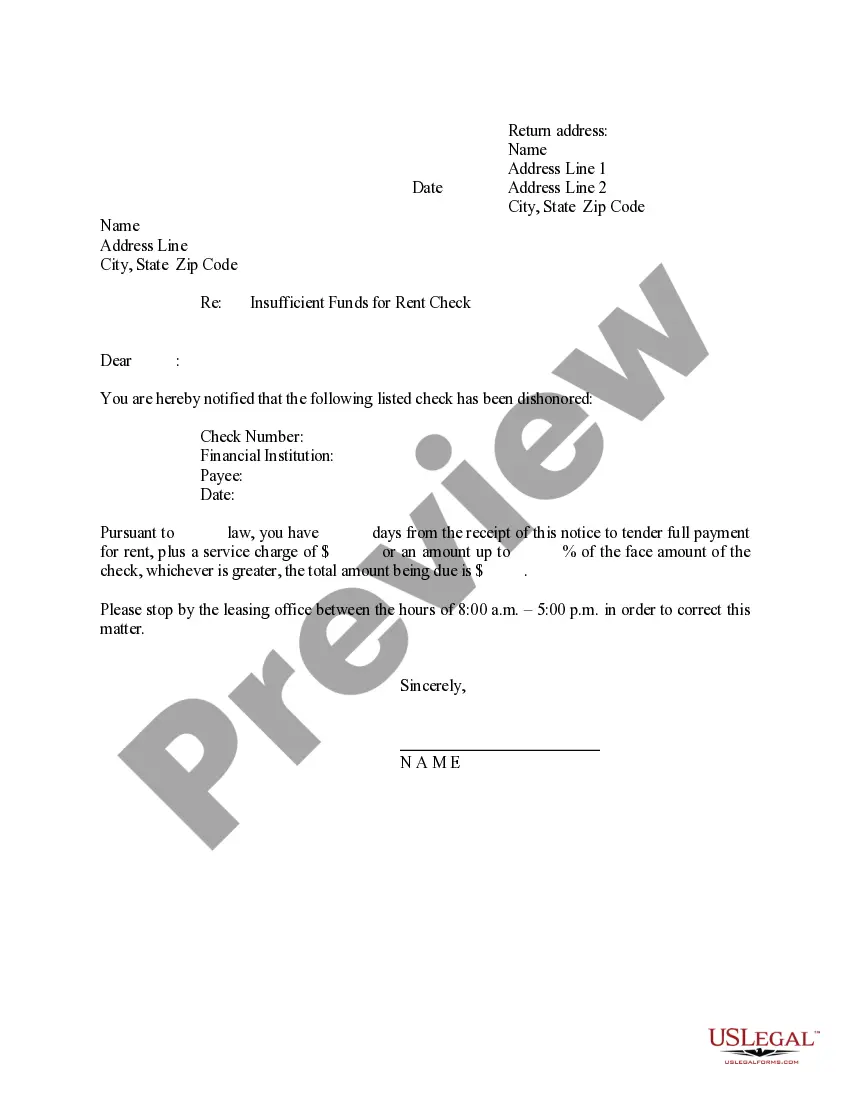
This form should be used when you receive a check that has been returned due to insufficient funds or no account. It is especially important when you wish to pursue repayment legally and comply with state requirements for notifying the debtor. Using this notice can help ensure you retain your rights to collect the amount owed and avoid additional losses.
Who this form is for
- Business owners who receive a bounced check from a customer.
- Individuals who have been issued a bad check and seek to recover their funds.
- Anyone needing to fulfill legal requirements regarding dishonored checks.
Instructions for completing this form
- Identify the debtor by entering their full name and address.
- Specify the amount of the bounced check and any applicable service charges.
- State the deadline for payment clearly, marking it on the form.
- Include any additional costs that may be incurred for collection.
- Sign and date the notice to ensure it is legally valid.
Does this form need to be notarized?
This form does not typically require notarization unless specified by local law. It serves as a written notice to the debtor and does not necessitate a witness or notarized signature to be effective.
Get your form ready online
Our built-in tools help you complete, sign, share, and store your documents in one place.
Make edits, fill in missing information, and update formatting in US Legal Forms—just like you would in MS Word.
Download a copy, print it, send it by email, or mail it via USPS—whatever works best for your next step.
Sign and collect signatures with our SignNow integration. Send to multiple recipients, set reminders, and more. Go Premium to unlock E-Sign.
If this form requires notarization, complete it online through a secure video call—no need to meet a notary in person or wait for an appointment.
We protect your documents and personal data by following strict security and privacy standards.

Make edits, fill in missing information, and update formatting in US Legal Forms—just like you would in MS Word.

Download a copy, print it, send it by email, or mail it via USPS—whatever works best for your next step.

Sign and collect signatures with our SignNow integration. Send to multiple recipients, set reminders, and more. Go Premium to unlock E-Sign.

If this form requires notarization, complete it online through a secure video call—no need to meet a notary in person or wait for an appointment.

We protect your documents and personal data by following strict security and privacy standards.
Common mistakes
- Failing to provide a complete and accurate account number.
- Not clearly stating the due date for payment.
- Omitting any associated fees that may apply.
- Sending the notice to the wrong address.
- Not keeping a copy of the notice for your records.
Why complete this form online
- Convenience of downloading and completing the form at your own pace.
- Editability allows you to customize the form as needed.
- Reliable templates drafted by licensed attorneys to ensure legal accuracy.
Legal use & context
- The form provides evidence that the debtor has been formally notified.
- Utilizing this notice can help recover funds through legal proceedings.
- Failure to follow through with the notice can limit legal options for recovery.
Quick recap
- The Notice of Dishonored Check is essential for notifying debtors about unpaid checks.
- This form helps facilitate recovery before legal action may be necessary.
- Understanding the requirements for your state is crucial for ensuring legal validity.
- Using this form online offers convenience and legal credibility.
Looking for another form?
Form popularity
FAQ
Contact the district attorney. Some states have a bad-check restitution program where the DA's office has someone contact the check writer and urge them to pay up. Work through a collection agency. Use a check recovery service. Take your customer to court if they refuse to resolve things.
If you don't pay the amount of a bounced check within the time frame your bank specifies, it can close your account.If your financial institution doesn't cover the check, it bounces and is returned to the depositor's bank. You'll likely be charged a nonsufficient funds fee, also known as an NSF or returned item fee.
If you are given a bad check, you can sue for the amount of the check plus bank fees. You can also add damages to your claim.
Whether you write or receive a bounced check also called a nonsufficient funds, or NSF, check it will cost you. Write one and you'll owe your bank an NSF fee of between $27 and $35, and the recipient of the check is permitted to charge a returned-check fee of between $20 and $40 or a percentage of the check amount.
When determining your bounced check fee, consider this: On average, a bank will charge YOU about $30 for a bad check, so you should charge a penalty of $35-$50. Why? Because it's likely you will be (or you should, anyway) immediately sending out notice to the tenant regarding the bad check.
Bouncing a check is usually a crime only if you intend to defraud the payee. In other words, the payee must be able to prove that you knew your check would bounce and therefore you intended to commit check fraud. Fortunately, most consumers don't wait long to repay bad checks and aren't charged with criminal penalties.
The amount of time merchants can allot for you to pay off a bounced check is rooted mainly in state laws. Familiarize yourself with your state's law and act accordingly in terms of paying of the bad check. In general, laws allow for bad check writers to be given anywhere from two to three years to pay their debt.
If a cheque bounces due to insufficient funds or any other technical reason, such as signature mismatch, their respective banks charges for both the defaulter and the payee. The penalty charges for cheque outward return are close to Rs. 300 for most banks, while charges for cheque inward return are about Rs. 100.
If the check amount exceeds certain thresholds, the crime may be treated as a felony. Civil penalties apply in all cases, with a common penalty amount equivalent to the check's face value, a multiple of the check amount with a cap, or the check amount plus court and attorney fees.