Kansas Owner's Statement of Receipt of Warning by Corporation or LLC
About this form
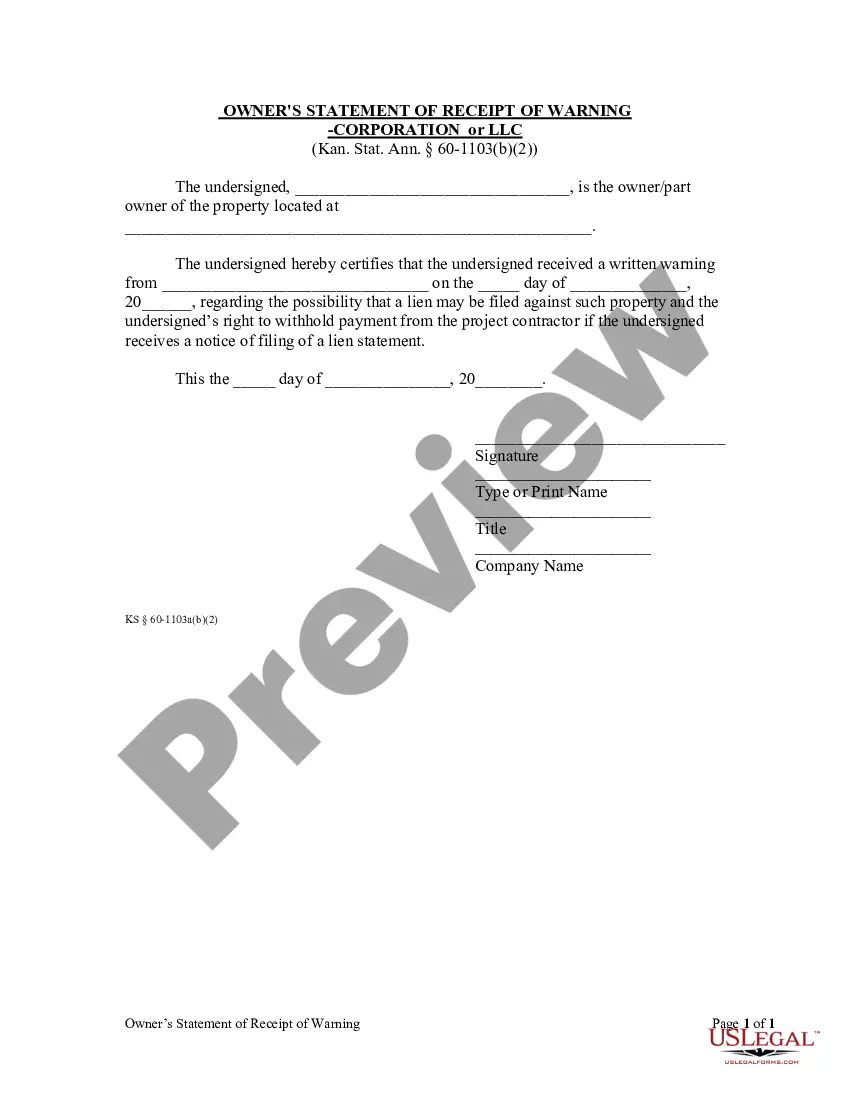
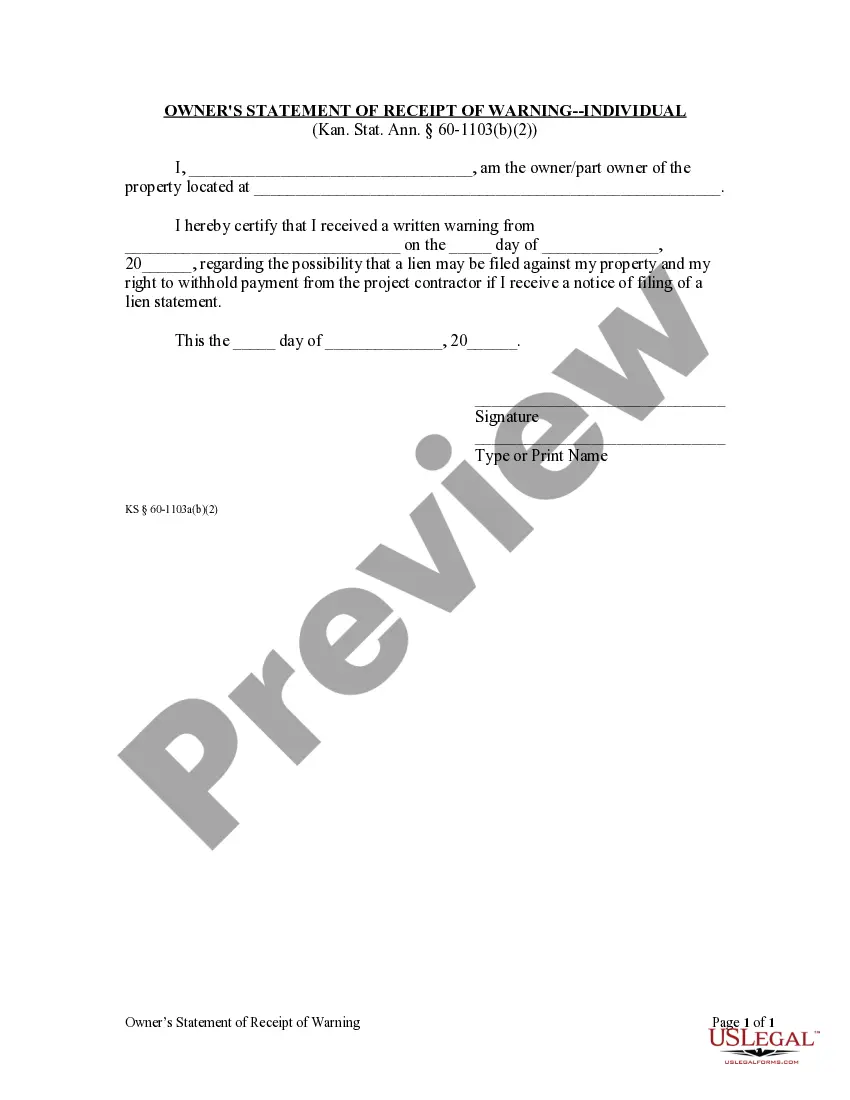
The Owner's Statement of Receipt of Warning by Corporation or LLC is a legal document required under Kansas law. This form allows property owners to formally acknowledge that they have received a warning from a subcontractor regarding potential liens on their property, as specified in Kan. Stat. Ann. § 60-1103(b). It serves as a key legal safeguard for property owners to understand their rights when hiring subcontractors for residential improvements, distinguishing it from other acknowledgment forms by its specific legal context and requirements.
Main sections of this form
- Owner's name and property address section
- Certification of receipt of a written warning from the subcontractor
- Date of receipt declaration
- Signature and printed name of the property owner
- Title of the signatory if applicable
Common use cases
This form should be used when a subcontractor has provided a written warning to a property owner about the possibility of a lien being filed against their property due to unpaid accounts. Utilizing this form helps property owners document their acknowledgment of this warning, which is necessary when the subcontractor files a lien statement.
Who this form is for
- Property owners who have received a warning from a subcontractor
- Subcontractors seeking to establish proof of notification to property owners
- Corporations or LLCs involved in residential construction or improvements
How to complete this form
- Enter the name of the property owner and the address of the property.
- Specify the name of the subcontractor who provided the warning.
- Indicate the date on which the warning was received.
- The property owner should sign the form and print their name clearly.
- If applicable, include the title and name of the corporation or LLC.
Does this document require notarization?
This form does not typically require notarization unless specified by local law. It is advisable for property owners to check local requirements to ensure compliance.
Get your form ready online
Our built-in tools help you complete, sign, share, and store your documents in one place.
Make edits, fill in missing information, and update formatting in US Legal Forms—just like you would in MS Word.
Download a copy, print it, send it by email, or mail it via USPS—whatever works best for your next step.
Sign and collect signatures with our SignNow integration. Send to multiple recipients, set reminders, and more. Go Premium to unlock E-Sign.
If this form requires notarization, complete it online through a secure video call—no need to meet a notary in person or wait for an appointment.
We protect your documents and personal data by following strict security and privacy standards.

Make edits, fill in missing information, and update formatting in US Legal Forms—just like you would in MS Word.

Download a copy, print it, send it by email, or mail it via USPS—whatever works best for your next step.

Sign and collect signatures with our SignNow integration. Send to multiple recipients, set reminders, and more. Go Premium to unlock E-Sign.

If this form requires notarization, complete it online through a secure video call—no need to meet a notary in person or wait for an appointment.

We protect your documents and personal data by following strict security and privacy standards.
Typical mistakes to avoid
- Failing to include the correct date of receipt.
- Not signing the form, which invalidates the acknowledgment.
- Omitting the name and contact information of the subcontractor.
- Using incorrect property addresses, which may lead to legal complications.
Benefits of using this form online
- Immediate access to a legally compliant template.
- Easy editing to customize it to your specific needs.
- Reliable format following state requirements.
- No need for physical paperwork; enables digital documentation.
Legal use & context
- Ensures compliance with Kansas law regarding lien notices.
- Documents the owner's awareness of potential lien rights, protecting them in disputes.
- Establishes clear communication between subcontractors and property owners.
Main things to remember
- The form is essential for property owners in Kansas to document the receipt of lien warnings.
- Proper completion of the form helps protect against potential legal disputes regarding lien rights.
- Using this form online saves time and ensures legal compliance with state regulations.
Looking for another form?



Form popularity
FAQ
The name and address of the business or individual receiving the payment. The name and address of the person making the payment. The date the payment was made. A receipt number. The amount paid. The reason for the payment. How the payment was made (credit card, cash, etc)
The word receipt should, of course, be at the very top, followed by the seller's information such as name and/or company's name, contact information, and any other relevant details. Similarly, you also need to indicate all of the relevant information about the buyer.
Write a receipt and make two copies one for you and one for your buyer. It should include the date, price, registration number, make and model, plus you and your buyer's names and addresses.
A blank receipt template can be used by any business to create their own receipt. It includes the same basic components of identifying the parties, the amount paid, how it's paid, and what the money is for, but a blank template can be customized to include other information the parties consider important.
Your company/trading name, VAT number (if applicable), address and contact info. Your customer's company/trading name, address and contact info. A unique invoice number. The date of the invoice. A description of what you are charging for.
You can still claim deductions on your taxes without receipts for every transaction. Keep in mind that you don't have to send your shoe box full of receipts to the IRS to prove you're being honest. You'll only need them if you're audited (which can happen up to seven years after filing your taxes).
Write the name of the item on the left side of the receipt and write the cost of each item on the right side of the receipt. If you sold more than one item, list the items and their prices in a row. Write the subtotal below all of the items. The subtotal is the cost of all the items before taxes and additional fees.
The date the payment was received. The tenant's full name. The full name of anyone else who made the payment on behalf of the tenant. The name of the landlord or property manager receiving the payment. The rental property address and unit number.
Select the word processor to be used in creating the receipt. Create the receipt's header, which should include the business's name, its contact details, and the date/time of the transaction in question.