Kansas Quitclaim Deed from Individual to Husband and Wife
What is this form?
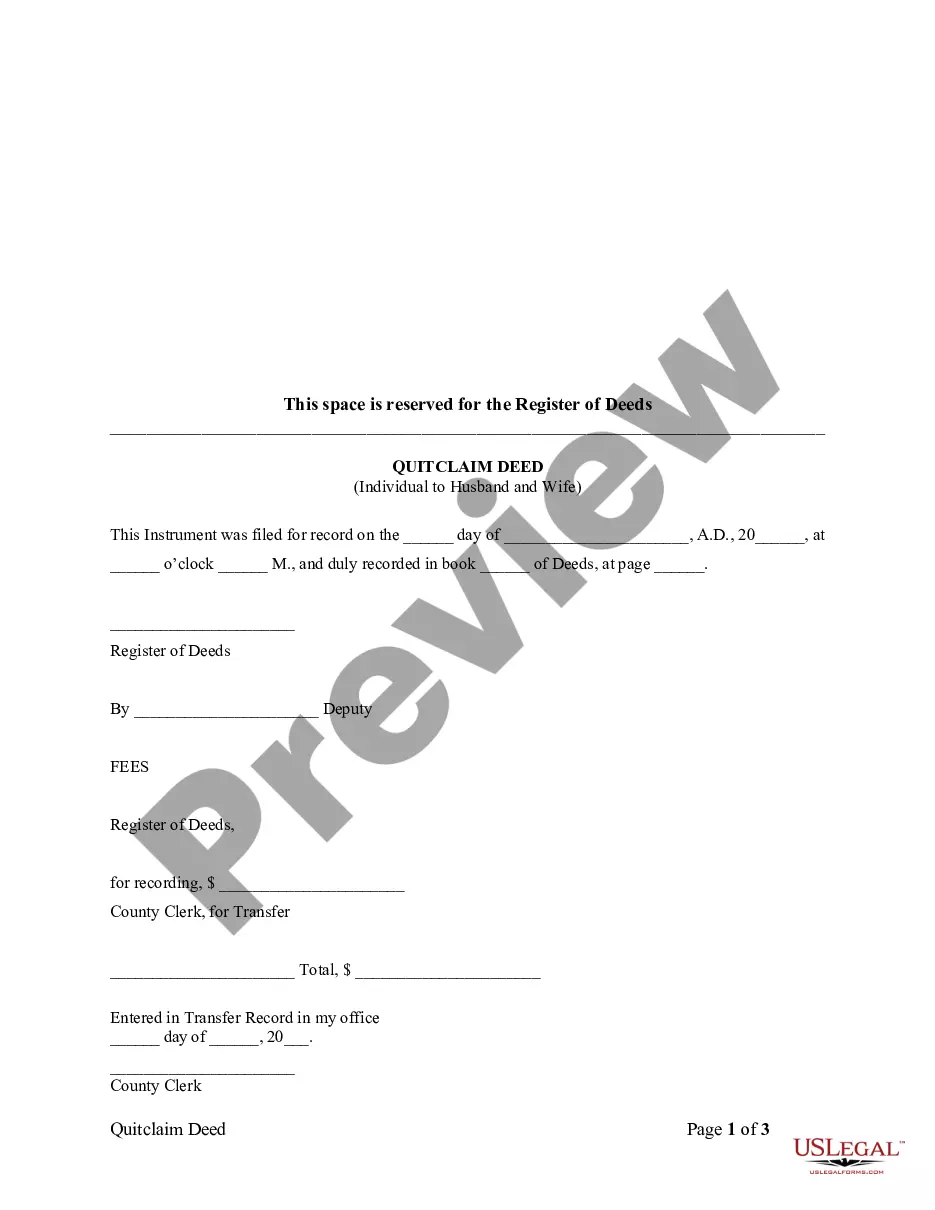
The Quitclaim Deed from Individual to Husband and Wife is a legal document that allows an individual (the Grantor) to transfer their interest in a property to a couple (the Grantees). This form facilitates the conveyance without providing any warranties about the title. Unlike warranty deeds, a quitclaim deed offers no guarantees regarding ownership rights, making it perfect for situations where the parties know each other well, such as family transfers or marital situations.
Main sections of this form
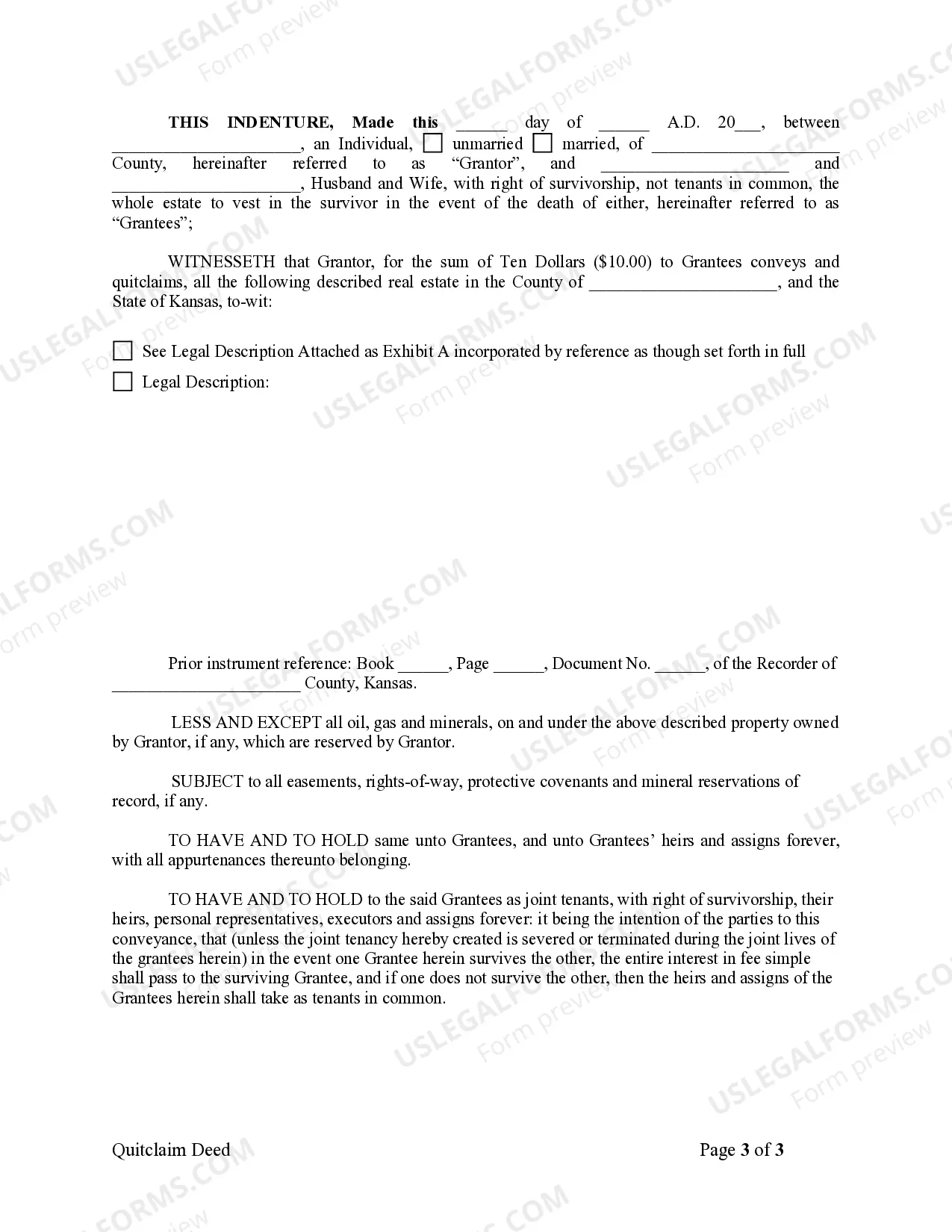
- Identification of the Grantor and Grantees, including marital status.
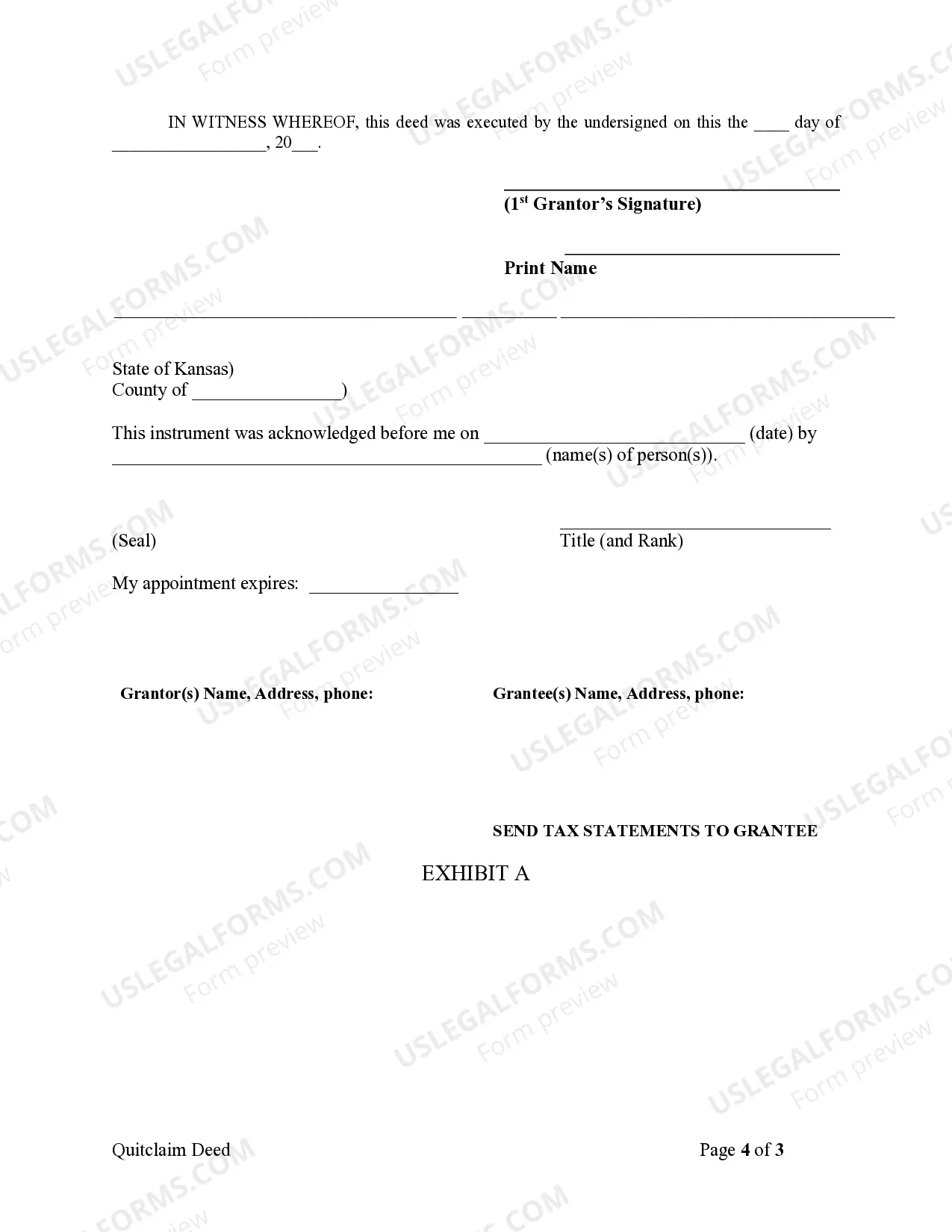
- Description of the property being transferred, including legal description references.
- Statement of the transfer, including the nominal consideration (Ten Dollars).
- Provisions regarding joint tenancy and rights of survivorship.
- Space for recording by the Register of Deeds.







When to use this form
This form is typically used when an individual wants to transfer ownership of a property to a husband and wife, particularly in situations such as marriage, estate transfers, or property gifting. It is ideal for couples who wish to hold property as joint tenants, ensuring that in the event of one spouse's death, the other automatically inherits the property.
Who this form is for
This form is suitable for:
- Individuals looking to transfer property to their spouse.
- Married couples wishing to clarify joint ownership.
- Parties in a family situation where informal property transfers are common.
How to prepare this document
- Identify the Grantor (the individual transferring the property).
- Clearly state the names of the Grantees (the husband and wife receiving the property).
- Provide a detailed legal description of the property being transferred.
- Sign and date the document in the presence of a notary (if required).
- Submit the form for recording with the local Register of Deeds.
Does this form need to be notarized?
Notarization is required for this form to take effect. Our online notarization service, powered by Notarize, lets you verify and sign documents remotely through an encrypted video session, available 24/7.
Get your form ready online
Our built-in tools help you complete, sign, share, and store your documents in one place.
Make edits, fill in missing information, and update formatting in US Legal Forms—just like you would in MS Word.
Download a copy, print it, send it by email, or mail it via USPS—whatever works best for your next step.
Sign and collect signatures with our SignNow integration. Send to multiple recipients, set reminders, and more. Go Premium to unlock E-Sign.
If this form requires notarization, complete it online through a secure video call—no need to meet a notary in person or wait for an appointment.
We protect your documents and personal data by following strict security and privacy standards.

Make edits, fill in missing information, and update formatting in US Legal Forms—just like you would in MS Word.

Download a copy, print it, send it by email, or mail it via USPS—whatever works best for your next step.

Sign and collect signatures with our SignNow integration. Send to multiple recipients, set reminders, and more. Go Premium to unlock E-Sign.

If this form requires notarization, complete it online through a secure video call—no need to meet a notary in person or wait for an appointment.

We protect your documents and personal data by following strict security and privacy standards.
Typical mistakes to avoid
- Failing to include the correct legal description of the property.
- Not signing the form or leaving it unsigned by the notary.
- Inaccurate identification of the Grantor and Grantees.
Benefits of using this form online
- Convenience of downloading and filling out the form at your own pace.
- Editability allows for easy changes before finalizing the documentation.
- Access to reliable templates drafted by licensed attorneys.
Looking for another form?







Form popularity
FAQ
It usually takes four to six weeks to complete the legal processes involved in the transfer of title.
If the quitclaim deed requires the signature of all co-owners, the deed is invalid unless all co-owners have signed it and the deed is then delivered to the grantee.If one individual owns real estate and desires to add a co-owner such as a spouse, a quitclaim deed might be used.
No law forbids adding someone to your mortgaged home's deed or in signing your home over to others through one. Mortgage lenders understand deeds, though, and use loan due-on-sale clauses to prevent unauthorized property sales or transfers.
The only way to forcibly change the ownership status is through a legal action and the resultant court order. However, if an owner chooses to be removed from the deed, it is simply a matter of preparing a new deed transferring that owner's interest in the property.
One of the simplest ways to add your wife to the home title is by using an interspousal deed. You can transfer the property from your sole and separate property to mutual tenancy, such as joint tenants with right of survivorship, with your wife.
If you do not have any loan or mortgage over the said property, then the easiest way to remove your name from the joint names, is if you were to execute a release deed or relinquishment deed in favour of your wife with respect to 50% share that you are the owner of, then she in turn becomes the full and absolute owner
When you own a home, you own both the deed and title for that property. In real estate, title means you have ownership and a right to use the property.The deed is the physical legal document that transfers ownership. It shows who you bought your house from, and when you sell it, it shows who you sold it to.
Generally speaking, no. Once a quit claim deed has been completed and filed with the County Clerk's Office, the title will officially pass from the grantor to the grantee. The only way to reverse a quit claim deed is to go to court and prove that the grantor was forced to sign the document under duress.
Recording A quitclaim deed must be filed with the County Recorder's Office where the real estate is located. Go to your County Website to locate the office nearest you. Signing (§ 58-2205) A quitclaim deed is required to be authorized with a notary public present.