How to create a warranty deed to joint tenants with right of survivorship
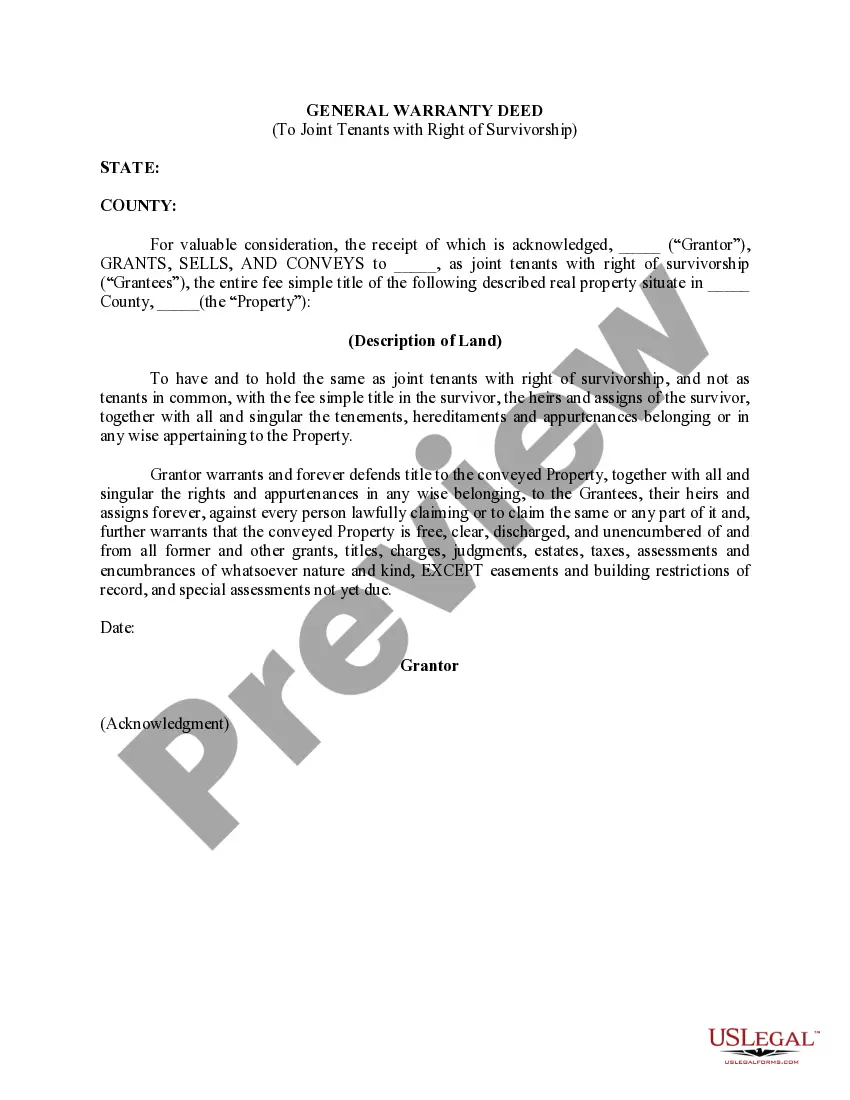
A warranty deed to joint tenants with right of survivorship is a legal document used to transfer ownership of real property to two or more individuals. This type of deed ensures that each owner has equal rights to the property during their lifetime, and upon the death of one owner, their interest automatically passes to the surviving owners without the need for probate.
How to complete a form
To create a warranty deed to joint tenants with right of survivorship, follow these steps:
- Gather the necessary information, including the names of the owners, property description, and county of the property.
- Fill out the deed form accurately, specifying that the ownership is as joint tenants with right of survivorship.
- Have all parties sign the deed in the presence of a notary public.
- File the completed deed with the county recorder's office to ensure it is legally recorded.
Who should use this form
This form is ideal for individuals who wish to jointly own property with another person, particularly in scenarios such as partners, siblings, or friends sharing a residence. It is suited for those wanting to simplify the transfer of property upon death, ensuring that surviving owners automatically inherit the property without going through probate.
Legal use and context
The warranty deed to joint tenants with right of survivorship is legally recognized in many states as a means of transferring property. It is essential for individuals to understand state-specific laws regarding joint tenancies and survivorship rights, as the regulations can vary by jurisdiction.
What to expect during notarization or witnessing
During the notarization process, all parties involved must sign the warranty deed in the presence of a notary public. The notary will verify the identities of the signers and may require identification. Once notarized, the deed must be recorded to be legally binding. Proper witnessing adds an extra layer of authenticity and may be required depending on state law.
Common mistakes to avoid when using this form
When filling out a warranty deed, users should watch for the following common mistakes:
- Incorrect property descriptions that may lead to disputes.
- Failing to specify joint tenancy with right of survivorship explicitly.
- Not having signatures notarized or witnessed properly, which can render the deed invalid.
- Neglecting to file the deed with the appropriate county office.
Key components of the form
The warranty deed to joint tenants with right of survivorship includes several critical components:
- The names of the grantors (current owners) and grantees (new owners).
- A clear description of the property, including legal descriptions.
- The declaration of joint tenancy with right of survivorship.
- Signatures of all parties involved, along with notarization details.