Indiana Revocation of Declaration of Mental Health Care Treatment
Overview of this form
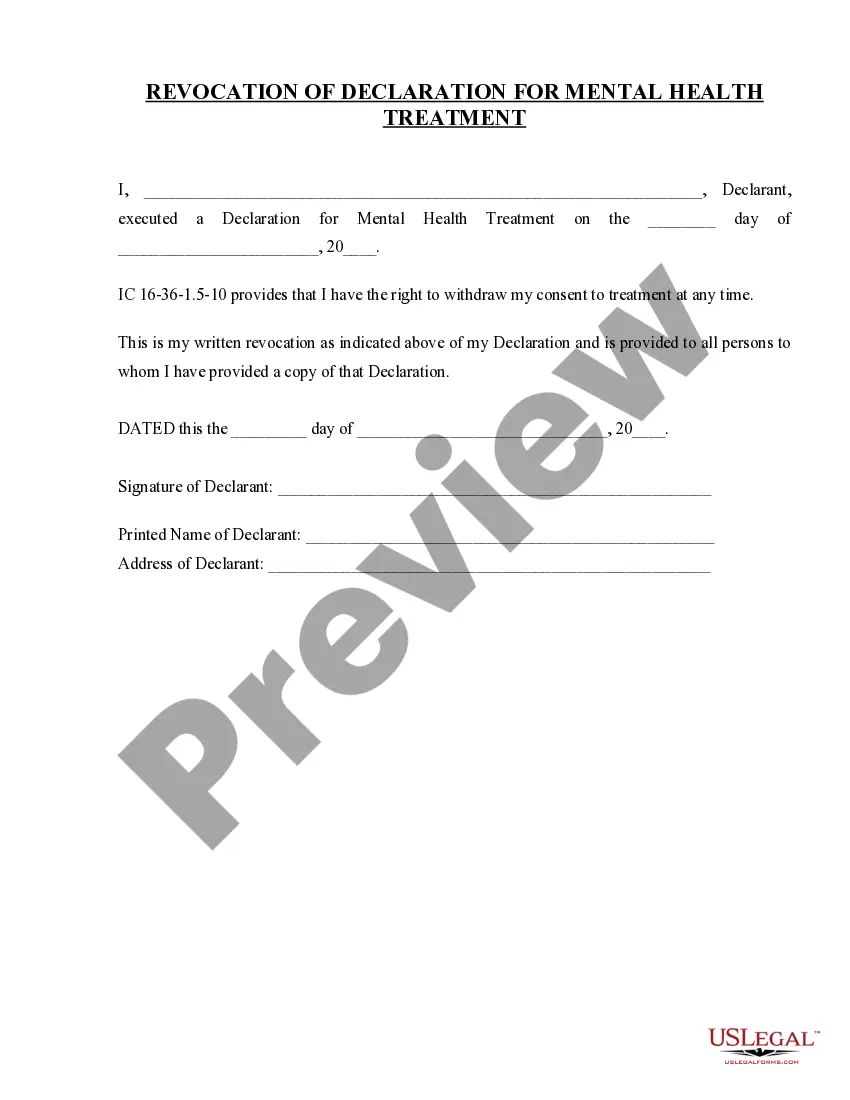
The Revocation of Declaration of Mental Health Care Treatment is a legal document that allows an individual to withdraw their previously stated consent to mental health treatment. This form serves as a formal cancellation of the Declaration for Mental Health Treatment and is different from other consent forms, as it specifically addresses the revocation of mental health care decisions.
What’s included in this form
- Name and signature of the Declarant.
- Date of the original Declaration for Mental Health Treatment.
- Date of signing the revocation.
- Written notice to all parties who received a copy of the original Declaration.
Situations where this form applies
You should use this form when you have previously signed a Declaration for Mental Health Treatment and now wish to revoke that consent. Situations may include changes in your personal health preferences, a change in your mental health condition, or the desire to alter your treatment approach.
Intended users of this form
- Individuals who have executed a Declaration for Mental Health Treatment.
- Individuals wishing to change their mental health care decisions.
- Family members or legal representatives acting on behalf of someone who is unable to revoke consent themselves.
Instructions for completing this form
- Enter your name as the Declarant.
- Fill in the date you originally executed the mental health treatment declaration.
- Specify the date when you are revoking that declaration.
- Sign the form to indicate your agreement to revoke consent.
- Provide your printed name and address for identification purposes.
Is notarization required?
This form does not typically require notarization unless specified by local law.
Get your form ready online
Our built-in tools help you complete, sign, share, and store your documents in one place.
Make edits, fill in missing information, and update formatting in US Legal Forms—just like you would in MS Word.
Download a copy, print it, send it by email, or mail it via USPS—whatever works best for your next step.
Sign and collect signatures with our SignNow integration. Send to multiple recipients, set reminders, and more. Go Premium to unlock E-Sign.
If this form requires notarization, complete it online through a secure video call—no need to meet a notary in person or wait for an appointment.
We protect your documents and personal data by following strict security and privacy standards.

Make edits, fill in missing information, and update formatting in US Legal Forms—just like you would in MS Word.

Download a copy, print it, send it by email, or mail it via USPS—whatever works best for your next step.

Sign and collect signatures with our SignNow integration. Send to multiple recipients, set reminders, and more. Go Premium to unlock E-Sign.

If this form requires notarization, complete it online through a secure video call—no need to meet a notary in person or wait for an appointment.

We protect your documents and personal data by following strict security and privacy standards.
Avoid these common issues
- Failing to sign and date the revocation form.
- Not notifying all parties who received the original Declaration.
- Leaving the form incomplete or omitting necessary information.
Why complete this form online
- Convenient access from anywhere, allowing you to complete the form at your own pace.
- Editability that allows you to ensure all information is accurate before finalizing.
- Reliability of access to forms drafted by licensed attorneys, ensuring legal compliance.
Key takeaways
- The Revocation of Declaration of Mental Health Care Treatment is essential for individuals wanting to change their mental health treatment choices.
- Completing this form correctly is vital to ensure healthcare providers acknowledge your current wishes.
- Utilizing this online form can simplify the process and provide you with a reliable legal document.
Looking for another form?
Form popularity
FAQ
Until an attorney-in-fact's powers are properly revoked, they can continue to legally act for the principal. To cancel a Power of Attorney, the principal can create a document called a Revocation of Power of Attorney or create a new Power of Attorney that indicates the previous Power of Attorney is revoked.
A principal can rescind a Power of Attorney at any time, even if the Power of Attorney has a specified end date, so long as the principal is competent and the attorney-in-fact is notified. Third parties (such as a bank or the Land Titles Office) should also be notified of the revocation.
The best way to revoke a Durable Power of Attorney for Health Care and Living will is to make a written statement revoking the document and give it to everyone who has a copy of your Durable Power of Attorney for Health Care and Living Will.
In other words, a Revocation of Power of Attorney is written confirmation that a principal (the person who appointed power in a Power of Attorney) no longer wants or needs their attorney-in-fact (the person who was appointed power in a Power of Attorney, sometimes called an agent or donor) to act on their behalf.
"In case you forget to mention when and under what circumstances your power of attorney can be revoked, and if the power of attorney does not state it is irrevocable, then the power of attorney can be revoked if you execute a document cancelling it.