Indiana Warranty Deed from Husband and Wife to an Individual
What is this form?
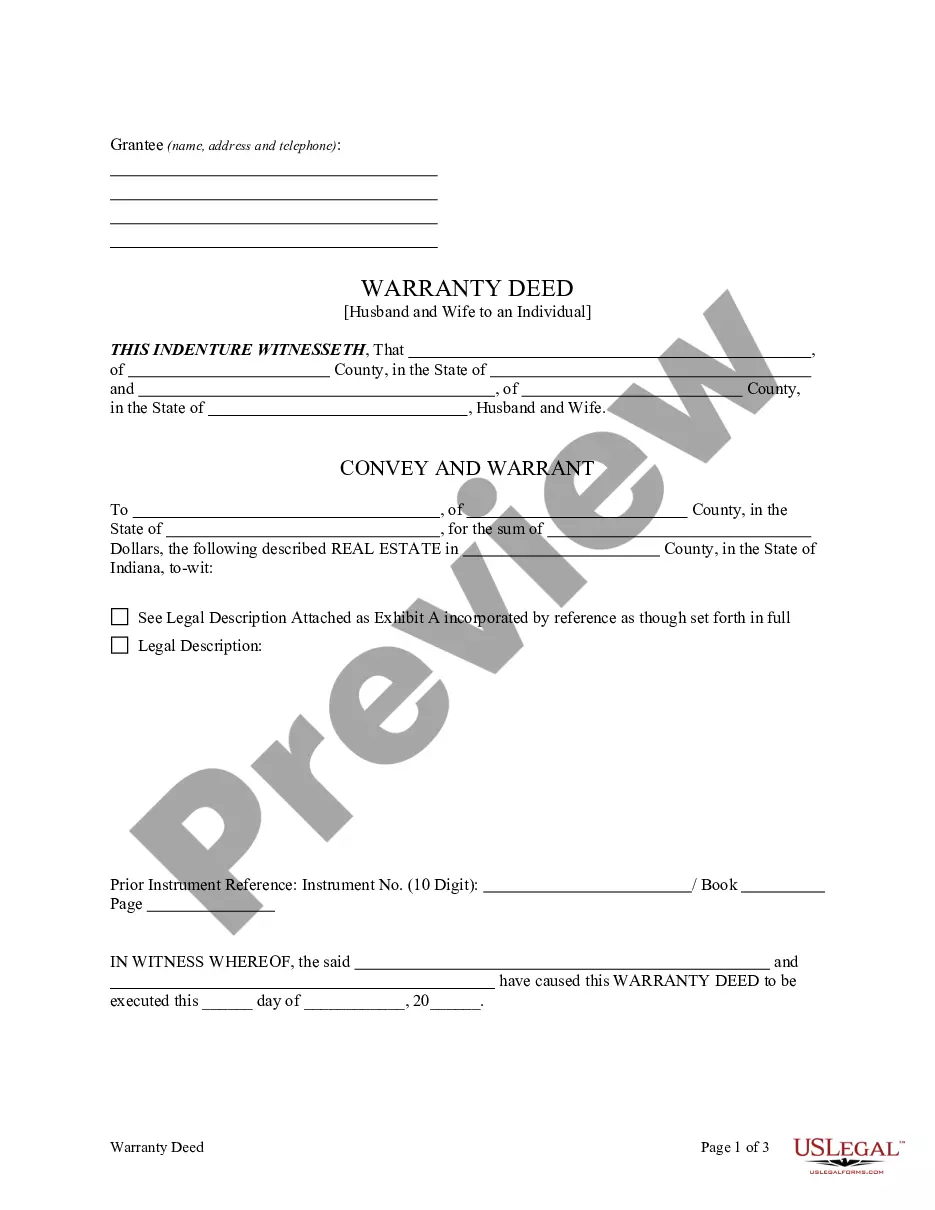
This Warranty Deed from Husband and Wife to an Individual is a legal document used to transfer property ownership from a married couple to a single individual. This form provides the grantee with a warranty of title, ensuring that the property is free of claims or liens unless specified otherwise. Unlike quitclaim deeds, which offer no warranty, this Warranty Deed offers protection to the grantee, making it a vital form for formal property transfers.
Form components explained
- Names of the grantors (husband and wife) and the grantee (individual)
- Description of the property, including legal description
- Warranty clause detailing the grantors' title to the property
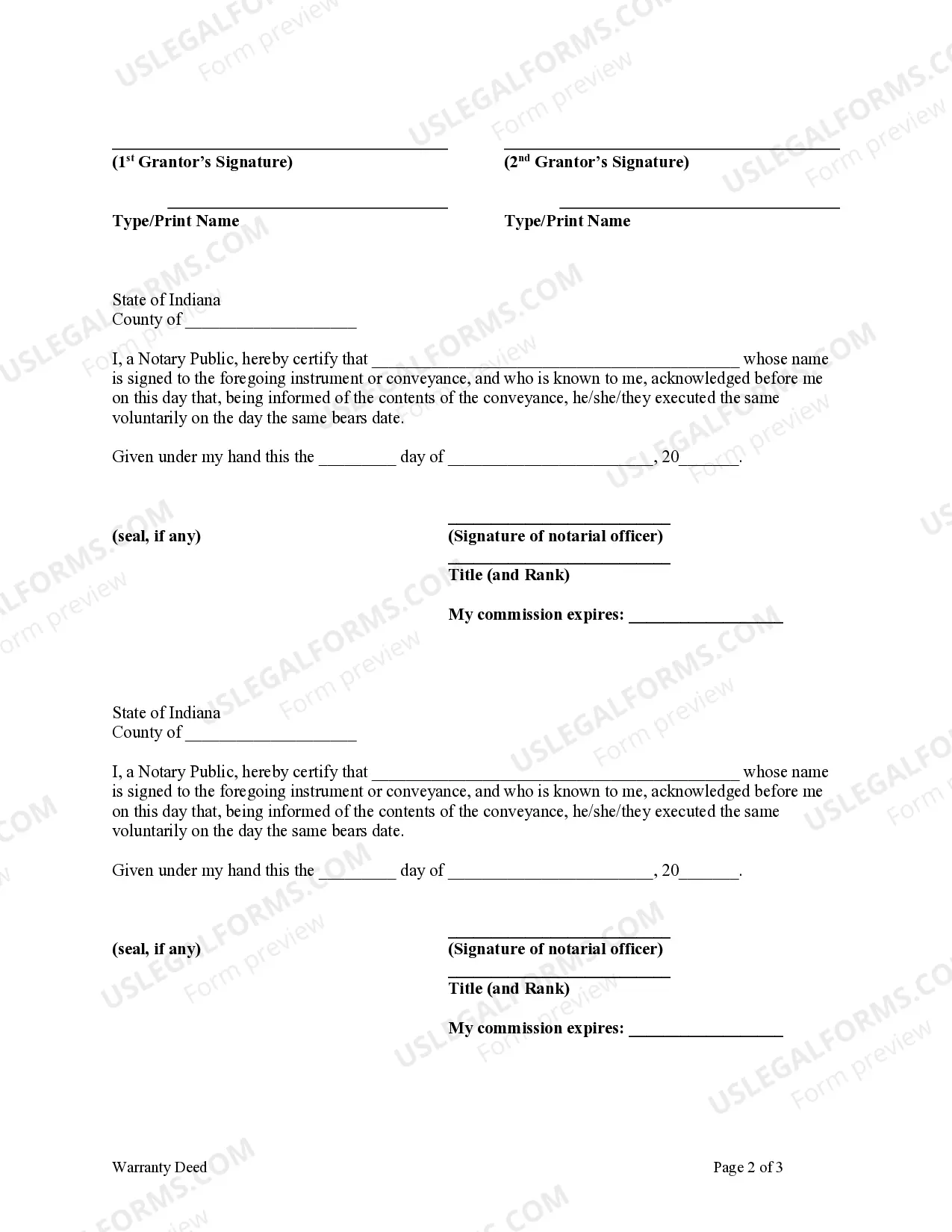
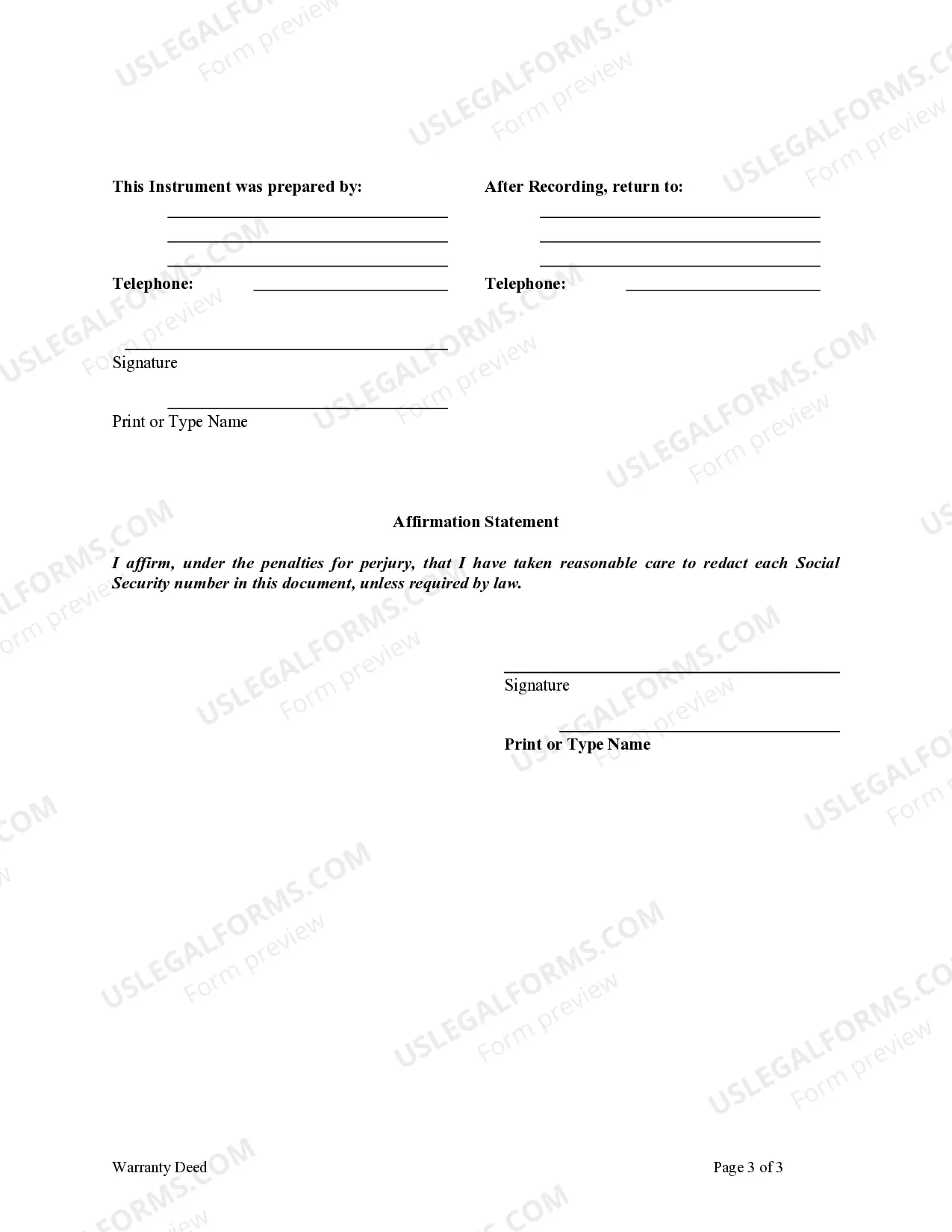
- Signature lines for the grantors
- Notary acknowledgment section






Situations where this form applies
This Warranty Deed should be used when a husband and wife wish to transfer real estate property to an individual without any reservations. This form is applicable in scenarios such as selling a family property, gifting a property to a friend, or re-titling property during estate planning. It is advisable to use this form in situations requiring legal assurance of the property's title.
Who needs this form
- Married couples looking to transfer property to another individual
- Individuals involved in real estate transactions who require legal protection for property title
- Real estate agents assisting clients in property transfers
- Attorneys advising clients on property transfers and estate planning
Completing this form step by step
- Identify the parties involved by entering the full names of the husband and wife as grantors and the individual as the grantee.
- Specify the property by including a detailed legal description to avoid any confusion about the property being transferred.
- Fill in the date of the transaction to establish the effective date of the property transfer.
- Both grantors must sign the document in the designated signature lines.
- Complete the notary acknowledgment section to ensure the deed is legally recognized.
Does this document require notarization?
To make this form legally binding, it must be notarized. Our online notarization service, powered by Notarize, lets you verify and sign documents remotely through an encrypted video session.
Get your form ready online
Our built-in tools help you complete, sign, share, and store your documents in one place.
Make edits, fill in missing information, and update formatting in US Legal Forms—just like you would in MS Word.
Download a copy, print it, send it by email, or mail it via USPS—whatever works best for your next step.
Sign and collect signatures with our SignNow integration. Send to multiple recipients, set reminders, and more. Go Premium to unlock E-Sign.
If this form requires notarization, complete it online through a secure video call—no need to meet a notary in person or wait for an appointment.
We protect your documents and personal data by following strict security and privacy standards.

Make edits, fill in missing information, and update formatting in US Legal Forms—just like you would in MS Word.

Download a copy, print it, send it by email, or mail it via USPS—whatever works best for your next step.

Sign and collect signatures with our SignNow integration. Send to multiple recipients, set reminders, and more. Go Premium to unlock E-Sign.

If this form requires notarization, complete it online through a secure video call—no need to meet a notary in person or wait for an appointment.

We protect your documents and personal data by following strict security and privacy standards.
Avoid these common issues
- Failing to include a proper legal description of the property.
- Not obtaining the necessary notarization before submitting the deed for recording.
- Leaving out dates or signatures, which can invalidate the document.
Why complete this form online
- Convenience of downloading the form instantly.
- Editable formats available to personalize the form according to specific needs.
- Access to professional templates drafted by licensed attorneys for assurance of legal compliance.
Looking for another form?









Form popularity
FAQ
Transferring a property title to a family member in Indiana generally requires drafting a new deed that specifies the new owner. You may choose to use an Indiana Warranty Deed from Husband and Wife to an Individual for clarity and legal protection. Be sure to sign the deed in front of a notary public and file it with your county recorder. This ensures that the property transfer is legally recognized and documented.
If your name is not on the deed but you are married in Indiana, you may still have rights to the property based on marital property laws. Indiana follows a rule of equitable distribution, meaning that marital assets are divided fairly, but not necessarily equally. Consulting with a legal professional can help clarify your rights in relation to an Indiana Warranty Deed from Husband and Wife to an Individual.
Adding someone to your house deed requires the filing of a legal form known as a quitclaim deed. When executed and notarized, the quitclaim deed legally overrides the current deed to your home. By filing the quitclaim deed, you can add someone to the title of your home, in effect transferring a share of ownership.
Locate the prior deed to the property. Create the new deed. Sign the new deed. Record the original deed.
No law forbids adding someone to your mortgaged home's deed or in signing your home over to others through one. Mortgage lenders understand deeds, though, and use loan due-on-sale clauses to prevent unauthorized property sales or transfers.
Signing (§ 32-21-2-3) All deed must be executed by one of the following: judge, clerk of a court of record, county auditor, county recorder, notary public, mayor of a city in Indiana or any other state, commissioner appointed in a state other than Indiana by the governor of Indiana, clerk of the city county council
One of the simplest ways to add your wife to the home title is by using an interspousal deed. You can transfer the property from your sole and separate property to mutual tenancy, such as joint tenants with right of survivorship, with your wife.
Retrieve your original deed. Get the appropriate deed form. Draft the deed. Sign the deed before a notary. Record the deed with the county recorder. Obtain the new original deed.
Discuss the terms of the deed with the new owners. Hire a real estate attorney to prepare the deed. Review the deed. Sign the deed in front of a notary public, with witnesses present. File the deed on public record.
An Indiana quitclaim deed is a legally binding document that allows a property's owner to sell or transfer the real estate to another party, a buyer, without any promise about the title.