Idaho Relative Caretaker Legal Documents Package
What this form package covers
The Idaho Relative Caretaker Legal Documents Package is designed to assist individuals looking to place a child with a relative in Idaho. This comprehensive package includes vital legal forms and guides that summarize state laws regarding relative caregiving and address the specific rights of relatives in child placement scenarios. Unlike other packages, this bundle offers significant savings, ensuring you have access to essential resources at over 50 percent off the individual prices.
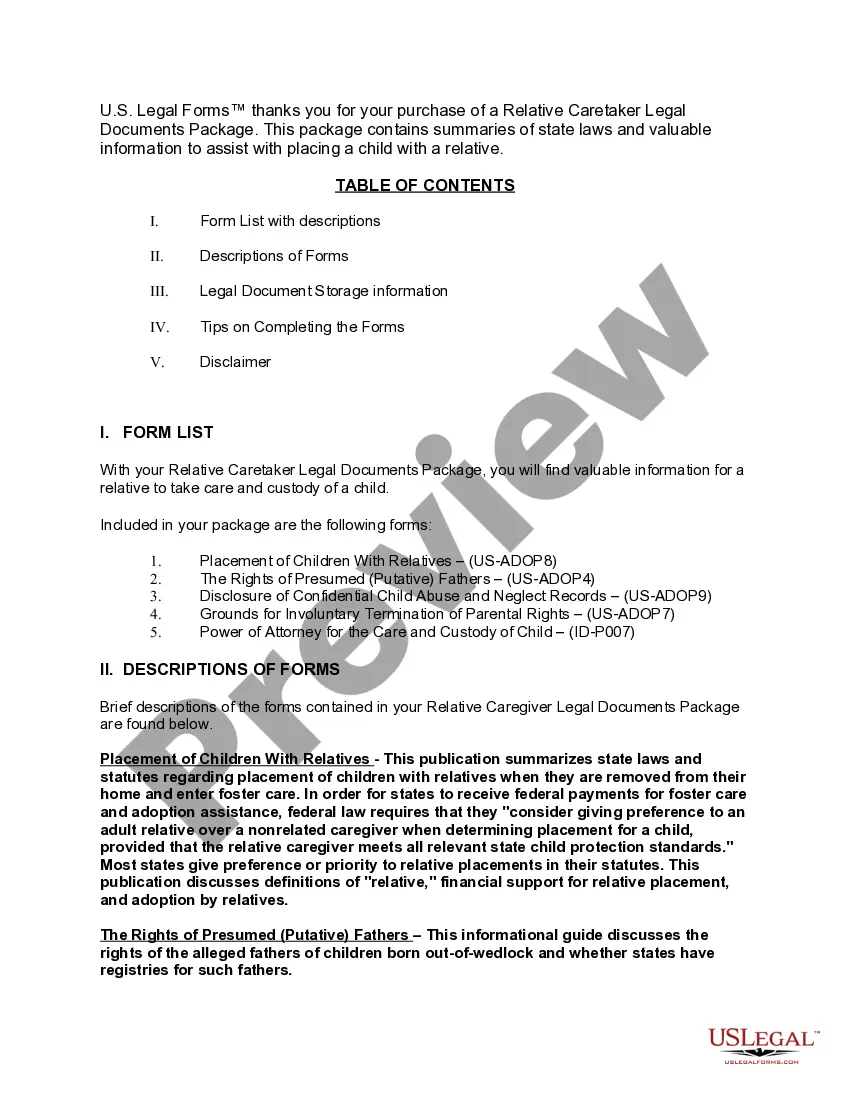
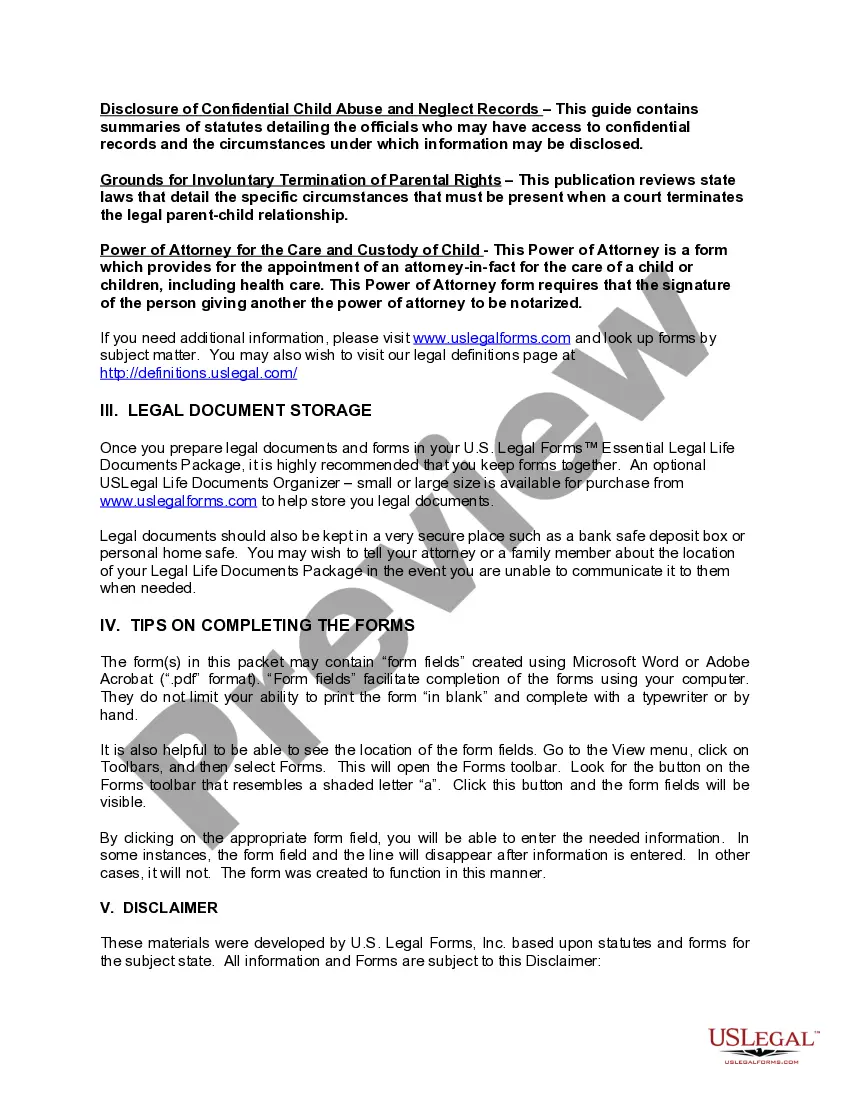
Documents contained in this package

When to use this document
This package is ideal for situations where a child needs to be placed with a relative, especially following a removal from their home or in foster care contexts. It can also be utilized when seeking to understand the rights and responsibilities of presumed fathers, handling confidential child abuse records, or seeking the involuntary termination of parental rights. Additionally, if you need to appoint someone for care and custody arrangements, this package provides the necessary Power of Attorney form.
Who should use this form package
- Relatives seeking to care for a child placed out-of-home.
- Presumed fathers who wish to understand their legal rights.
- Individuals or families navigating child custody and placement issues.
- Anyone needing legal documentation related to child care and custody for relatives.
Completing these forms step by step
- Review the included forms and guides to understand their purpose and requirements.
- Identify the parties involved, including the child and the relative caretaker.
- Fill in the required information on each form using clear and accurate details.
- Sign and date the forms where indicated, ensuring compliance with state requirements.
- If applicable, arrange for notarization of the Power of Attorney form.
Do forms in this package need to be notarized?
Some included forms must be notarized to ensure validity. US Legal Forms provides secure online notarization powered by Notarize, allowing you to complete the process through a verified video call anytime.
Get your form ready online
Our built-in tools help you complete, sign, share, and store your documents in one place.
Make edits, fill in missing information, and update formatting in US Legal Forms—just like you would in MS Word.
Download a copy, print it, send it by email, or mail it via USPS—whatever works best for your next step.
Sign and collect signatures with our SignNow integration. Send to multiple recipients, set reminders, and more. Go Premium to unlock E-Sign.
If this form requires notarization, complete it online through a secure video call—no need to meet a notary in person or wait for an appointment.
We protect your documents and personal data by following strict security and privacy standards.

Make edits, fill in missing information, and update formatting in US Legal Forms—just like you would in MS Word.

Download a copy, print it, send it by email, or mail it via USPS—whatever works best for your next step.

Sign and collect signatures with our SignNow integration. Send to multiple recipients, set reminders, and more. Go Premium to unlock E-Sign.

If this form requires notarization, complete it online through a secure video call—no need to meet a notary in person or wait for an appointment.

We protect your documents and personal data by following strict security and privacy standards.
Typical mistakes to avoid
- Failing to provide complete information required on the forms.
- Not signing and dating the forms appropriately.
- Neglecting to seek notarization when necessary.
- Overlooking local laws that may affect the completion of the documents.
Why use this package online
- Convenient download allows immediate access to legal forms and information.
- Cost-effective solution offering significant savings compared to purchasing items individually.
- Forms can be completed digitally or printed for manual entry, ensuring flexibility.
- Reliable guidance from legal professionals ensures up-to-date compliance with Idaho laws.
Looking for another form?









Form popularity
FAQ
Charles Loring Brace, a protestant minister who founded the Children's Aid Society of New York in 1853, conceived the idea to relocate and find homes for the orphans. Between 1859 and 1929 some 200,000 orphaned children were transported from coastal cities to rural areas in the Midwest.
Under 6th century AD Roman Law, Codex Justinianeus, when the family patriarch was poised to die without a male heir, an heir could be provided from another family through adoption. Families with many sons often adopted their sons to other noble families in order to forge a coveted family connection.
Adopting Through an Agency. Adopting Independently. Adopting Through Identification. Adopting Internationally. Adopt as Stepparents. Adopting as a Same-Sex Couple. Relative Adoptions. Adult Adoptions.
While the practice of adoption has been around for millennia, the recent history of adoption in the United States can be tracked to the 1850s, with the passage of the first "modern" adoption law in Massachusetts that recognized adoption as a social and legal process based on child welfare rather than adult interests.
Adopting babies out of the foster care system is typically difficult, because of a high demand, and children in the foster care system often have very specific emotional and physical needs that some families may not feel equipped to handle.
While the practice of adoption has been around for millennia, the recent history of adoption in the United States can be tracked to the 1850s, with the passage of the first "modern" adoption law in Massachusetts that recognized adoption as a social and legal process based on child welfare rather than adult interests.
Practices that aimed to hide this difference ironically made modern adoption most distinctive. In the United States, state legislatures began passing adoption laws in the nineteenth-century. The Massachusetts Adoption of Children Act, enacted in 1851, is widely considered the first modern adoption law.
Charles Loring Brace, a protestant minister who founded the Children's Aid Society of New York in 1853, conceived the idea to relocate and find homes for the orphans. Between 1859 and 1929 some 200,000 orphaned children were transported from coastal cities to rural areas in the Midwest.
Adoption is a way of providing the security, permanency and love of a new family when it is not possible for a child to remain with his/her birth parents or within the birth family. Adoption is a legal process which fully transfers Parental Responsibility from the child's birth parents to their adoptive parents.