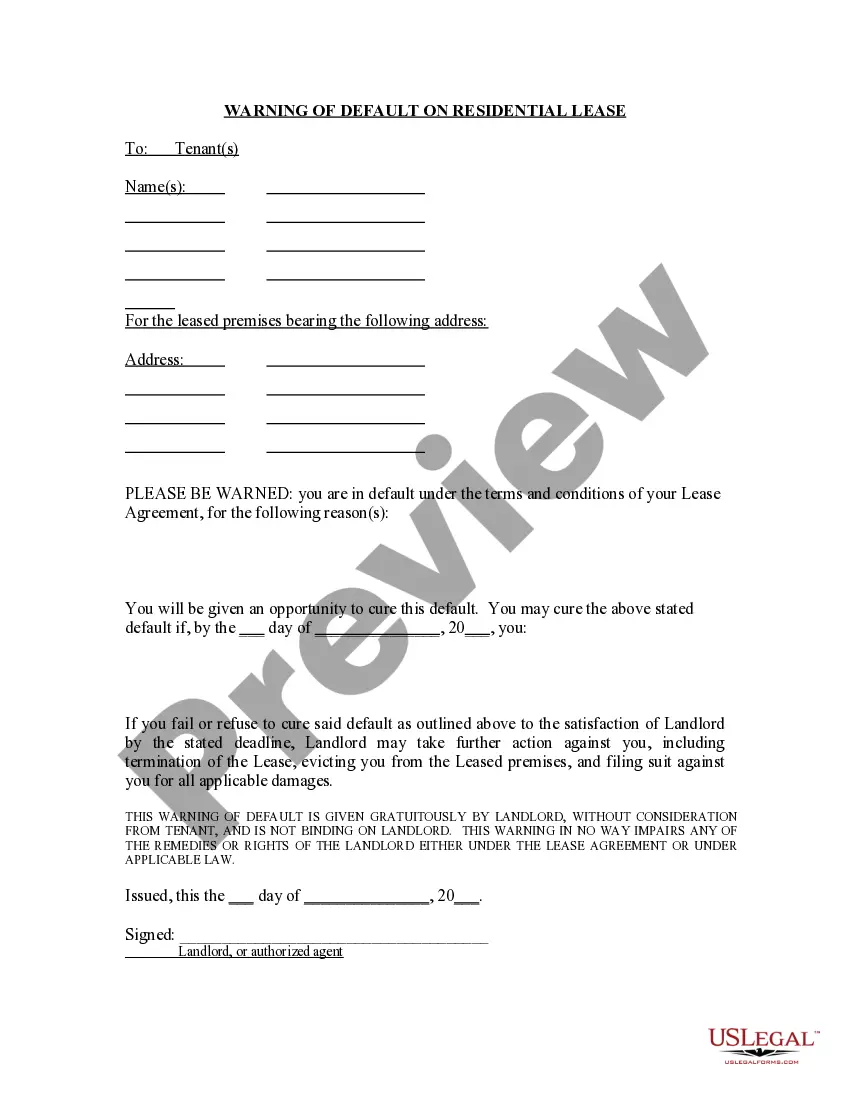
Idaho Warning of Default on Residential Lease
What is this form?
The Warning of Default on Residential Lease is a formal notice from a landlord to a tenant. This document alerts the tenant to specific conditions that, if not addressed, could lead to a default under the lease agreement. It serves as a proactive communication tool and helps differentiate itself from eviction notices by focusing on remedying the situation rather than immediate termination of the lease. This warning is crucial in maintaining clear communication and records in landlord-tenant relationships.
Main sections of this form
- Date of issuance: Specifies when the notice is given.
- Landlord's signature: Indicates the authorization behind the warning.
- Conditions of default: Details the specific issues that need to be remedied by the tenant.
- Disclaimer of binding obligations: Clarifies that this warning is not legally binding and does not limit landlord rights.



When this form is needed
This form should be used when a landlord identifies breaches in a residential lease agreement that could lead to a default. Common scenarios include failure to pay rent on time, improper maintenance of the property, or violation of lease terms. By issuing this warning, landlords aim to provide tenants an opportunity to correct these issues before taking more serious actions, such as eviction.
Who this form is for
- Landlords who lease residential properties.
- Property managers acting on behalf of landlords.
- Tenants who wish to understand potential lease violations and remedies.
How to prepare this document
- Enter the date the warning is issued.
- Specify the conditions of default clearly and concisely.
- Sign the document to validate it as the landlord or authorized agent.
- Distribute the completed form to the tenant, following any relevant state guidelines for service.
Does this form need to be notarized?
This form does not typically require notarization unless specified by local law. Always check local regulations to confirm requirements in your jurisdiction. However, if you need notarization, US Legal Forms offers integrated online notarization services for added convenience.
Get your form ready online
Our built-in tools help you complete, sign, share, and store your documents in one place.
Make edits, fill in missing information, and update formatting in US Legal Forms—just like you would in MS Word.
Download a copy, print it, send it by email, or mail it via USPS—whatever works best for your next step.
Sign and collect signatures with our SignNow integration. Send to multiple recipients, set reminders, and more. Go Premium to unlock E-Sign.
If this form requires notarization, complete it online through a secure video call—no need to meet a notary in person or wait for an appointment.
We protect your documents and personal data by following strict security and privacy standards.

Make edits, fill in missing information, and update formatting in US Legal Forms—just like you would in MS Word.

Download a copy, print it, send it by email, or mail it via USPS—whatever works best for your next step.

Sign and collect signatures with our SignNow integration. Send to multiple recipients, set reminders, and more. Go Premium to unlock E-Sign.

If this form requires notarization, complete it online through a secure video call—no need to meet a notary in person or wait for an appointment.

We protect your documents and personal data by following strict security and privacy standards.
Mistakes to watch out for
- Failing to specify the default conditions clearly, which can lead to confusion.
- Not signing the form, making it invalid.
- Forgetting to document the date of issuance, which is crucial for timelines.
Benefits of completing this form online
- Convenient access and download options for quick use.
- Editability allows customization to fit specific lease requirements.
- Prepared by licensed attorneys, ensuring reliability and legal accuracy.
Legal use & context
- This form serves to document the landlord's efforts to resolve issues amicably.
- It precedes any legal action regarding lease default, ensuring due process is followed.
- It is essential for protecting landlords' rights while providing tenants an opportunity to rectify their violations.
Looking for another form?




Form popularity
FAQ
In landlord-tenant law, default refers to the failure of a tenant to timely pay rent due.In general, the landlord is required to give the tenant notice of the default before bringing eviction proceedings or applying security deposit proceeds to the payment in default.
Default by landlord The most common form of landlord default is failure to provide services and maintain the property condition. When a landlord defaults on the terms of the lease, tenants may sue for damages.
A landlord cannot evict a tenant without an adequately obtained eviction notice and sufficient time. A landlord cannot retaliate against a tenant for a complaint. A landlord cannot forego completing necessary repairs or force a tenant to do their own repairs.A landlord cannot remove a tenant's personal belongings.
Your lease agreement will state what constitutes a default of the lease as well as if there is any grace period in making lease payments. Not making a contractually required monthly payment will normally be a breach of the lease and the lessor can then repossess the vehicle from you.
The Idaho law enacted in 1977 clearly specifies the rights of landlords and tenants. Some of the tenant rights include: Right to remain on the property until they're properly evicted by a court order. Right to have repairs made within a reasonable amount of time after a request is made.
Protect your rental income. Even the most reliable tenants sometimes struggle to pay their rent.Tenant default insurance from Simply Business provides vital back-up for landlords it can cover your rental income if your tenant fails to pay rent.
Step 1: Speak to your tenant. Step 2: Provide notice of contract breach. Step 3: Decide between an interdict or cancellation. Step 4: Eviction process. Step 5: Eviction notice. Final advice.
Tenant default occurs when a Tenant breaches one of the tenant's covenants in its lease. Tenant default can arise in a number of different ways but will typically be for one of the following: Non-payment of rent or other sums reserved under the lease.
Paying the rent - One way or another, if you walk away from your lease and no one else rents the apartment then you will owe the landlord this money.Your landlord will typically collect this rent at the expiration of your lease.