Idaho Quitclaim Deed from Husband and Wife to LLC
Understanding this form
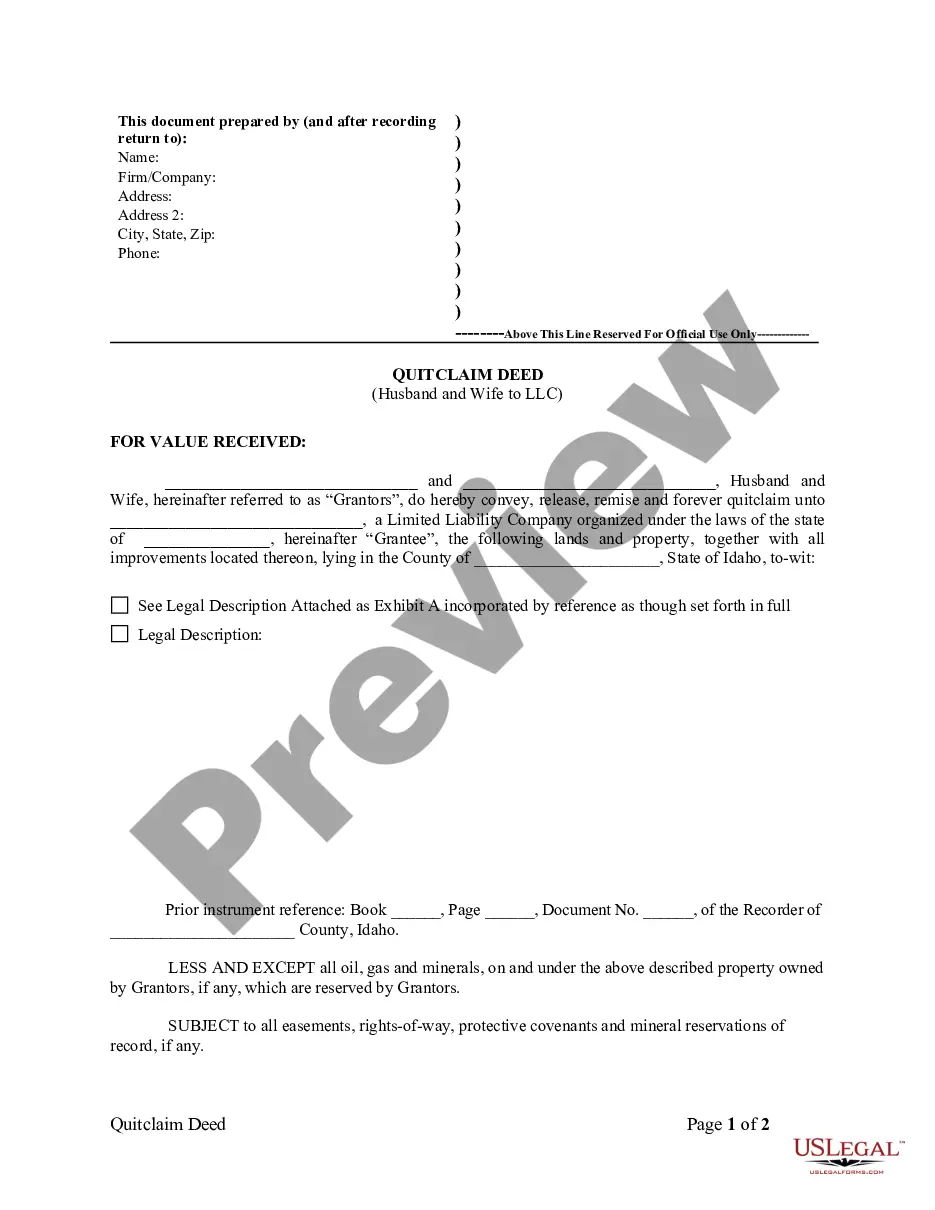
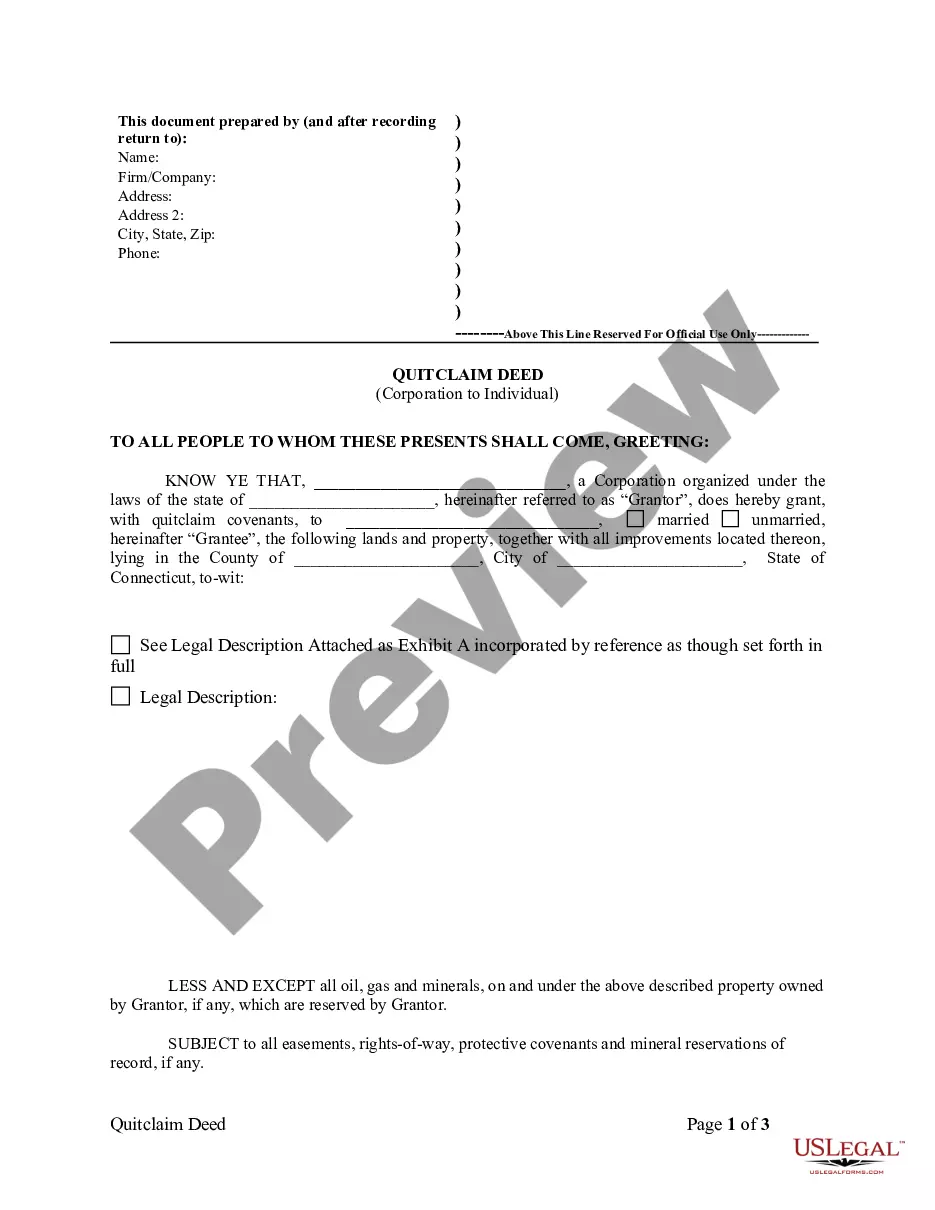
The Quitclaim Deed from Husband and Wife to LLC is a legal document that transfers property ownership from a married couple to a limited liability company (LLC). Unlike warranty deeds, this quitclaim deed does not guarantee that the title is free of claims, making it essential for specific situations where a swift transfer of interest is needed without extensive title investigation. This form is particularly useful for couples who wish to move property ownership to an LLC for liability protection or business purposes.
What’s included in this form
- Identification of the grantors (husband and wife) and the grantee (LLC).
- Description of the property being transferred.
- Clauses reserving rights to any oil, gas, or mineral interests on the property.
- Provisions regarding easements and rights-of-way affecting the property.
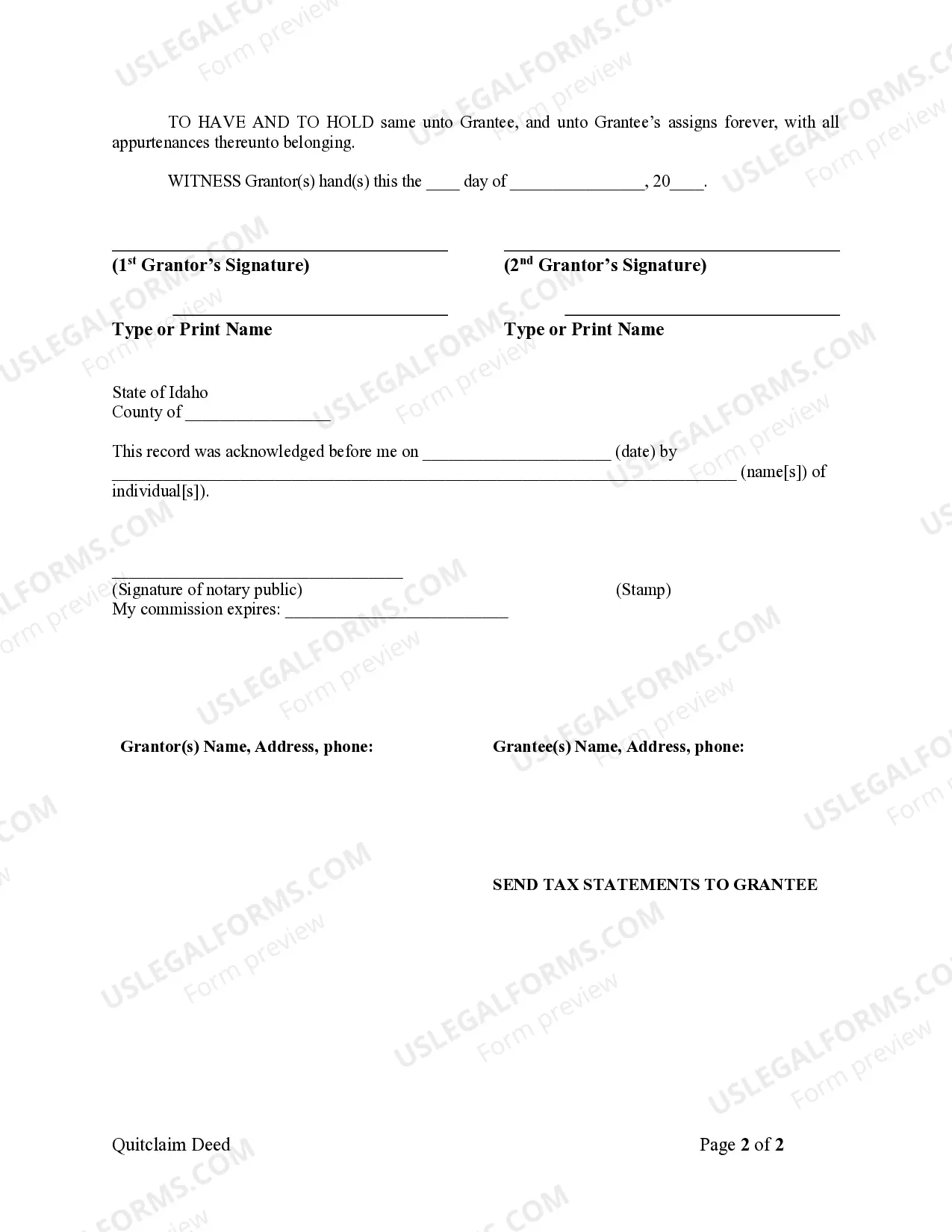
- Signature and acknowledgment requirements for both grantors.





When to use this document
This form is needed when a husband and wife want to transfer their interest in a property to an LLC, often for reasons related to business, asset protection, or estate planning. It is useful for couples who are simplifying their property ownership structure or creating a distinct business entity while maintaining control over the property.
Who this form is for
- Married couples who own property and want to transfer it to their LLC.
- Couples looking to protect their personal assets through a business entity.
- Property owners considering restructuring their real estate ownership for tax or legal reasons.
How to complete this form
- Identify the parties involved: enter the names of the husband and wife as grantors and the LLC as the grantee.
- Clearly describe the property being transferred, including any unique identifiers such as parcel numbers.
- Include reservations for any oil, gas, or mineral rights if applicable.
- Have all grantors sign the deed in the presence of a notary public.
- Submit the completed document to the local county clerk for recording.
Notarization requirements for this form
This document requires notarization to meet legal standards. US Legal Forms provides secure online notarization powered by Notarize, allowing you to complete the process through a verified video call, available 24/7.
Get your form ready online
Our built-in tools help you complete, sign, share, and store your documents in one place.
Make edits, fill in missing information, and update formatting in US Legal Forms—just like you would in MS Word.
Download a copy, print it, send it by email, or mail it via USPS—whatever works best for your next step.
Sign and collect signatures with our SignNow integration. Send to multiple recipients, set reminders, and more. Go Premium to unlock E-Sign.
If this form requires notarization, complete it online through a secure video call—no need to meet a notary in person or wait for an appointment.
We protect your documents and personal data by following strict security and privacy standards.

Make edits, fill in missing information, and update formatting in US Legal Forms—just like you would in MS Word.

Download a copy, print it, send it by email, or mail it via USPS—whatever works best for your next step.

Sign and collect signatures with our SignNow integration. Send to multiple recipients, set reminders, and more. Go Premium to unlock E-Sign.

If this form requires notarization, complete it online through a secure video call—no need to meet a notary in person or wait for an appointment.

We protect your documents and personal data by following strict security and privacy standards.
Common mistakes
- Failing to include a proper legal description of the property.
- Not having the document notarized as required.
- Inaccurate information about the LLC, such as its official name or registered agent details.
Why use this form online
- Convenience of downloading and completing the form at your own pace.
- Editability to customize the form to fit your specific property and situation.
- Assurance that the form is drafted in accordance with state laws for validity.
Quick recap
- A Quitclaim Deed transfers property ownership without warranty, making it a simpler alternative compared to warranty deeds.
- Ensure all required details, such as the property description and grantor signatures, are accurately completed.
- This form is especially beneficial for married couples transferring property to their LLC.
Looking for another form?

Form popularity
FAQ
Fill out the quit claim deed form, which can be obtained online, or write your own using the form as a guide. The person giving up the interest in the property is the grantor, and the person receiving the interest is the grantee.
Quitclaim deeds, therefore, are commonly used to transfer property within a family, such as from a parent to an adult child, between siblings, or when a property owner gets married and wants to add their spouse to the title. Married couples who own a home together and later divorce also use quitclaim deeds.
Research quit claim deed requirements in your area. Obtain the proper form. Get a legal description of your property. Fill out the form. File the form with the county. When to Use a Quit Claim Deed. Questions?
A Quitclaim Deed must be notarized by a notary public or attorney in order to be valid.Consideration in a Quitclaim Deed is what the Grantee will pay to the Grantor for the interest in the property.
The drawback, quite simply, is that quitclaim deeds offer the grantee/recipient no protection or guarantees whatsoever about the property or their ownership of it. Maybe the grantor did not own the property at all, or maybe they only had partial ownership.
Quitclaim deeds are most often used to transfer property between family members.Examples include when an owner gets married and wants to add a spouse's name to the title or deed, or when the owners divorce and one spouse's name is removed from the title or deed.
A quitclaim deed transfers title but makes no promises at all about the owner's title.A person who signs a quitclaim deed to transfer property they do not own results in no title at all being transferred since there is no actual ownership interest. The quitclaim deed only transfers the type of title you own.
In California, the statute of limitations is five years. Any challenge to the quitclaim must be based on either a procedural error or on undo duress.
But you might be wondering if an owner can transfer a deed to another person without a real estate lawyer. The answer is yes. Parties to a transaction are always free to prepare their own deeds.A quitclaim deed, for example, is far simpler than a warranty deed.