Idaho Quitclaim Deed from Corporation to Corporation
What is this form?
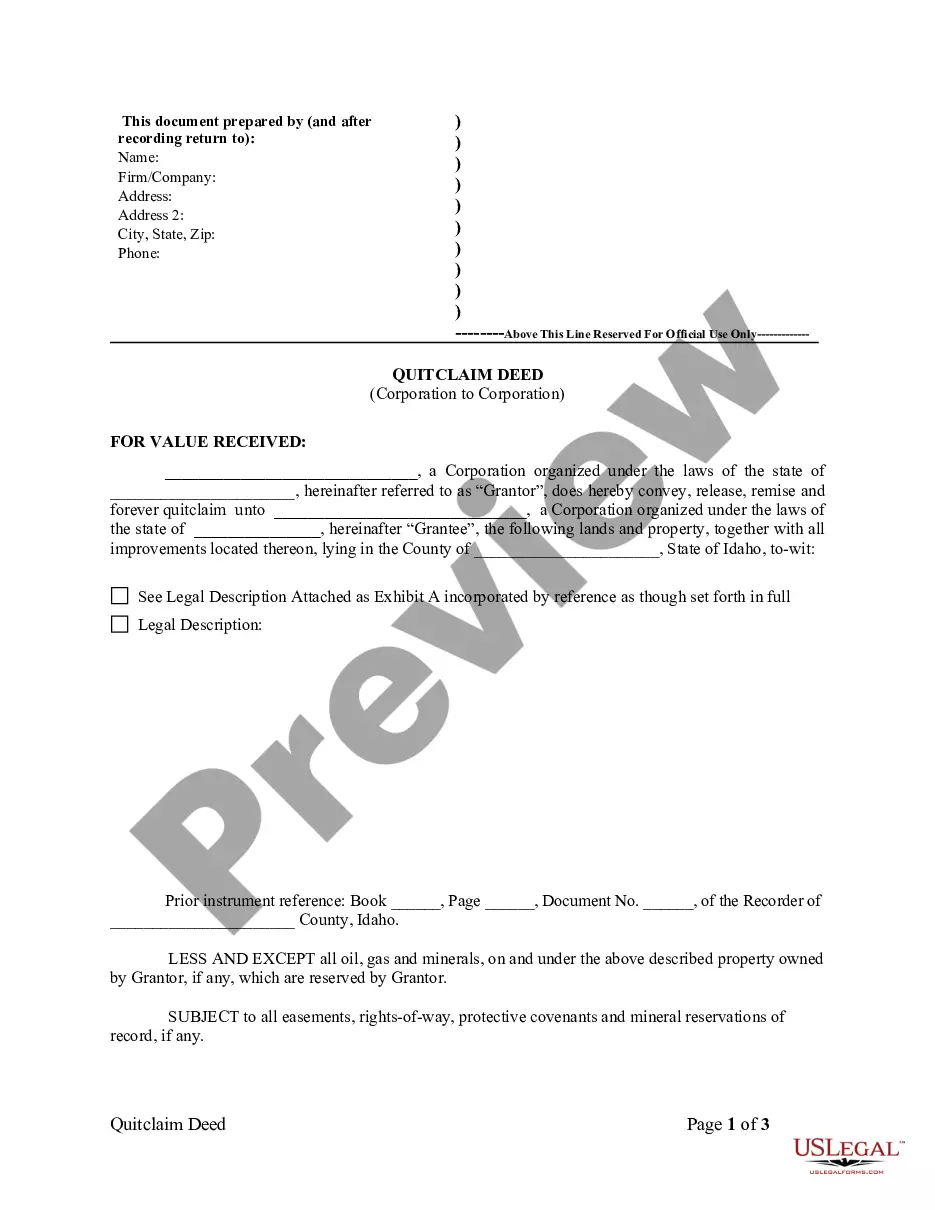
The Quitclaim Deed from Corporation to Corporation is a legal document where one corporation (the Grantor) transfers its interest in a property to another corporation (the Grantee) without any guarantees regarding the title. This type of deed is ideal for transferring property between corporations, particularly when the Grantor wishes to convey property while excluding certain rights, such as oil, gas, and mineral interests. Unlike other deeds, a quitclaim deed offers less protection to the Grantee, as the Grantor does not warrant the title.
Main sections of this form
- Identification of the Grantor and Grantee corporations.
- A description of the property being transferred.
- Exclusions for oil, gas, and minerals on the property, if applicable.
- Statement of any easements or rights-of-way affecting the property.
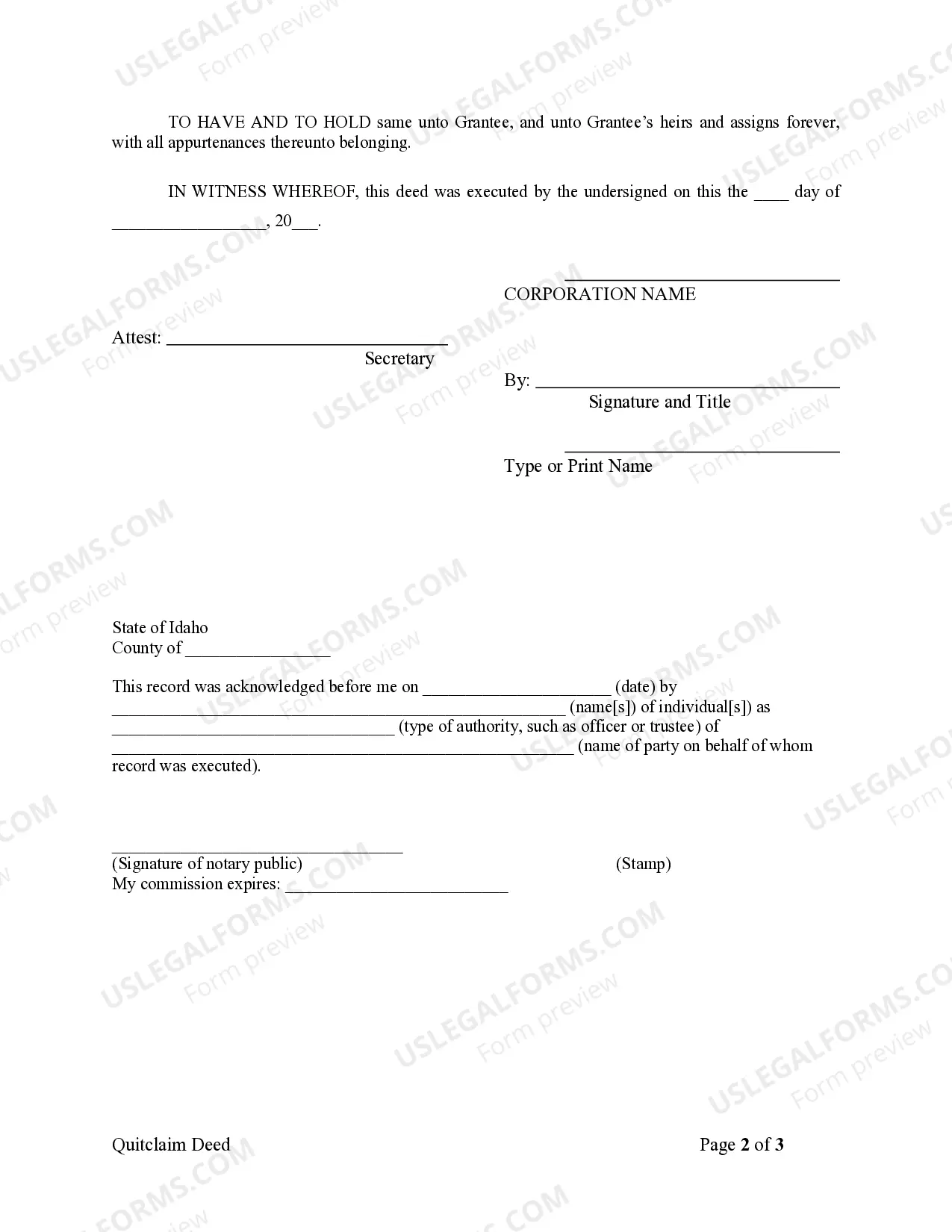
- Signatures of the authorized representatives of both corporations.
- Notary acknowledgment for legal validity.



Common use cases
This form is useful when a corporation wishes to transfer property ownership to another corporation without sales or warranty of the underlying title. Common scenarios include intra-company transfers, mergers, or organizational restructures where property ownership is changed between corporate entities.
Intended users of this form
- Certainly corporations looking to transfer property ownership to another corporation.
- Businesses involved in mergers or acquisitions.
- Corporate legal teams or authorized representatives handling property transactions.
How to complete this form
- Identify the Grantor and Grantee corporations, including their legal names and addresses.
- Clearly describe the property being conveyed in detail.
- State any excluded rights, such as oil, gas, and mineral rights, if necessary.
- Have the authorized representatives of both corporations sign the deed.
- Secure a notary public to notarize the signatures and provide legal validation.
Is notarization required?
This form needs to be notarized to ensure legal validity. US Legal Forms provides secure online notarization powered by Notarize, allowing you to complete the process through a verified video call, available anytime.
Get your form ready online
Our built-in tools help you complete, sign, share, and store your documents in one place.
Make edits, fill in missing information, and update formatting in US Legal Forms—just like you would in MS Word.
Download a copy, print it, send it by email, or mail it via USPS—whatever works best for your next step.
Sign and collect signatures with our SignNow integration. Send to multiple recipients, set reminders, and more. Go Premium to unlock E-Sign.
If this form requires notarization, complete it online through a secure video call—no need to meet a notary in person or wait for an appointment.
We protect your documents and personal data by following strict security and privacy standards.

Make edits, fill in missing information, and update formatting in US Legal Forms—just like you would in MS Word.

Download a copy, print it, send it by email, or mail it via USPS—whatever works best for your next step.

Sign and collect signatures with our SignNow integration. Send to multiple recipients, set reminders, and more. Go Premium to unlock E-Sign.

If this form requires notarization, complete it online through a secure video call—no need to meet a notary in person or wait for an appointment.

We protect your documents and personal data by following strict security and privacy standards.
Common mistakes
- Failing to provide a complete and accurate property description.
- Not including proper corporate names or failing to use a corporate format.
- Omitting necessary signatures from all involved parties.
- Neglecting to have the deed notarized when required.
Benefits of using this form online
- Convenient access to necessary legal templates at any time.
- Ability to customize the deed based on specific needs before downloading.
- Ensured reliability as the templates are drafted by licensed attorneys.
- Easy to complete with guided instructions for users with varying levels of legal experience.
Key takeaways
- The Quitclaim Deed from Corporation to Corporation allows for the transfer of property without warranties.
- Essential for business transactions involving real estate transfers between corporations.
- Notarization is required to ensure the deed's validity.
Looking for another form?
Form popularity
FAQ
A quitclaim deed affects ownership and the name on the deed, not the mortgage. Because quitclaim deeds expose the grantee to certain risks, they are most often used between family members and where there is no exchange of money.Quitclaim deeds transfer title but do not affect mortgages.
The drawback, quite simply, is that quitclaim deeds offer the grantee/recipient no protection or guarantees whatsoever about the property or their ownership of it. Maybe the grantor did not own the property at all, or maybe they only had partial ownership.
Fill out the quit claim deed form, which can be obtained online, or write your own using the form as a guide. The person giving up the interest in the property is the grantor, and the person receiving the interest is the grantee.
A quitclaim deed is a deed (proof of ownership) that is passed from a grantor (the existing property owner) to a grantee (the new property owner) that does not have a warranty.A quitclaim deed has no guarantees for the grantor or grantee.
But you might be wondering if an owner can transfer a deed to another person without a real estate lawyer. The answer is yes. Parties to a transaction are always free to prepare their own deeds.A quitclaim deed, for example, is far simpler than a warranty deed.
A quit claim deed in the state of Idaho is a legal document that conveys a property from a Grantor (the person selling the property) to the Grantee (the person purchasing or receiving the property) without any form of guarantee that the Grantor has the legal authority to sell or transfer the property, or that the
A quitclaim deed is quick and easy because it transfers all of one person's interest in the property to another.The deed transfers all claims the seller has to the property, if any. If the seller has no interest in the real estate, no interest is transferred.
A quitclaim deed transfers title but makes no promises at all about the owner's title.A person who signs a quitclaim deed to transfer property they do not own results in no title at all being transferred since there is no actual ownership interest. The quitclaim deed only transfers the type of title you own.