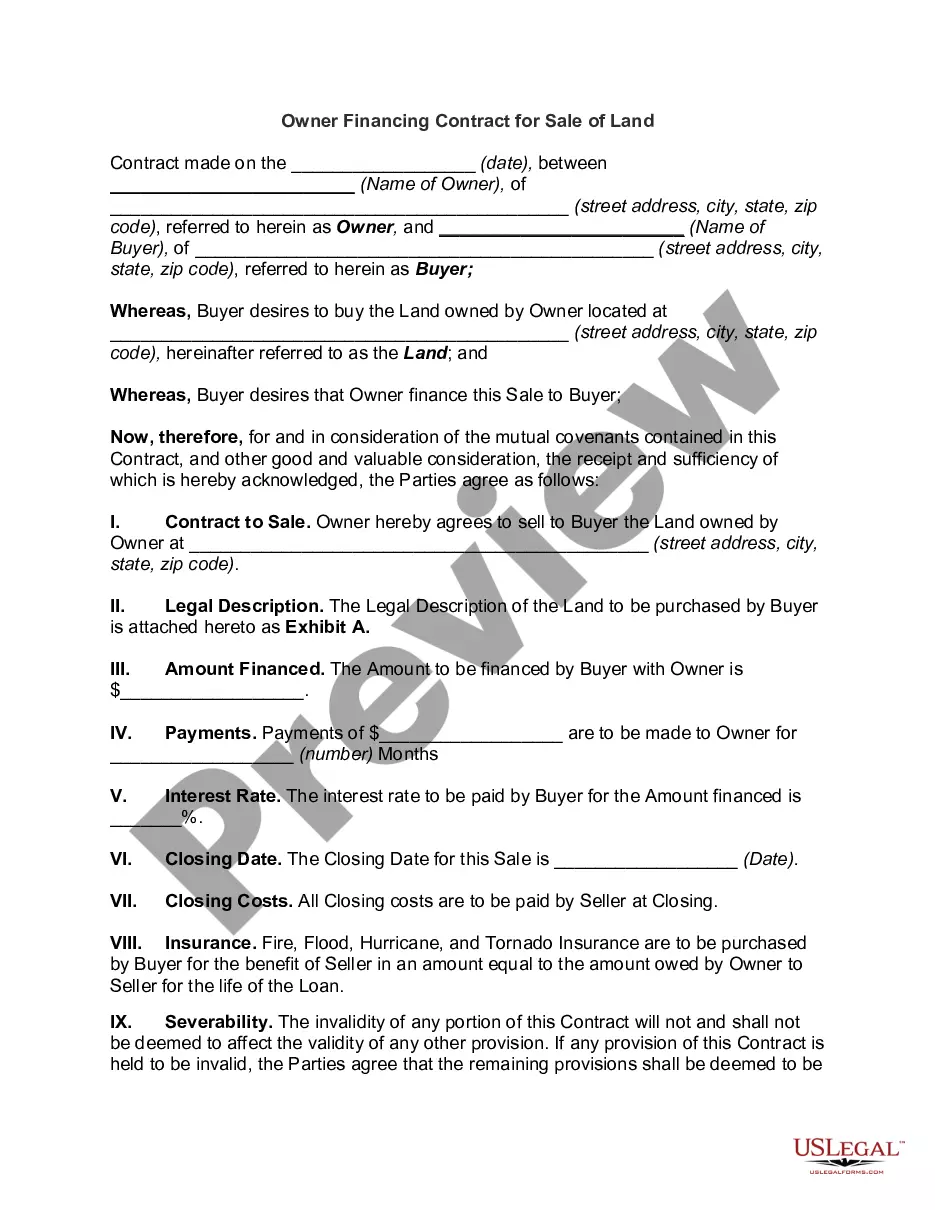
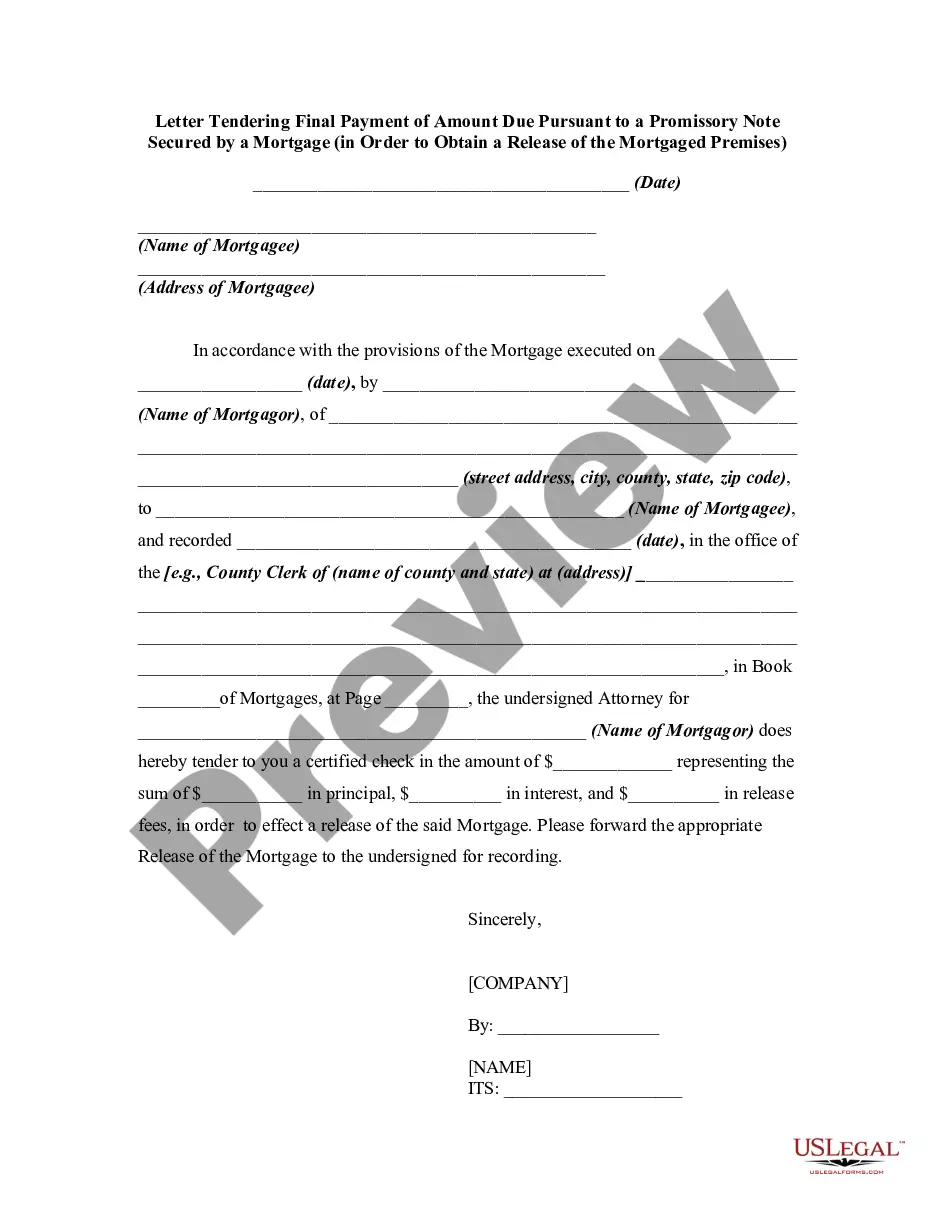
Idaho Final Notice of Default for Past Due Payments in connection with Contract for Deed
Understanding this form
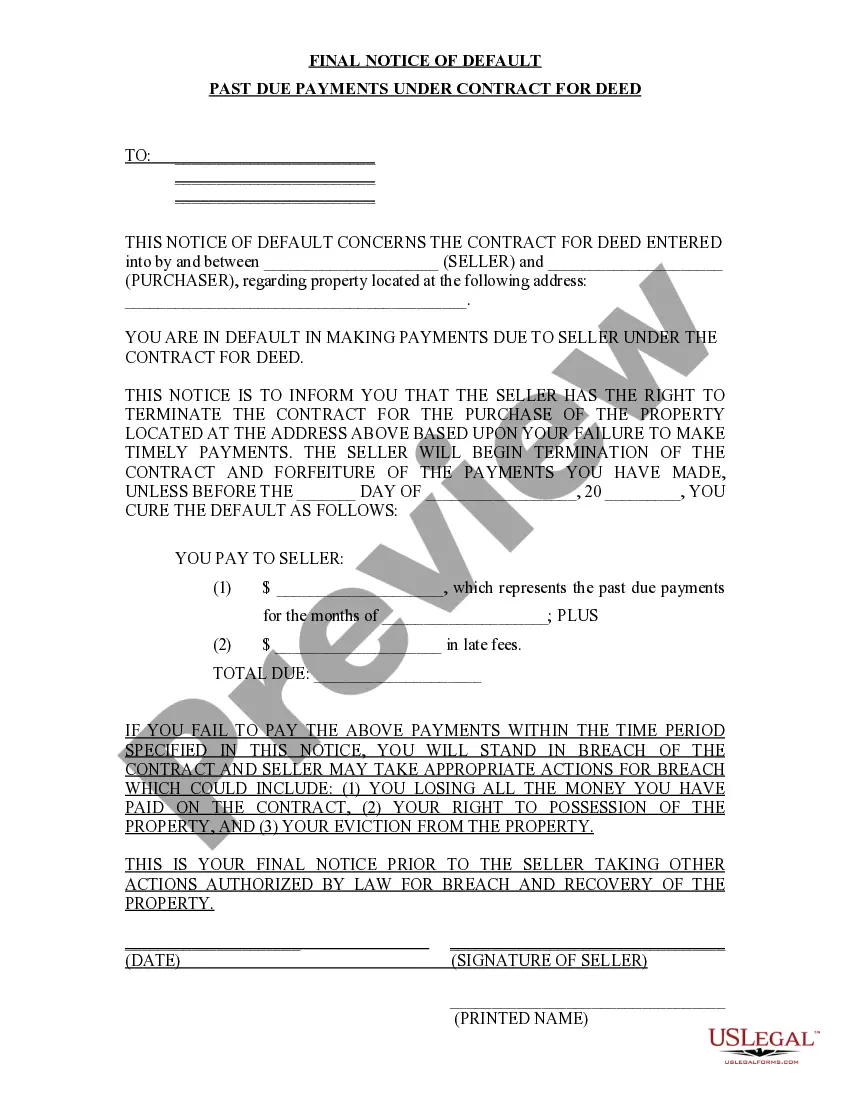
The Final Notice of Default for Past Due Payments in connection with Contract for Deed is a legal document sent by the seller to notify the purchaser of failure to make required payments on the property. This notice serves to establish that if the purchaser does not pay the specified amount by a certain deadline, they will be in default of the contract, and the seller may terminate the agreement, potentially leading to eviction and loss of payments made.
Form components explained
- Contact information of the seller and purchaser.
- Property address associated with the contract for deed.
- Details of the default, including amounts due and late fees.
- Deadline for payment to cure the default.
- Consequences of failing to make the payment, including potential eviction.
- Signature of the seller to validate the notice.
Common use cases
This form should be used when a purchaser has missed payments required under a Contract for Deed. It acts as the final warning before the seller takes legal action to terminate the contract and reclaim the property. Use this form if you wish to formally inform the purchaser of their current default status and the potential consequences of failing to remedy the situation.
Who can use this document
- Sellers of property under a Contract for Deed who need to notify the purchaser of default.
- Purchasers who wish to understand the implications of their non-payment and the action their seller may take.
- Real estate professionals assisting clients in managing contracts for deed.
How to complete this form
- Identify the parties involved: seller and purchaser.
- Specify the property address linked to the contract.
- Detail the amount owed, including past due payments and any applicable late fees.
- Set a clear deadline for the purchaser to remedy the default.
- Correspondingly, complete the seller's signature and date to finalize the notice.
Does this document require notarization?
This form does not typically require notarization unless specified by local law.
Get your form ready online
Our built-in tools help you complete, sign, share, and store your documents in one place.
Make edits, fill in missing information, and update formatting in US Legal Forms—just like you would in MS Word.
Download a copy, print it, send it by email, or mail it via USPS—whatever works best for your next step.
Sign and collect signatures with our SignNow integration. Send to multiple recipients, set reminders, and more. Go Premium to unlock E-Sign.
If this form requires notarization, complete it online through a secure video call—no need to meet a notary in person or wait for an appointment.
We protect your documents and personal data by following strict security and privacy standards.

Make edits, fill in missing information, and update formatting in US Legal Forms—just like you would in MS Word.

Download a copy, print it, send it by email, or mail it via USPS—whatever works best for your next step.

Sign and collect signatures with our SignNow integration. Send to multiple recipients, set reminders, and more. Go Premium to unlock E-Sign.

If this form requires notarization, complete it online through a secure video call—no need to meet a notary in person or wait for an appointment.

We protect your documents and personal data by following strict security and privacy standards.
Common mistakes to avoid
- Failing to accurately state the amount due.
- Not providing a clear deadline for payment.
- Omitting signatures or dates, which can invalidate the notice.
- Not following local requirements regarding notice delivery.
Advantages of online completion
- Immediate access to the latest legal form templates.
- Convenient download options for ease of use.
- Editable forms that can be tailored to your specific situation.
- Reduced time spent on paperwork, allowing for efficient handling of legal matters.
Looking for another form?
Form popularity
FAQ
A judgment is a court's final decision regarding the legal rights and obligations of the parties involved. In contrast, default refers to the failure to meet obligations, such as making timely payments under a Contract for Deed. Regarding the Idaho Final Notice of Default for Past Due Payments, a judgment may occur after a default has been entered if no action is taken by the borrower. It’s crucial to understand these differences to navigate legal proceedings effectively.
A default judgment occurs when a court rules in favor of one party because the other party has not responded to the legal claims made against them. In the context of an Idaho Final Notice of Default for Past Due Payments related to a Contract for Deed, this judgment can lead to the loss of property if the borrower fails to take action. Understanding this concept is vital, as it may impact your financial future and property rights.
When an account is considered past due, that means the minimum required payment was not applied to the account as of the last payment due date. Your account technically becomes past due the moment after you miss the payment. Some credit card issuers immediately apply a late fee to your credit card.
To request payment professionally, it's important to first make sure there was no error or miscommunication about the invoice. Send a polite email to your client explaining that the payment is now past due and ask to make sure they received the initial invoice and there were no problems with it.
Your company name and address. recipient's name and address. today's date. a clear reference and/or any account reference numbers. the amount outstanding. original payment due date. a brief explanation that no payment has been received.
Final Notice Letter should be very formal with all relevant fields like address of the receiver, date, address of the sender, salutation, body of the letter and full signature of the sender written in proper order.