Iowa Warranty Deed from Individual to Corporation
Overview of this form
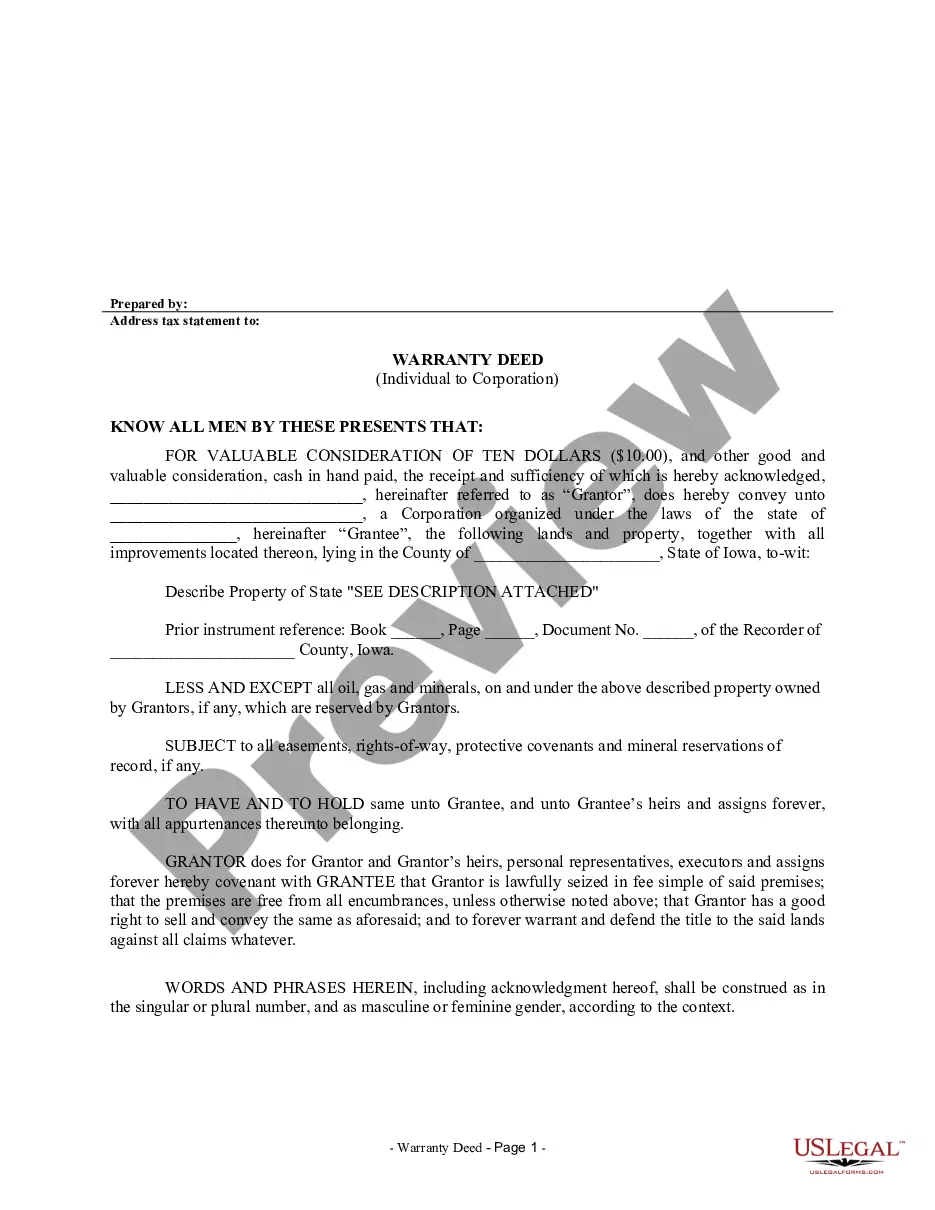
The Warranty Deed from Individual to Corporation is a legal document used to transfer property ownership from an individual (the grantor) to a corporation (the grantee). This type of warranty deed protects the grantee by ensuring that the grantor guarantees clear title to the property, meaning that it is free from claims or encumbrances, except as specified in the deed. This form is distinct from other property transfer documents because it involves a transaction between a private individual and a corporate entity, ensuring clarity in the transfer of ownership rights.
Key components of this form
- Preparation section indicating who drafted the deed.
- Identification of the grantor (individual) and the grantee (corporation).
- Description of the property being transferred.
- Legal assurances regarding the title and any exceptions (such as oil, gas, and mineral rights).
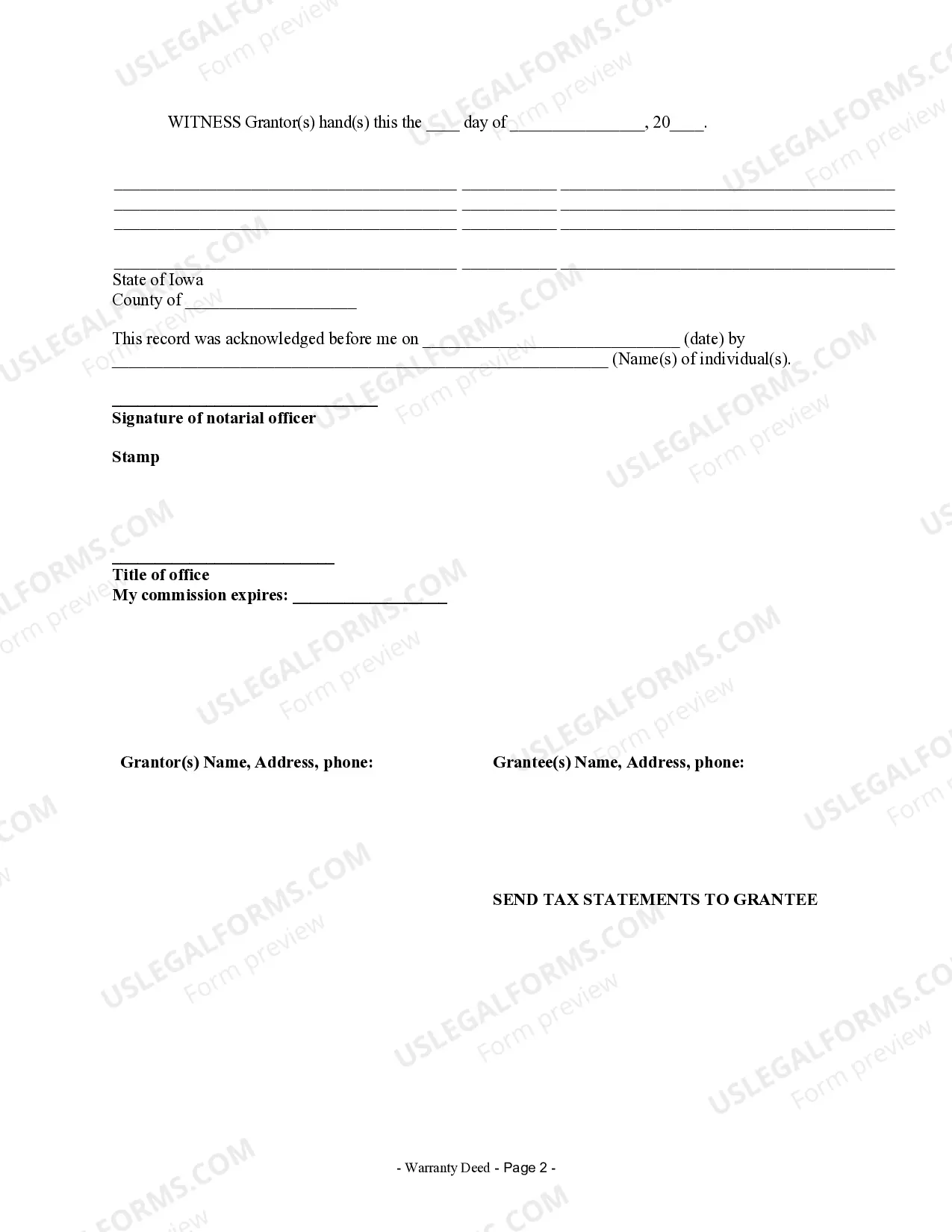
- Signatures of the grantor and a notary public for validation.

When this form is needed
This form should be used when an individual wishes to transfer ownership of real property to a corporation. It is commonly utilized in scenarios where a business is acquiring property for operational purposes or investment. Additionally, it is applicable in situations where the grantor wants to ensure the security of the transfer by providing warranties relating to the title of the property.
Who can use this document
- Individuals who own real estate and wish to sell or transfer it to a corporation.
- Corporate entities looking to acquire property from an individual.
- Legal professionals who are assisting clients with property transaction processes.
- Real estate investors interested in directly acquiring property under a corporate structure.
Steps to complete this form
- Identify the parties involved by entering the names and addresses of the grantor and the grantee.
- Provide a detailed description of the property being transferred, including any legal description needed.
- Indicate any exceptions, such as reserved rights to oil, gas, and minerals.
- Specify the date of the transaction and the signature of the grantor.
- Have the document notarized to validate the signatures and formalize the transaction.
Is notarization required?
Notarization is required for this form to take effect. Our online notarization service, powered by Notarize, lets you verify and sign documents remotely through an encrypted video session, available 24/7.
Get your form ready online
Our built-in tools help you complete, sign, share, and store your documents in one place.
Make edits, fill in missing information, and update formatting in US Legal Forms—just like you would in MS Word.
Download a copy, print it, send it by email, or mail it via USPS—whatever works best for your next step.
Sign and collect signatures with our SignNow integration. Send to multiple recipients, set reminders, and more. Go Premium to unlock E-Sign.
If this form requires notarization, complete it online through a secure video call—no need to meet a notary in person or wait for an appointment.
We protect your documents and personal data by following strict security and privacy standards.

Make edits, fill in missing information, and update formatting in US Legal Forms—just like you would in MS Word.

Download a copy, print it, send it by email, or mail it via USPS—whatever works best for your next step.

Sign and collect signatures with our SignNow integration. Send to multiple recipients, set reminders, and more. Go Premium to unlock E-Sign.

If this form requires notarization, complete it online through a secure video call—no need to meet a notary in person or wait for an appointment.

We protect your documents and personal data by following strict security and privacy standards.
Mistakes to watch out for
- Failing to accurately describe the property being transferred.
- Not including necessary exceptions, like mineral rights that are being reserved.
- Overlooking the need for notarization, which may invalidate the deed.
- Using incorrect names or designations for the parties involved in the transaction.
Benefits of using this form online
- Convenience of accessing and downloading the form from anywhere at any time.
- Editability allowing users to fill out the form according to their specific needs.
- Assurance that the form is drafted by licensed attorneys to meet legal standards.
- Streamlined process with clear instructions to guide users through completion.
Quick recap
- The Warranty Deed from Individual to Corporation is essential for legally transferring property to a corporate entity.
- Complete the form accurately to ensure a clear ownership transfer and avoid legal complications.
- Notarization is a mandatory step in validating the document.
- Understand the specific requirements in your state to ensure compliance with local laws.
Looking for another form?
Form popularity
FAQ
One potential disadvantage of putting property in an LLC is the initial setup and ongoing maintenance costs. While protecting your assets is a significant benefit, you may face fees for forming the LLC and yearly state compliance costs. Additionally, transferring property might complicate your estate planning, so it's essential to consider these factors.
To transfer a deed from an individual to an LLC, you will need to complete an Iowa Warranty Deed from Individual to Corporation. Begin by accurately completing the form with both parties' information and property details. Next, sign the deed in front of a notary public and file it with your local county clerk’s office to finalize the ownership change.
Many people choose to put their property in an LLC to limit personal liability and protect their assets. By creating an LLC, individuals can separate their personal holdings from their business interests, reducing exposure to lawsuits. This structure also often provides favorable tax benefits, making it a popular choice for property ownership.
Transferring property from personal ownership to an LLC requires you to complete an Iowa Warranty Deed from Individual to Corporation. First, draft the deed indicating the transfer from your name to the LLC. After signing, file this deed with the county recorder to officially document the change in ownership.
To fill out an Iowa Warranty Deed from Individual to Corporation, start by gathering the property details and both the grantor's and grantee's information. Ensure you accurately input the legal description of the property, which may require a current title or survey. Finally, sign the form in the presence of a notary public, ensuring it meets all state requirements.
Yes, a warranty deed can be transferred. If you hold a warranty deed, you can convey your interest in the property to another party, provided all legal requirements are met. For those involved in an Iowa Warranty Deed from Individual to Corporation, understanding how to properly transfer ownership can save time and prevent future complications.
When a corporation transfers ownership of property, the deed must be signed by an authorized individual, usually an officer of the corporation. This ensures that the transfer is legally binding and recognized under Iowa law. It's important to follow proper procedures when executing an Iowa Warranty Deed from Individual to Corporation to avoid potential legal issues.
While a warranty deed offers strong protection against title issues, it may expose the seller to liability if any claims arise regarding the property title. If the buyer discovers defects in the title, the seller may have to address those claims even after the sale. When creating an Iowa Warranty Deed from Individual to Corporation, consider consulting a professional to understand all implications involved.
To create a warranty deed in Iowa, you will typically need the legal description of the property, the names of both the grantor and grantee, and notarization of the document. It's important to ensure that the deed complies with Iowa state laws for it to be valid. Utilizing a service like USLegalForms can help streamline the process when drafting an Iowa Warranty Deed from Individual to Corporation.
In Iowa, you file a warranty deed with the county recorder's office where the property is located. This ensures that the change in ownership is properly documented and made public. Filing an Iowa Warranty Deed from Individual to Corporation at the local county office protects both parties and maintains a clear property history.