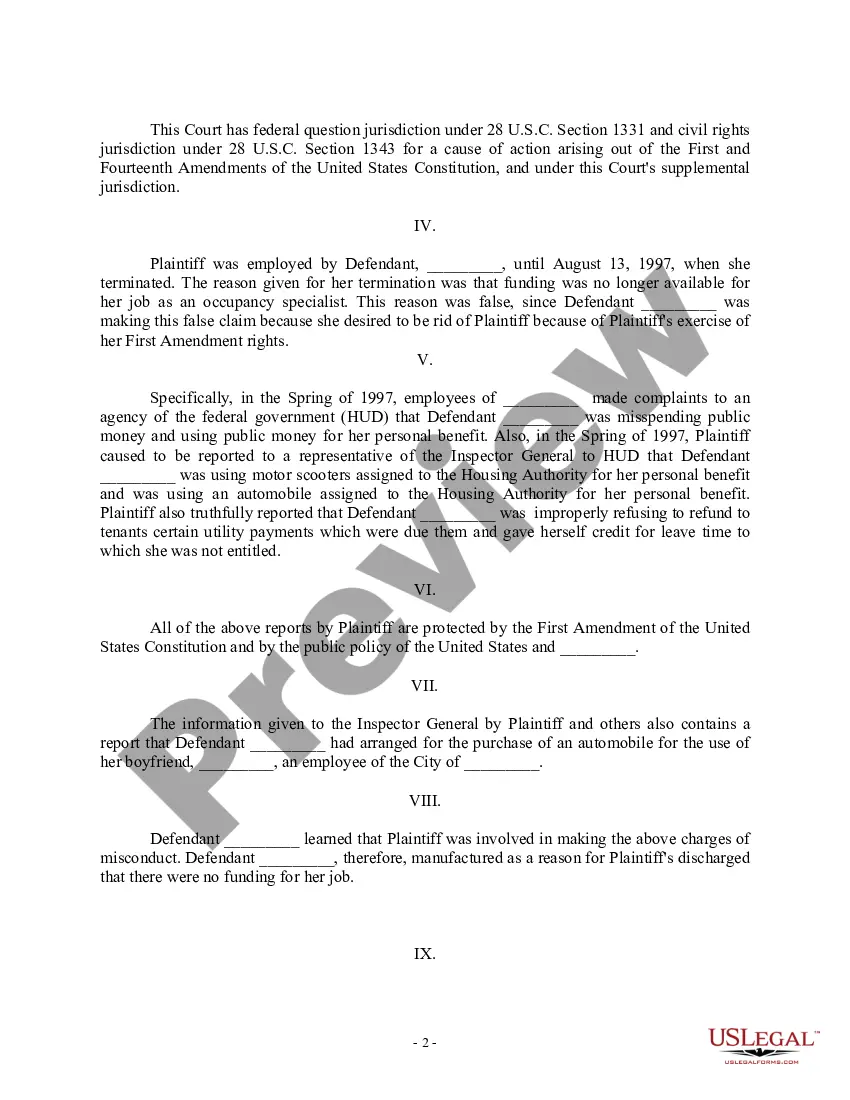
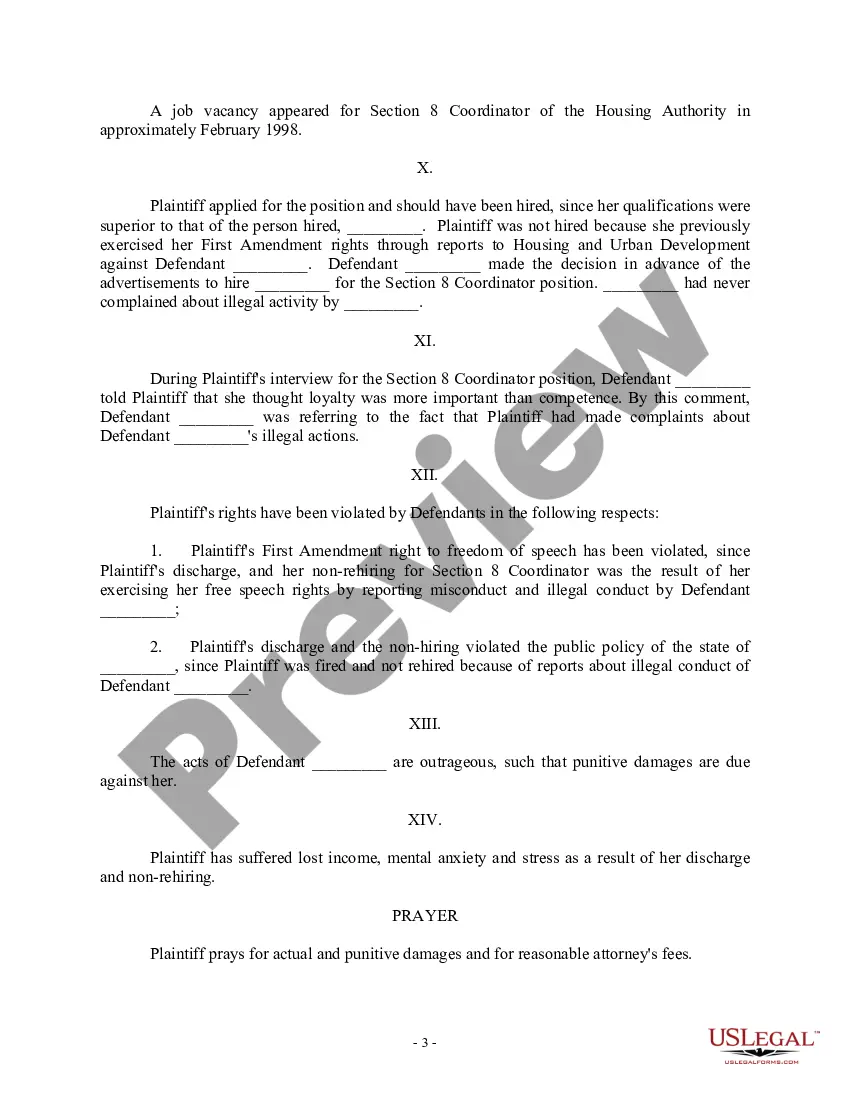
This form is a Complaint. This action is to recover damages for a violation of the First Amendment of the United States Constitution. The plaintiff is seeking punitive damages and reasonable attorney's fees.
Wyoming Complaint for Violation of Civil Rights and for Wrongful Discharge and Failure To Rehire - 1st, 14th Amendments, US Constitution - Jury Trial Demand
Category:
State:
Multi-State
Control #:
US-000285
Format:
Word;
Rich Text
Instant download
Description
Free preview







How to fill out Complaint For Violation Of Civil Rights And For Wrongful Discharge And Failure To Rehire - 1st, 14th Amendments, US Constitution - Jury Trial Demand?
Finding the correct authentic document template can be a challenge. Obviously, there are numerous templates available online, but how do you get the genuine form you need? Utilize the US Legal Forms website.
The platform offers a plethora of templates, such as the Wyoming Complaint for Violation of Civil Rights and for Wrongful Discharge and Failure To Rehire - 1st, 14th Amendments, US Constitution - Jury Trial Demand, which you can employ for both business and personal purposes. All of the forms are reviewed by professionals and comply with federal and state regulations.
If you are currently registered, Log In to your account and click on the Acquire button to obtain the Wyoming Complaint for Violation of Civil Rights and for Wrongful Discharge and Failure To Rehire - 1st, 14th Amendments, US Constitution - Jury Trial Demand. Use your account to browse through the legal forms you have previously obtained. Navigate to the My documents tab in your account and download another copy of the document you need.
Select the file format and download the legal document template to your device. Complete, modify, print, and sign the acquired Wyoming Complaint for Violation of Civil Rights and for Wrongful Discharge and Failure To Rehire - 1st, 14th Amendments, US Constitution - Jury Trial Demand. US Legal Forms is the largest repository of legal forms where you can find a variety of document templates. Utilize the service to download properly crafted paperwork that adhere to state requirements.
- First, ensure you have selected the correct form for your city/state.
- You can review the form using the Review button and examine the form details to confirm it is suitable for you.
- If the form does not meet your requirements, use the Search field to locate the right form.
- Once you are confident that the form is appropriate, click the Buy now button to obtain the form.
- Choose the pricing plan you prefer and enter the required information.
- Create your account and complete the purchase using your PayPal account or credit card.
Form popularity
FAQ
The amount you can sue for a violation of civil rights varies based on the specifics of your case, including damages suffered and the severity of the violation. Generally, you may seek compensatory damages for lost wages, emotional distress, and other related losses. Filing a Wyoming Complaint for Violation of Civil Rights and for Wrongful Discharge and Failure To Rehire - 1st, 14th Amendments, US Constitution - Jury Trial Demand can help you pursue the compensation you deserve. It is advisable to consult with a legal expert to better understand potential damages and outcomes.
A civil rights violation occurs when an individual's rights, protected by the Constitution, are infringed upon by government actions or policies. This includes violations related to the 1st and 14th Amendments, such as discrimination or wrongful discharge. If you believe your rights have been violated, you may consider filing a Wyoming Complaint for Violation of Civil Rights and for Wrongful Discharge and Failure To Rehire - 1st, 14th Amendments, US Constitution - Jury Trial Demand. Understanding these violations can help you seek justice and ensure your rights are upheld.
The 14th Amendment provides, in part, that no state can "deny to any person within its jurisdiction the equal protection of the laws." Title IX specifically prohibits sex discrimination.
14th Amendment - Citizenship Rights, Equal Protection, Apportionment, Civil War Debt.
In many ways the centerpiece of Constitutional law in the modern day, the 14th Amendment includes provisions barring states from depriving people of their natural rights without due process of law, or denying them equal protection of the laws.
It strengthened the federal government's power over the States, particularly regarding State treatment of citizens. It provided the legal framework for the civil rights movement relating to racial discrimination. That movement in turn gave momentum to other movements involving gender, age and physical handicaps.
Passed by the Senate on June 8, 1866, and ratified two years later, on July 9, 1868, the Fourteenth Amendment granted citizenship to all persons "born or naturalized in the United States," including formerly enslaved people, and provided all citizens with ?equal protection under the laws,? extending the provisions of ...