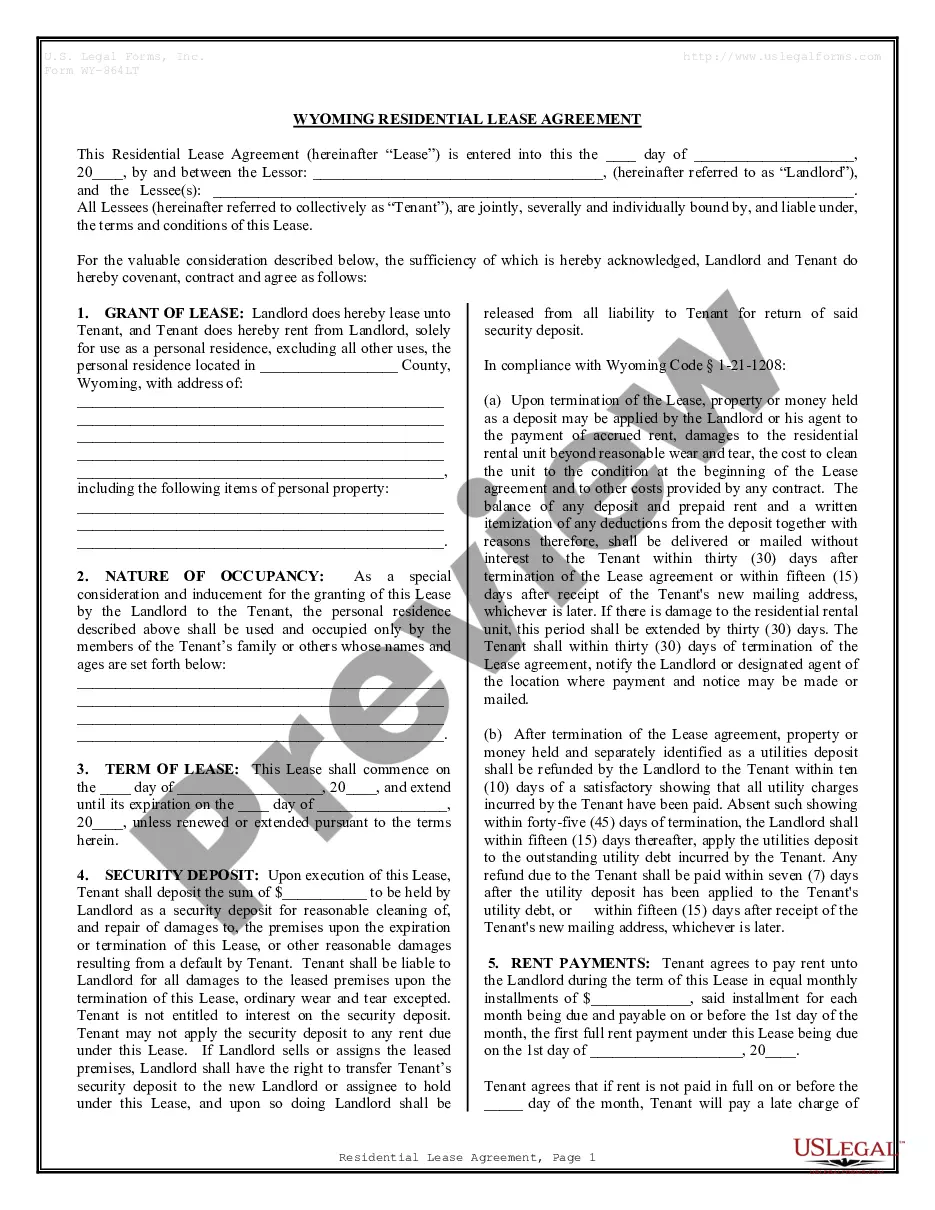
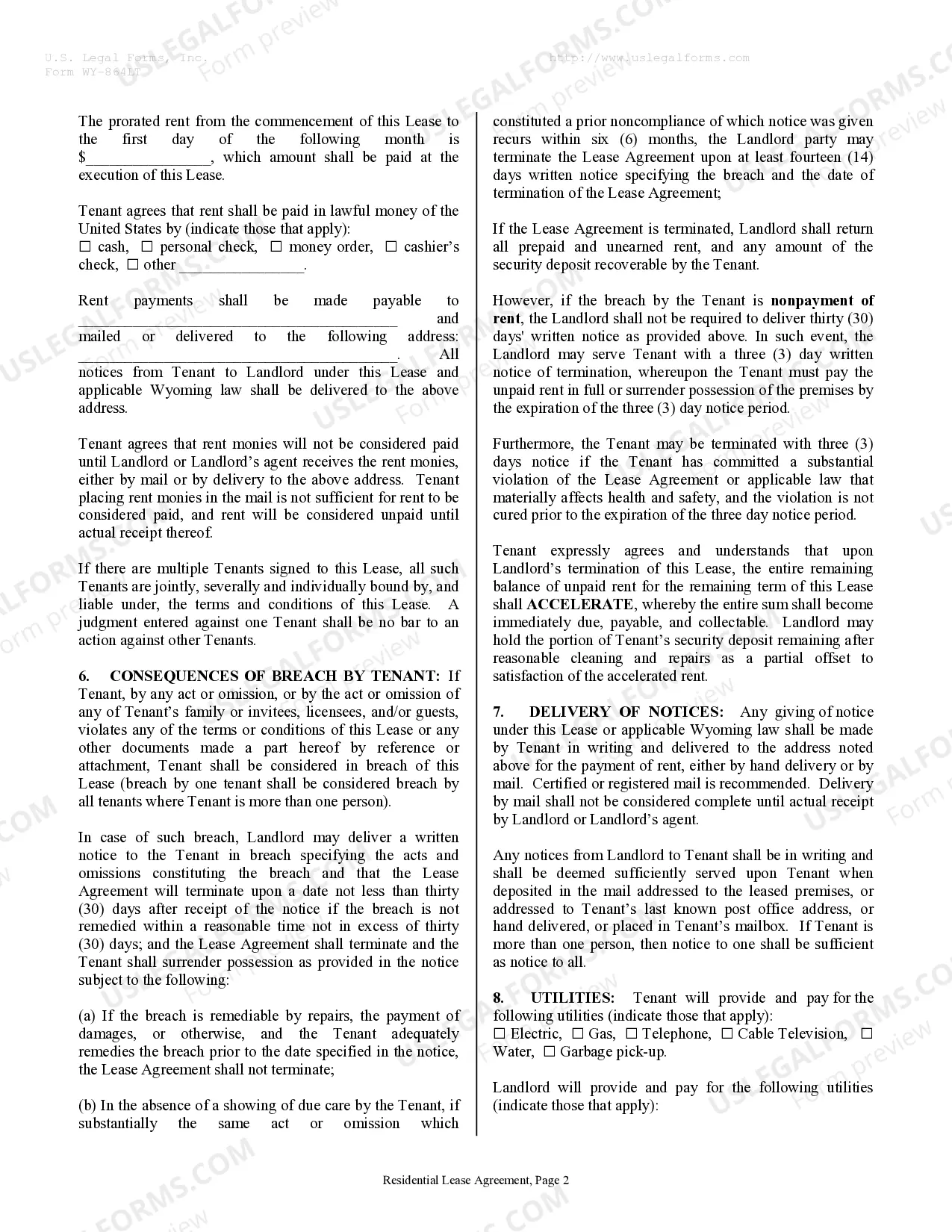
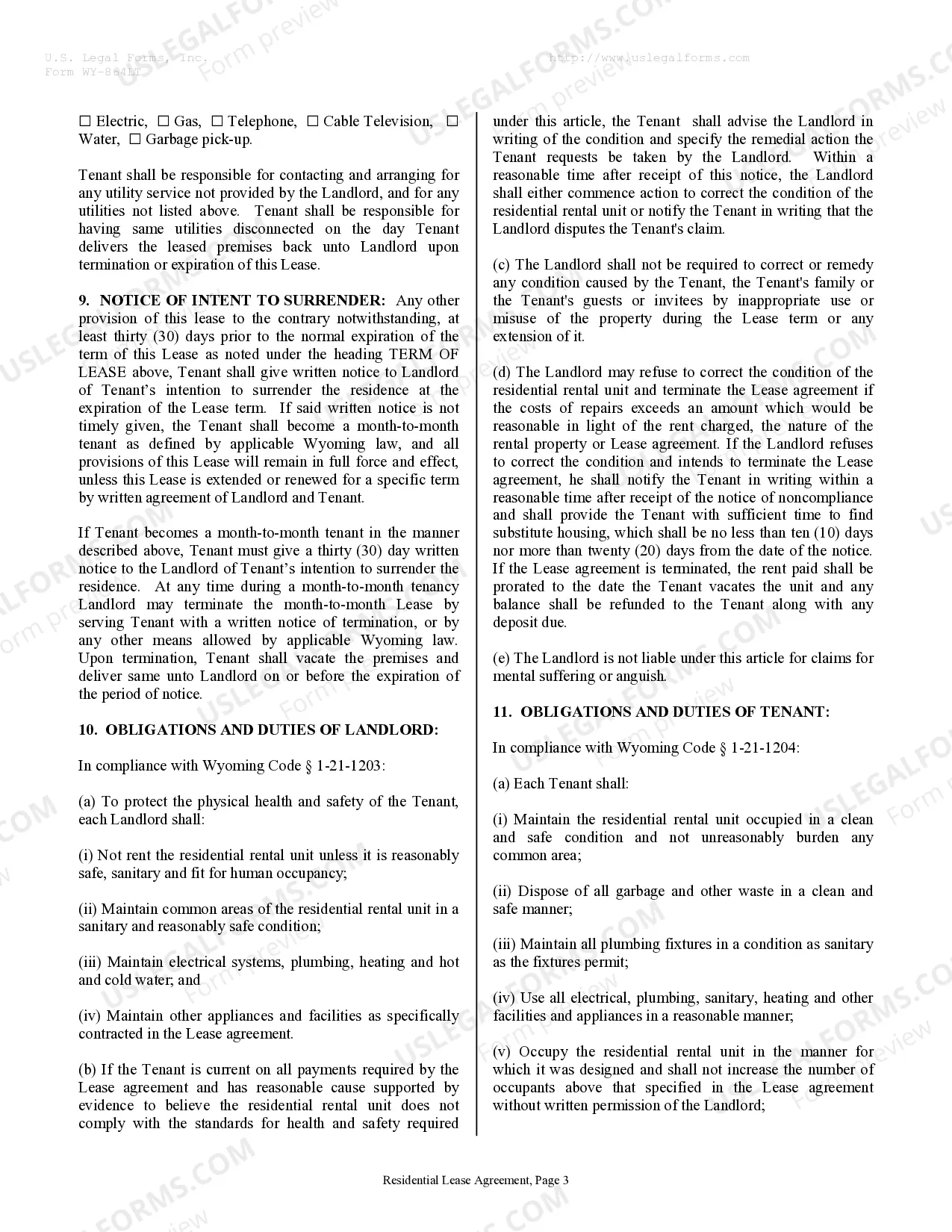
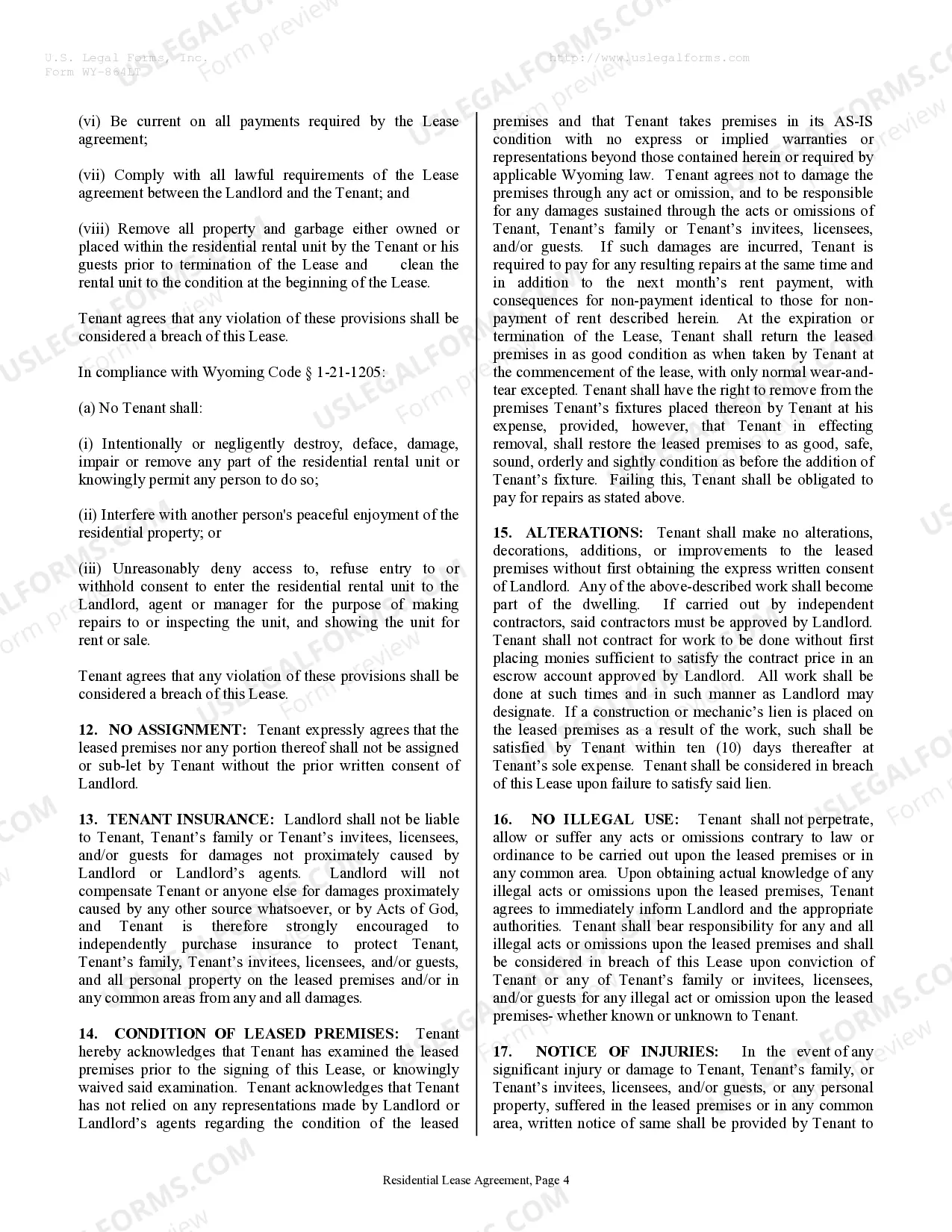
Residential Rental Lease Agreement
Wyoming
ARTICLE 12
RESIDENTIAL RENTAL PROPERTY
Definitions: 1-21-1201
(a) As used in this article:
(i) "Owner" means the owner, lessor or sublessor of a residential
rental unit and for purposes of notice and other communication required
or allowed under this article, "owner" includes a managing agent, leasing
agent or resident manager unless the agent or manager specifies otherwise
in writing in the rental agreement;
(ii) "Rental agreement" means any agreement, written or oral,
which establishes or modifies the terms, conditions, rules or any other
provisions regarding the use and occupancy of a residential rental unit;
(iii) "Renter" means any renter, lessee, tenant or other
person entitled under a rental agreement to occupy a residential rental
unit to the exclusion of others;
(iv) "Residential rental unit" means a renter's principal
place of residence and includes the appurtenances, grounds, common areas
and facilities held out for the occupancy of the residential renter generally
and any other area or facility provided to the renter in the rental agreement,
excluding a mobile home lot or recreational property rented on an occasional
basis;
(v) "Termination" means the lawful ending or cessation of
a rental agreement for any reason including expiration of the rental period,
voluntary termination by mutual agreement of the parties, termination in
accordance with W.S. 1-21-1203(d), abandonment of the leased premises by
the renter prior to expiration of the rental period or termination resulting
from court order.
Duties of owners and renters; generally: 1-21-1202
(a) Each owner and his agent renting or leasing a residential
rental unit shall maintain that unit in a safe and sanitary condition fit
for human habitation. Each residential rental unit shall have operational
electrical, heating and plumbing, with hot and cold running water unless
otherwise agreed upon in writing by both parties. Provided, however, this
section shall not prevent the rental of seasonal rental units such as summer
cabins which are not intended to have such amenities.
(b) Each renter shall cooperate in maintaining his residential
rental unit in accordance with this article.
(c) This article does not apply to breakage, malfunctions
or other conditions which do not materially affect the physical health
or safety of the ordinary renter.
(d) Any duty or obligation in this article may be assigned
to a different party or modified by explicit written agreement signed by
the parties.
Owner's duties; notice by renter of noncompliance; duty to correct;
exceptions; termination of rental agreement; liability limited: 1-21-1203
(a) To protect the physical health and safety of the renter,
each owner shall:
(i) Not rent the residential rental unit unless it is reasonably
safe, sanitary and fit for human occupancy;
(ii) Maintain common areas of the residential rental unit
in a sanitary and reasonably safe condition;
(iii) Maintain electrical systems, plumbing, heating and
hot and cold water; and
(b) If the renter is current on all payments required by
the rental agreement and has reasonable cause supported by evidence to
believe the residential rental unit does not comply with the standards
for health and safety required under this article, the renter shall advise
the owner in writing of the condition and specify the remedial action the
renter requests be taken by the owner. Within a reasonable time after
receipt of this notice, the owner shall either commence action to correct
the condition of the residential rental unit or notify the renter in writing
that the owner disputes the renter's claim. The notices required
by this subsection shall be served by certified mail or in the manner specified
by W.S. 1-21-1003.
(c) The owner shall not be required to correct or remedy
any condition caused by the renter, the renter's family or the renter's
guests or invitees by inappropriate use or misuse of the property during
the rental term or any extension of it.
(d) The owner may refuse to correct the condition of the
residential rental unit and terminate the rental agreement if the costs
of repairs exceeds an amount which would be reasonable in light of the
rent charged, the nature of the rental property or rental agreement. If
the owner refuses to correct the condition and intends to terminate the
rental agreement, he shall notify the renter in writing within a reasonable
time after receipt of the notice of noncompliance and shall provide the
renter with sufficient time to find substitute housing, which shall be
no less than ten (10) days nor more than twenty (20) days from the date
of the notice. If the rental agreement is terminated, the rent paid
shall be prorated to the date the renter vacates the unit and any balance shall be refunded to the
renter along with any deposit due in accordance with W.S. 1-21-1208.
(e) The owner is not liable under this article for claims
for mental suffering or anguish.
Renter's duties: 1-21-1204
(a) Each renter shall:
(i) Maintain the residential rental unit occupied in a clean
and safe condition and not unreasonably burden any common area;
(iv) Use all electrical, plumbing, sanitary, heating and
other facilities and appliances in a reasonable manner;
(v) Occupy the residential rental unit in the manner for
which it was designed and shall not increase the number of occupants above
that specified in the rental agreement without written permission of the
owner;
(vii) Comply with all lawful requirements of the rental agreement
between the owner and the renter; and
(viii) Remove all property and garbage either owned or placed
within the residential rental unit by the renter or his guests prior to
termination of the rental agreement and clean the rental unit to the condition
at the beginning of the rental agreement.
Prohibited acts by renter: 1-21-1205
(a) No renter shall:
(i) Intentionally or negligently destroy, deface, damage,
impair or remove any part of the residential rental unit or knowingly permit
any person to do so;
(iii) Unreasonably deny access to, refuse entry to or withhold
consent to enter the residential rental unit to the owner, agent or manager
for the purpose of making repairs to or inspecting the unit, and showing
the unit for rent or sale.
Renter's remedies; notice to owner or agent; judicial remedy;
rights under termination of rental agreement:
1-21-1206
(a) The remedies set forth in this section are available
to a renter in compliance with all provisions of W.S. 1-21-1204 and 1-21-1205
when the rental agreement has not been lawfully terminated pursuant to
W.S. 1-21-1203(d).
(b) If a reasonable time has elapsed after the renter has
served written notice on the owner under W.S. 1-21-1203 and the owner has
failed to respond or to correct the condition described in the notice,
the renter may cause a "notice to repair or correct condition" to be prepared
and served on the owner by certified mail or in the manner specified by
W.S. 1-21-1003. This notice shall:
(ii) State the number of days that have elapsed since the
notice was served and that under the circumstances the period of time constitutes
the reasonable time allowed under W.S. 1-21-1203(b);
(v) State that if the owner fails to commence reasonable
corrective action within three (3) days he will seek redress in the courts.
(c) If the owner has not corrected or used due diligence
to correct the conditions following notice under this section, or if the
owner has notified the renter that the claim is disputed, the renter may
commence a civil action in county or justice of the peace court. The court
shall endorse on the summons the number of days within which the owner
is required to appear and defend the action, which shall not be less than
three (3) nor more than twenty (20) days from the date of service. Upon
a showing of an unreasonable refusal to correct or the failure to use due
diligence to correct a condition described in this article, the renter
may be awarded costs, damages and affirmative relief as determined by the
court. Damages awarded to the renter may include rent improperly retained
or collected. Affirmative relief may include a declaration terminating
the rental agreement, or an order directing the owner to make reasonable
repairs.
(d) If the court terminates the rental agreement pursuant
to subsection (c) of this section, the renter is entitled to receive
a refund of the balance of the rent and the deposit on the rental unit
within thirty (30) days of the date the agreement is ordered terminated.
The renter shall be required to vacate the rental unit no sooner than ten
(10) days nor later than twenty (20) days after termination of the rental
agreement by a court.
Required notice of nonrefundable deposit: 1-21-1207
Any rental agreement shall state whether any portion of a deposit
is nonrefundable and written notice of this fact shall also be provided
to the renter at the time the deposit is taken by the owner or his designated
agent.
Deductions from deposit; written itemization; time limits; failure
to give notice; recovery by renter; utilities deposit; penalty: 1-21-1208
(a) Upon termination of the rental agreement, property or
money held as a deposit may be applied by the owner or his agent to the
payment of accrued rent, damages to the residential rental unit beyond
reasonable wear and tear, the cost to clean the unit to the condition at
the beginning of the rental agreement and to other costs provided by any
contract. The balance of any deposit and prepaid rent and a written itemization
of any deductions from the deposit together with reasons therefor, shall
be delivered or mailed without interest to the renter within thirty (30)
days after termination of the rental agreement or within fifteen (15) days
after receipt of the renter's new mailing address, whichever is later.
If there is damage to the residential rental unit, this period shall be
extended by thirty (30) days. The renter shall within thirty (30) days
of termination of the rental agreement, notify the owner or designated
agent of the location where payment and notice may be made or mailed.
(b) After termination of the rental agreement, property or
money held and separately identified as a utilities deposit shall be refunded
by the owner to the renter within ten (10) days of a satisfactory showing
that all utility charges incurred by the renter have been paid. Absent
such showing within forty-five (45) days of termination, the owner shall
within fifteen (15) days thereafter, apply the utilities deposit to the
outstanding utility debt incurred by the renter. Any refund due to the
renter shall be paid within seven (7) days after the utility deposit has
been applied to the renter's utility debt, or within fifteen (15) days
after receipt of the renter's new mailing address, whichever is later.
(c) If the owner of a residential rental unit or his agent
unreasonably fails to comply with subsection (a) or (b) of this section,
the renter may recover the full deposit and court costs. In an action by
a renter pursuant to this section, if the owner is the prevailing party
and the court finds the renter acted unreasonably in bringing the action,
the owner may be awarded court costs in addition to any other relief available.
Holder of owner's interest bound by provisions: 1-21-1209
The holder of the interest of the owner or designated agent in
the residential rental unit at the time of termination of the rental agreement
shall be bound by the provisions of W.S. 1-21-1207 and 1-21-1208.
Possession of premises and disposition of personal property abandoned
by renter after termination of rental agreement: 1-21-1210
(a) Upon regaining lawful possession of the rental unit following
termination of the rental agreement, the owner may immediately dispose
of any trash or property the owner reasonably believes to be hazardous,
perishable or valueless and abandoned. Any property remaining within the
rental unit after termination of the rental agreement shall be presumed
to be both valueless and abandoned. Any valuable property may be removed
from the residential rental unit and shall thereafter be disposed of as
follows:
(i) The owner shall provide written notice to the renter
in accordance with this paragraph, describing the property claimed to be
abandoned and stating that the property shall be disposed of after seven
(7) days from the date of service of the notice if the renter or his agent
does not, within the seven (7) day period, take possession of the property
or notify the owner in writing of the renter's intent to take possession
of the property. The notice provided by the owner under this paragraph
shall be deemed served:
(ii) If the owner does not receive a written response from
the renter within seven (7) days after service of notice under paragraph
(i) of this subsection, the property shall be conclusively deemed abandoned
and the owner may retain or dispose of the property;
(iii) If the renter responds in writing to the owner on or
before seven (7) days after service of notice under paragraph (i) of this
subsection that he intends to take possession of the property, the property
shall be held for an additional period of seven (7) days after the written
response is received. If the renter fails to take possession of the property
within the additional fifteen (15) day period, the property shall be conclusively
deemed abandoned and the owner may retain or dispose of the property.
(b) The owner is entitled to payment of storage costs for
the period the property remains in safekeeping plus the cost of removal
of the property to the place of storage. An owner shall be allowed reasonable
storage costs if he stores the property himself or actual storage costs
if the property is stored commercially. Payment of storage costs
shall be made before the renter removes the property.
(c) The owner is not responsible for any loss to the renter
resulting from storage.
Owner's remedies; eviction; judicial remedies; damages:
1-21-1211
(a) If the renter does not vacate the premises as required
by a court order issued pursuant to W.S. 1-21-1001 et seq., the sheriff
may remove the renter's possessions and prevent the renter from reentering
the premises without further action by the court.
(b) If the renter damages the rental property, the owner
may apply any property or money held as a deposit to the payment of damages
as provided in W.S. 1-21-1208(a) and the renter shall remain liable for
any damages beyond the damages paid by the deposit, plus interest at ten
percent (10%) per annum on any unpaid amounts. The owner may take any legal
action available to recover damages caused to the unit by the renter.