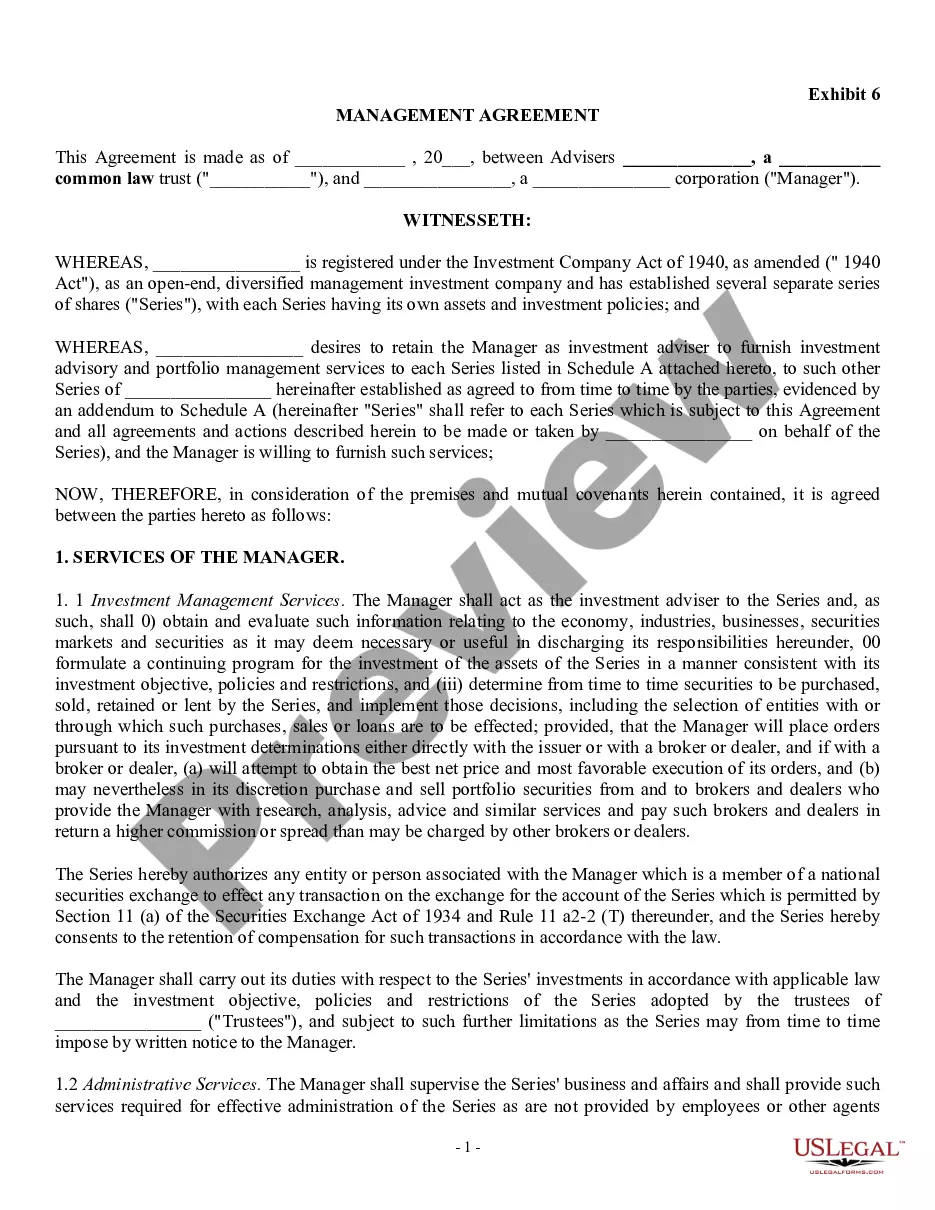
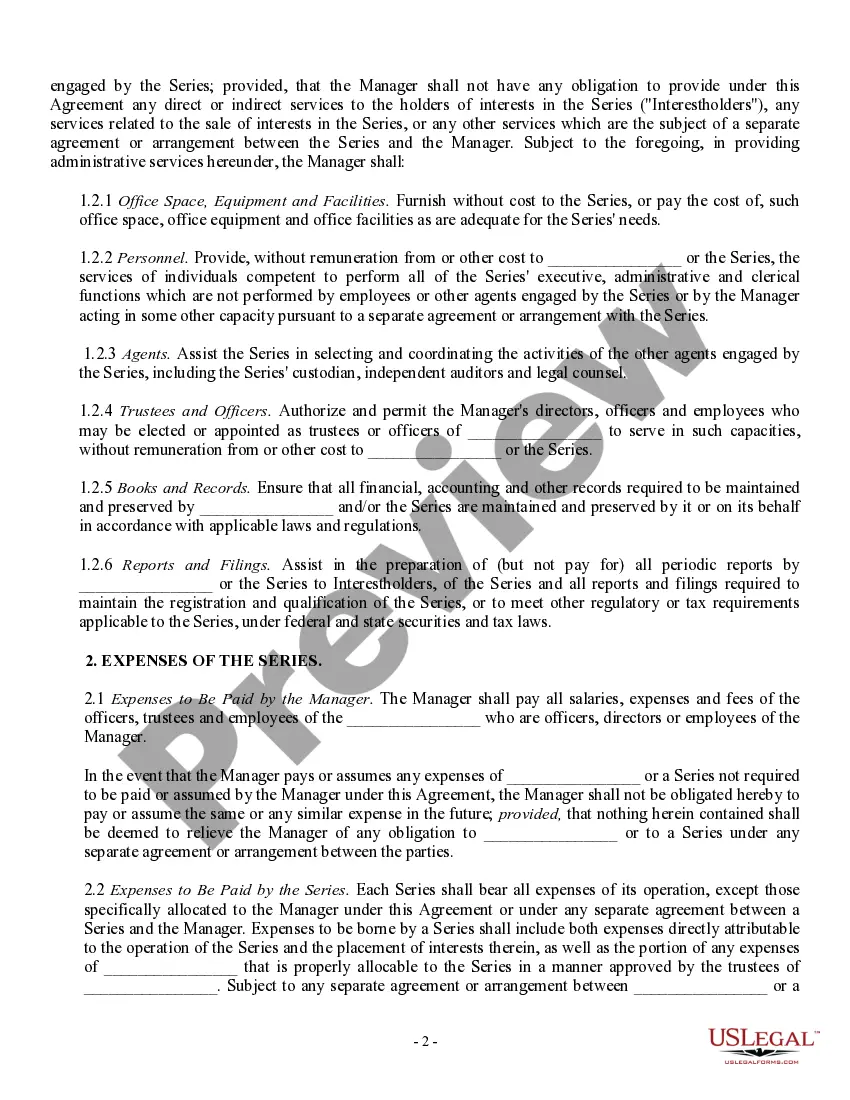
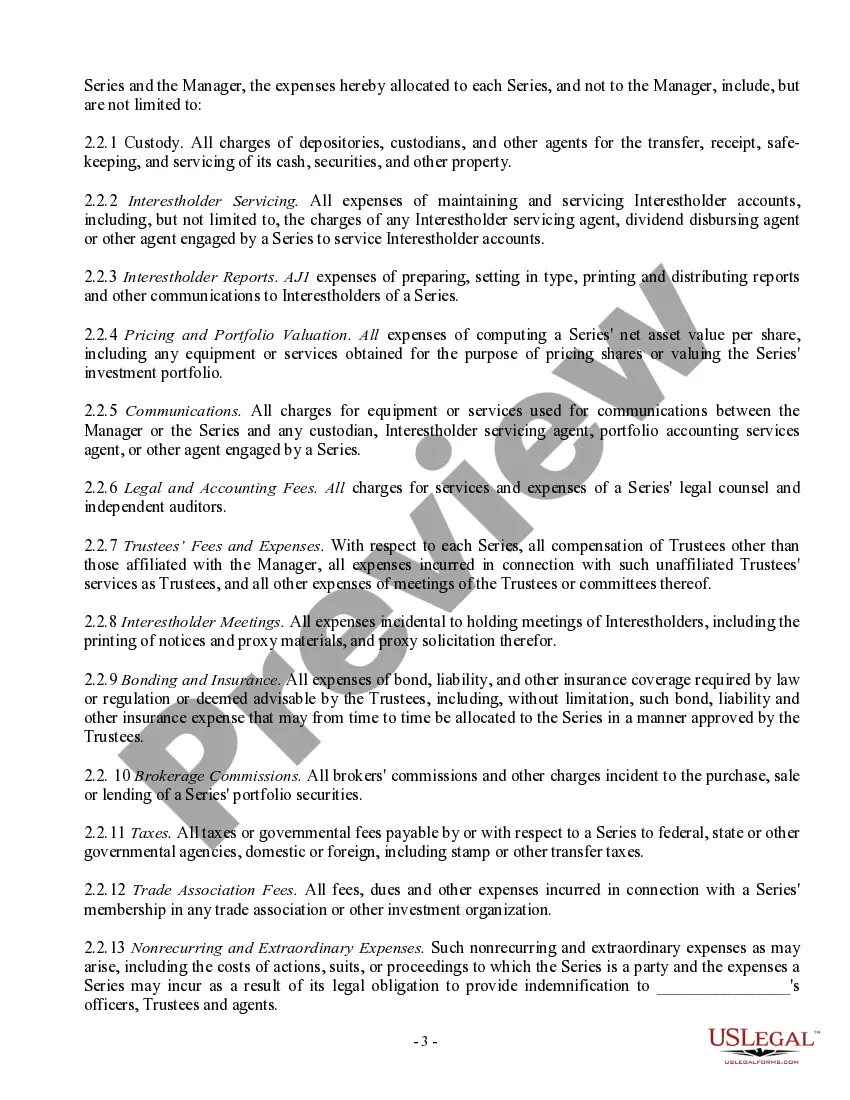
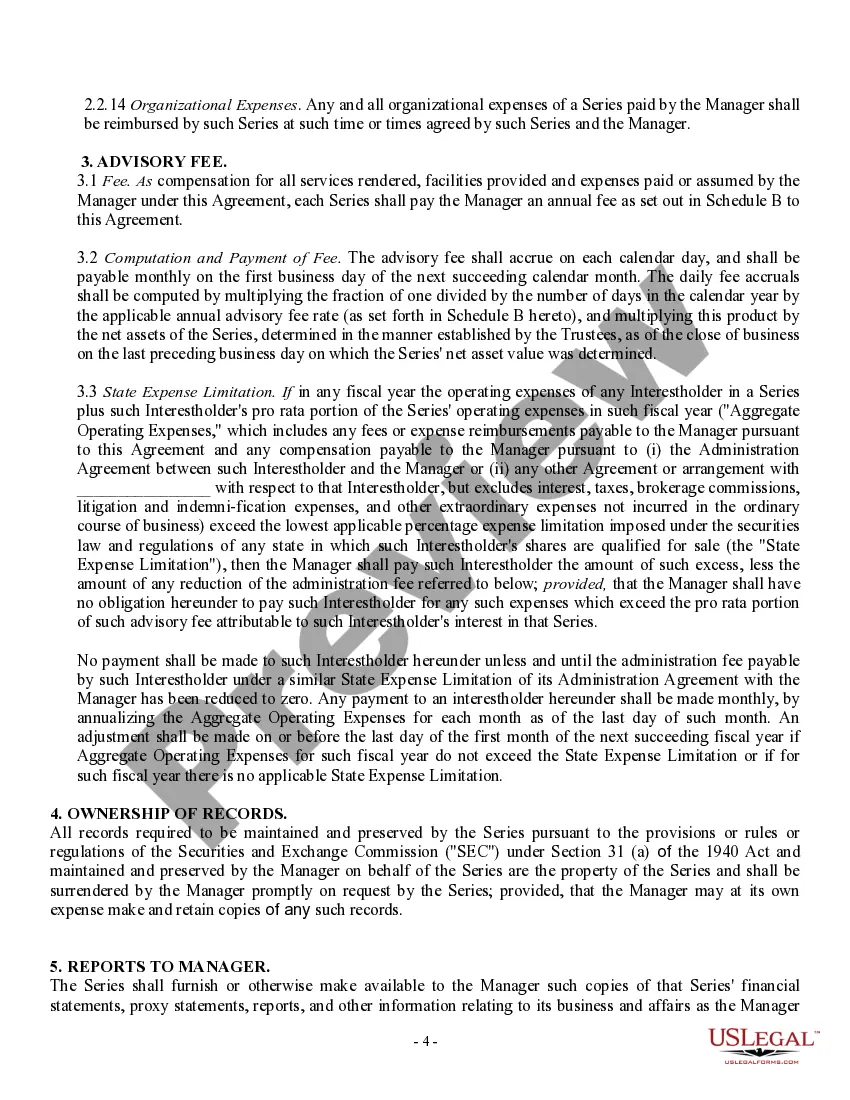
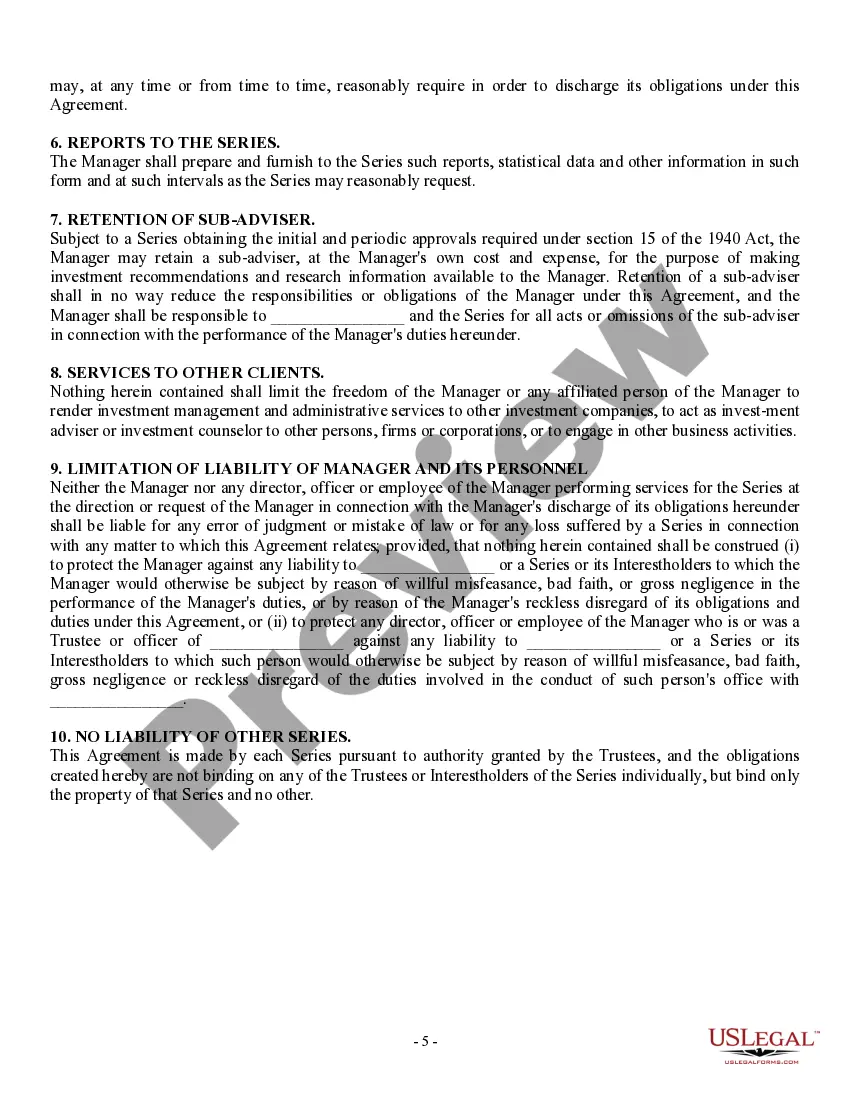
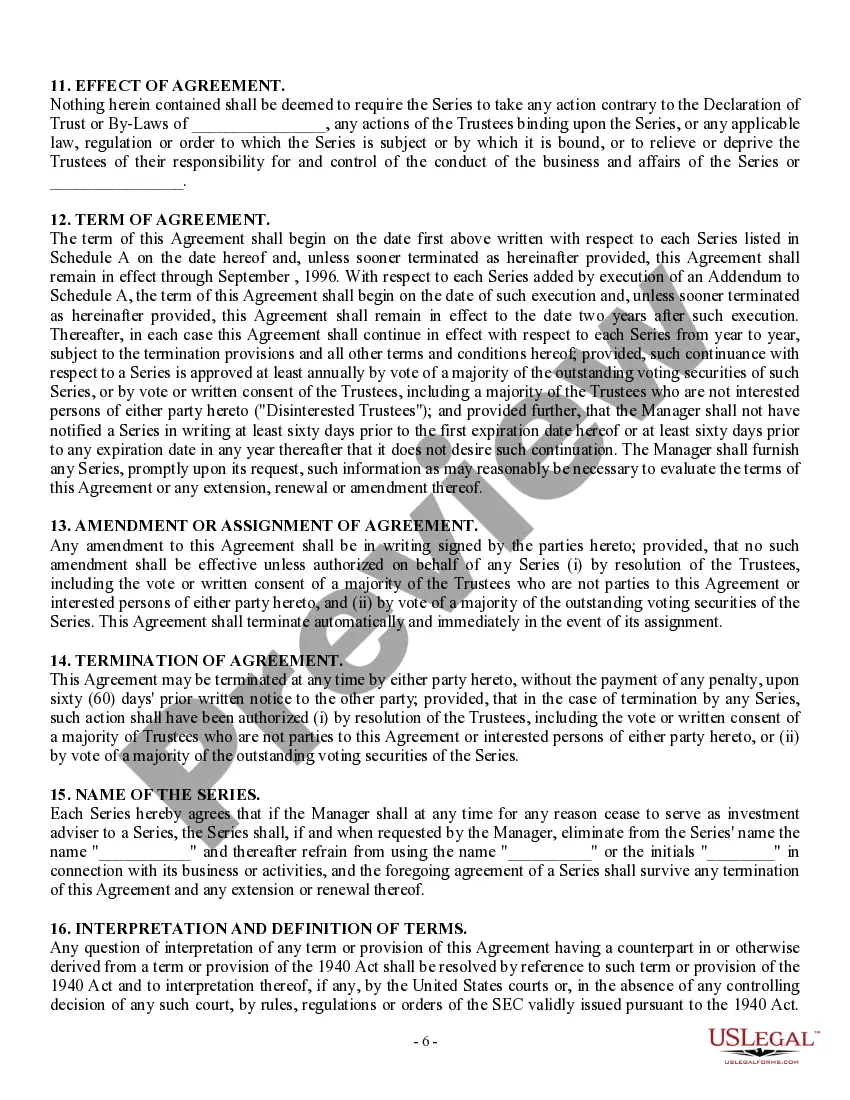
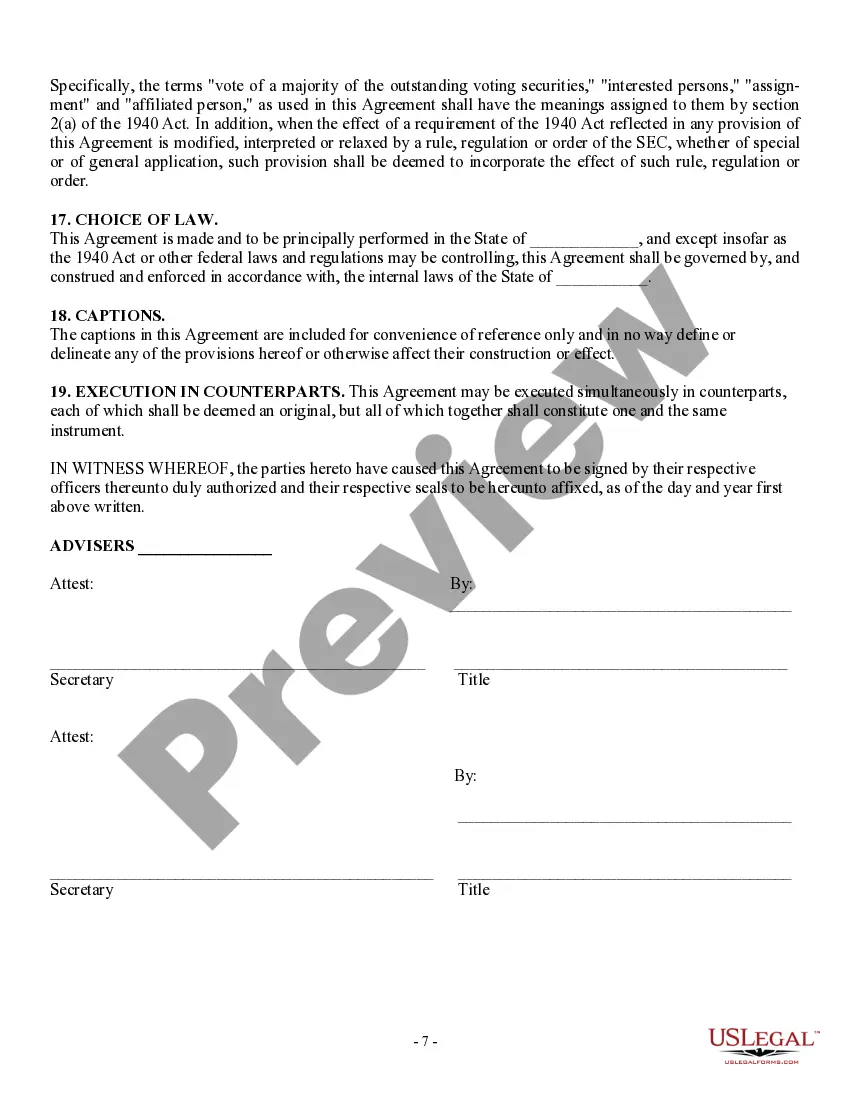
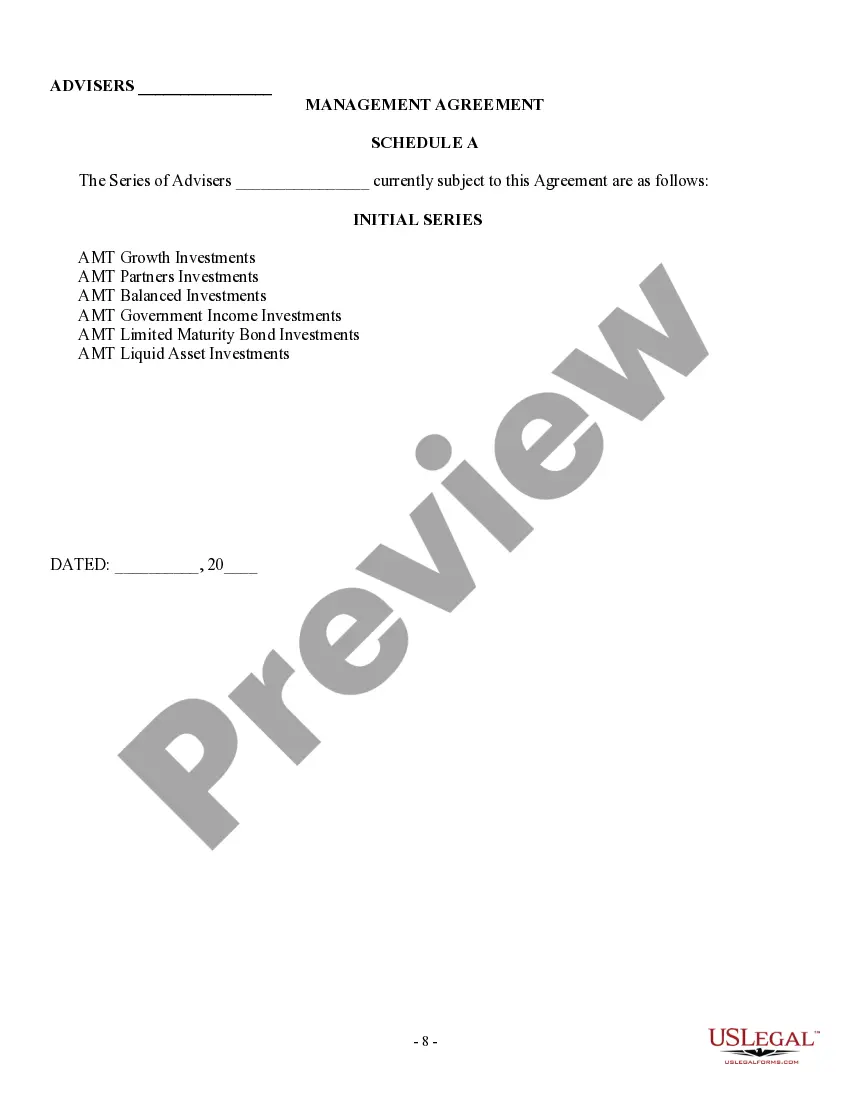
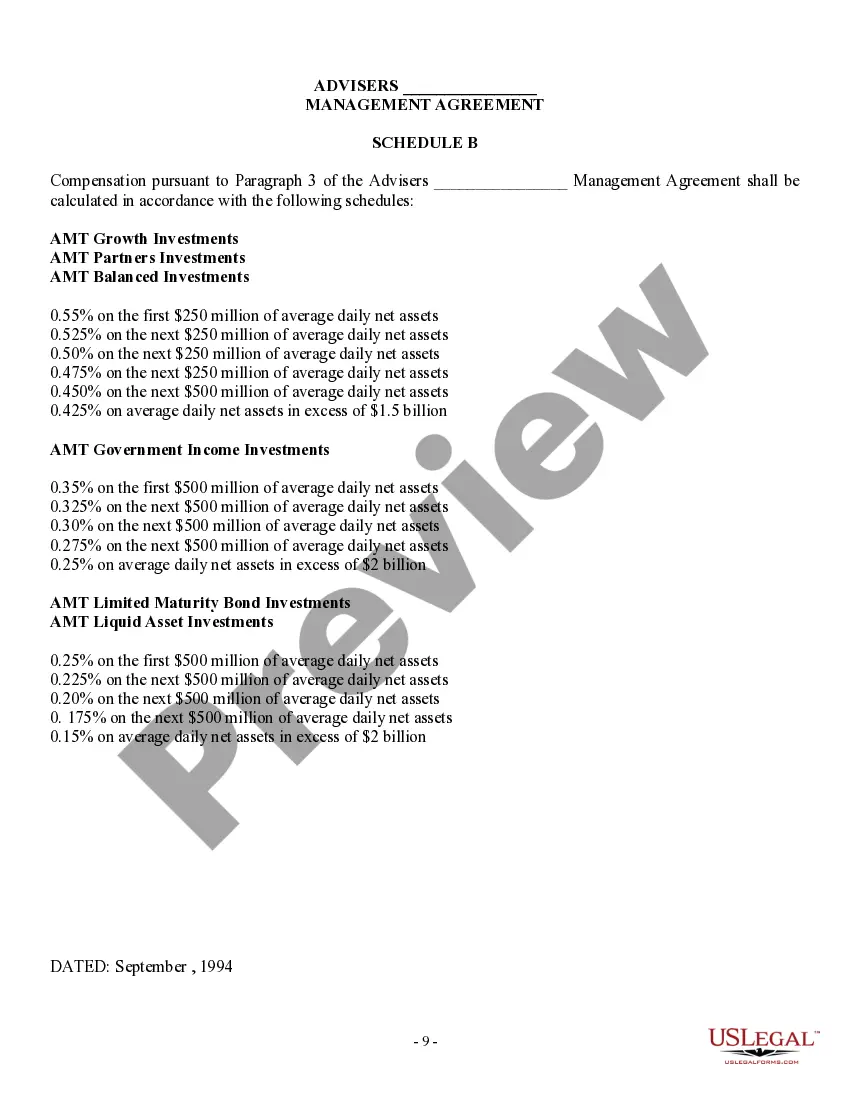
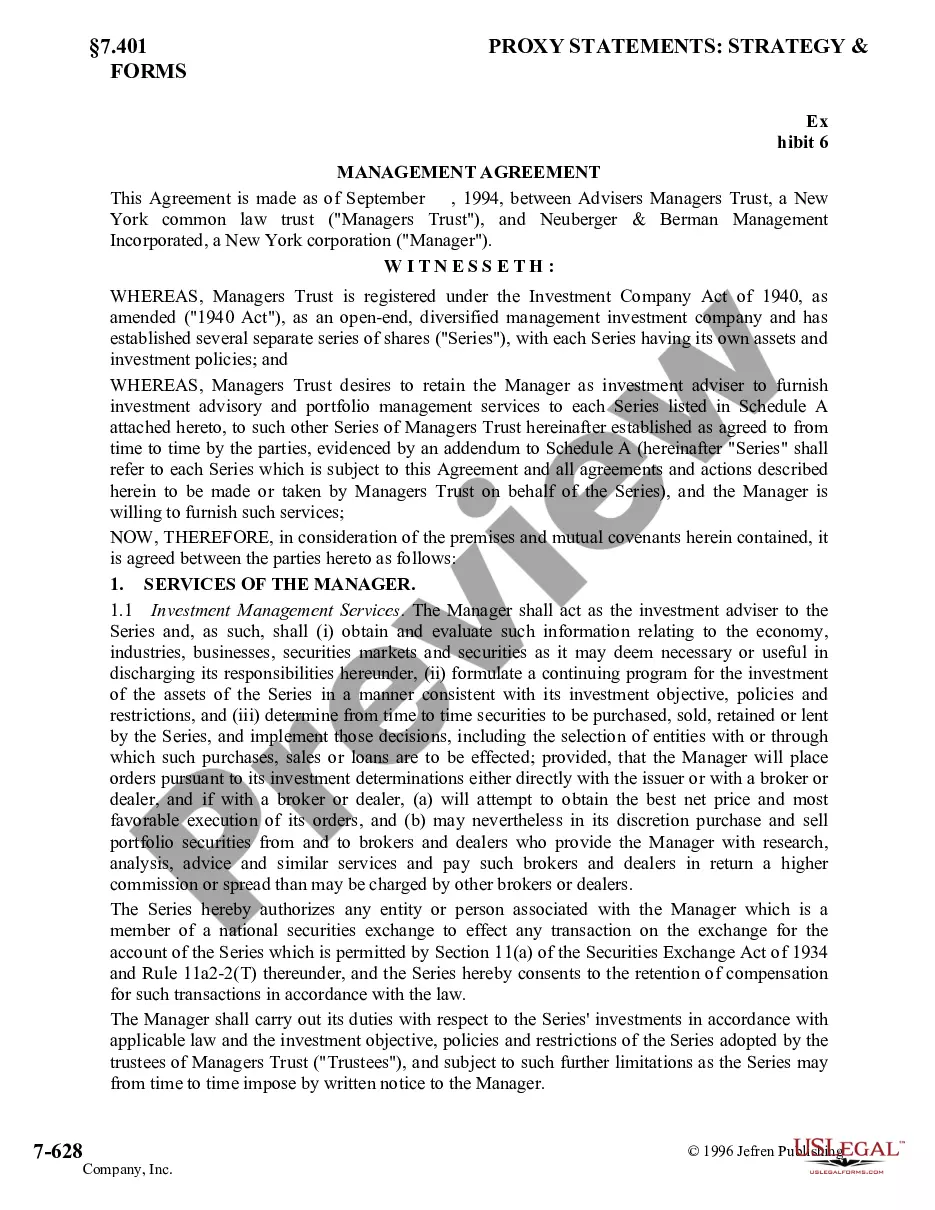
This form is a Management Agreement. Advisers for a common law trust agree to retain the services of a manager for the trust in order to procure advisement and portfolio management services for each series of shares listed on the schedule attached to the document.
West Virginia Management Agreement between a Trust and a Corporation
Category:
State:
Multi-State
Control #:
US-C-7-628
Format:
Word;
Rich Text
Instant download
Description
Free preview

Get your form ready online
Our built-in tools help you complete, sign, share, and store your documents in one place.
Built-in online Word editor
Make edits, fill in missing information, and update formatting in US Legal Forms—just like you would in MS Word.
Export easily
Download a copy, print it, send it by email, or mail it via USPS—whatever works best for your next step.
E-sign your document
Sign and collect signatures with our SignNow integration. Send to multiple recipients, set reminders, and more. Go Premium to unlock E-Sign.
Notarize online 24/7
If this form requires notarization, complete it online through a secure video call—no need to meet a notary in person or wait for an appointment.
Store your document securely
We protect your documents and personal data by following strict security and privacy standards.

Make edits, fill in missing information, and update formatting in US Legal Forms—just like you would in MS Word.

Download a copy, print it, send it by email, or mail it via USPS—whatever works best for your next step.

Sign and collect signatures with our SignNow integration. Send to multiple recipients, set reminders, and more. Go Premium to unlock E-Sign.

If this form requires notarization, complete it online through a secure video call—no need to meet a notary in person or wait for an appointment.

We protect your documents and personal data by following strict security and privacy standards.
Looking for another form?
How to fill out Management Agreement Between A Trust And A Corporation?
You can spend time on the web looking for the lawful document format that meets the state and federal specifications you require. US Legal Forms provides thousands of lawful forms that happen to be reviewed by professionals. You can actually acquire or printing the West Virginia Management Agreement between a Trust and a Corporation from my assistance.
If you have a US Legal Forms accounts, you are able to log in and click on the Acquire button. After that, you are able to complete, edit, printing, or signal the West Virginia Management Agreement between a Trust and a Corporation. Every single lawful document format you buy is your own eternally. To have one more backup of the bought type, go to the My Forms tab and click on the related button.
If you work with the US Legal Forms site for the first time, follow the simple directions listed below:
- Very first, make certain you have chosen the proper document format for that state/area of your liking. Read the type outline to make sure you have picked the appropriate type. If available, make use of the Review button to check throughout the document format as well.
- In order to get one more version in the type, make use of the Research field to discover the format that meets your needs and specifications.
- After you have identified the format you desire, click Buy now to continue.
- Choose the pricing program you desire, enter your qualifications, and sign up for your account on US Legal Forms.
- Full the transaction. You may use your charge card or PayPal accounts to fund the lawful type.
- Choose the format in the document and acquire it in your product.
- Make alterations in your document if required. You can complete, edit and signal and printing West Virginia Management Agreement between a Trust and a Corporation.
Acquire and printing thousands of document templates utilizing the US Legal Forms web site, that offers the biggest collection of lawful forms. Use specialist and status-distinct templates to tackle your business or personal demands.
Form popularity
FAQ
-- To receive additional property from any source and administer the additional property as a portion of the appropriate trust or estate under the management of the fiduciary but the fiduciary is not required to receive the property without his or her consent.
A deed of trust is an agreement between a home buyer and a lender at the closing of a property. The agreement states that the home buyer will repay the home loan and the mortgage lender will hold the property's legal title until the loan is paid in full.
A Deed of Trust is an agreement between a borrower, a lender and a third-party person who's appointed as a Trustee. It's used to secure real estate transactions where money needs to be borrowed in order for property to be purchased.
West Virginia Code §11-22-1, provides for exemptions to paying the Transfer Tax Fee. Deeds must specifically state the reason for exemption, otherwise, the Transfer Tax Fee will be charged. Every Deed recorded requires a completed Sales Listing Form to be attached. The Sales Listing Form can be found here.
A trust deed is a legal agreement between you and your creditors to pay back part of what you owe over a set period. This is usually four years, but may vary.
A deed of trust involves three parties: a lender, a borrower, and a trustee. The lender gives the borrower money. In exchange, the borrower gives the lender one or more promissory notes. As security for the promissory notes, the borrower transfers a real property interest to a third-party trustee.
A deed of trust may convey both real property or some interest therein and personal property or only real property or some interest therein or only personal property in order to secure a debt.
- A party against whom a claim, counterclaim, or cross-claim is asserted or a declaratory judgment is sought may, at any time, move with or without supporting affidavits for a summary judgment in the party's favor as to all or any part thereof.