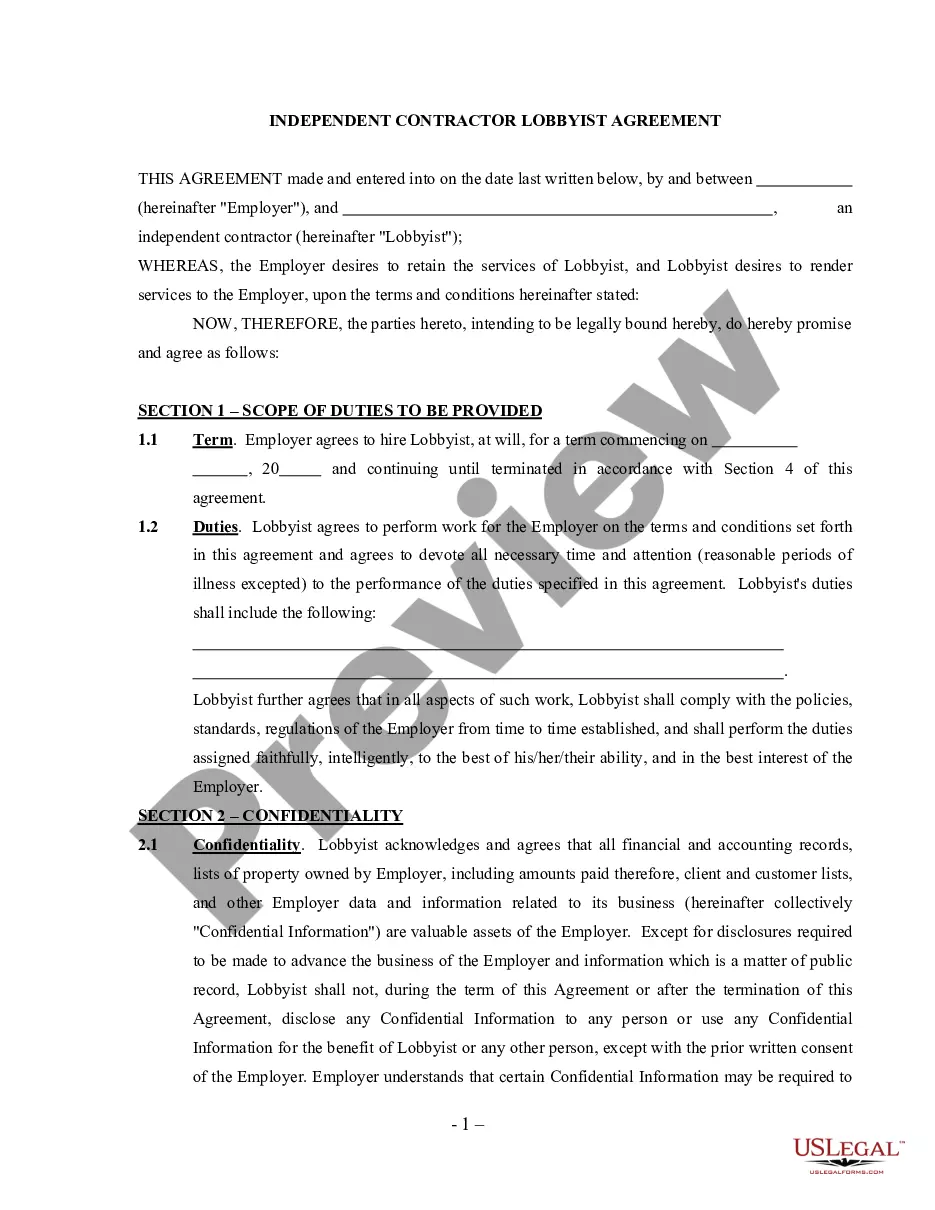
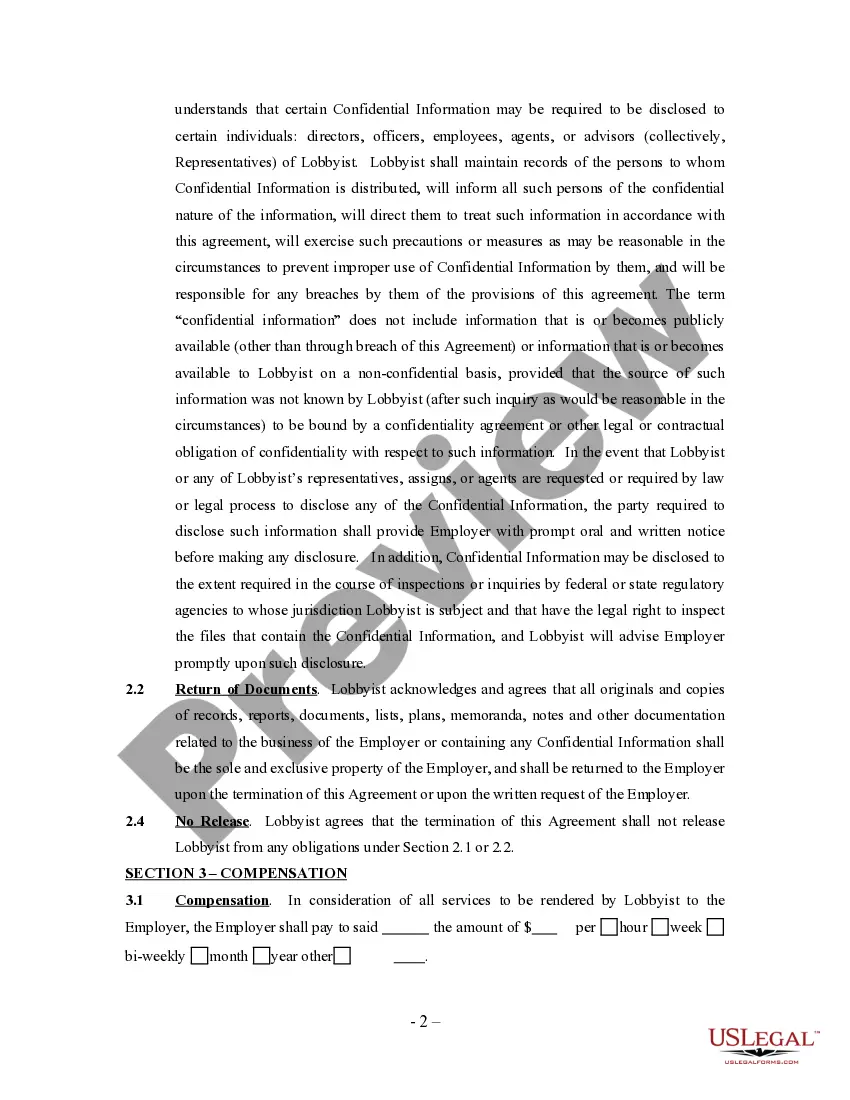
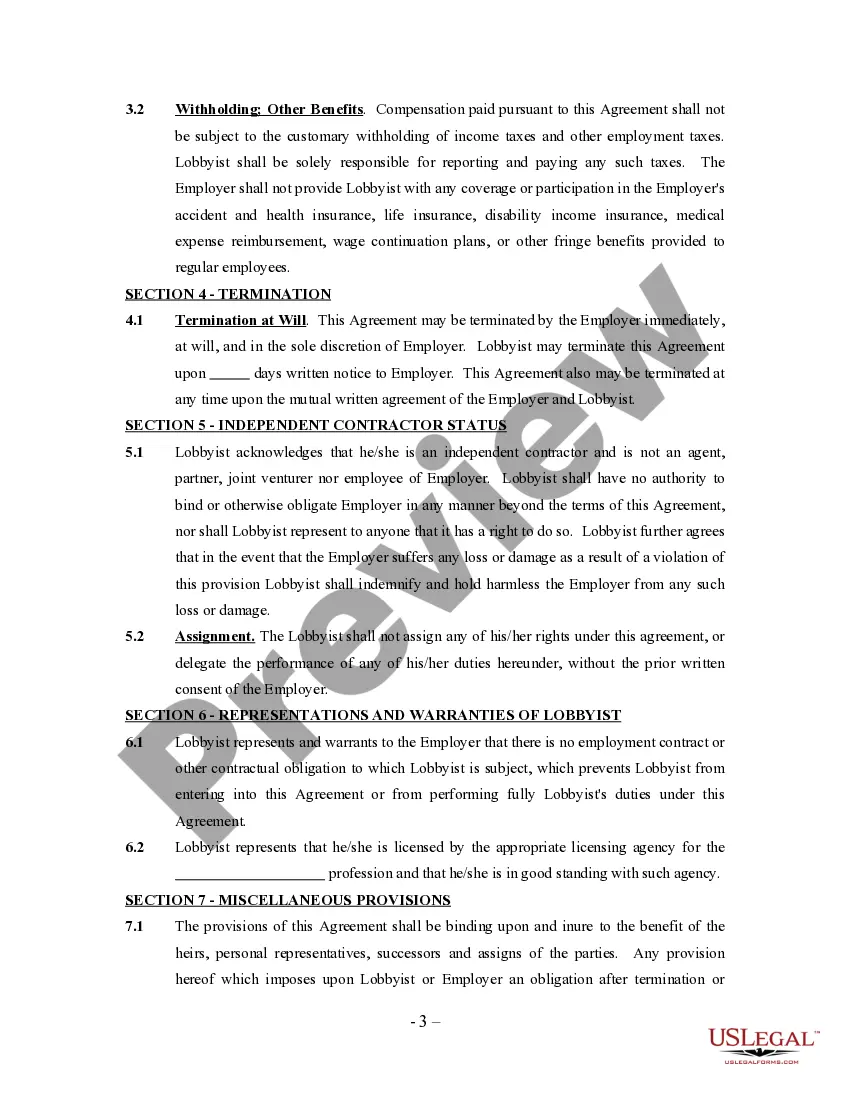
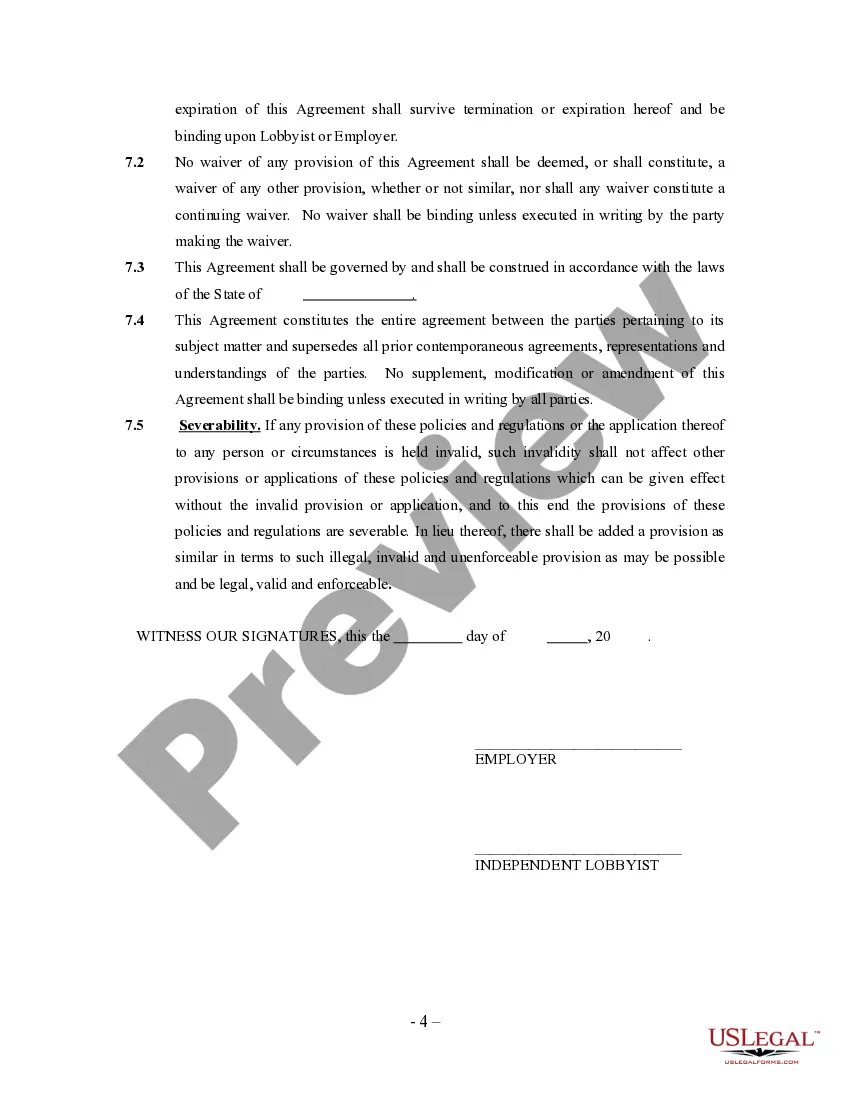
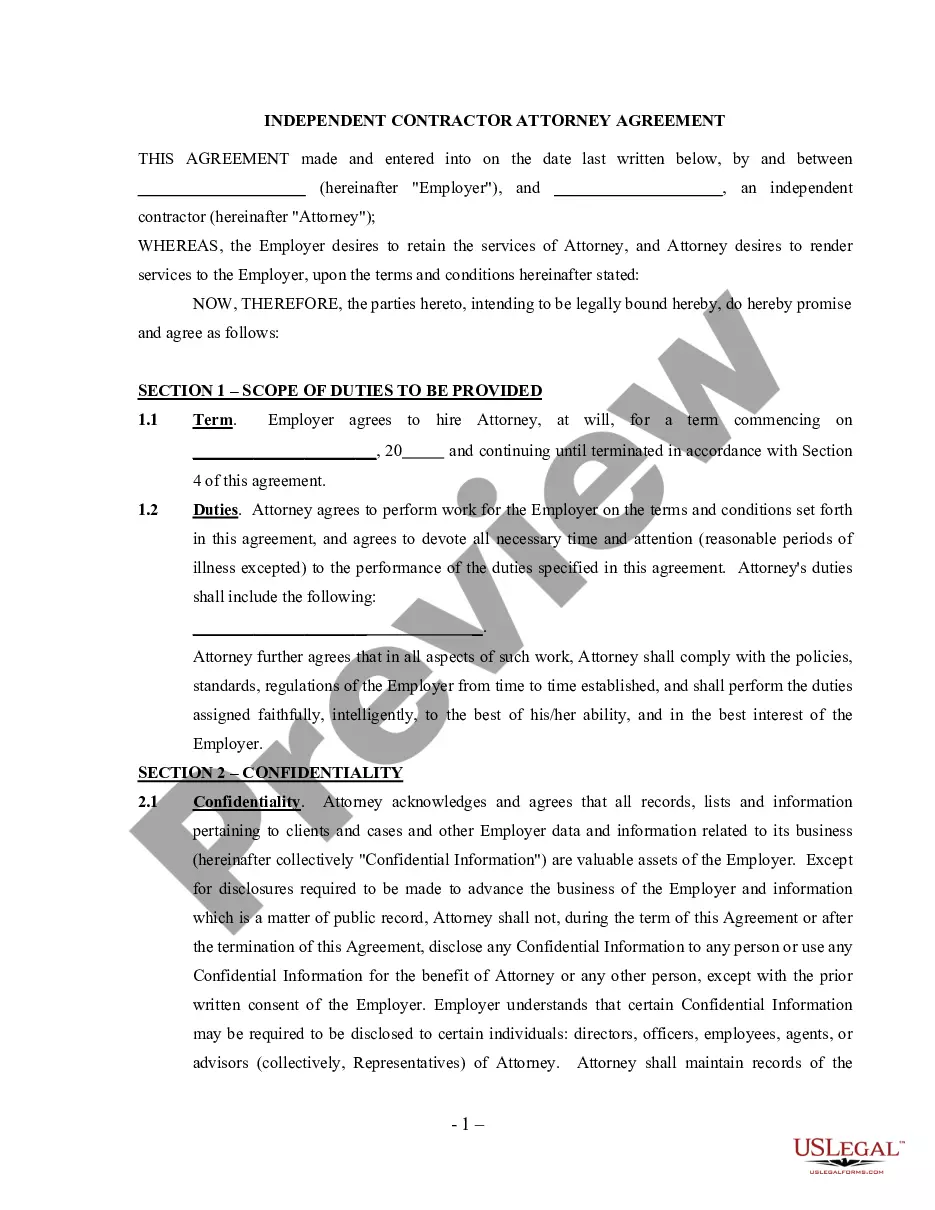
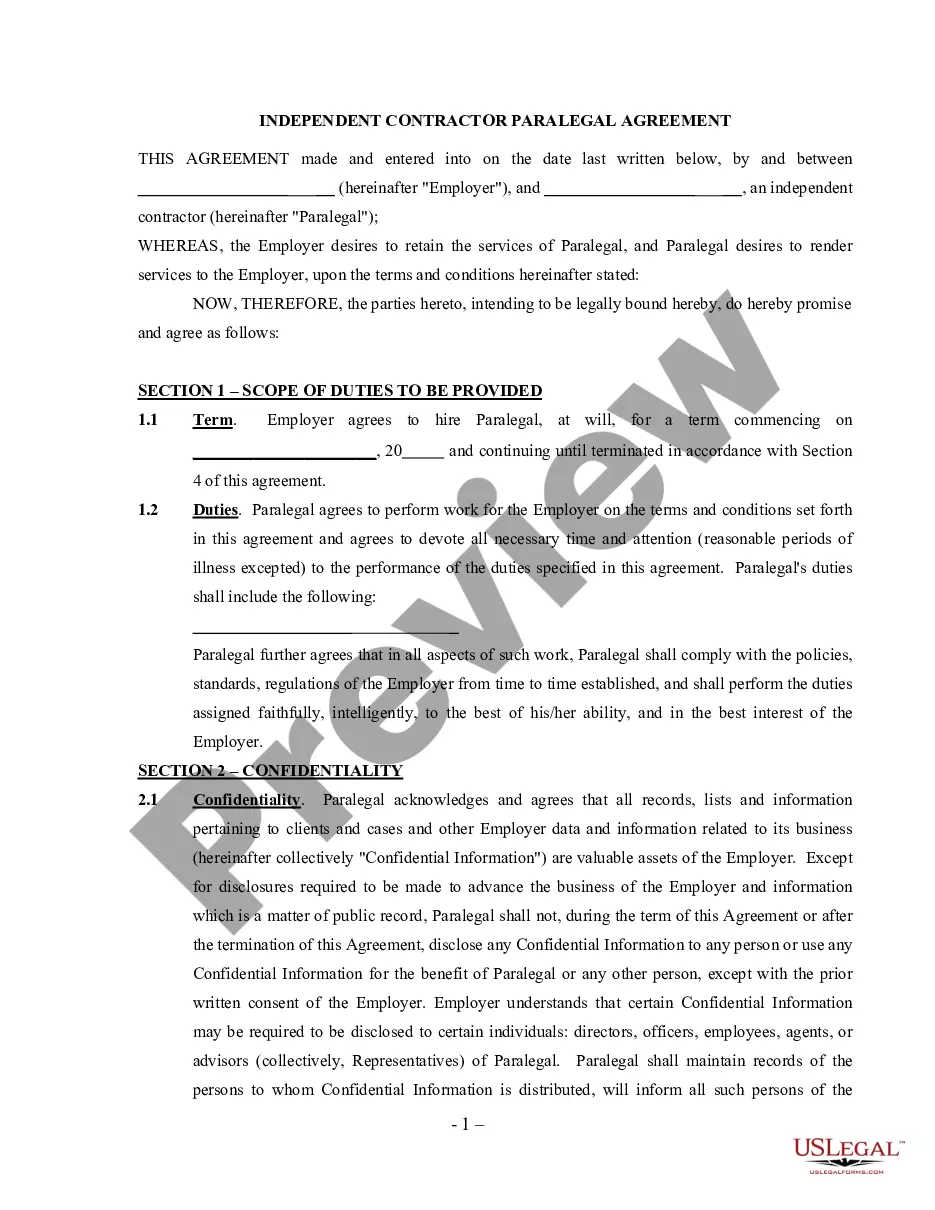
Employer hires a lobbyist as an independent contractor to provide lobbying services as specified in the contract.
West Virginia Lobbyist Agreement - Self-Employed Independent Contractor
State:
Multi-State
Control #:
US-INDC-206
Format:
Word;
Rich Text
105 downloads
Description
Free preview
Get your form ready online
Our built-in tools help you complete, sign, share, and store your documents in one place.
Built-in online Word editor
Make edits, fill in missing information, and update formatting in US Legal Forms—just like you would in MS Word.
Export easily
Download a copy, print it, send it by email, or mail it via USPS—whatever works best for your next step.
E-sign your document
Sign and collect signatures with our SignNow integration. Send to multiple recipients, set reminders, and more. Go Premium to unlock E-Sign.
Notarize online 24/7
If this form requires notarization, complete it online through a secure video call—no need to meet a notary in person or wait for an appointment.
Store your document securely
We protect your documents and personal data by following strict security and privacy standards.

Make edits, fill in missing information, and update formatting in US Legal Forms—just like you would in MS Word.

Download a copy, print it, send it by email, or mail it via USPS—whatever works best for your next step.

Sign and collect signatures with our SignNow integration. Send to multiple recipients, set reminders, and more. Go Premium to unlock E-Sign.

If this form requires notarization, complete it online through a secure video call—no need to meet a notary in person or wait for an appointment.

We protect your documents and personal data by following strict security and privacy standards.
Looking for another form?
How to fill out Lobbyist Agreement - Self-Employed Independent Contractor?
It is feasible to spend time online searching for the sanctioned document template that meets the state and federal standards you require.
US Legal Forms offers thousands of legal forms that can be reviewed by experts.
You can easily download or create the West Virginia Lobbyist Agreement - Self-Employed Independent Contractor from their services.
- If you already have a US Legal Forms account, you may Log In and then click the Obtain button.
- After that, you can complete, modify, create, or sign the West Virginia Lobbyist Agreement - Self-Employed Independent Contractor.
- Every legal document template you purchase is yours permanently.
- To get another copy of any purchased form, go to the My documents section and click the corresponding option.
- If you are using the US Legal Forms site for the first time, follow the simple instructions below.
- First, ensure that you have selected the correct document template for your state/region of choice.
- Review the form details to confirm you have chosen the right one.
- If available, utilize the Preview feature to look through the document template as well.
- If you wish to obtain another version of your form, use the Search box to find the template that fits your needs and specifications.
- Once you have found the template you want, click Get now to continue.
- Choose the pricing plan you prefer, enter your details, and create an account on US Legal Forms.
- Complete the transaction.
- You can use your credit card or PayPal account to pay for the legal form.
- Select the format of your document and download it to your device.
- Make adjustments to your document if necessary.
- You can complete, edit, sign, and print the West Virginia Lobbyist Agreement - Self-Employed Independent Contractor.
- Download and print thousands of document templates using the US Legal Forms website, which offers the largest collection of legal forms.
- Utilize professional and state-specific templates to address your business or personal needs.
Form popularity
FAQ
Yes, West Virginia allows independent contractors across various professions, including lobbying. As an independent contractor, you can establish your own business, set your rates, and work with multiple clients. However, to operate as a lobbyist within this structure, it is vital to enter into a West Virginia Lobbyist Agreement - Self-Employed Independent Contractor, ensuring compliance with state regulations and offering your clients the professional services they need.
Becoming a lobbyist in West Virginia involves several steps. First, you should familiarize yourself with the state's legislation and political landscape, as this knowledge is crucial for effective lobbying. Next, consider seeking mentorship or internships to gain practical experience. Finally, securing a West Virginia Lobbyist Agreement - Self-Employed Independent Contractor will help formalize your role and connect you with clients seeking your expertise.
In West Virginia, anyone who engages in lobbying activities on behalf of a client or organization must register as a lobbyist. This includes individuals who advocate for specific bills, policies, or government decisions. Both professional lobbyists and those acting as self-employed independent contractors under a West Virginia Lobbyist Agreement must comply with registration laws to operate legally and effectively in the state.
To be a lobbyist in West Virginia, you typically need to possess a strong understanding of the state's legislative process and policy issues. While formal education is not strictly required, having a degree in political science, law, or public relations can be beneficial. Additionally, it helps to have experience in lobbying or related fields to demonstrate your capability. A West Virginia Lobbyist Agreement - Self-Employed Independent Contractor may also necessitate certain certifications to further establish your credibility.
Lobbyists in Texas also face specific requirements, including registration with the state and adherence to ethical guidelines. They must submit detailed reports of their lobbying activities and financial disclosures. Though the requirements differ, understanding both the Texas and West Virginia Lobbyist Agreements - Self-Employed Independent Contractor can provide a strong foundation for your lobbying efforts across states.
Yes, lobbyists are required to register before undertaking any lobbying activities in West Virginia. This registration ensures transparency and accountability in the lobbying process. By adhering to the requirements in the West Virginia Lobbyist Agreement - Self-Employed Independent Contractor, you not only comply with the law but also build trust with the stakeholders you engage with.
To be considered a lobbyist in West Virginia, individuals must meet certain criteria, including registering with the state and potentially completing specific training or orientation sessions. Moreover, a lobbyist must understand the laws and regulations governing lobbying activities. If you follow the process outlined in the West Virginia Lobbyist Agreement - Self-Employed Independent Contractor, you'll ensure you meet all necessary requirements.
In West Virginia, the law specifies that professional lobbyists must register if they have more than one lobbying contact within a calendar year. This means that even if you only plan to have limited outreach as a self-employed independent contractor, it's important to keep track of your interactions. Understanding this threshold can help you maintain compliance with the West Virginia Lobbyist Agreement - Self-Employed Independent Contractor guidelines.
Filling out an independent contractor agreement requires you to detail the nature of the work, payment terms, and duration of the contract. Start by stating the agreement’s purpose, then provide the responsibilities of each party. Make sure to include necessary legal language, as this ensures compliance with regulations, especially in a West Virginia Lobbyist Agreement - Self-Employed Independent Contractor.
In West Virginia, the amount of work you can perform without a contractor license varies by the type of project. Generally, if the work falls below a certain monetary threshold, you may not need a license. However, it’s essential to check specific requirements related to your profession, especially if it involves a West Virginia Lobbyist Agreement - Self-Employed Independent Contractor.