West Virginia Non-Foreign Affidavit Under IRC 1445
What is this form?
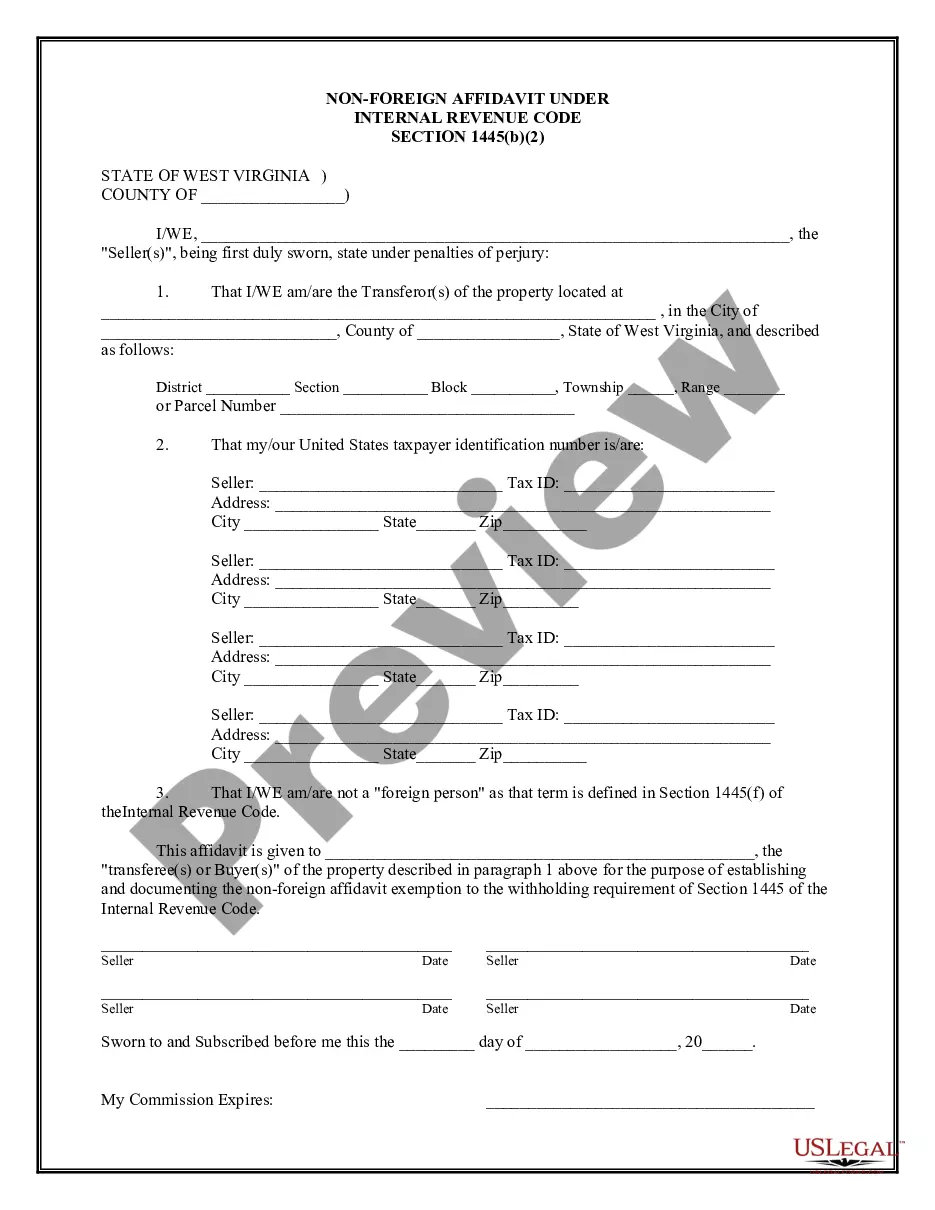
The Non-Foreign Affidavit Under IRC 1445 is a legal document that allows a seller of real property to confirm that they are not a foreign person as defined by the Internal Revenue Code. The affidavit is essential for buyers to comply with U.S. tax regulations, as it exempts them from withholding taxes when purchasing property from non-U.S. persons. This form differs from other affidavits as it specifically addresses tax requirements under IRC Section 1445, making it vital for real estate transactions involving foreign nationals.
Main sections of this form
- Identification of Seller(s) and their taxpayer identification number.
- Details of the property being transferred.
- Declaration of non-foreign status as defined by the IRC.
- Signature and date fields for all sellers involved in the transaction.
- Notary public section for witnessing the affidavit.

When this form is needed
This form is used when a seller of real estate is not a foreign person and needs to document this status for their buyer. It is required during the sale of property to ensure compliance with U.S. tax withholding requirements outlined in IRC 1445. This affidavit is essential to retain tax efficiency and avoid unnecessary withholding for both parties involved in the transaction.
Who should use this form
This form is intended for:
- Individuals selling real property in the United States.
- Real estate agents or brokers facilitating property transactions.
- Buyers of real estate who need assurance of the seller's non-foreign status.
Completing this form step by step
- Identify all sellers and their taxpayer identification numbers.
- Provide the detailed description of the property being sold, including location and parcel number.
- Confirm and declare that you are not a foreign person as defined by IRC 1445.
- Sign and date the affidavit in the designated areas.
- Schedule a notarization with a notary public to witness the signatures.
Is notarization required?
To make this form legally binding, it must be notarized. Our online notarization service, powered by Notarize, lets you verify and sign documents remotely through an encrypted video session.
Get your form ready online
Our built-in tools help you complete, sign, share, and store your documents in one place.
Make edits, fill in missing information, and update formatting in US Legal Forms—just like you would in MS Word.
Download a copy, print it, send it by email, or mail it via USPS—whatever works best for your next step.
Sign and collect signatures with our SignNow integration. Send to multiple recipients, set reminders, and more. Go Premium to unlock E-Sign.
If this form requires notarization, complete it online through a secure video call—no need to meet a notary in person or wait for an appointment.
We protect your documents and personal data by following strict security and privacy standards.

Make edits, fill in missing information, and update formatting in US Legal Forms—just like you would in MS Word.

Download a copy, print it, send it by email, or mail it via USPS—whatever works best for your next step.

Sign and collect signatures with our SignNow integration. Send to multiple recipients, set reminders, and more. Go Premium to unlock E-Sign.

If this form requires notarization, complete it online through a secure video call—no need to meet a notary in person or wait for an appointment.

We protect your documents and personal data by following strict security and privacy standards.
Mistakes to watch out for
- Failing to include all sellers' names and taxpayer identification numbers.
- Omitting detailed property descriptions.
- Not notarizing the affidavit before submission.
- Incorrectly declaring foreign or non-foreign status.
Advantages of online completion
- Convenient access to downloadable legal templates anytime.
- Editable fields to tailor the document to specific individual needs.
- Reliability with attorney-drafted forms ensuring compliance with legal standards.
Quick recap
- The Non-Foreign Affidavit is essential for U.S. sellers of real estate.
- It prevents unnecessary tax withholding by establishing non-foreign status.
- Completing this form correctly is crucial for compliance with federal tax laws.
Looking for another form?
Form popularity
FAQ
The disposition of a U.S. real property interest by a foreign person (the transferor) is subject to the Foreign Investment in Real Property Tax Act of 1980 (FIRPTA) income tax withholding. FIRPTA authorized the United States to tax foreign persons on dispositions of U.S. real property interests.
A: The buyer must agree to sign an affidavit stating that the purchase price is under $300,000 and the buyer intends to occupy. The buyer may choose not to sign the form, in which case withholding must be done.
FIRPTA Certificate: Certification of Non-Foreign Status - FIRPTA is the Foreign Investment in Real Property Act and Form 8288. It was developed to ensure that foreign sellers of U.S. property be subject to U.S. tax on the sale.
Foreign affidavit is an affidavit involving a matter of concern in one state but taken in another state or country before an officer of that state or country.
FIRPTA Exemptions The sales price is $300,000 or less, and. The buyer signs affidavit at or before closing stating they intend to use property for personal purposes for at least 50% of time property occupied for the each of the first two 12 month periods immediately after closing.
The Foreign Investment in Real Property Transfer Act (FIRPTA) requires any buyer of a U.S. real property interest to withhold ten percent of the amount realized by a foreign seller. 26 USC § 1445(a).
This document, included in the seller's opening package, requests that the seller swears under penalty of perjury that they are not a non-resident alien for purposes of United States income taxation. A Seller unable to complete this affidavit may be subject to withholding up to 15%.
The only other way to avoid FIRPTA is via a withholding certificate. If FIRPTA withholding exceeds the maximum tax liability realized on the sale of the real property, sellers can appeal to the IRS for a lower withholding amount.