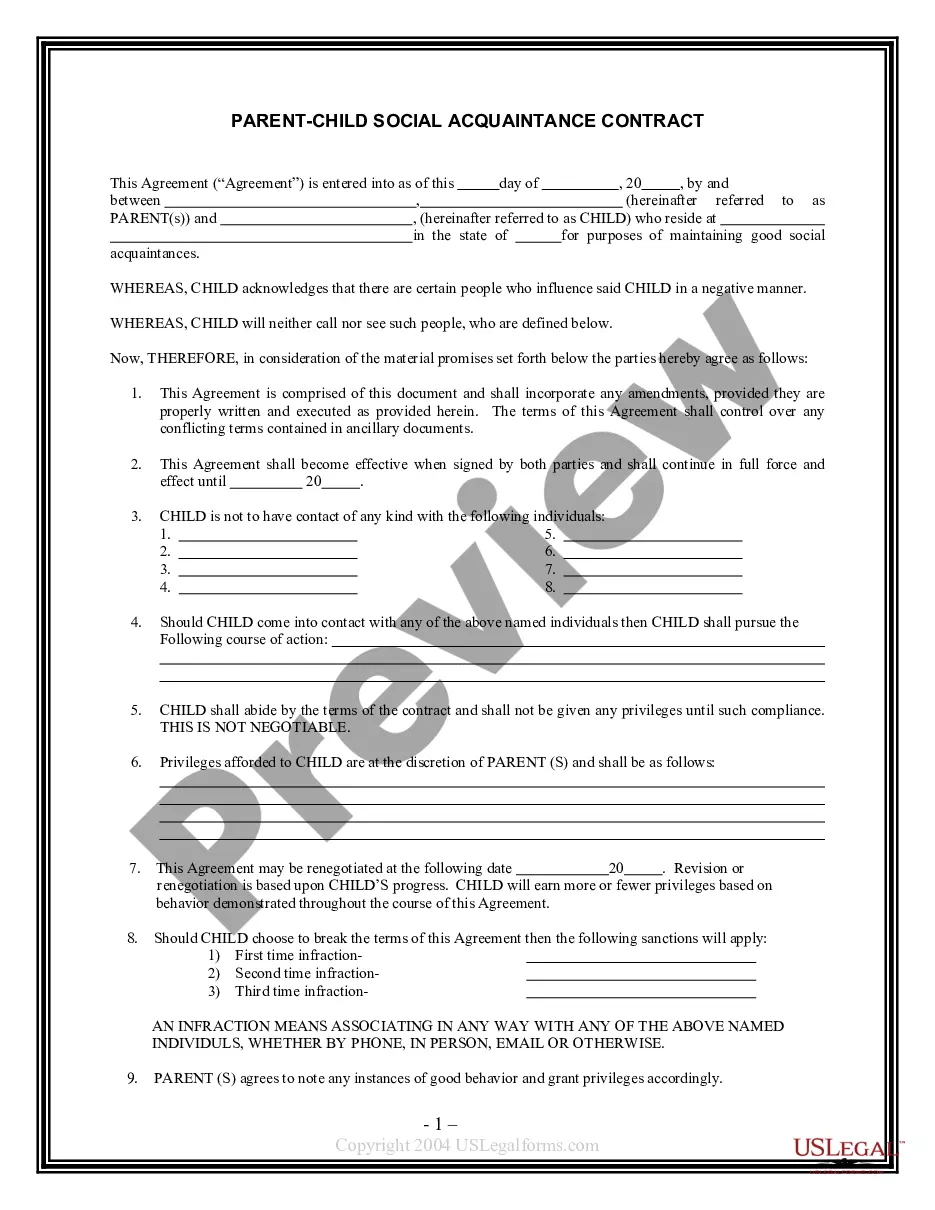
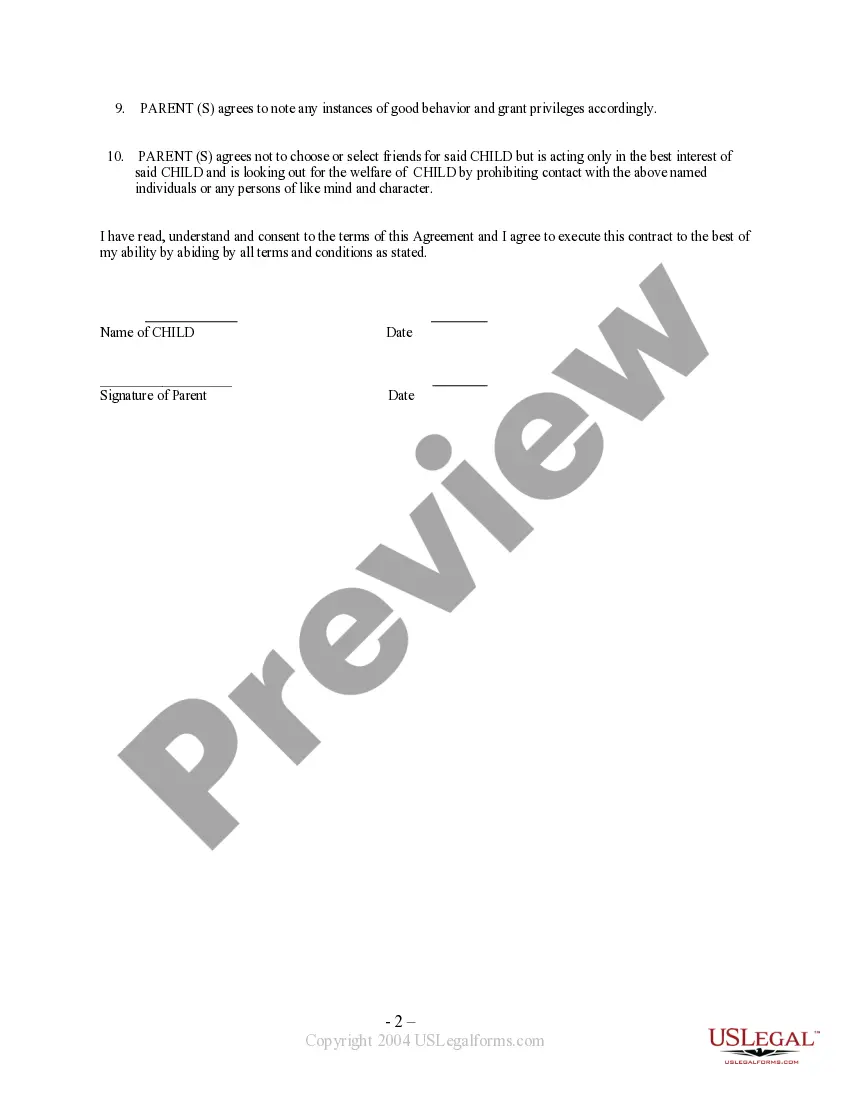
This is a contract between parent(s) and child acknowledging that there are certain people from whom child should refrain from associating. This contract affords privileges for good behavior and for abiding by its terms while listing the repercussions for breaking the contract.
Wisconsin Parent - Child Social Acquaintance Contract
Category:
State:
Multi-State
Control #:
US-PC09
Format:
Word;
Rich Text
Instant download
Description
Free preview
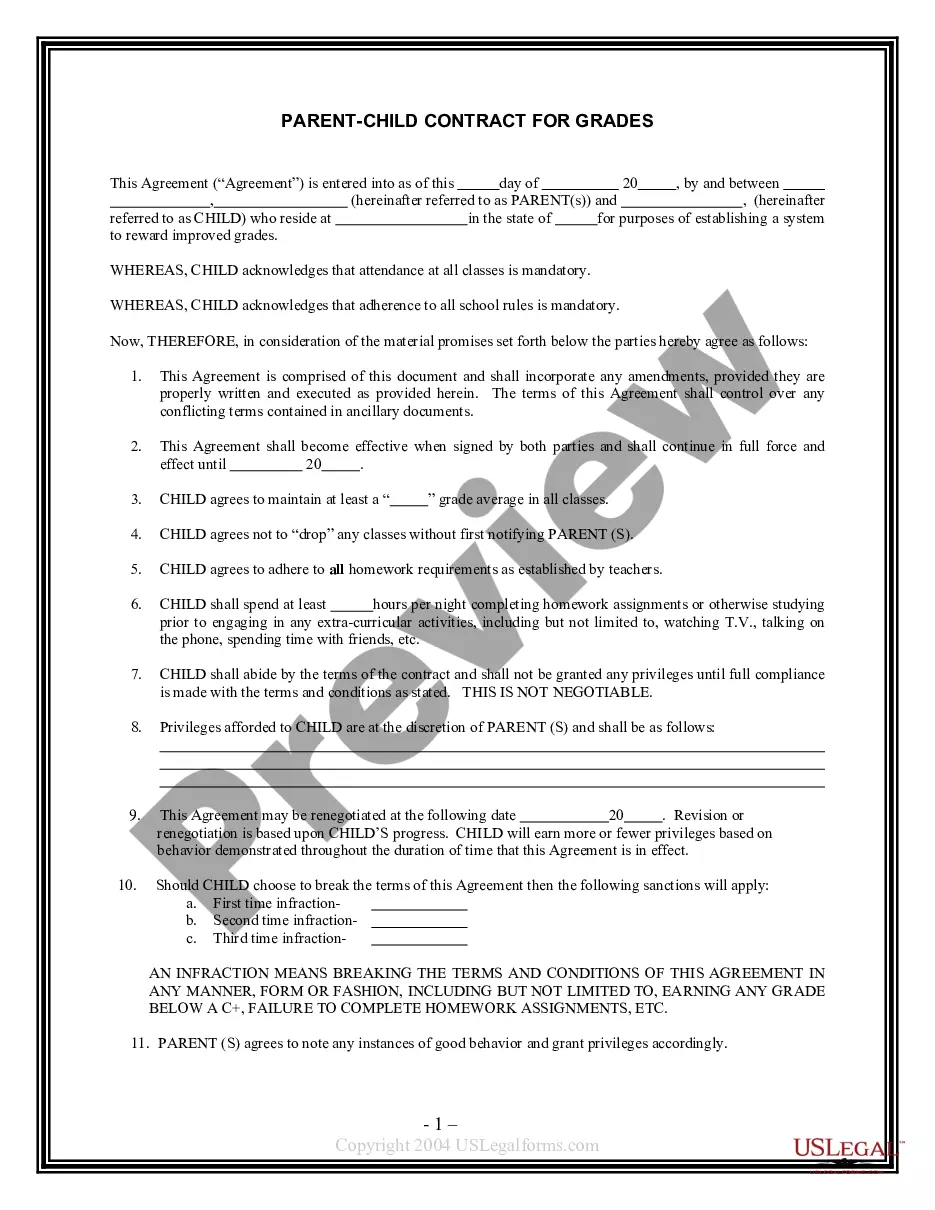
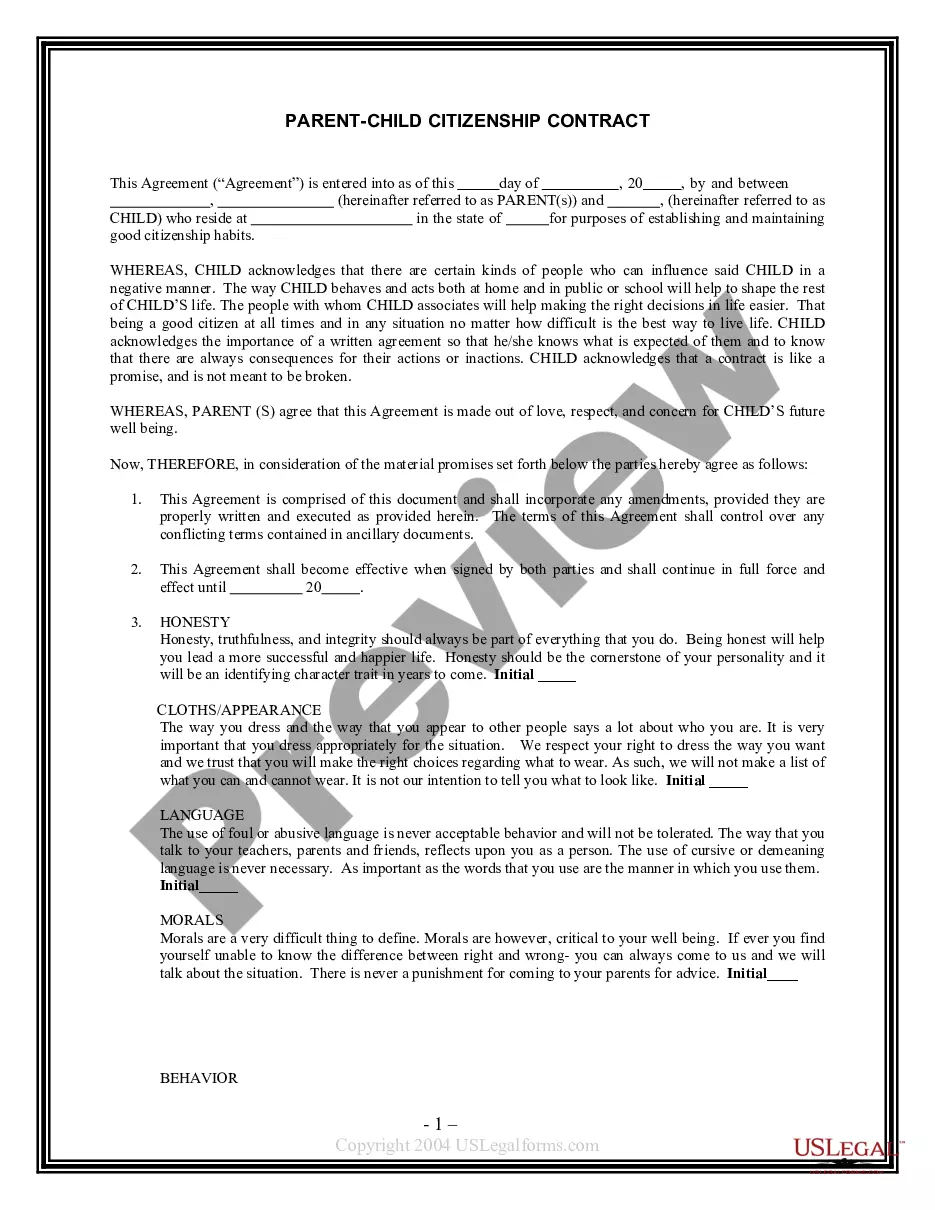
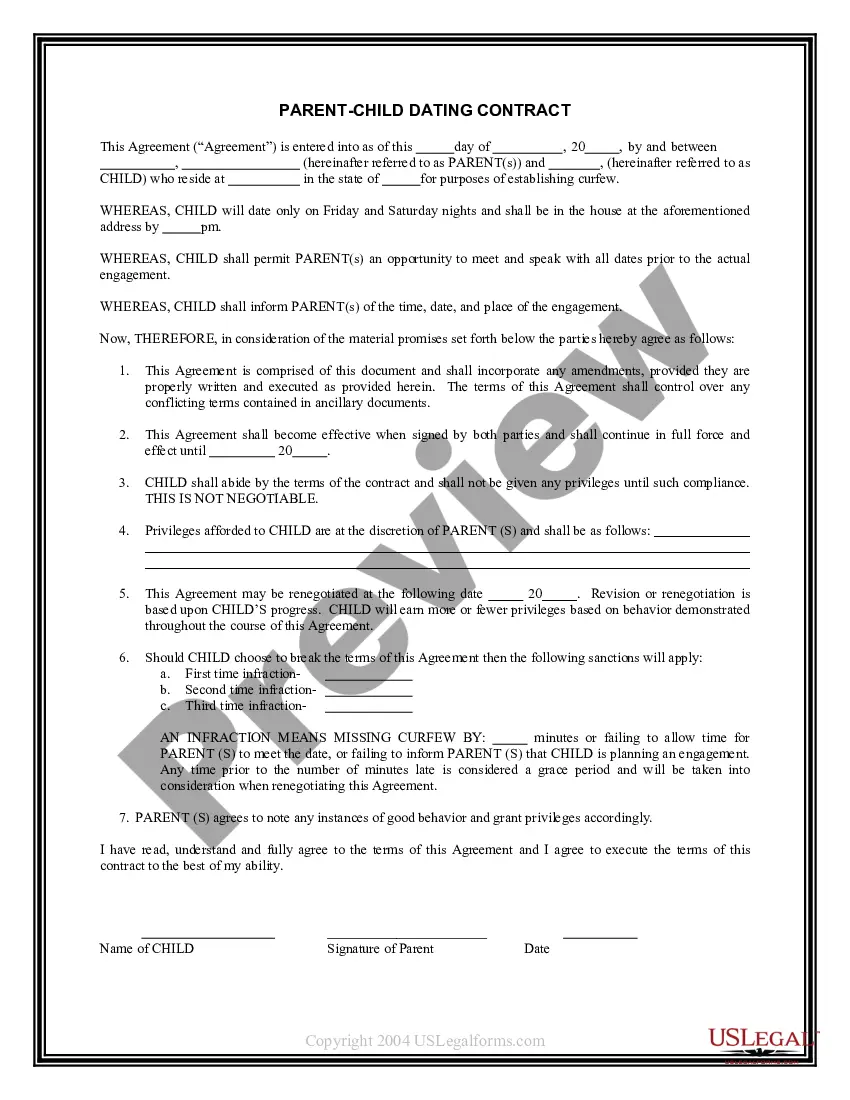
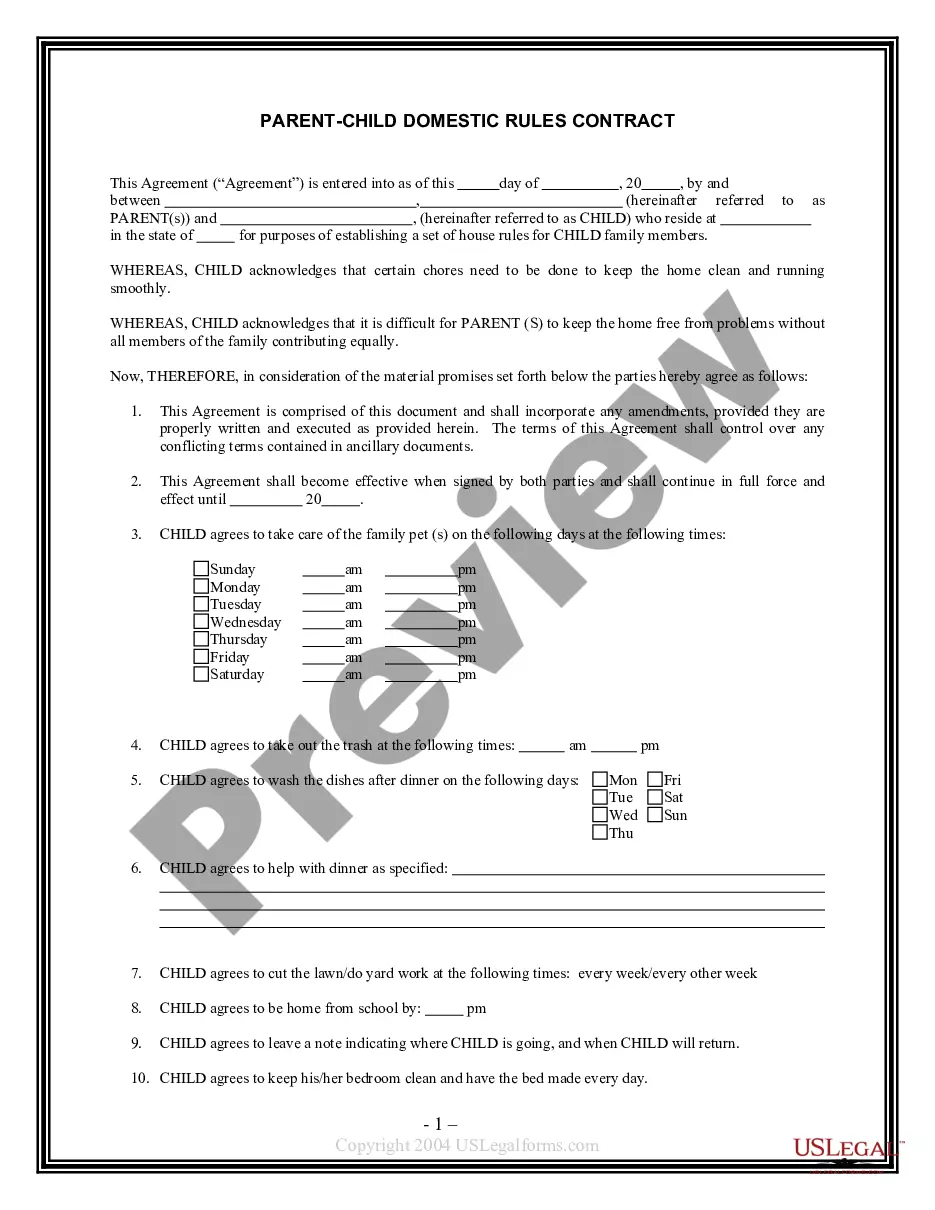
Get your form ready online
Our built-in tools help you complete, sign, share, and store your documents in one place.
Built-in online Word editor
Make edits, fill in missing information, and update formatting in US Legal Forms—just like you would in MS Word.
Export easily
Download a copy, print it, send it by email, or mail it via USPS—whatever works best for your next step.
E-sign your document
Sign and collect signatures with our SignNow integration. Send to multiple recipients, set reminders, and more. Go Premium to unlock E-Sign.
Notarize online 24/7
If this form requires notarization, complete it online through a secure video call—no need to meet a notary in person or wait for an appointment.
Store your document securely
We protect your documents and personal data by following strict security and privacy standards.

Make edits, fill in missing information, and update formatting in US Legal Forms—just like you would in MS Word.

Download a copy, print it, send it by email, or mail it via USPS—whatever works best for your next step.

Sign and collect signatures with our SignNow integration. Send to multiple recipients, set reminders, and more. Go Premium to unlock E-Sign.

If this form requires notarization, complete it online through a secure video call—no need to meet a notary in person or wait for an appointment.

We protect your documents and personal data by following strict security and privacy standards.
Looking for another form?





How to fill out Parent - Child Social Acquaintance Contract?
You might spend numerous hours online looking for the legal document format that meets the state and federal standards you require. US Legal Forms provides a vast array of legal templates that can be assessed by professionals.
You can conveniently download or print the Wisconsin Parent - Child Social Acquaintance Contract from the platform. If you possess a US Legal Forms account, you may Log In and click on the Download button. Subsequently, you can complete, modify, print, or sign the Wisconsin Parent - Child Social Acquaintance Contract. Every legal document format you obtain is yours indefinitely.
To obtain an additional copy of any purchased form, navigate to the My documents tab and click on the respective button. If you are visiting the US Legal Forms site for the first time, follow the simple instructions below: First, ensure that you have selected the appropriate document format for the state/city you choose. Review the form outline to confirm you have selected the correct one. If available, use the Review button to browse through the document format as well.
- If you wish to find an alternative version of the form, utilize the Search field to locate the format that meets your needs and criteria.
- Once you have located the format you want, click on Get now to continue.
- Choose the pricing plan you prefer, enter your details, and register for a free account on US Legal Forms.
- Complete the purchase. You can use your credit card or PayPal account to pay for the legal document.
- Select the format of the document and download it to your device.
- Make modifications to your document if possible. You can complete, edit, sign, and print the Wisconsin Parent - Child Social Acquaintance Contract.
- Download and print thousands of document templates using the US Legal Forms Website, which offers the largest collection of legal forms. Utilize professional and state-specific templates to address your business or personal needs.
Form popularity
FAQ
To write a Wisconsin Parent - Child Social Acquaintance Contract, start by clearly defining the purpose of the agreement. Include specific expectations regarding social interactions, responsibilities, and any rules you wish to set. Next, ensure both parties understand and agree to the terms by discussing each point. Finally, formalize the contract by having both parent and child sign it, reinforcing the importance of this commitment.
In Wisconsin, a child can express their preference regarding which parent they wish to live with as early as 14 years old. However, the court takes into account the child's maturity and the reasons for their preference. While the child's opinion is considered, it is not the sole factor in custody decisions; the court evaluates the overall best interests of the child. Utilizing a Wisconsin Parent - Child Social Acquaintance Contract can help clarify expectations and responsibilities as children grow and their preferences evolve.
In Wisconsin, failure to assume parental responsibility refers to a situation where a parent neglects their duty to provide care, support, and supervision for their child. This can include not making necessary decisions for the child's welfare or failing to ensure the child's safety. Such situations can lead to legal implications, including potential custody disputes or the involvement of child protective services. Understanding your rights and responsibilities, especially in the context of a Wisconsin Parent - Child Social Acquaintance Contract, is essential for maintaining a healthy relationship with your child.
Wisconsin law does not specify an exact age at which a child can refuse to visit a parent. However, a child's preference may be taken into account during custody arrangements, especially as they grow older. The Wisconsin Parent - Child Social Acquaintance Contract can facilitate discussions about parental rights and responsibilities. This contract also allows parents to clarify visitation terms that consider the child’s feelings and well-being.
In Wisconsin, there is no specific legal age that determines when a child can be left home alone. Parents should consider their child's maturity and ability to handle emergencies. The Wisconsin Parent - Child Social Acquaintance Contract can help outline expectations and responsibilities for both parents and children regarding staying home alone. This contract encourages open communication and fosters a sense of responsibility.
At what age can a child refuse visitation in Wisconsin? In Wisconsin, children cannot dictate where they reside but the courts may take the child's preference into consideration at about age 14 or when the child can articulate a preference and a reason for the preference.
Parent has a legal obligation to pay child support until the child turns 18 or 19 if still enrolled in high school or a GED course. Note that you still owe past due child support after your child turns 18. Past due child support cases can be opened up to 20 years after the youngest child on the order turns 18.
The standard percentage of income guideline in Wisconsin for child support is: 17% of income for 1 child. 25% of income for 2 children. 29% of income for 3 children.
If both parents are under 18 (and unemancipated) at the time of the child's conception, their parents (the child's grandparents) share primary responsibility for supporting the child. This responsibility lasts until both minor unemancipated parents become age 18 or are emancipated.
Child support in Wisconsin is determined by each parent's gross monthly income, the standard percentage based on the number of children (see table below), and the percentage of time each parent spends with the child(ren).