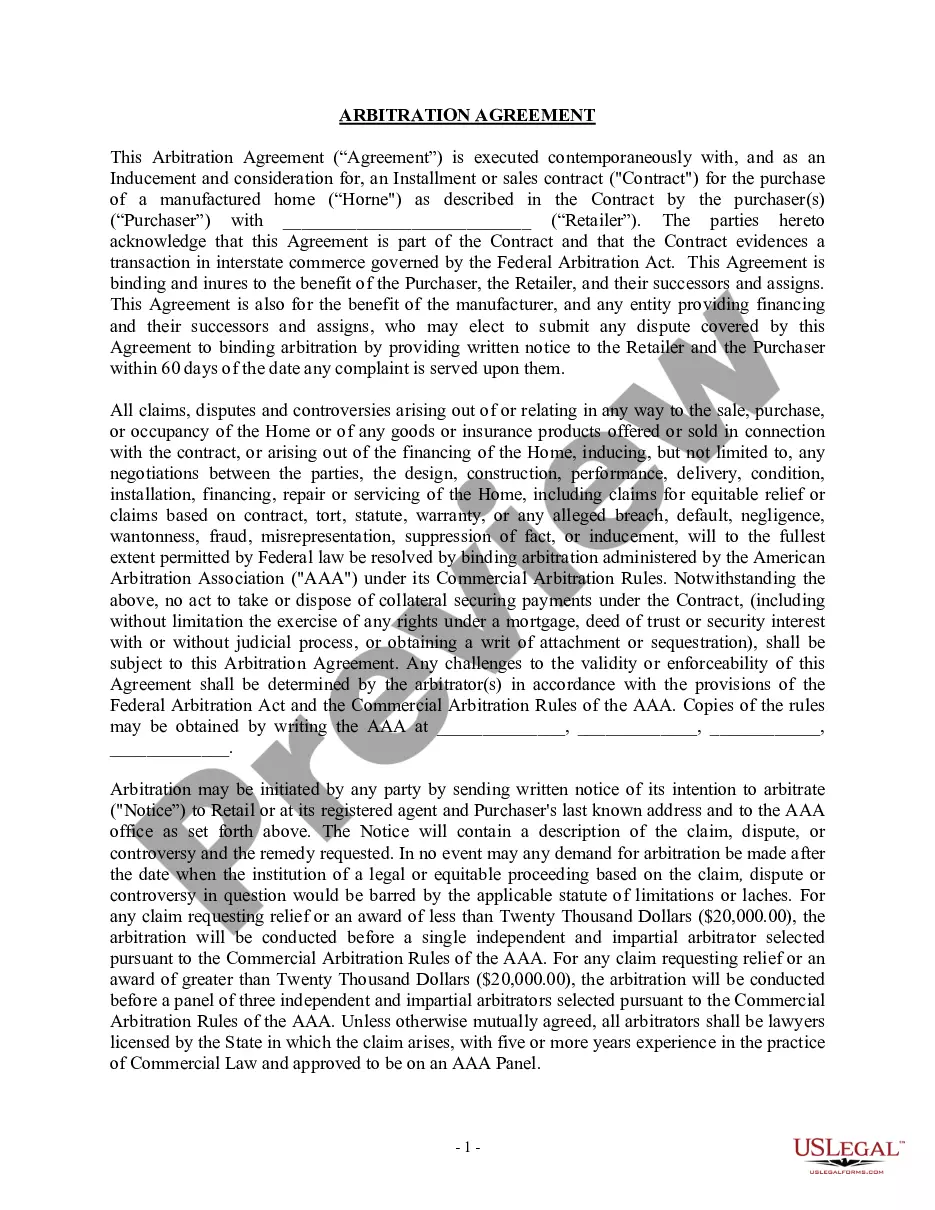
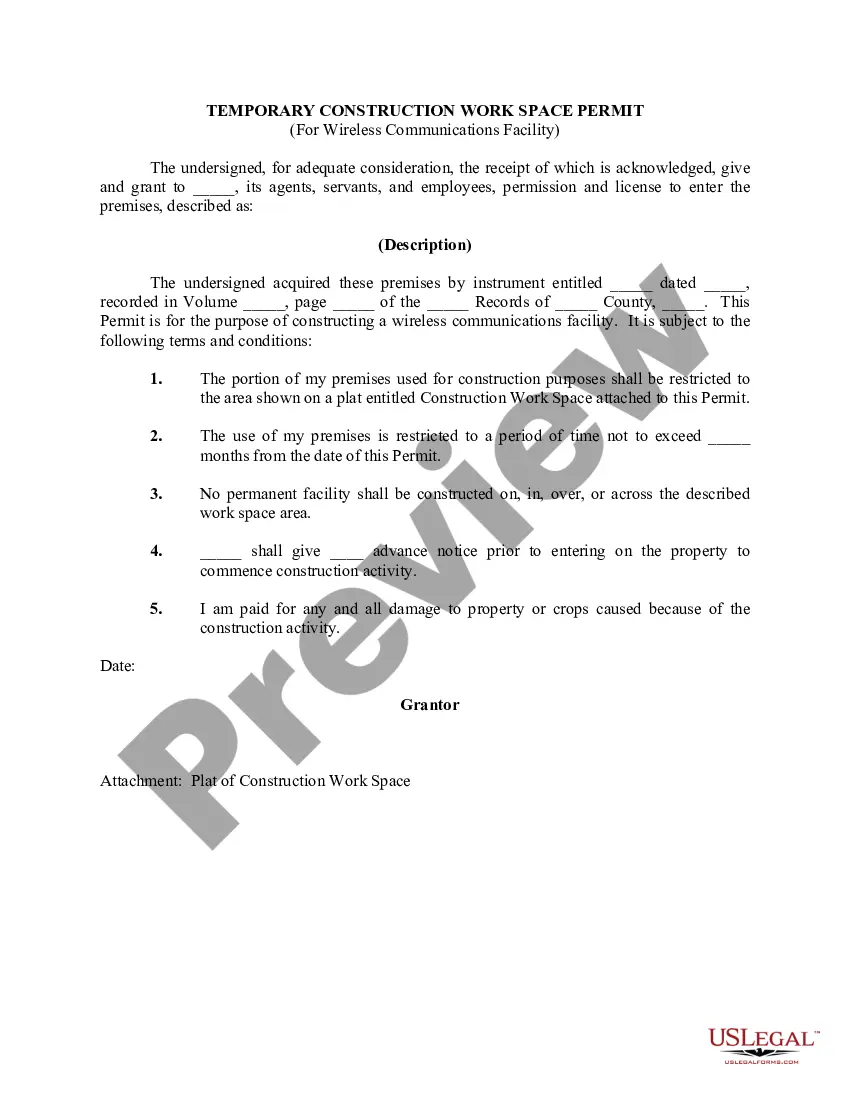
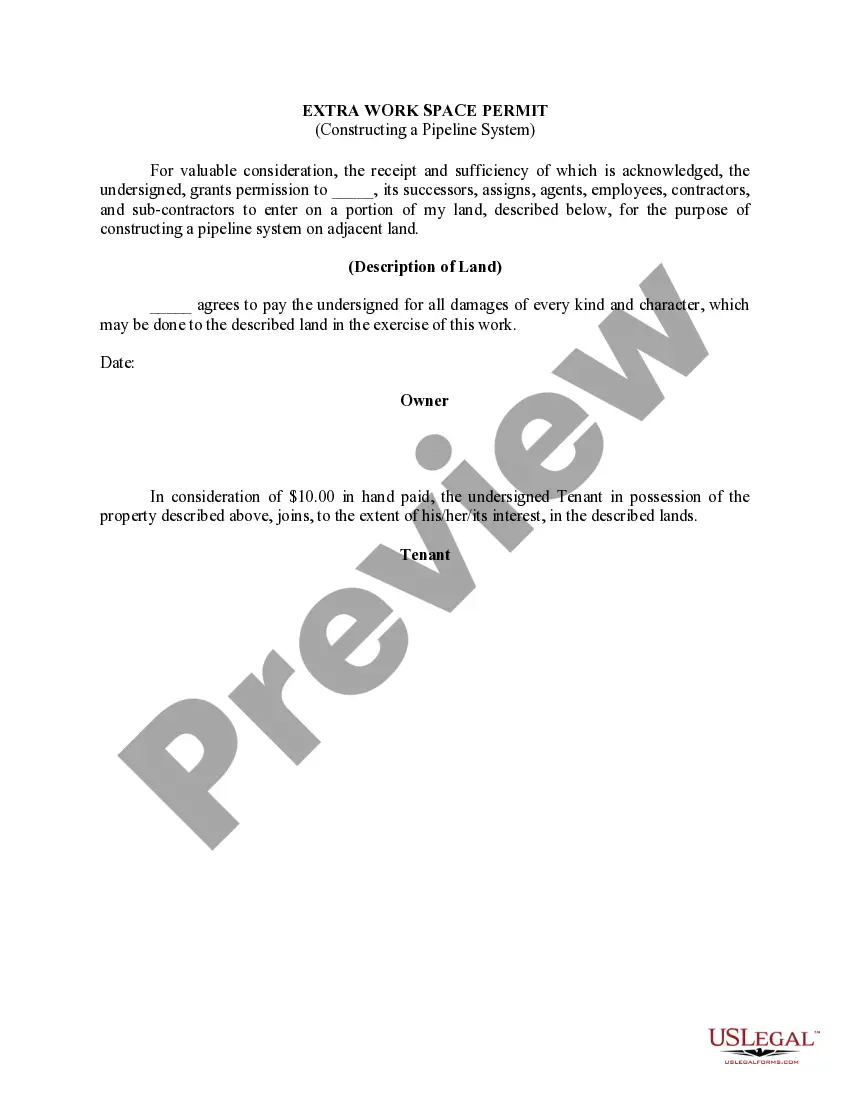
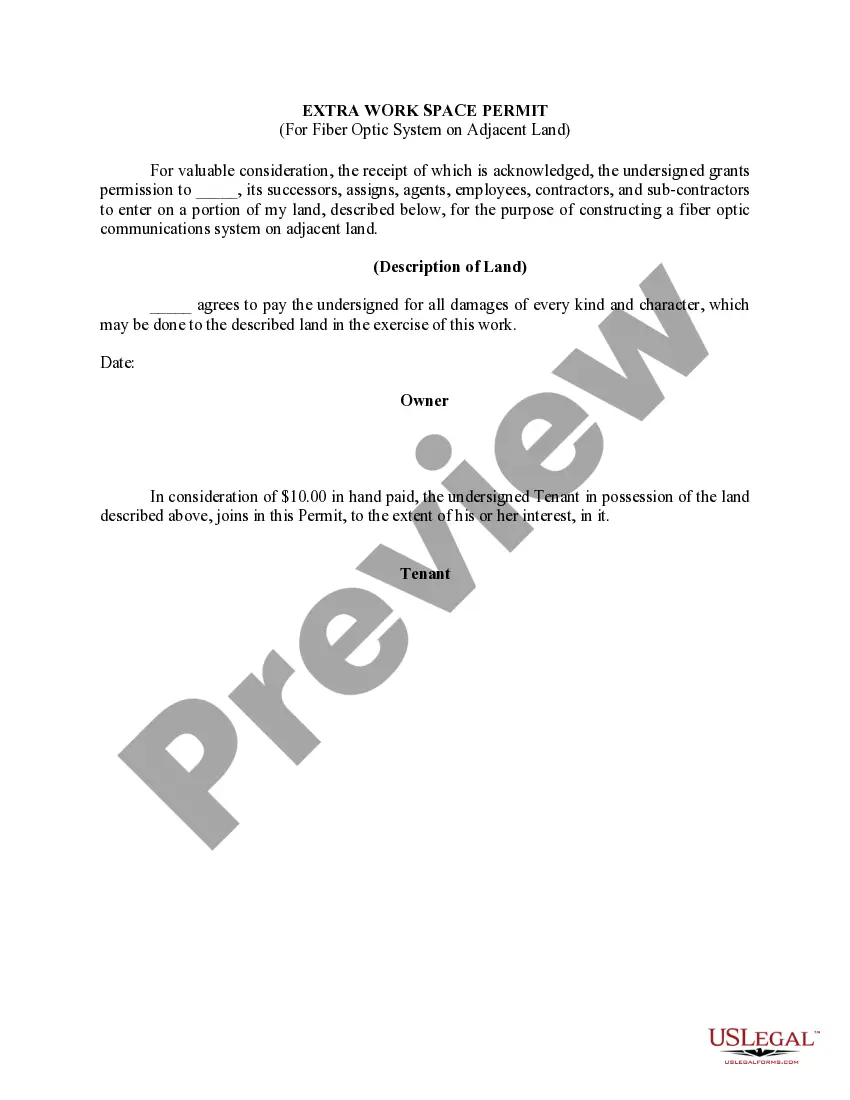
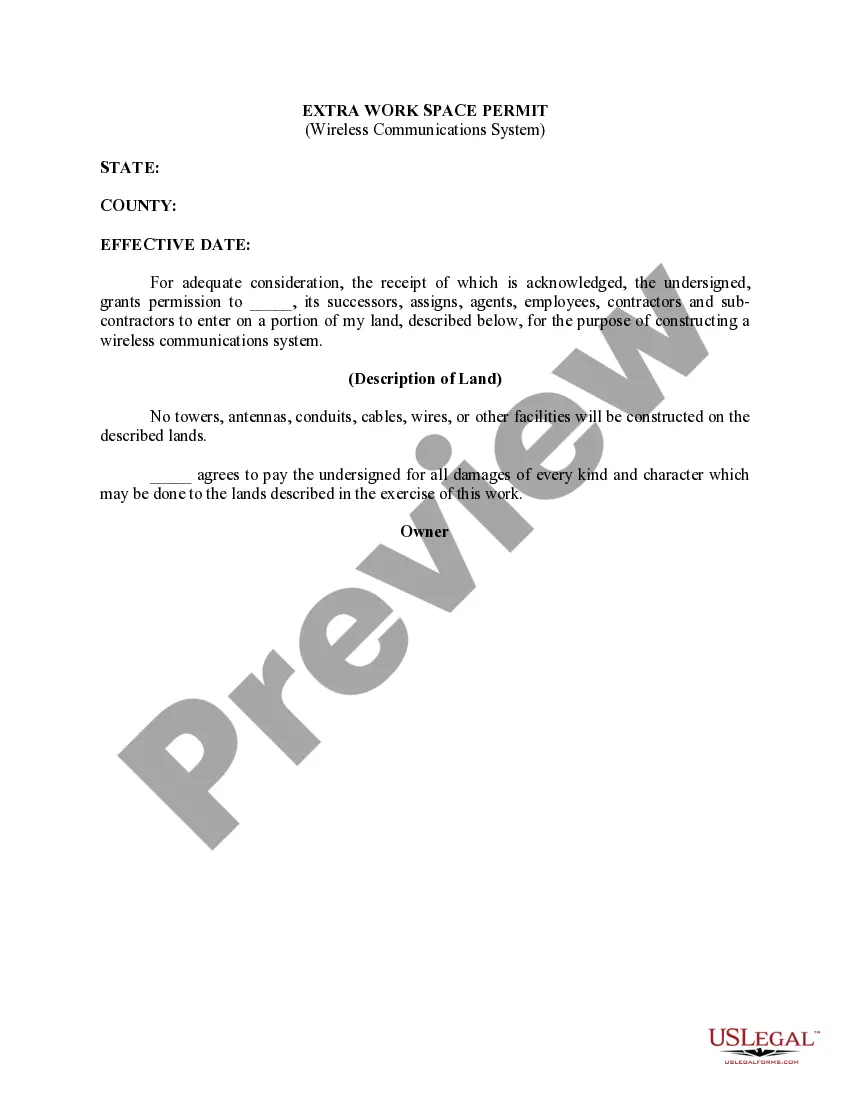
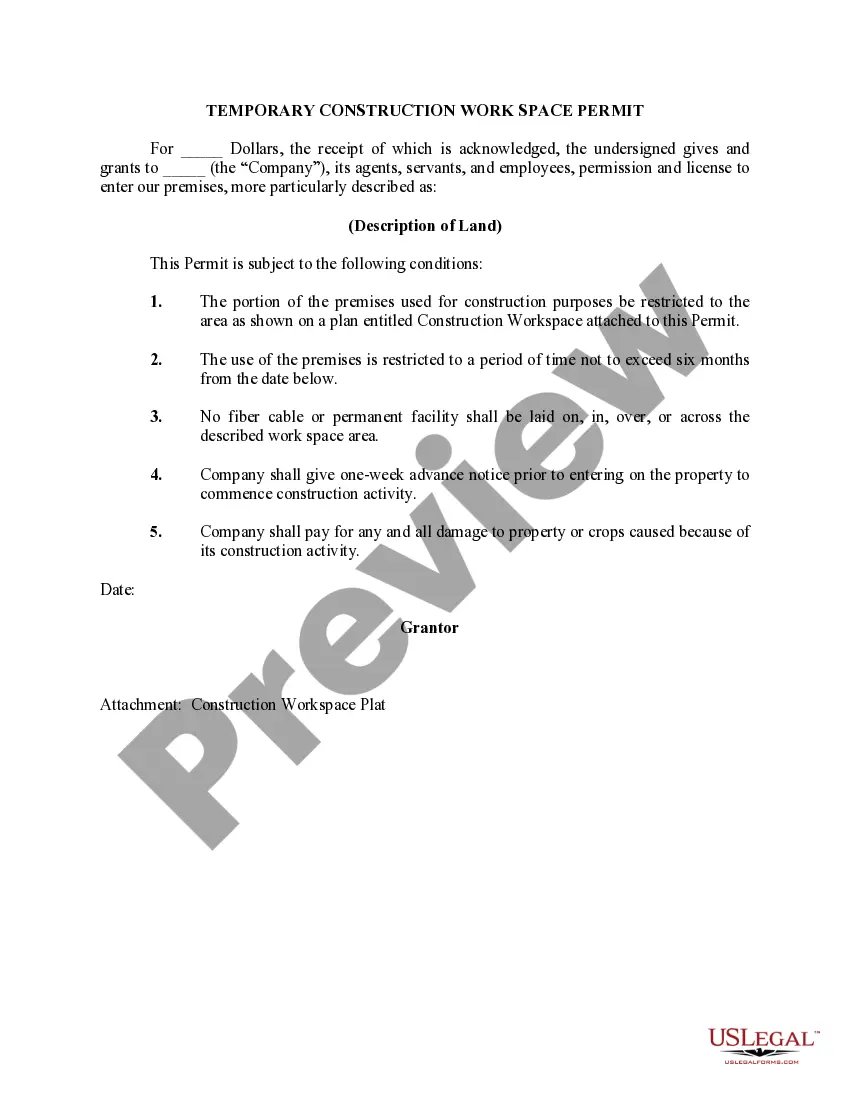
Wisconsin Temporary Construction Work Space Permit (For Wireless Communications Facility)
Description
Get your form ready online
Our built-in tools help you complete, sign, share, and store your documents in one place.
Make edits, fill in missing information, and update formatting in US Legal Forms—just like you would in MS Word.
Download a copy, print it, send it by email, or mail it via USPS—whatever works best for your next step.
Sign and collect signatures with our SignNow integration. Send to multiple recipients, set reminders, and more. Go Premium to unlock E-Sign.
If this form requires notarization, complete it online through a secure video call—no need to meet a notary in person or wait for an appointment.
We protect your documents and personal data by following strict security and privacy standards.

Make edits, fill in missing information, and update formatting in US Legal Forms—just like you would in MS Word.

Download a copy, print it, send it by email, or mail it via USPS—whatever works best for your next step.

Sign and collect signatures with our SignNow integration. Send to multiple recipients, set reminders, and more. Go Premium to unlock E-Sign.

If this form requires notarization, complete it online through a secure video call—no need to meet a notary in person or wait for an appointment.

We protect your documents and personal data by following strict security and privacy standards.
Looking for another form?




How to fill out Temporary Construction Work Space Permit (For Wireless Communications Facility)?
Finding the right legal file design can be a battle. Naturally, there are a variety of themes accessible on the Internet, but how would you find the legal type you require? Make use of the US Legal Forms internet site. The support offers a huge number of themes, for example the Wisconsin Temporary Construction Work Space Permit (For Wireless Communications Facility), which can be used for company and private requirements. All of the kinds are inspected by specialists and meet federal and state needs.
In case you are previously listed, log in to your profile and click on the Down load option to get the Wisconsin Temporary Construction Work Space Permit (For Wireless Communications Facility). Use your profile to appear throughout the legal kinds you may have ordered earlier. Proceed to the My Forms tab of your own profile and get yet another version in the file you require.
In case you are a whole new user of US Legal Forms, listed here are basic directions that you should adhere to:
- Very first, make certain you have chosen the proper type for your personal area/region. You can look over the shape utilizing the Review option and study the shape description to make certain this is basically the best for you.
- If the type does not meet your preferences, take advantage of the Seach field to find the appropriate type.
- Once you are certain the shape is proper, go through the Get now option to get the type.
- Opt for the rates strategy you would like and enter the necessary details. Build your profile and buy your order making use of your PayPal profile or credit card.
- Pick the document format and down load the legal file design to your system.
- Complete, edit and print out and signal the attained Wisconsin Temporary Construction Work Space Permit (For Wireless Communications Facility).
US Legal Forms is definitely the most significant local library of legal kinds for which you can find a variety of file themes. Make use of the company to down load professionally-produced papers that adhere to express needs.
Form popularity
FAQ
The Federal Communications Commission (FCC) sets exposure limits for RF energy from cell phone tower antennas. The FCC limits are based on standards developed by national and international organizations and consider the heating effects of RF energy.
Guidelines for Cellular Antenna Sites Although the FCC permits an effective radiated power (ERP) of up to 500 watts per channel (depending on the tower height), the majority of cellular or PCS cell sites in urban and suburban areas operate at an ERP of 100 watts per channel or less.
Cell tower companies are entities that own and operate cell towers. Tower companies either build or acquire towers from other tower companies or wireless carriers. These companies develop and operate towers to lease space on the towers to wireless providers.
To placate airline regulators, AT&T and Verizon have agreed to create a C-band ?buffer zone? around 50 airports. The cell carriers won't operate C-band cell towers within 1.3 miles (2100 m) of the end of any runway. They'll offer reduced C-band speeds for an additional 0.3 miles (540 m) beyond that.
Fall zone means the maximum area (the furthest distance from the tower base) in which a telecommunications facility will collapse in the event of a failure, usually less than the total height of the structure. This zone must be defined by a professional civil or structural engineer licensed in the state.
Unless the underlying jurisdiction does not require any zoning at all, most cell towers must be approved by the local land use office prior to being built.
The Federal Communications Commission (FCC) regulates systems such as cell phone towers. Exposure levels from cell phone towers must comply with the FCC's radiofrequency (RF) radiation exposure guidelines, which were developed to protect the public from RF-related health risks.