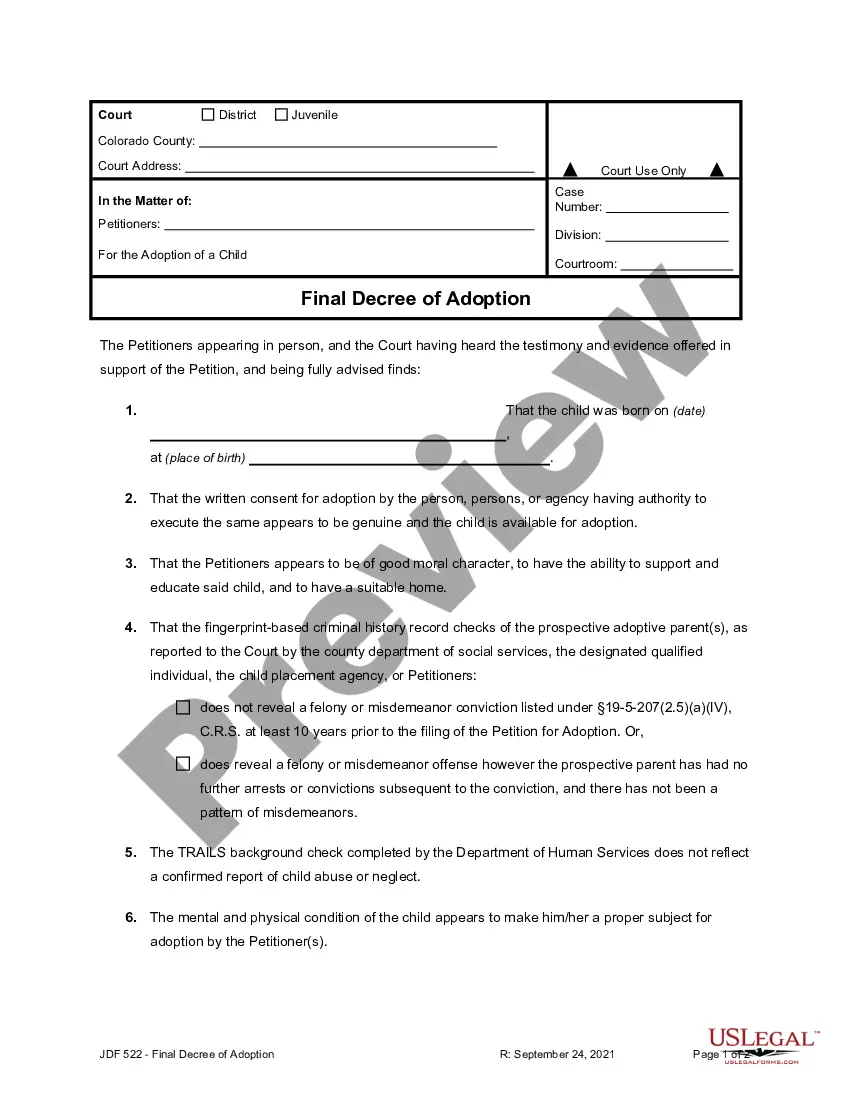
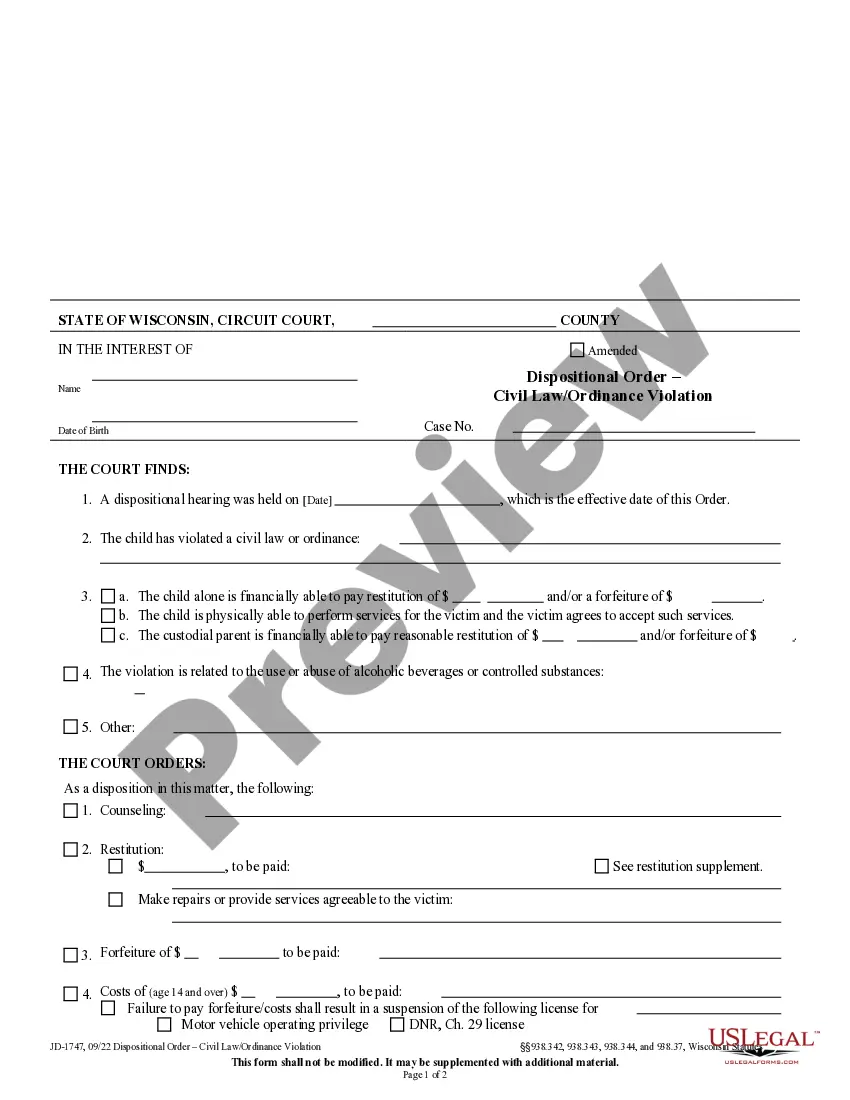
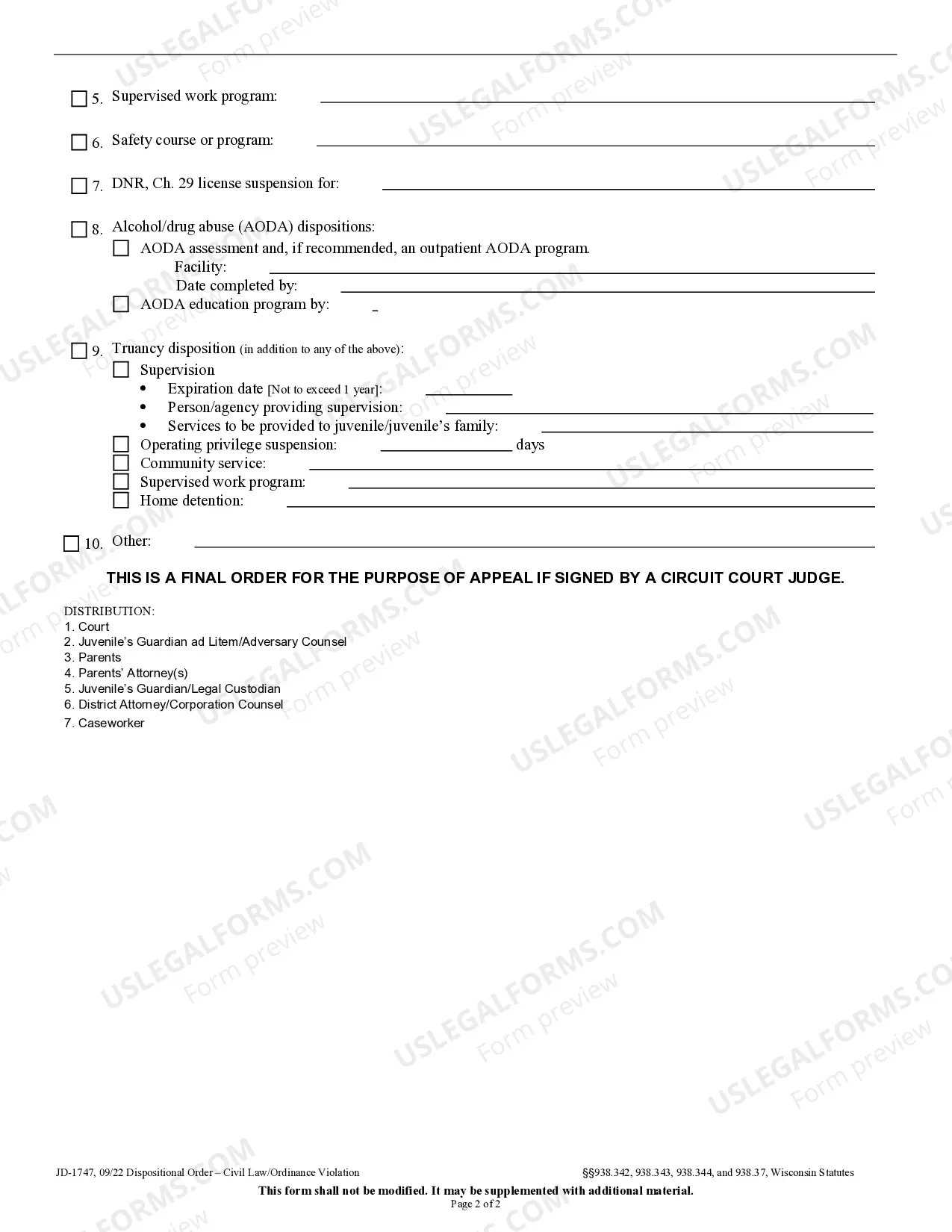
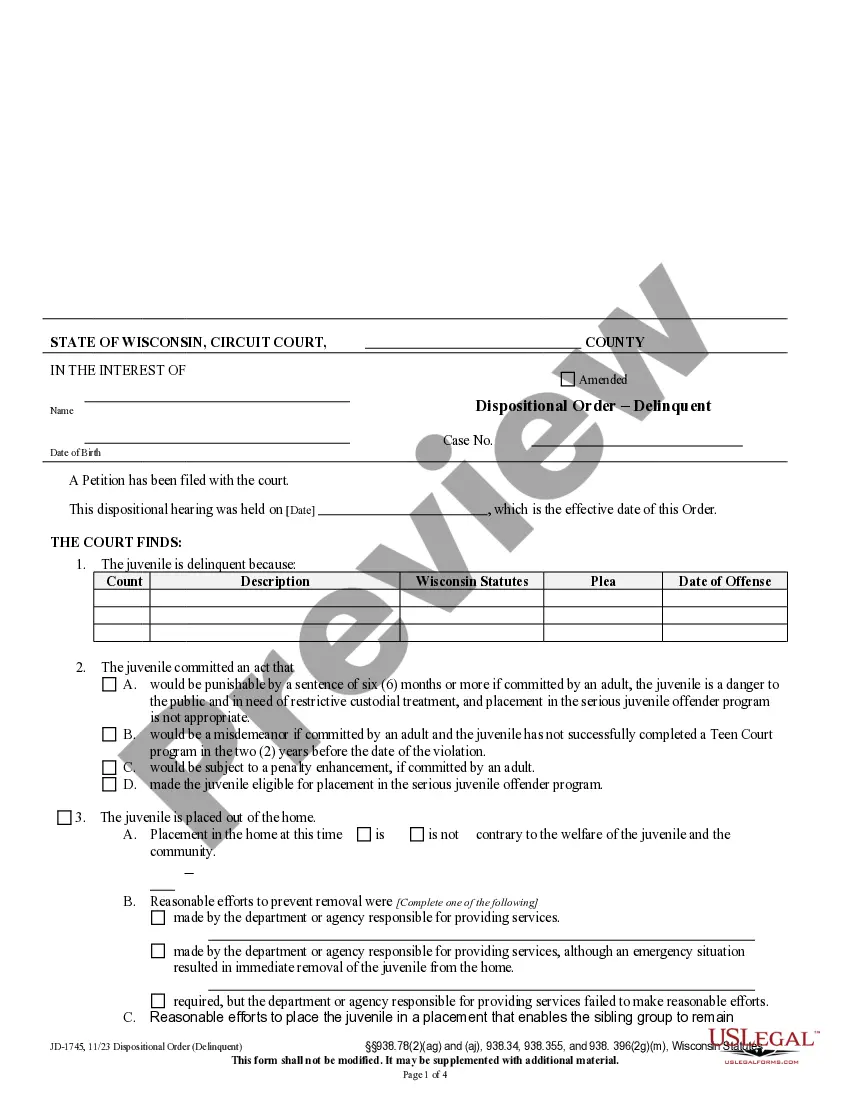
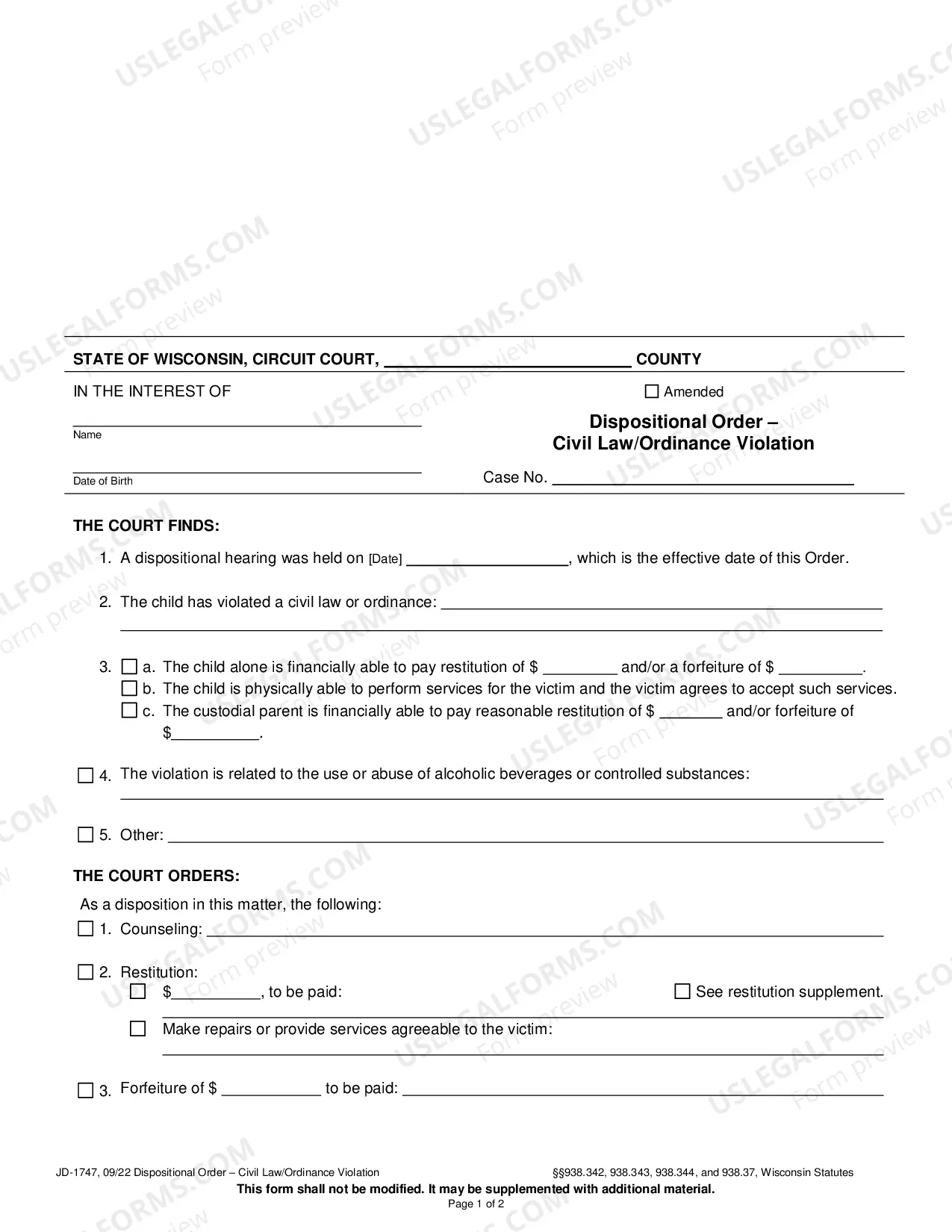
This is a Dispositional Order, to be used in the State of Wisconsin. This form is a Court Order detailing the disposition in a civil law/ordinance case.
Wisconsin Dispositional Order - Civil Law - Ordinance Violation
State:
Wisconsin
Category:
Control #:
WI-JD-1747
Format:
Word;
PDF;
Rich Text
Instant download
This website is not affiliated with any governmental entity
Public form
Description
Free preview
Get your form ready online
Our built-in tools help you complete, sign, share, and store your documents in one place.
Built-in online Word editor
Make edits, fill in missing information, and update formatting in US Legal Forms—just like you would in MS Word.
Export easily
Download a copy, print it, send it by email, or mail it via USPS—whatever works best for your next step.
E-sign your document
Sign and collect signatures with our SignNow integration. Send to multiple recipients, set reminders, and more. Go Premium to unlock E-Sign.
Notarize online 24/7
If this form requires notarization, complete it online through a secure video call—no need to meet a notary in person or wait for an appointment.
Store your document securely
We protect your documents and personal data by following strict security and privacy standards.

Make edits, fill in missing information, and update formatting in US Legal Forms—just like you would in MS Word.

Download a copy, print it, send it by email, or mail it via USPS—whatever works best for your next step.

Sign and collect signatures with our SignNow integration. Send to multiple recipients, set reminders, and more. Go Premium to unlock E-Sign.

If this form requires notarization, complete it online through a secure video call—no need to meet a notary in person or wait for an appointment.

We protect your documents and personal data by following strict security and privacy standards.
Looking for another form?

How to fill out Wisconsin Dispositional Order - Civil Law - Ordinance Violation?
Out of the great number of services that offer legal samples, US Legal Forms provides the most user-friendly experience and customer journey while previewing forms before purchasing them. Its complete library of 85,000 samples is grouped by state and use for simplicity. All of the forms available on the platform have already been drafted to meet individual state requirements by certified legal professionals.
If you have a US Legal Forms subscription, just log in, search for the template, press Download and gain access to your Form name in the My Forms; the My Forms tab keeps all your saved forms.
Keep to the guidelines below to obtain the document:
- Once you see a Form name, ensure it’s the one for the state you need it to file in.
- Preview the form and read the document description before downloading the sample.
- Look for a new template using the Search field if the one you have already found is not appropriate.
- Click on Buy Now and select a subscription plan.
- Create your own account.
- Pay with a credit card or PayPal and download the template.
After you have downloaded your Form name, it is possible to edit it, fill it out and sign it in an web-based editor of your choice. Any document you add to your My Forms tab might be reused multiple times, or for as long as it remains the most up-to-date version in your state. Our service provides quick and simple access to templates that fit both lawyers and their clients.
Form popularity
FAQ
ORDINANCE" SECTION 2 ISSUANCE OF ORDINANCE VIOLATION RECEIPT (OVR) - Any person who is cited for violation of any provision of a City Ordinance shall be issued an Ordinance Violation Receipt (OVR).
How Do I Fight a Disorderly Conduct Charge in Wisconsin? If the police charge you with disorderly conduct, contact a criminal defense attorney. Often, a criminal defense attorney can get your criminal charge reduced. Also, self-defense can be used to defeat a charge of disorderly conduct.
Ordinances are municipality-specific laws.In most situations, ordinance violations are relatively minor offenses, such as disorderly conduct or violating a local noise ordinance.
City Ordinance Violation Often, insurance companies do not have access to this information and it will not show up in your driving record.
A common thing you will hear is that these ordinance violations are civil cases, and they do not show up on background checks.Usually, expungement cases are decided by the Chief Judge in the given county. Often, the State's Attorney will object to your Petition to Expunge.
Ordinances generally govern matters not already covered by state or federal laws.Examples of ordinances would be those related to noise, snow removal, pet restrictions, and building and zoning regulations, to name a few.
Ordinances are municipality-specific laws.In many cases, ordinance violations are fairly minor offenses, like parking where parking is prohibited or violating a local noise ordinance. But sometimes, they are for more serious offenses, like shoplifting.
Understanding Ordinance ViolationsViolations of the municipal code may be prosecuted as ordinance violations instead of criminal offenses. Technically, an ordinance violation is not a criminal matter, and most are punishable by fines only. The practical consequences, however, may be more severe.