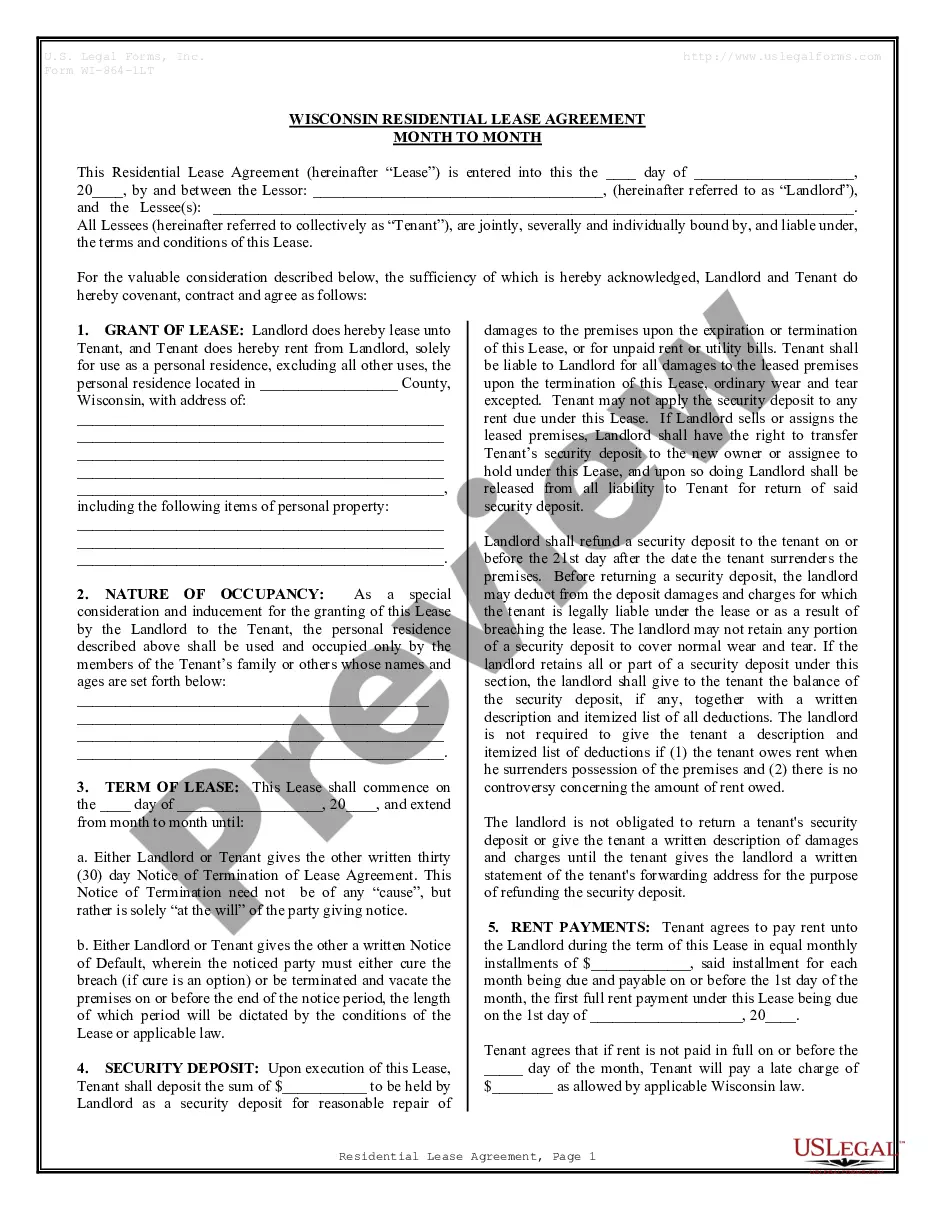
Residential Rental Lease Agreement
Wisconsin
CHAPTER 704
LANDLORD AND TENANT
Definitions.
In this chapter, unless the context indicates
otherwise: 704.01
(1) "Lease" means an agreement, whether oral or written, for transfer
of possession of real property, or both real and personal property, for
a definite period of time. A lease is for a definite period of time
if it has a fixed commencement date and a fixed expiration date or if the
commencement and expiration can be ascertained by reference to some event,
such as completion of a building. A lease is included within this
chapter even though it may also be treated as a conveyance under ch. 706.
An agreement for transfer of possession of only personal property is not
a lease. Chap. 704, 704.01(1)
(2) "Periodic tenant" means a tenant who holds possession without
a valid lease and pays rent on a periodic basis. It includes a tenant
from day-to-day, week-to-week, month-to-month, year-to-year or other recurring
interval of time, the period being determined by the intent of the parties
under the circumstances, with the interval between rent-paying dates normally
evidencing that intent. Chap. 704, 704.01(2)
(3) "Premises" mean the property covered by the lease, including
not only the realty and fixtures, but also any personal property furnished
with the realty. Chap. 704, 704.01(3)
(4) "Tenancy" includes a tenancy under a lease, a periodic tenancy
or a tenancy at will. Chap. 704, 704.01(4)
(5) "Tenant at will" means any tenant holding with the permission
of the tenant's landlord without a valid lease and under circumstances
not involving periodic payment of rent; but a person holding possession
of real property under a contract of purchase or an employment contract
is not a tenant under this chapter. Chap. 704, 704.01(5)
704.01 - ANNOT.
Landlords' liability for defective premises: caveat lessee, negligence, or strict liability. Love, 1975 WLR 19.
Requirement of writing for rental agreements and termination.
Chap. 704, 704.03
(1) Original agreement. A lease for more than a year,
or a contract to make such a lease, is not enforceable unless it meets
the requirements of s. 706.02 and in addition sets forth the amount
of rent or other consideration, the time of commencement and expiration
of the lease and a reasonably definite description of the premises, or
unless a writing signed by the landlord and the tenant sets forth the amount of
rent or other consideration, the duration of the lease and a reasonably
definite description of the premises and the commencement date is established
by entry of the tenant into possession under the writing. Sections 704.05
and 704.07 govern as to matters within the scope of such sections and not
provided for in such written lease or contract. Chap. 704, 704.03(1)
(2) Entry under unenforceable lease. If a tenant enters
into possession under a lease for more than one year which does not meet
the requirements of sub. (1), and the tenant pays rent on a periodic basis,
the tenant becomes a periodic tenant. If the premises in such case
are used for residential purposes and the rent is payable monthly, the
tenant becomes a month-to-month tenant; but if the use is agricultural
or nonresidential, the tenant becomes a year-to-year tenant without regard
to the rent-payment periods. Except for duration of the tenancy and
matters within the scope of ss. 704.05 and 704.07, the tenancy is governed
by the terms and conditions agreed upon. Notice as provided in s.
704.19 is necessary to terminate such a periodic tenancy. Chap. 704, 704.03(2)
(3) Assignment. An assignment by the tenant of a leasehold
interest which has an unexpired period of more than one year is not enforceable
against the assignor unless the assignment is in writing reasonably identifying
the lease and signed by the assignor; and any agreement to assume the obligations
of the original lease which has an unexpired period of more than one year
is not enforceable unless in writing signed by the assignee. Chap. 704,
704.03(3)
(4) Termination of written lease prior to normal expiration date.
An agreement to terminate a tenancy more than one year prior to the expiration
date specified in a valid written lease is not enforceable unless it is
in writing signed by both parties. Any other agreement between the
landlord and tenant to terminate a lease prior to its normal expiration
date, or to terminate a periodic tenancy or tenancy at will without the
statutory notice required by s. 704.19 may be either oral or written. Nothing
herein prevents surrender by operation of law. Chap. 704, 704.03(4)
(5) Proof. In any case where a lease or agreement is
not in writing signed by both parties but is enforceable under this section,
the lease or agreement must be proved by clear and convincing evidence.
Chap. 704, 704.03(5)
704.03 - ANNOT.
If there is no written lease, section 704.07 applies to the obligation to make repairs. For there to be a remedy for
a breach of a duty to repair other than that provided in s. 704.07, the
obligation must be in a written lease signed by both parties. Halverson
v. River Falls Youth Hockey Association, 226 Wis. 2d 105, 593 N.W.2d 895
(Ct. App. 1999).
Rights and duties of landlord and tenant in absence of written
agreement to contrary. Chap. 704, 704.05
(1) When section applicable. So far as applicable,
this section governs the rights and duties of the landlord and tenant in
the absence of any inconsistent provision in writing signed by both the
landlord and the tenant. This section applies to any tenancy. Chap.
704, 704.05(1)
(2) Possession of tenant and access by landlord. Until
the expiration date specified in the lease, or the termination of a periodic
tenancy or tenancy at will, and so long as the tenant is not in default,
the tenant has the right to exclusive possession of the premises, except
as hereafter provided. The landlord may upon advance notice and at reasonable
times inspect the premises, make repairs and show the premises to prospective
tenants or purchasers; and if the tenant is absent from the premises and
the landlord reasonably believes that entry is necessary to preserve or
protect the premises, the landlord may enter without notice and with such
force as appears necessary. Chap. 704, 704.05(2)
(3) Use of premises, additions or alterations by tenant.
The tenant can make no physical changes in the nature of the premises,
including decorating, removing, altering or adding to the structures thereon,
without prior consent of the landlord. The tenant cannot use the premises
for any unlawful purpose nor in such manner as to interfere unreasonably
with use by another occupant of the same building or group of buildings.
Chap. 704, 704.05(3)
(4) Tenant's fixtures. At the termination of the tenancy,
the tenant may remove any fixtures installed by the tenant if the tenant
either restores the premises to their condition prior to the installation
or pays to the landlord the cost of such restoration. Where such fixtures
were installed to replace similar fixtures which were part of the premises
at the time of the commencement of the tenancy, and the original fixtures
cannot be restored the tenant may remove fixtures installed by the tenant
only if the tenant replaces them with fixtures at least comparable in condition
and value to the original fixtures. The tenant's right to remove
fixtures is not lost by an extension or renewal of a lease without reservation
of such right to remove. This subsection applies to any fixtures
added by the tenant for convenience as well as those added for purposes
of trade, agriculture or business; but this subsection does not govern
the rights of parties other than the landlord and tenant. Chap. 704, 704.05(4)
(5)Storage or disposition of personalty left by tenant. Chap.
704, 704.05(5)
(a) Procedure. If a tenant removes from the
premises and leaves personal property, the landlord may do all of the following:
Chap. 704, 704.05(5)(a)
1. Store the personalty, on or off the premises, with a lien
on the personalty for the actual and reasonable cost of removal and storage
or, if stored by the landlord, for the actual and reasonable value of storage.
The landlord shall give written notice of the storage to the tenant within
10 days after the charges begin. The landlord shall give the notice either
personally or by ordinary mail addressed to the tenant's last-known address
and shall state the daily charges for storage. The landlord may not
include the cost of damages to the premises or past or future rent due
in the amount demanded for satisfaction of the lien. The landlord
may not include rent charged for the premises in calculating the cost of
storage. Medicine and medical equipment are not subject to the lien under
this subdivision, and the landlord shall promptly return them to the tenant
upon request. Chap. 704, 704.05(5)(a)1.
2. Give the tenant notice, personally or by ordinary mail
addressed to the tenant's last-known address, of the landlord's intent
to dispose of the personalty by sale or other appropriate means if the
property is not repossessed by the tenant. If the tenant fails to
repossess the property within 30 days after the date of personal service or the date of
the mailing of the notice, the landlord may dispose of the property by
private or public sale or any other appropriate means. The landlord
may deduct from the proceeds of sale any costs of sale and any storage
charges if the landlord has first stored the personalty under subd. 1.
If the proceeds minus the costs of sale and minus any storage charges are
not claimed within 60 days after the date of the sale of the personalty,
the landlord is not accountable to the tenant for any of the proceeds of
the sale or the value of the property. The landlord shall send the
proceeds of the sale minus the costs of the sale and minus any storage
charges to the department of administration for deposit in the appropriation
under s. 20.505 (7) (gm). Chap. 704, 704.05(5)(a)2.
(c)Rights of third persons. The landlord's lien and power
to dispose as provided by this subsection apply to any property left on
the premises by the tenant, whether owned by the tenant or by others. That
lien has priority over any ownership or security interest, and the power
to dispose under this subsection applies notwithstanding rights of others
existing under any claim of ownership or security interest.
The tenant or any secured party has the right to redeem the property at
any time before the landlord has disposed of it or entered into a contract
for its disposition by payment of the landlord's charges under par. (a)
for removal, storage, disposition and arranging for the sale. Chap. 704,
704.05(5)(c)
(d) Other procedure. The remedies of this subsection
are not exclusive and shall not prevent the landlord from resorting to
any other available judicial procedure. Chap. 704, 704.05(5)(d)
704.05 - ANNOT.
Constructive eviction discussed. First Wis. Trust Co. v.
L. Wiemann Co. 93 Wis. 2d 258, 286 N.W.2d 360 (1980).
Allegation in lessee's complaint that premises were undamaged did not relieve lessor of burden to prove damages. Rivera v.
Eisenberg, 95 Wis. 2d 384, 290 N.W.2d 539 (Ct. App. 1980).
Landlords' liability for defective premises: caveat lessee, negligence, or strict liability. Love, 1975 WLR 19.
Water heater thermostat settings.
A landlord of premises which are subject to a residential tenancy and served by a water heater
serving only that premises shall set the thermostat of that water heater
at no higher than 125 degrees Fahrenheit before any new tenant occupies
that premises or at the minimum setting of that water heater if the minimum
setting is higher than 125 degrees Fahrenheit. Chap. 704, 704.06
704.06 - ANNOT.
Repairs; untenantability. 704.07
(1)Application of section. This section applies to
any nonresidential tenancy if there is no contrary provision in writing
signed by both parties and to all residential tenancies. An agreement to
waive the requirements of this section in a residential tenancy is void.
Nothing in this section is intended to affect rights and duties arising
under other provisions of the statutes. Chap. 704, 704.07(1)
(2) Duty of landlord. Chap. 704, 704.07(2)
(a) Unless the repair was made necessary by the negligence
or improper use of the premises by the tenant, the landlord is under duty
to: Chap. 704, 704.07(2)(a)
2. Keep in a reasonable state of repair all equipment under
the landlord's control necessary to supply services which the landlord
has expressly or impliedly agreed to furnish to the tenant, such as heat,
water, elevator or air conditioning; Chap. 704, 704.07(2)(a)2.
4. Except for residential premises subject to a local housing
code, repair or replace any plumbing, electrical wiring, machinery or equipment
furnished with the premises and no longer in reasonable working condition,
except as provided in sub. (3) (b). Chap. 704, 704.07(2)(a)4.
(b) If the premises are part of a building, other parts of
which are occupied by one or more other tenants, negligence or improper
use by one tenant does not relieve the landlord from the landlord's duty
as to the other tenants to make repairs as provided in par. (a). Chap.
704, 704.07(2)(b)
(c) If the premises are damaged by fire, water or other casualty,
not the result of the negligence or intentional act of the landlord, this
subsection is inapplicable and either sub. (3) or (4) governs. Chap. 704,
704.07(2)(c)
(3) Duty of tenant. Chap. 704, 704.07(3)
(a) If the premises are damaged by the negligence or improper
use of the premises by the tenant, the tenant must repair the damage and
restore the appearance of the premises by redecorating. However,
the landlord may elect to undertake the repair or redecoration, and in
such case the tenant must reimburse the landlord for the reasonable cost
thereof; the cost to the landlord is presumed reasonable unless proved
otherwise by the tenant. Chap. 704, 704.07(3)(a)
(b) Except for residential premises subject to a local housing
code, the tenant is also under a duty to keep plumbing, electrical wiring,
machinery and equipment furnished with the premises in reasonable working
order if repair can be made at cost which is minor in relation to the rent.
Chap. 704, 704.07(3)(b)
(c) A tenant in a residential tenancy shall comply with a
local housing code applicable to the premises. Chap. 704, 704.07(3)(c)
(4) Untenantability. If the premises become untenantable
because of damage by fire, water or other casualty or because of any condition
hazardous to health, or if there is a substantial violation of sub. (2)
materially affecting the health or safety of the tenant, the tenant may
remove from the premises unless the landlord proceeds promptly to repair
or rebuild or eliminate the health hazard or the substantial violation
of sub. (2) materially affecting the health or safety of the tenant; or
the tenant may remove if the inconvenience to the tenant by reason of the
nature and period of repair, rebuilding or elimination would impose undue
hardship on the tenant. If the tenant remains in possession, rent
abates to the extent the tenant is deprived of the full normal use of the
premises. This section does not authorize rent to be withheld in
full, if the tenant remains in possession. If the tenant justifiably
moves out under this subsection, the tenant is not liable for rent after
the premises become untenantable and the landlord must repay any rent paid
in advance apportioned to the period after the premises become untenantable.
This subsection is inapplicable if the damage or condition is caused by
negligence or improper use by the tenant. Chap. 704, 704.07(4)
704.07 - ANNOT.
The remedy provided by (3) does not exclude diminution of market
value as an alternative method of computing such damages, and although
the former is to be preferred where the property is easily repairable and
the latter where the injury does not destroy the property, evidence of
each method may be introduced by either party with the lesser amount awardable
as the proper measure of damages. Laska v. Steinpreis, 69 Wis. 2d
307, 231 N.W.2d 196.
Landlord must exercise ordinary care toward tenant and others on
premises with permission. Pagelsdorf v. Safeco Ins. Co. of America,
91 Wis. 2d 734, 284 N.W.2d 55 (1979).
Sub. (3) (a) requires a tenant to pay for damage which the tenant
negligently causes to a landlord's property regardless of whether the landlord
or landlord's insurer initially pays for the damage. Bennett v. West
Bend Mutual Ins. Co. 200 Wis. 2d 313, 546 N.W.2d 204 (Ct. App. 1996).
If there is no written lease, section 704.07 applies to the obligation
to make repairs. For there to be a remedy for a a breach of a duty
to repair other than that provided in s. 704.07, the obligation must be
in a written lease signed by both parties. Halverson v. River Falls Youth
Hockey Association, 226 Wis. 2d 105, 593 N.W.2d 895 (Ct. App. 1999).
Landlord and tenant law-- the implied warranty of habitability in
residential leases. 58 MLR 191.
Landlord no longer immune from tort liability for failure to exercise
reasonable care in maintaining premises. 64 MLR 563
(1981).
Transferability; effect of assignment or transfer; remedies.
Chap. 704, 704.09
(1) Transferability of interest of tenant or landlord. A
tenant under a tenancy at will or any periodic tenancy less than year-to-year
may not assign or sublease except with the agreement or consent of the
landlord. The interest of any other tenant or the interest of any landlord
may be transferred except as the lease expressly restricts power to transfer.
A lease restriction on transfer is construed to apply only to voluntary
transfer unless there is an express restriction on transfer by operation
of law. Chap. 704, 704.09(1)
(2) Effect of transfer on liability of transferor. In the
absence of an express release or a contrary provision in the lease, transfer
or consent to transfer does not relieve the transferring party of any contractual
obligations under the lease, except in the special situation governed by
s. 704.25 (5). Chap. 704, 704.09(2)
(3) Covenants which apply to transferee. All covenants and
provisions in a lease which are not either expressly or by necessary implication
personal to the original parties are enforceable by or against the successors
in interest of any party to the lease. However, a successor in interest
is liable in damages, or entitled to recover damages, only for a breach
which occurs during the period when the successor holds his or her interest,
unless the successor has by contract assumed greater liability; a personal
representative may also recover damages for a breach for which the personal
representative's decedent could have recovered. Chap. 704, 704.09(3)
(4) Same procedural remedies. The remedies available between
the original landlord and tenant are also available to or against any successor
in interest to either party. Chap. 704, 704.09(4)
(5) Consent as affecting subsequent transfers. If a lease restricts
transfer, consent to a transfer or waiver of a breach of the restriction
is not a consent or waiver as to any subsequent transfers. Chap. 704, 704.09(5)
704.09 - ANNOT.
Lien of landlord. Except as provided in ss. 704.05
(5), 704.90 and 779.43 or by express agreement of the parties, the
landlord has no right to a lien on the property of the tenant; the common-law
right of a landlord to distrain for rent is abolished. Chap. 704, 704.11
704.11 - ANNOT.
Acts of tenant not to affect rights of landlord.
No act of a tenant in acknowledging as landlord a person other than the tenant's
original landlord or the latter's successors in interest can prejudice
the right of the original landlord or the original landlord's successors
to possession of the premises. Chap. 704, 704.13
704.13 - ANNOT.
Requirement that landlord notify tenant of automatic renewal
clause.
A provision in a lease of residential property that the
lease shall be automatically renewed or extended for a specified period
unless the tenant or either party gives notice to the contrary prior to
the end of the lease is not enforceable against the tenant unless the lessor,
at least 15 days but not more than 30 days prior to the time specified
for the giving of such notice to the lessor, gives to the tenant written
notice in the same manner as specified in s. 704.21 calling the attention
of the tenant to the existence of the provision in the lease for automatic
renewal or extension. Chap. 704, 704.15
704.15 - ANNOT.
Notice terminating tenancies for failure to pay rent or other
breach by tenant. 704.17
(1) Month-to-month and week-to-week tenancies. Chap. 704, 704.17(1)
(a) If a month-to-month tenant or a week-to-week tenant fails
to pay rent when due, the tenant's tenancy is terminated if the landlord
gives the tenant notice requiring the tenant to pay rent or vacate on or
before a date at least 5 days after the giving of the notice and if the
tenant fails to pay accordingly. A month-to-month tenancy is terminated
if the landlord, while the tenant is in default in payment of rent, gives
the tenant notice requiring the tenant to vacate on or before a date at
least 14 days after the giving of the notice. Chap. 704, 704.17(1)(a)
(b) If a month-to-month tenant commits waste or a material
violation of s. 704.07 (3) or breaches any covenant or condition of the
tenant's agreement, other than for payment of rent, the tenancy can be
terminated if the landlord gives the tenant notice requiring the tenant
to vacate on or before a date at least 14 days after the giving of the
notice. Chap. 704, 704.17(1)(b)
(c) A property owner may terminate the tenancy of a week-to-week
or month-to-month tenant if the property owner receives written notice
from a law enforcement agency of a city, town or village that a nuisance
under s. 823.113 (1) or (1m) (b) exists in that tenant's rental unit or
was caused by that tenant on the property owner's property and if the property
owner gives the tenant written notice requiring the tenant to vacate on
or before a date at least 5 days after the giving of the notice. The notice
shall state the basis for its issuance and the right of the tenant to contest
the termination of tenancy in an eviction action under ch. 799. If the
tenant contests the termination of tenancy, the tenancy may not be terminated
without proof by the property owner by the greater preponderance of the
credible evidence of the allegation in the notice from the law enforcement
agency of a city, town or village that a nuisance under s. 823.113 (1)
or (1m) (b) exists in that tenant's rental unit or was caused by that tenant.
Chap. 704, 704.17(1)(c)
(2) Tenancies under a lease for one year or less, and year-to-year
tenancies. Chap. 704, 704.17(2)
(a) If a tenant under a lease for a term of one year or less,
or a year-to-year tenant, fails to pay any installment of rent when due,
the tenant's tenancy is terminated if the landlord gives the tenant notice
requiring the tenant to pay rent or vacate on or before a date at least
5 days after the giving of the notice and if the tenant fails to pay accordingly.
If a tenant has been given such a notice and has paid the rent on or before
the specified date, or been permitted by the landlord to remain in possession
contrary to such notice, and if within one year of any prior default in
payment of rent for which notice was given the tenant fails to pay a subsequent
installment of rent on time, the tenant's tenancy is terminated if the landlord,
while the tenant is in default in payment of rent, gives the tenant notice
to vacate on or before a date at least 14 days after the giving of the
notice. Chap. 704, 704.17(2)(a)
(b) If a tenant under a lease for a term of one year or less,
or a year-to-year tenant, commits waste or a material violation of s. 704.07
Chap. 704, 704.17(2)(b)(3) or breaches any covenant or condition of the tenant's lease,
other than for payment of rent, the tenant's tenancy is terminated if the
landlord gives the tenant a notice requiring the tenant to remedy the default
or vacate the premises on or before a date at least 5 days after the giving
of the notice, and if the tenant fails to comply with such notice.
A tenant is deemed to be complying with the notice if promptly upon receipt
of such notice the tenant takes reasonable steps to remedy the default
and proceeds with reasonable diligence, or if damages are adequate protection
for the landlord and the tenant makes a bona fide and reasonable offer
to pay the landlord all damages for the tenant's breach. If within one
year from the giving of any such notice, the tenant again commits waste
or breaches the same or any other covenant or condition of the tenant's
lease, other than for payment of rent, the tenant's tenancy is terminated
if the landlord, prior to the tenant's remedying the waste or breach, gives
the tenant notice to vacate on or before a date at least 14 days after
the giving of the notice.
(c) A property owner may terminate the tenancy of a tenant
who is under a lease for a term of one year or less or who is a year-to-year
tenant if the property owner receives written notice from a law enforcement
agency of a city, town or village that a nuisance under s. 823.113 (1)
or (1m) (b) exists in that tenant's rental unit or was caused by that tenant
on the property owner's property and if the property owner gives the tenant
written notice requiring the tenant to vacate on or before a date at least
5 days after the giving of the notice. The notice shall state the
basis for its issuance and the right of the tenant to contest the termination
of tenancy in an eviction action under ch. 799. If the tenant contests
the termination of tenancy, the tenancy may not be terminated without proof
by the property owner by the greater preponderance of the credible evidence of the allegation in the
notice from the law enforcement agency of a city, town or village that
a nuisance under s. 823.113 (1) or (1m) (b) exists in that tenant's rental
unit or was caused by that tenant. Chap. 704, 704.17(2)(c)
(3) Lease for more than one year. 704.17(3)
(a) If a tenant under a lease for more than one year fails
to pay rent then due, or commits waste, or breaches any other covenant
or condition of the tenant's lease, the tenancy is terminated if the landlord
gives the tenant notice requiring the tenant to pay the rent, repair the
waste, or otherwise comply with the lease on or before a date at least
30 days after the giving of the notice, and if the tenant fails to comply
with the notice. A tenant is deemed to be complying with the notice
if promptly upon receipt of the notice the tenant takes reasonable steps
to remedy the default and proceeds with reasonable diligence, or if damages
are adequate protection for the landlord and the tenant makes a bona fide
and reasonable offer to pay the landlord all damages for the tenant's breach;
but in case of failure to pay rent, all rent due must be paid on or before
the date specified in the notice. Chap. 704, 704.17(3)(a)
(b) A property owner may terminate the tenancy of a tenant
who is under a lease for a term of more than one year if the property owner
receives written notice from a law enforcement agency of a city, town or
village that a nuisance under s. 823.113 (1) or (1m) (b) exists in that
tenant's rental unit or was caused by that tenant on the property owner's
property and if the property owner gives the tenant written notice to vacate
on or before a date at least 5 days after the giving of the notice. The
notice shall state the basis for its issuance and the right of the tenant
to contest the termination of tenancy in an eviction action under ch. 799.
If the tenant contests the termination of tenancy, the tenancy may not
be terminated without proof by the property owner by the greater preponderance
of the credible evidence of the allegation in the notice from the law enforcement
agency of a city, town or village that a nuisance under s. 823.113 (1)
or (1m) (b) exists in that tenant's rental unit or was caused by that tenant.
Chap. 704, 704.17(3)(b)
(4) Form of notice and manner of giving. Notice must
be in writing and given as specified in s. 704.21. If so given, the
tenant is not entitled to possession or occupancy of the premises after
the date of termination specified in the notice. Chap. 704, 704.17(4)
(5) Contrary provision in the lease. Provisions in
the lease or rental agreement for termination contrary to this section
are invalid except in leases for more than one year. Chap. 704, 704.17(5)
704.17 - ANNOT.
Only a limited number of defenses may be raised in an eviction
action, including such defenses as the landlord's title to the
premises and whether the eviction was in retaliation for the tenant's reporting
housing violations, but not including those raised by defendants as to
violation of federal antitrust and state franchise laws as well as public
policy defenses. Clark Oil & Refining Corp. v. Leistikow, 69
Wis. 2d 226, 230 N.W.2d 736.
Absent notice of termination, the violation of the terms of a lease that required landlord permission for long term guests did
not result in in the tenants losing their rights to possession of the property.
Consequently the tenants' guests were on the premises with the legal possessor's
permission and were not trespassers. Johnson v. Blackburn, 220 Wis. 2d
260, 582 N.W.2d 488 (Ct. App. 1998).
Notice necessary to terminate periodic tenancies and tenancies
at will. 704.19
(1) Scope of section. The following types of tenancies,
however created, are subject to this section: Chap. 704, 704.19(1)
(a) A periodic tenancy, whether a tenancy from year-to-year,
from month-to-month, or for any other periodic basis according to which
rent is regularly payable; (Chap. 704, 704.19(1)(a), and
(b) A tenancy at will. (Chap. 704, 704.19(1)(b)
(2) Requirement of notice. (Chap. 704, 704.19(2)
(a) A periodic tenancy or a tenancy at will can be terminated
by either the landlord or the tenant only by giving to the other party
written notice complying with this section, unless any of the following
conditions is met: (Chap. 704, 704.19(2)(a)
(b) A periodic tenancy can be terminated by notice under this
section only at the end of a rental period. In the case of a tenancy
from year-to-year the end of the rental period is the end of the rental
year even though rent is payable on a more frequent basis. Nothing
in this section prevents termination of a tenancy for nonpayment of rent
or breach of any other condition of the tenancy, as provided in s. 704.17.
Chap. 704, 704.19(2)(b)
(3) Length of notice. At least 28 days' notice must be given
except in the following cases: If rent is payable on a basis less than
monthly, notice at least equal to the rent-paying period is sufficient;
all agricultural tenancies from year-to-year require at least 90 days'
notice. Chap. 704, 704.19(3)
(4) Contents of notice. Notice must be in writing, formal
or informal, and substantially inform the other party to the landlord-tenant
relation of the intent to terminate the tenancy and the date of termination.
A notice is not invalid because of errors in the notice which do not mislead,
including omission of the name of one of several landlords or tenants.
Chap. 704, 704.19(4)
(5) Effect of inaccurate termination date in notice. If a
notice provides that a periodic tenancy is to terminate on the first day
of a succeeding rental period rather than the last day of a rental period,
and the notice was given in sufficient time to terminate the tenancy at
the end of the rental period, the notice is valid; if the notice was given
by the tenant, the landlord may require the tenant to remove on the last
day of the rental period, but if the notice was given by the landlord the
tenant may remove on the last day specified in the notice. If a notice
specified any other inaccurate termination date, because it does not allow
the length of time required under sub. (3) or because it does not correspond
to the end of a rental period in the case of a periodic tenancy, the notice
is valid but not effective until the first date which could have been properly
specified in such notice subsequent to the date specified in the notice,
but the party to whom the notice is given may elect to treat the date specified
in the notice as the legally effective date. If a notice by a tenant
fails to specify any termination date, the notice is valid but not effective
until the first date which could have been properly specified in such notice
as of the date the notice is given. Chap. 704, 704.19(5)
(6) Tenant moving out without notice. If any periodic tenant
vacates the premises without notice to the landlord and fails to pay rent
when due for any period, such tenancy is terminated as of the first date
on which it would have terminated had the landlord been given proper notice
on the day the landlord learns of the removal. Chap. 704, 704.19(6)
(7) When notice given. Notice is given on the day specified
below, which is counted as the first day of the notice period: (Chap. 704,
704.19(7)
(a) The day of giving or leaving under s. 704.21 (1) (a) and
(2) (a) and (b); (Chap. 704, 704.19(7)(a)
(b) The day of leaving or affixing a copy or the date of mailing,
whichever is later, under s. 704.21 (1) (b) and (c); (Chap. 704, 704.19(7)(b)
(c) The 2nd day after the day of mailing if the mail is addressed
to a point within the state, and the 5th day after the day of mailing in
all other cases, under s. 704.21 (1) (d) and (2) (c); (Chap. 704, 704.19(7)(c)
(d) The day of service under s. 704.21 (1) (e) and (2) (d).
(Chap. 704, 704.19(7)(d)
(e) The day of actual receipt by the other party under s.
704.21 (5). (Chap. 704, 704.19(7)(e)
(8) Effect of notice. If a notice is given as required by
this section, the tenant is not entitled to possession or occupancy of
the premises after the date of termination as specified in the notice.
(Chap. 704, 704.19(8)
704.19 - ANNOT.
A landlord cannot evict a tenant solely because the tenant has
reported building code violations. Dickhut v. Norton, 45
Wis. 2d 389, 173 N.W.2d 297.
Retaliatory eviction as a defense. 54 MLR 239.
Landlords' liability for defective premises: caveat lessee, negligence, or strict liability. Love, 1975 WLR 19.
Manner of giving notice. 704.21(1)
(1) Notice by landlord. Notice by the landlord or a person
in the landlord's behalf must be given under this chapter by one of the
following methods:
(a) By giving a copy of the notice personally to the tenant
or by leaving a copy at the tenant's usual place of abode in the presence
of some competent member of the tenant's family at least 14 years of age,
who is informed of the contents of the notice; (Chap. 704, 704.21(1)(a)
(b) By leaving a copy with any competent person apparently
in charge of the rented premises or occupying the premises or a part thereof,
and by mailing a copy by regular or other mail to the tenant's last-known
address; (Chap. 704, 704.21(1)(b)
(c) If notice cannot be given under par. (a) or (b) with reasonable
diligence, by affixing a copy of the notice in a conspicuous place on the
rented premises where it can be conveniently read and by mailing a copy
by regular or other mail to the tenant's last-known address; (Chap. 704,
704.21(1)(c)
(d) By mailing a copy of the notice by registered or certified
mail to the tenant at the tenant's last-known address; (Chap. 704, 704.21(1)(d)
(e) By serving the tenant as prescribed in s. 801.11 for the
service of a summons. Chap. 704, 704.21(1)(e)
(2) Notice by tenant. Notice by the tenant or a person in
the tenant's behalf must be given under this chapter by one of the following
methods: (Chap. 704, 704.21(2)
(a) By giving a copy of the notice personally to the landlord
or to any person who has been receiving rent or managing the property as
the landlord's agent, or by leaving a copy at the landlord's usual place
of abode in the presence of some competent member of the landlord's family
at least 14 years of age, who is informed of the contents of the notice;
(Chap. 704, 704.21(2)(a)
(b) By giving a copy of the notice personally to a competent
person apparently in charge of the landlord's regular place of business
or the place where the rent is payable; (Chap. 704, 704.21(2)(b)
(c) By mailing a copy by registered or certified mail to the
landlord at the landlord's last-known address or to the person who has
been receiving rent or managing the property as the landlord's agent at
that person's last-known address; (Chap. 704, 704.21(2)(c)
(d) By serving the landlord as prescribed in s. 801.11 for
the service of a summons. Chap. 704, 704.21(2)(d)
(3) Corporation or partnership. If notice is to be given
to a corporation notice may be given by any method provided in sub.
(1) or (2) except that notice under sub. (1) (a) or (2) (a) may be given
only to an officer, director, registered agent or managing agent, or left
with an employee in the office of such officer or agent during regular
business hours. If notice is to be given to a partnership, notice
may be given by any method in sub. (1) or (2) except that notice under
sub. (1) (a) or (2) (a) may be given only to a general partner or managing
agent of the partnership, or left with an employee in the office of such
partner or agent during regular business hours, or left at the usual place
of abode of a general partner in the presence of some competent member
of the general partner's family at least 14 years of age, who is informed
of the contents of the notice. Chap. 704, 704.21(3)
(4) Notice to one of several parties. If there are 2 or more
landlords or 2 or more cotenants of the same premises, notice given to
one is deemed to be given to the others also. Chap. 704, 704.21(4)
(5) Effect of actual receipt of notice. If notice is not properly
given by one of the methods specified in this section, but is actually
received by the other party, the notice is deemed to be properly given;
but the burden is upon the party alleging actual receipt to prove the fact
by clear and convincing evidence. Chap. 704, 704.21(5)
704.21 - ANNOT.
History: Sup. Ct. Order, 67 Wis. 2d 585, 777 (1975);
1993 a. 486.
Service of process in residential tenancy on nonresident party.
Chap. 704, 704.22
(1) A party to a residential tenancy in this state who is not a
resident of this state shall designate an agent to accept service of process
in this state for an action involving the tenancy. The agent shall
be a resident of this state or a corporation authorized to do business
in this state. If a party is a corporation, the agent is the corporation's
registered agent. Chap. 704, 704.22(1)
(2) Designation of an agent under sub. (1) shall be in writing and
filed with the department of financial institutions. Chap. 407, 704.22(2)
704.22 - ANNOT.
Removal of tenant on termination of tenancy.
If a tenant remains in possession without consent of the tenant's landlord after termination
of the tenant's tenancy, the landlord may in every case proceed in any
manner permitted by law to remove the tenant and recover damages for such
holding over. Chap. 704, 704.23
704.23 - ANNOT.
Effect of holding over after expiration of lease; removal of
tenant. 704.25
(1) Removal and recovery of damages. If a tenant holds over
after expiration of a lease, the landlord may in every case proceed in
any manner permitted by law to remove the tenant and recover damages for
such holding over. Chap. 704, 704.25(1)
(2) Creation of periodic tenancy by holding over. 704.25(2)
(a) Nonresidential leases for a year or longer. If
premises are leased for a year or longer primarily for other than private
residential purposes, and the tenant holds over after expiration of the
lease, the landlord may elect to hold the tenant on a year-to-year basis.
Chap. 704, 704.25(2)(a)
(b) All other leases. If premises are leased for less
than a year for any use, or if leased for any period primarily for private
residential purposes, and the tenant holds over after expiration of the
lease, the landlord may elect to hold the tenant on a month-to-month basis;
but if such lease provides for a weekly or daily rent, the landlord may
hold the tenant only on the periodic basis on which rent is computed. Chap.
704, 704.25(2)(b)
(c) When election takes place. Acceptance of rent for
any period after expiration of a lease or other conduct manifesting the
landlord's intent to allow the tenant to remain in possession after the
expiration date constitutes an election by the landlord under this section
unless the landlord has already commenced proceedings to remove the tenant.
Chap. 704, 704.25(2)(c)
(3) Terms of tenancy created by holding over. A periodic
tenancy arising under this section is upon the same terms and conditions
as those of the original lease except that any right of the tenant to renew
or extend the lease, or to purchase the premises, or any restriction on
the power of the landlord to sell without first offering to sell the premises
to the tenant, does not carry over to such a tenancy. Chap. 704, 704.25(3)
(4) Effect of contrary agreement. This section governs except
as the parties agree otherwise either by the terms of the lease itself
or by an agreement at any subsequent time. Chap. 704, 704.25(4)
(5) Holdover by assignee or subtenant. If an assignee or subtenant
holds over after the expiration of the lease, the landlord may either elect
to: (Chap. 704, 704.25(5)
(a) Hold the assignee or subtenant or, if he or she participated
in the holding over, the original tenant as a periodic tenant under sub.
(2); (Chap. 704, 704.25(5)(a) or
(b) Remove any person in possession and recover damages from
the assignee or subtenant or, if the landlord has not been accepting rent
directly from the assignee or subtenant, from the original tenant. Chap.
704, 704.25(5)(b)
(6) Notice terminating a tenancy created by holding over.
Any tenancy created pursuant to this section is terminable under s.
704.19. Chap. 704, 704.25(6)
704.25 - ANNOT.
Damages for failure of tenant to vacate at end of lease or after
notice.
If a tenant remains in possession without consent of
the tenant's landlord after expiration of a lease or termination of a tenancy
by notice given by either the landlord or the tenant, or after termination
by valid agreement of the parties, the landlord may recover from the tenant
damages suffered by the landlord because of the failure of the tenant to
vacate within the time required. In absence of proof of greater damages,
the landlord may recover as minimum damages twice the rental value apportioned
on a daily basis for the time the tenant remains in possession. As
used in this section, rental value means the amount for which the premises
might reasonably have been rented, but not less than the amount actually
paid or payable by the tenant for the prior rental period, and includes
the money equivalent of any obligations undertaken by the tenant as part
of the rental agreement, such as payment of taxes, insurance and repairs.
704.27
704.27 - ANNOT.
This section requires a minimum award of double rent where greater damages have not been proved. Vincenti v. Stewart,
107 Wis. 2d 651, 321 N.W.2d 340 (Ct. App. 1982).
"Rental value" includes only those obligations tenant is required to pay during holdover period regardless of whether or
not tenant uses premises. Univest Corp. v. General Split Corp. 148
Wis. 2d 29, 435 N.W.2d 234 (1989).
Recovery of rent and damages by landlord; mitigation. 704.29
(1) Scope of section. If a tenant unjustifiably removes from
the premises prior to the effective date for termination of the tenant's
tenancy and defaults in payment of rent, or if the tenant is removed for
failure to pay rent or any other breach of a lease, the landlord can recover
rent and damages except amounts which the landlord could mitigate in accordance
with this section, unless the landlord has expressly agreed to accept a
surrender of the premises and end the tenant's liability. Except
as the context may indicate otherwise, this section applies to the liability
of a tenant under a lease, a periodic tenant, or an assignee of either.
Chap. 704, 704.29(1)
(2) Measure of recovery. Chap. 704, 704.29(2)
(a) In this subsection, "reasonable efforts" mean those steps
that the landlord would have taken to rent the premises if they had been vacated in due
course, provided that those steps are in accordance with local rental practice for similar properties.
(b) In any claim against a tenant for rent and damages, or for either, the amount of
recovery is reduced by the net rent obtainable by reasonable efforts to rerent the premises. In
the absence of proof that greater net rent is obtainable by reasonable efforts to rerent the premises,
the tenant is credited with rent actually received under a rerental agreement minus expenses incurred
as a reasonable incident of acts under sub.(4), including a fair proportion of any cost of remodeling
or other capital improvements. In any case the landlord can recover, in addition to rent and other elements
of damage, all reasonable expenses of listing and advertising incurred in rerenting and attempting
to rerent, except as taken into account in computing the net rent under the preceding sentence. If the
landlord has used the premises as part of reasonable efforts to rerent, under sub. (4)(c), the tenant
is credited with the reasonable value of the use of the premises, which is presumed to be equal to
the rent recoverable from the defendant unless the landlord proves otherwise. If the landlord has other
similar premises for rent and receives an offer from a prospective tenant not obtained by the defendant,
it is reasonable for the landlord to rent the other premises for the landlord's own account in preference to
those vacated by the defaulting tenant.